2026 U.S. Midterm Elections: Complete Guide for Voters
The 2026 U.S. Midterm Elections will be one of the most important political events in the United States before the next presidential election. Unlike a presidential election, midterm elections do not decide who becomes president, but they can have a major effect on which party controls Congress, what legislation can pass, and how federal policy develops during the second half of a president’s term. Voters across the country will also make decisions about governors, state legislators, judges, ballot measures, and many local offices, depending on where they live. Congressional elections are held every two years, while state and local elections can vary by state and locality.
For voters, understanding the 2026 election is about more than knowing the date. Voters need to understand which offices are on their ballot, when their state holds its primary election, whether they are registered, what identification may be required, and which voting options are available. Early voting and voting by mail can make the process more convenient, but the rules are different from one state to another. Because election administration is largely handled at the state and local level, voters should always confirm important deadlines and requirements with their state or local election office.
This complete guide explains the major things voters should know about the 2026 U.S. Midterm Elections. It covers the election date, Congress, Senate and House races, state elections, primaries, voter registration, early voting, mail voting, voter identification, campaign issues, how to evaluate candidates, and practical steps voters can take before Election Day. Whether you are voting for the first time or have participated in many elections, having a clear plan can make the process easier and help you make an informed decision.
When Are the 2026 U.S. Midterm Elections?
The 2026 U.S. Midterm Elections will take place on Tuesday, November 3, 2026. The general election date follows the traditional federal election schedule of the first Tuesday after the first Monday in November. The 2026 election is called a midterm election because it occurs in the middle of a four-year presidential term. The next presidential election is scheduled for November 7, 2028, meaning the 2026 election will serve as an important political checkpoint before voters choose a president again.
Although November 3 is the national Election Day, voters should not assume that they can only vote on that date. Many states provide early in-person voting, while absentee and vote-by-mail options are also available in many parts of the country. The exact number of early voting days, locations, hours, ballot-request rules, and return deadlines depend on state law. USAGov advises voters to check their state’s election information for the dates and procedures that apply to them.
Another important point is that the 2026 election calendar begins well before November. Political parties hold primary elections to determine which candidates will represent them in the general election. Primary dates are not the same nationwide, and some states use different systems for selecting candidates. Voters should therefore identify their state’s primary date and registration deadline early rather than waiting until the fall general election.
The November ballot can also contain much more than federal races. Depending on the state and locality, voters may encounter races for governor, state legislature, attorney general, secretary of state, judges, county offices, mayors, school boards, and other positions. Ballot measures can also ask voters to approve or reject specific proposals. This means two voters living in different states can have very different ballots even though they vote on the same federal Election Day.
What Are the Midterm Elections?
Midterm elections are elections held approximately halfway through a president’s four-year term. Their most important national function is choosing members of Congress. Every seat in the U.S. House of Representatives is up for election every two years, while only one class of U.S. Senate seats is normally elected during a particular cycle. Members of the House serve two-year terms, while senators serve six-year terms divided into three classes.
The word “midterm” sometimes causes confusion because it can sound as though the election is only about Congress. In reality, midterm years can include a wide variety of state and local contests. A voter may have the opportunity to choose congressional representatives while also voting for a governor, state lawmakers, judges, or local officials. The exact ballot depends on the voter’s state, county, city, and district.
Midterm elections are especially significant because control of Congress can change without a presidential election taking place. If one political party wins enough seats, it may gain control of the House or Senate. That can affect which bills receive consideration, how congressional committees operate, how federal spending is debated, and how the executive branch is overseen.
For voters, this makes it important to look beyond the presidential administration when thinking about national politics. The president cannot pass federal legislation alone. Congress plays a central role in writing and approving laws, authorizing government programs, overseeing federal agencies, and dealing with taxes and spending. The representatives and senators elected in 2026 can therefore have a significant influence on national policy.

Why the 2026 Election Matters
The 2026 election matters because the results can change the balance of power in Washington. The current 119th Congress began in January 2025, and the official Senate information lists Republicans as holding 53 seats, Democrats 45 seats, and Independents 2 seats as of July 2026. The two Independents caucus with Democrats for organizational purposes.
The House is also closely watched because all 435 voting House seats are elected every two years. The official House membership information shows the chamber has 435 voting representatives. Because every House seat is contested during a midterm cycle, even relatively small changes in districts across the country can affect which party controls the chamber.
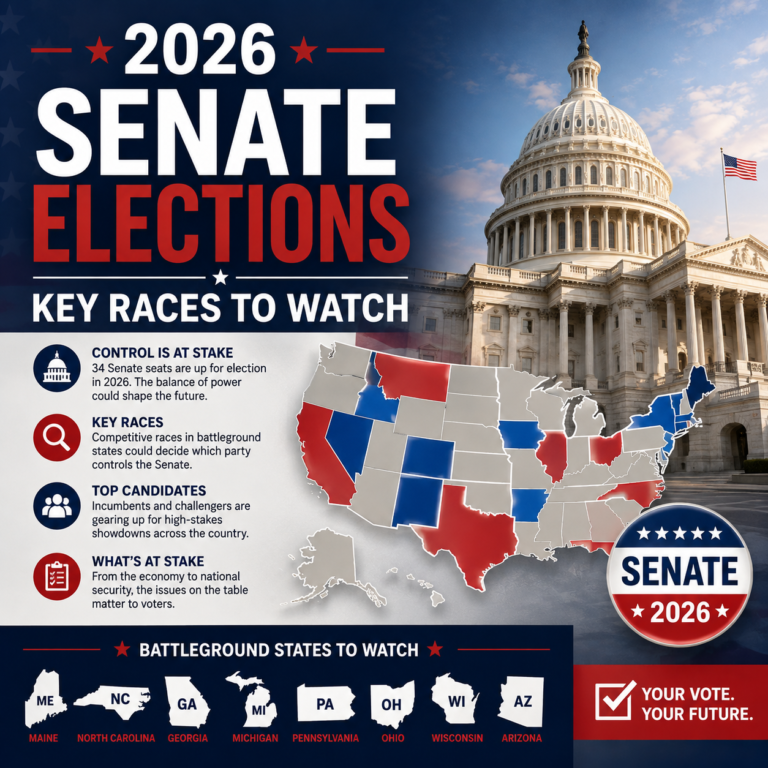
The Senate is different because senators serve six-year terms and elections are staggered. The 2026 cycle includes the Senate’s Class II seats, whose terms expire in January 2027. The Senate’s official information identifies 35 Class II seats, including seats held by both Democrats and Republicans. Several incumbents have also announced retirements or faced changes in their races, making the Senate map important for both parties.
The results can also influence the political environment heading into 2028. Parties use midterm results to assess voter priorities, campaign strategies, candidate recruitment, and geographic strengths and weaknesses. A strong or weak performance in 2026 can shape the conversations surrounding the next presidential campaign.

What Will Voters Be Voting For?
The most visible races in 2026 will be for the U.S. House of Representatives and U.S. Senate. House voters choose a representative from their congressional district, while Senate voters choose a senator representing their entire state when a Senate seat is on the ballot. Because House districts are smaller than states, House candidates often focus heavily on district-level concerns as well as national political issues.
Every state has two U.S. senators, but not every state will elect a senator in 2026. Senate elections are staggered so that roughly one-third of the Senate is elected during each two-year election cycle. The 2026 Senate contests are therefore concentrated in one of the Senate’s three classes. Voters should check their specific ballot rather than assuming a Senate race will appear in every state.
Governors are another major category of races. The timing of gubernatorial elections differs among states, so some voters will have a governor’s race in 2026 while others will not. Governors can influence state budgets, education policy, public safety, transportation, economic development, health programs, and many other areas. For voters, state-level races can sometimes have a more direct impact on daily life than national politics.
State legislatures and local offices can also be extremely important. State lawmakers make decisions about laws, budgets, education, infrastructure, elections, and many other matters. Local officials may influence zoning, public services, schools, transportation, policing, and community development. This is why voters should review their complete ballot instead of focusing exclusively on the most publicized congressional contests.
Understanding the U.S. House Elections
The U.S. House of Representatives has 435 voting members, and all voting House seats are elected every two years. Each representative serves a particular congressional district, and the number of districts assigned to each state is based on population. This makes House elections highly dependent on local district boundaries and the candidates running in each district.
For voters, the first step is determining which congressional district they live in. Two people living in the same state can have completely different House candidates because they live in different districts. Congressional districts can also change over time because of redistricting, so voters should confirm their current district rather than relying on an old election ballot.
House races can be influenced by national political trends, but local issues often matter as well. Candidates may discuss taxes, immigration, the economy, health care, education, government spending, national security, energy, infrastructure, and other national subjects. At the same time, voters may care about specific issues affecting their district, such as agriculture, manufacturing, transportation, housing, or federal projects.
The House is particularly important because legislation must generally pass both chambers of Congress before reaching the president. A change in House control can therefore affect which proposals advance and which proposals receive less attention. Voters who want to understand the national consequences of their House vote should look not only at individual candidates but also at how their race could affect the overall balance of the chamber.
Understanding the 2026 Senate Elections
The U.S. Senate has 100 members, with each state represented by two senators. Unlike House representatives, senators represent their entire state. Senate elections are held on a staggered schedule, which means voters in some states will elect senators in 2026 while voters in other states will not have a Senate race on their general-election ballot.
The 2026 Senate map includes Class II seats. The official Senate list shows a mixture of Democratic and Republican incumbents in this class, along with several open-seat situations created by retirements or other changes.
Senate races can attract national attention because a relatively small number of seats can determine which party controls the chamber. However, voters should still evaluate candidates individually. A candidate’s party affiliation can tell voters something about general political alignment, but it does not necessarily explain every position the candidate holds.
Senators vote on federal legislation, nominations, treaties, budgets, and other major matters. Because senators serve six-year terms, a Senate election can have consequences that extend well beyond the immediate political cycle. Voters should consider both current policy questions and the longer-term responsibilities associated with the office.
2026 Primary Elections
Before the general election, political parties generally hold primary elections to select their candidates. The primary process is controlled largely by state law, so the rules can vary significantly. Some states have open primaries, some have closed primaries, and others use different systems. The rules governing who can participate may depend on party registration, state law, or the type of election.
This makes it important for voters to understand their state’s primary rules before Election Day. A voter who assumes that every state operates the same way could accidentally miss an important deadline or misunderstand which candidates will appear on the ballot.
Primary elections can sometimes be more competitive than the general election, especially in districts or states where one political party is dominant. In those situations, the primary may effectively determine which candidate has the strongest chance of winning in November. Voters should therefore not automatically treat the primary as less important than the general election.
The best approach is to research primary candidates using reliable information, including official campaign materials, public records, candidate debates, and reputable reporting. Voters should also check their state election office for the official primary date and registration requirements.
How to Register to Vote for the 2026 Election
Voter registration is one of the most important steps to complete before an election. In the United States, most states require eligible voters to register before voting, although North Dakota is an exception. Registration deadlines vary by state and can be as much as a month before an election.
USAGov directs voters to Vote.gov to begin the registration process. Depending on the state, voters may be able to register online, by mail, or in person at a local election office. The documents and information required can also vary, so voters should follow the instructions provided for their state.
Registration is not necessarily a one-time task that voters can forget forever. Moving to a new address, changing a name, or moving to another state can require voters to update or replace their registration. A voter who has moved should check the registration information well before the election to make sure the correct address and polling location are listed.
It is also a good idea to verify registration before the deadline rather than waiting until Election Day. USAGov recommends checking registration status so voters can confirm their name, address, party information where applicable, and polling place. Early verification gives voters more time to correct problems if something is wrong.
How to Check Your Voter Registration
Checking voter registration is relatively straightforward, but the exact system depends on the state. USAGov explains that voters can use the Can I Vote service to select their state and access the state’s voter-registration information. This can help confirm whether a voter is registered and whether the information on file is accurate.
Voters should pay particular attention to their name and address. If a voter has moved recently, the old registration may not reflect the correct polling location. A change of address can also affect which congressional district, state legislative district, school district, or local election contests appear on the ballot.
Voters who have not participated in elections for a long period may also want to check whether their registration has been marked inactive. According to USAGov, states may update voter registration lists and may mark some registrations inactive under certain circumstances. Inactive voters may have additional steps to complete before voting.
Checking registration well before Election Day is therefore one of the simplest ways to reduce last-minute problems. It also gives voters a chance to learn where they need to vote and what voting options are available in their area.
Early Voting in the 2026 Midterms
Early voting allows eligible voters to cast their ballots in person before Election Day. The availability of early voting varies considerably by state. Some states offer many days of early voting, while others have more limited schedules or different procedures.
Early voting can be useful for people who have work commitments, travel plans, family responsibilities, or other reasons that make November 3 inconvenient. It can also help voters avoid long lines that may occur at certain polling locations on Election Day.
However, voters should not assume that early voting works the same way everywhere. The number of days, locations, hours, identification requirements, and eligibility rules can vary. USAGov provides state-specific election information so voters can identify the early voting rules that apply to them.
If you plan to vote early, check the official state or local election website before leaving home. Confirm the location and opening hours and make sure you know what identification, if any, is required. Taking a few minutes to verify these details can make the voting process much easier.
Voting by Mail and Absentee Voting
Voting by mail and absentee voting provide alternatives to voting in person. Many states offer some form of mail voting, but the rules vary. Some states require voters to request a ballot, while some states operate all-mail elections in which ballots are automatically sent to registered voters.
One of the most important things to remember is that requesting a ballot and returning a ballot are separate steps. A voter may need to request the ballot by one deadline and return it by another. The return deadline can also depend on whether the ballot must be received by election officials or merely postmarked by Election Day.
Voters should read the instructions included with their ballot carefully. Errors involving signatures, envelopes, witness requirements, identification, or other state-specific procedures can potentially cause a ballot to be rejected. Because rules differ, voters should use official election guidance rather than relying on information from social media posts or outdated articles.
Military voters and U.S. citizens living abroad also have absentee voting options. USAGov explains that eligible military members, their families, and U.S. citizens overseas can use the Federal Post Card Application process to register and request an absentee ballot.
Do You Need an ID to Vote?
Voter identification rules vary by state. Some states require specific forms of identification at polling places, while other states use different methods to verify voters. Because the requirements are not identical across the country, voters should check the rules for their own state.
A driver’s license or state identification card may be accepted in many places, but voters should not assume that every type of identification is accepted everywhere. Some states may allow alternative documents or procedures if a voter does not have the preferred form of ID.
USAGov recommends checking state-specific voting information to understand voter ID requirements and other rules.
The safest strategy is to verify the requirement before Election Day. If you are unsure whether your identification is acceptable, contact your state or local election office rather than waiting until you arrive at the polling place.
What Issues Could Shape the 2026 Election?
Election issues can change as campaigns develop, but voters are likely to hear extensive discussion about the economy, inflation, taxes, jobs, immigration, health care, housing, energy, national security, education, government spending, and the role of federal government.
The importance of each issue will differ from voter to voter. Someone working in manufacturing may focus heavily on trade and industrial policy, while a parent may prioritize education or child-related costs. A retiree may pay closer attention to Social Security, Medicare, taxes, and health care. Younger voters may focus on housing affordability, education costs, employment opportunities, climate policy, or other issues.
State and local issues can be just as important. A governor’s race may focus on education funding, infrastructure, public safety, taxes, or state budgets. A local election might focus on property taxes, schools, roads, zoning, or public services. Voters should therefore consider the office itself when deciding which issues deserve the most attention.
Rather than asking which candidate talks about the most issues, voters can ask which issues are directly connected to the responsibilities of the office. A House candidate, senator, governor, mayor, and school board member have different powers. Understanding those responsibilities can help voters evaluate campaign promises more realistically.
How to Research Candidates
Researching candidates is one of the most important parts of preparing to vote. Campaign advertisements can provide useful information, but they are designed to persuade voters. It is therefore helpful to compare information from several sources rather than relying on a single campaign message.
Start by visiting the candidate’s official campaign website to understand the positions the candidate publicly supports. Then compare those claims with reputable news coverage, debate performances, voting records for incumbents, and information from nonpartisan election resources.
For candidates who already hold public office, voters can examine their legislative records and official statements. A candidate’s past voting record can provide more information than campaign slogans because it shows how the person acted while in office. However, voters should also consider the circumstances surrounding major votes rather than judging a record from isolated examples.
It can also be useful to write down your top five issues before researching candidates. After reviewing the candidates, compare their positions with your priorities. This approach can help reduce the influence of emotionally charged campaign advertisements and keep the focus on the issues that matter most to you.
How to Evaluate Political Campaign Claims
Political campaigns frequently make strong claims about their opponents, their own accomplishments, and what will happen if they win. Voters should approach such claims carefully. A campaign statement is not automatically false simply because it is political, but it should be evaluated against evidence.
One useful method is to identify the exact claim being made. If a candidate says a particular law reduced taxes, increased employment, or changed government spending, look for independent information about the policy and its measurable results. Broad statements can sometimes leave out important context.
Voters should also distinguish between facts and predictions. A candidate can accurately describe a current policy but make an uncertain prediction about what will happen after a proposed change. Predictions should be treated as campaign positions rather than guaranteed outcomes.
Fact-checking can be especially valuable during the final weeks of a campaign, when political advertising increases. Voters should prefer established news organizations, government records, official legislative documents, and nonpartisan research organizations when verifying important claims.
How Political Parties Affect the 2026 Election
The Democratic and Republican parties will be major participants in the 2026 elections, but voters may also encounter independent and third-party candidates depending on the race and state. Party affiliation can provide a general indication of a candidate’s political coalition, but it does not necessarily tell voters everything about the individual.
Primary elections are particularly important for party nominations. In states where primary rules are restrictive, voters may need to meet specific requirements to participate. In other states, voters may have more flexibility. The exact rules should be checked with the relevant state election authority.
In the general election, voters are generally not required to vote for candidates from the same party as their registration. USAGov notes that general-election voters can generally choose among candidates regardless of their party registration, while primary rules can differ by state.
For voters, the most useful approach is to understand both party platforms and individual candidates. A party platform can explain broad priorities, while a candidate’s record and statements can reveal how that particular person approaches those priorities.
What Is on Your Ballot?
Every voter should obtain a sample ballot or official ballot information before voting. The ballot can contain federal, state, and local races, and the choices can be different even for people living only a few miles apart.
Your ballot may include a House race, a Senate race, a governor’s race, state legislative races, judicial elections, local offices, and ballot measures. Some voters may have only a few contests, while others may face a long list of choices.
Reviewing the ballot before voting allows you to research unfamiliar candidates. It can also help prevent voters from making rushed decisions at the polling place. Many election authorities provide sample ballots or candidate information before Election Day.
A sample ballot is especially useful for voters who plan to vote in person. You can make a personal list of the races and candidates you want to research, then use reliable sources to understand each contest before casting your ballot.
Can You Vote Online in the 2026 Election?
Federal elections in the United States do not allow voters to cast ballots online. USAGov states that voters generally must vote either in person at an official polling place or through an absentee or mail ballot where permitted.
This distinction is important because many election-related activities can happen online. Voters may be able to register online in some states, check registration status, request certain voting materials, locate polling places, and research candidates online. However, these digital services should not be confused with online ballot casting.
Voters should be cautious about websites or social media posts claiming that they can submit a federal election vote through an unofficial online service. Election information should come from official government election websites or trusted election organizations.
If you are unsure about whether an online election service is legitimate, start with your state’s official election website or Vote.gov. These resources can direct you to the appropriate government service.
What Happens on Election Day?
On Election Day, voters who are voting in person generally go to their assigned polling location during the hours established by their state or local election authority. Polling locations can change, especially when districts, facilities, or election arrangements change, so voters should verify their location before November 3.
At the polling place, voters may be asked to confirm their registration and provide identification depending on state rules. After completing the required steps, voters receive access to the voting system used in their jurisdiction. Different states and counties use different voting equipment and procedures.
Voters should take their time when reviewing the ballot. If the ballot contains multiple contests, read each section carefully. If you are uncertain about a procedure, ask a poll worker for assistance rather than guessing.
After voting, follow the instructions for submitting the ballot. The exact process can vary depending on the voting equipment and jurisdiction. If you experience a problem, ask a poll worker or election official for help and understand the options available under your state’s rules.
What If You Make a Mistake While Voting?
Election procedures provide ways to address certain voting problems, but the solution depends on the circumstances and the state. If you make a mistake on a paper ballot, do not simply guess what to do. Ask a poll worker for instructions.
If your name is not found on the voter list, election officials may be able to investigate the issue or explain whether you can cast a provisional ballot. Provisional voting procedures vary, and voters should follow the instructions provided by election officials.
A provisional ballot does not necessarily mean that a voter has done something wrong. It is a mechanism used in certain situations when election officials need to verify a voter’s eligibility or registration information before counting the ballot.
The best way to reduce these problems is to check your registration, polling location, identification requirements, and other voting information before Election Day. Preparation gives voters more time to resolve potential issues.
What Are Provisional Ballots?
A provisional ballot is used when there is a question about whether a voter is eligible to vote in a particular election or whether the voter has completed the required registration process. The rules governing provisional ballots differ by state.
For example, a voter may encounter a provisional ballot situation if their name does not appear on the expected voter list or if there is another registration-related issue. Election officials can then review the circumstances according to state law.
Voters should not assume that a provisional ballot will automatically be counted or automatically rejected. The final treatment depends on whether the voter meets the applicable legal requirements and whether the ballot satisfies the state’s rules.
If you believe you are eligible to vote but encounter a problem, ask election officials what options are available. Do not leave the polling place simply because your name or information appears differently than expected.
How to Find Your Polling Place
Polling locations are determined by state and local election authorities. Your assigned location can depend on your home address and voting district. Because polling places can change between elections, it is important to verify the location for the 2026 election rather than relying on an old location.
USAGov provides information that can help voters determine where and when they can vote. Voters can also use their state election website to find official polling-place information.
If you are planning to vote on Election Day, check the polling location in advance and consider how long it will take to get there. If you have work or family responsibilities, you may also want to investigate early voting or mail voting options.
Voters should be especially careful with unofficial polling-place information shared on social media. Election information can change, and old posts can remain online long after the information becomes outdated.
Why Local Elections Matter in the Midterms
One of the biggest mistakes voters can make during a midterm election is focusing only on Congress. State and local governments make decisions that can have a direct effect on everyday life.
Governors and state legislatures can influence state taxes, education funding, transportation, infrastructure, public safety, economic policy, and many other areas. Local officials can make decisions about community services, zoning, development, schools, public facilities, and local budgets.
The media often concentrates on highly competitive Senate and House races because they have national consequences. But a local election may have a much more immediate impact on a voter’s neighborhood.
For this reason, voters should review the entire ballot before voting. A complete voting decision includes not only the most famous races but also the less-publicized contests that affect the community.
How to Avoid Election Misinformation
Election misinformation can become a major problem during campaign season. False claims may circulate through social media, videos, messaging apps, websites, and even misleading political advertisements.
One of the simplest ways to protect yourself is to verify important election information through official sources. If you see a post claiming that the election date has changed, a polling location has moved, or a particular voting requirement exists, check your state or local election authority before sharing it.
Voters should also be careful with screenshots that appear to come from government agencies. Images can be edited or taken out of context. Whenever possible, find the original information on an official government website.
Election information is especially sensitive because an incorrect deadline or polling-place claim can prevent someone from voting. Sharing information without checking it can therefore cause real harm even when the original person did not intend to mislead anyone.
How to Make a Personal Voting Plan
A simple voting plan can make the 2026 election much easier. Start by checking your registration status and identifying your polling location. Then find out whether your state offers early voting or mail voting and determine which option works best for your schedule.
Next, obtain your sample ballot and make a list of all the races that will appear. Research the candidates and ballot measures that you do not understand. Focus on the responsibilities of each office and compare the candidates based on your priorities.
After researching, decide when and how you will vote. If you plan to vote by mail, do not wait until the final deadline. If you plan to vote in person, check the polling hours and location before Election Day.
Finally, keep your plan flexible. Unexpected circumstances can occur. Knowing your alternative options, such as early voting or another permitted voting method, can help ensure that a last-minute problem does not prevent you from participating.
Important 2026 Election Deadlines to Watch
There is no single voter-registration deadline that applies to the entire United States. Every state establishes its own rules, and deadlines can be significantly earlier than Election Day. USAGov specifically advises voters to check their state’s deadline because it may be as much as a month before an election.
The same principle applies to mail voting. The deadline to request a ballot can be different from the deadline to return it. Some states focus on when the ballot is received, while others have rules concerning postmarks or other requirements.
Early voting also has different schedules across the country. A voter in one state may have several opportunities to vote before November 3, while another voter may have a different schedule.
For that reason, a national article can explain the overall process, but your state election office should be treated as the final authority for exact dates and requirements. Voters should check their state’s official information as the election approaches.
Frequently Asked Questions About the 2026 U.S. Midterm Elections
When is Election Day 2026?
The 2026 U.S. Midterm Elections will be held on Tuesday, November 3, 2026. However, voters may have opportunities to vote earlier depending on their state’s laws.
Is 2026 a presidential election year?
No. The 2026 election is a midterm election, meaning there is no presidential general election. The next presidential election is scheduled for November 7, 2028.
Are all House seats up for election in 2026?
Yes. House representatives serve two-year terms, so all 435 voting House seats are elected every two years.
Are all Senate seats up for election?
No. Senate elections are staggered. The 2026 elections involve the Senate’s Class II seats rather than all 100 Senate seats.
Do I need to register to vote?
Most states require eligible voters to register, although registration rules vary. North Dakota is an exception to the general registration requirement. Voters should check their state’s registration rules and deadline.
Can I vote by mail?
Many states allow absentee or vote-by-mail voting, but eligibility, ballot-request procedures, and deadlines vary. Some states also operate all-mail elections.
Can I vote online?
No. Federal elections do not allow voters to cast ballots online. Voters generally vote in person or use an approved absentee or mail voting process.
Can I vote early?
Many states offer early in-person voting, but the dates, locations, and rules differ. Check your state’s official election information before making plans.
Do I have to vote for the party I am registered with?
In general elections, voters generally can choose among candidates regardless of their registered party. Primary election rules can be different depending on the state.
What if I recently moved?
You should check your voter registration and update it if necessary. Moving to another state generally requires registering in the new state, while moving within a state may require an address update.
What if I do not know where to vote?
Use official state or local election information to confirm your polling location. Do not rely on an old polling location from a previous election because locations can change.
Final Thoughts on the 2026 U.S. Midterm Elections
The 2026 U.S. Midterm Elections will give Americans an opportunity to shape the direction of Congress as well as numerous state and local governments. The election is scheduled for November 3, 2026, but the voting process begins much earlier with registration, primary elections, candidate research, and decisions about how and when to vote.
For voters, preparation is one of the most important parts of the process. Checking registration status, confirming your address, learning your state’s deadlines, reviewing your sample ballot, and researching candidates can make voting more straightforward. Because election rules vary from state to state, voters should always confirm final details through official election authorities.
The 2026 midterms are also a reminder that elections are about more than national headlines. Congress will be central to the national political story, but governors, state legislators, judges, county officials, mayors, school boards, and ballot measures can also appear on voters’ ballots. These decisions can influence policies that affect communities every day.
Ultimately, an informed voter does not need to follow every political story or campaign advertisement. A better approach is to understand what is on the ballot, learn what each office does, compare candidates using reliable information, and make a decision based on personal priorities and verified facts. With the right preparation, voters can approach the 2026 U.S. Midterm Elections with greater confidence and a clear understanding of their choices.
For More Information about this article, Please Click Here.
For More Information, Please Click Here.