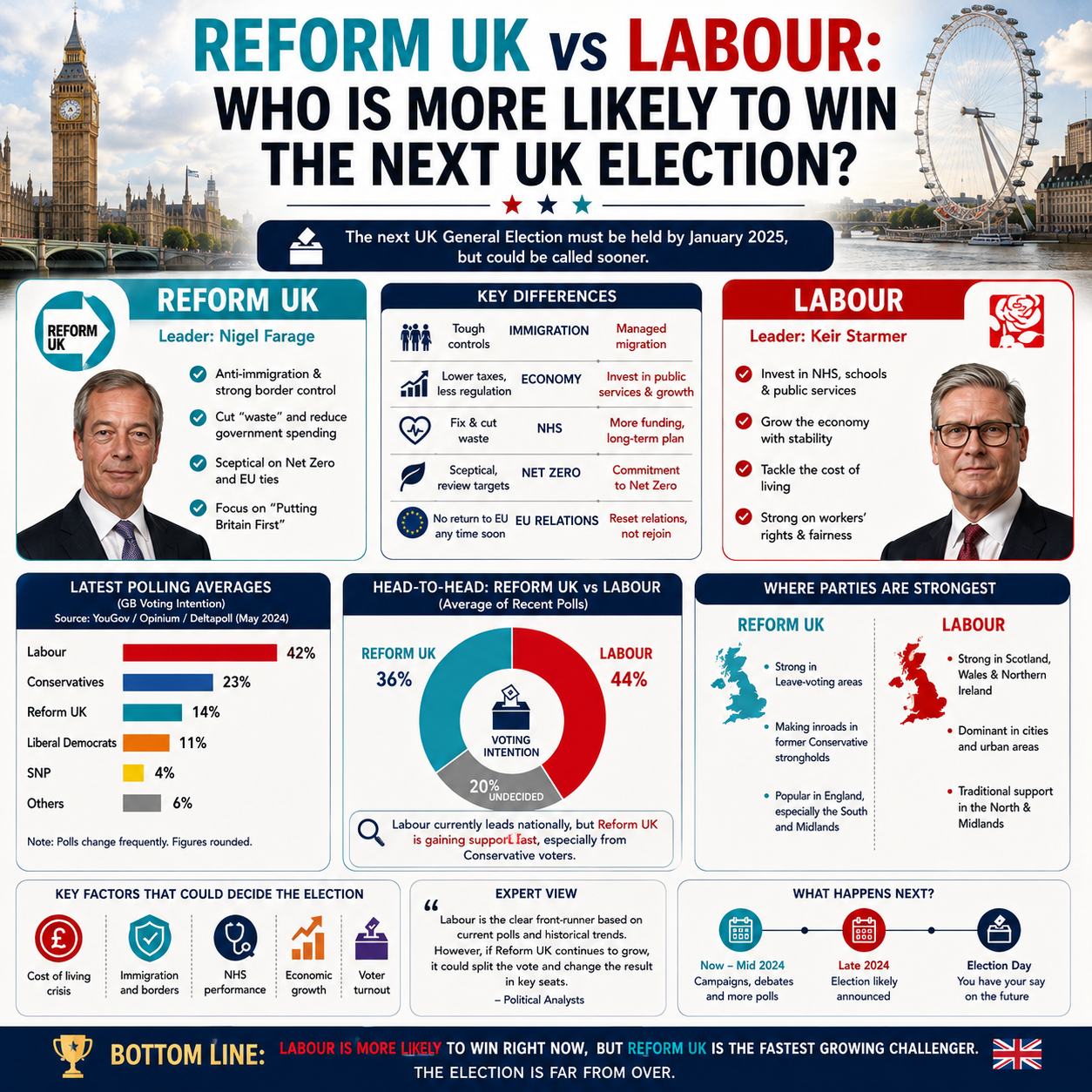
Reform UK vs Labour 1: Who Is More Likely to Win the Next UK Election?
Reform UK vs Labour: Who Is More Likely to Win the Next UK Election?
Introduction
The next UK general election is shaping up to be a very different contest from the traditional Labour-versus-Conservative elections that dominated British politics for decades. Reform UK has emerged as a major political force, creating a direct challenge to Labour and changing the way analysts think about the next election. As of August 2026, Labour and Reform UK are extremely close in national voting-intention polls, making the question of which party is more likely to win far from straightforward. The latest YouGov poll conducted on 9–10 August put Labour on 24% and Reform UK on 22%, while the Conservatives were only one point behind Reform UK at 21%.
The current picture is particularly interesting because the political environment has changed significantly since the 2024 general election. Labour won a large parliamentary majority in 2024, while Reform UK won a much smaller number of seats despite receiving a substantial share of the national vote. Since then, Reform UK has expanded its influence, while Labour has experienced periods of both weakness and recovery. Recent polling suggests that Labour has regained some ground, but Reform UK remains close enough to challenge the governing party seriously. A recent Ipsos poll conducted between 30 July and 4 August also placed Labour three points ahead of Reform UK.
The comparison between the two parties is complicated by Britain’s first-past-the-post electoral system. Winning the highest percentage of votes nationally does not automatically mean winning the most parliamentary seats. A party must finish first in individual constituencies, and the distribution of its support can be just as important as its national vote share. This creates a particularly difficult challenge for Reform UK because its national popularity needs to be converted into hundreds of constituency victories if it wants to become the largest party or form a government.
This article examines Labour and Reform UK in detail, comparing their current polling positions, leadership, voter bases, policies, regional strengths, electoral challenges, and potential paths to victory. It also considers the role of the Conservatives, Liberal Democrats, and Greens, because their performance could directly affect the Labour-Reform contest. Based on the evidence available in August 2026, Labour currently has a narrow advantage, but Reform UK is close enough that the race remains genuinely open.

When Is the Next UK General Election?
The next UK general election does not have to take place immediately. Under the current parliamentary timetable, the next general election must be held no later than 15 August 2029 unless Parliament is dissolved earlier. This gives Labour and Reform UK several years to strengthen their positions, change policies, recruit candidates, and respond to developments that could reshape voter opinion. The long timeframe is one of the biggest reasons why current polling should be treated as a snapshot rather than a final forecast.
The timing of the election matters because governments and opposition parties can experience significant changes in popularity during a parliamentary term. Economic conditions can improve or deteriorate, public services can become more or less popular, international events can change priorities, and political leaders can gain or lose public confidence. A party leading in August 2026 could therefore be behind by the time voters actually cast their ballots.
Labour has the advantage of being the governing party and therefore has time to demonstrate whether its policies are working. Reform UK, meanwhile, has time to build its organization and turn national support into constituency-level strength. Both parties can therefore use the years before the election to address weaknesses. Labour can try to improve its government record, while Reform UK can attempt to establish itself as a credible alternative government rather than simply a protest movement.
An earlier election would obviously shorten this preparation period and could produce a very different result. However, unless an election is called earlier, voters may not make their final decision for several years. This means anyone asking which party will win should distinguish between the current favorite and the eventual winner. Labour may currently have a small advantage, but the eventual contest could look very different.

Labour’s Current Position
Labour enters the contest from a position of considerable institutional strength because it won the 2024 general election with a large majority. It has a nationwide parliamentary presence, control of the government, established constituency organizations, and the ability to present itself as the governing alternative to Reform UK. These advantages are important under the first-past-the-post system.
However, Labour’s position is not as secure as its 2024 majority might suggest. The political environment has changed rapidly since the election, and Reform UK has attracted significant support from voters who previously supported the Conservatives and, in some constituencies, Labour. Current polling shows that Labour’s national support is competitive but not dominant. The latest YouGov poll gave Labour 24%, only two points ahead of Reform UK.
Labour has also experienced a political change in leadership during 2026, with Andy Burnham now serving as Prime Minister. This is highly significant because leadership can influence both public perceptions and electoral strategy. Early reports suggest that Burnham has received a more positive public response than the previous Labour leadership, although it remains far too early to know whether that improvement will last until the next general election.
The main question for Labour is whether it can turn its current polling recovery into a long-term advantage. If the government can improve the economy, public services, household finances, and voter confidence, Labour could strengthen its position significantly. If dissatisfaction returns, Reform UK could benefit. Labour therefore has a strong starting position but cannot afford to assume that its 2024 majority will automatically protect it at the next election.

Reform UK’s Current Position
Reform UK has become one of the most important forces in British politics. Its rise has challenged the dominance of Labour and Conservatives and has created a new three-way national contest. In recent polling, Reform UK has frequently been close to Labour and has sometimes led the national voting-intention figures. For example, a YouGov poll conducted on 2–3 August put Reform UK on 23%, compared with 22% for Labour.
The party’s strength comes partly from its ability to attract voters who are dissatisfied with the established political parties. Immigration, national sovereignty, taxation, government spending, political accountability, and concerns about the direction of Britain are among the issues that can motivate Reform supporters. Its leader, Nigel Farage, is also a well-known political figure with a long history of campaigning on Brexit and related issues.
Reform UK’s biggest problem is not necessarily winning votes; it is converting those votes into parliamentary seats. The party’s performance in the 2024 general election demonstrated this problem clearly. It received a significant national vote share but won far fewer seats than its percentage of votes might suggest under a proportional system. The first-past-the-post system rewards parties whose support is concentrated enough to finish first in constituencies.
For Reform UK to defeat Labour at the next general election, it will therefore need more than strong national polling. It must build a strong constituency organization, recruit credible candidates, concentrate resources in winnable seats, and persuade voters that it is capable of governing. If it succeeds in doing that, its current polling strength could become a serious threat to Labour. If it fails, it could once again win millions of votes without winning enough seats to form a government.

Labour vs Reform UK in Current Polling
The most important evidence available right now comes from opinion polling. The latest YouGov survey conducted on 9–10 August 2026 showed Labour on 24%, Reform UK on 22%, Conservatives on 21%, Greens on 12%, and Liberal Democrats on 11%. This means Labour has a two-point lead over Reform UK, but the gap is small enough to be within the normal range of polling movement.
Other recent polling tells a similar story while producing slightly different numbers. Ipsos found Labour three points ahead of Reform UK in its survey conducted from 30 July to 4 August. This reinforces the idea that Labour currently has a modest advantage but that Reform UK remains a very close challenger.
The direction of travel is also important. Reform UK had led some polls earlier in the year, while Labour has recently recovered. A YouGov poll from early August put Reform UK ahead by one point, demonstrating how quickly the race can change. More recent polling has put Labour back in front.
The overall picture is therefore not one of Labour dominating Reform UK. Instead, the two parties are competing within a relatively narrow range. Labour currently has a slight polling advantage, but Reform UK has demonstrated enough strength to make the next election highly competitive. If the election were held immediately, Labour would probably have the stronger overall position, but there is no basis for saying that Labour is certain to win.
Why Labour Currently Has an Advantage
Labour’s biggest advantage is its existing parliamentary strength. It already controls the government and has MPs across a large number of constituencies. This means Labour does not need to build its entire electoral organization from scratch. It can defend existing seats while targeting areas where it needs to gain support.
Another advantage is that Labour has greater experience as a governing party. Voters who are uncertain about Reform UK’s ability to govern may choose Labour because it represents a more established governing option. Reform UK must overcome the argument that running a successful political campaign is different from managing a national government.
Labour may also benefit from the distribution of support. Even if Reform UK and Labour receive similar national vote shares, Labour could win more seats if its votes are distributed efficiently across constituencies. This is one of the most important advantages of the first-past-the-post system. A party does not need to win every constituency; it needs to finish first in enough constituencies to build a parliamentary majority or become the largest party.
The recent improvement in Labour’s polling is another advantage. The latest surveys suggest that the party has regained ground against Reform UK. If that trend continues, Labour could enter the next election with a much clearer lead. The challenge is maintaining that momentum over a potentially long period.
Why Reform UK Could Still Overtake Labour
Reform UK’s biggest advantage is momentum and the ability to attract voters from several political groups. The party has already demonstrated that it can become one of the largest parties in national voting intention. Its support is not simply limited to traditional fringe-party voters; it has attracted former Conservative voters and has made progress in areas where Labour previously had strong support.
The party also benefits from a clear political identity. Reform UK has developed a recognizable message focused on issues such as immigration, government reform, national sovereignty, and reducing what it sees as unnecessary government spending. Supporters often view the party as a direct challenge to the political establishment.
Nigel Farage also gives Reform UK a highly recognizable leader. His long political career and media presence provide the party with a level of national visibility that many newer parties struggle to achieve. This can be particularly valuable during election campaigns when voters are deciding between unfamiliar candidates and established political figures.
However, Reform UK must convert this visibility into trust. Some voters may support the party as a protest but remain uncertain about giving it control of government. Reform UK therefore needs to demonstrate that its policies can work in practice and that its candidates and organization are capable of managing the responsibilities of government.
The Importance of First-Past-the-Post
The first-past-the-post electoral system may be the single biggest factor determining whether Labour or Reform UK wins. Under this system, each constituency elects one MP, and the candidate with the most votes wins. National vote share is therefore only indirectly related to parliamentary representation.
This creates a major challenge for Reform UK. Imagine Labour and Reform UK each receive around 25% of the national vote. That does not mean they would necessarily win an equal number of seats. If Reform’s votes are concentrated in constituencies where it is already strong, it could win many seats. If its votes are spread thinly across hundreds of constituencies, it could finish second in many places and win far fewer seats.
Labour’s existing geographical distribution may give it an advantage. It has traditionally had strong support across urban and industrial areas and has a large number of constituencies where it can remain competitive even if its national vote share falls. Reform UK is attempting to develop a similar constituency base.
This is why predictions based only on national polling can be misleading. A proper election forecast must consider constituency-level polling, regional trends, previous results, tactical voting, candidate strength, and local campaigning. Labour may currently have a national lead, but the size of its eventual parliamentary majority would depend on where those votes are located.
Reform UK’s Challenge in Turning Votes Into Seats
Reform UK’s electoral challenge can be described as a conversion problem. The party has shown that it can attract a large national vote share, but it needs to turn that support into first-place finishes in individual constituencies.
This requires a strong local organization. Candidates need to campaign effectively, understand local issues, build community relationships, and convince voters that Reform UK can represent their constituency. A national campaign led by a famous leader is not enough to win hundreds of individual seats.
The party’s success in local and regional elections can provide evidence that it is building this organization. Its performance in the 2026 local elections demonstrated substantial support in parts of England, particularly in areas with strong previous support for Brexit. However, local elections use different electoral structures in some places, so their results cannot simply be converted into Westminster seats.
Reform UK’s performance in individual parliamentary by-elections and constituency contests will also be important. If it can demonstrate repeated victories in constituencies previously held by Labour or Conservatives, it will strengthen the argument that its national polling can translate into Westminster power.
Labour’s Challenge in Defending Its Seats
Labour faces a different problem. Instead of building from a relatively small parliamentary base, it must defend a large number of seats. Governing parties can lose support because voters judge them on their record. This means Labour has more seats at risk than it did before winning the 2024 election.
Reform UK could target Labour constituencies where its support is particularly strong. These may include areas where voters have concerns about immigration, economic conditions, public services, or cultural issues. If Reform UK can win enough of these seats, Labour’s parliamentary majority could disappear even if Labour remains competitive nationally.
Labour must also watch challenges from the Greens and Liberal Democrats. In some constituencies, the main threat to Labour may not be Reform UK. A fragmented opposition can help Labour in some areas but hurt it in others, depending on how votes are distributed.
The governing party’s biggest defense is therefore its record. If Labour can point to improvements in living standards, public services, economic performance, housing, and other priorities, it may persuade voters to stay with the government. If voters remain dissatisfied, Reform UK could make significant gains.
Leadership: Andy Burnham vs Nigel Farage
Leadership is likely to be one of the most closely watched aspects of the Labour-Reform contest. Andy Burnham’s arrival as Prime Minister has changed Labour’s public image and political strategy. Early reporting indicates that his style emphasizes practical measures and visible changes to everyday problems, creating what some commentators have described as a “Burnham bounce.”
Nigel Farage, by contrast, has a long-established public profile. He has spent decades campaigning on issues including Britain’s relationship with the European Union and immigration. His familiarity gives Reform UK a major advantage in terms of recognition, but it also means that his political record and statements receive intense scrutiny.
The contrast between the two leaders could become central to the next election campaign. Burnham may seek to present Labour as a practical governing party focused on improving daily life, while Farage may portray Reform UK as the party willing to challenge established political assumptions.
Ultimately, voters will judge both leaders on credibility. A leader may have strong personal popularity but still fail to convince voters that their party can govern effectively. The election will therefore depend not only on which leader is more popular but on which leader can create the strongest argument for their party.
Immigration and Reform UK
Immigration is one of Reform UK’s strongest political issues. The party has consistently argued for significant changes to immigration policy and stronger border controls. This message has helped it attract voters who believe successive governments have failed to manage migration effectively.
Labour also faces pressure on immigration because it is responsible for government policy. If legal migration, asylum applications, or border-related issues remain controversial, Reform UK can argue that Labour has not done enough. If Labour demonstrates visible improvements, it can attempt to reduce the political advantage Reform currently has on the issue.
The challenge for Reform UK is that immigration cannot be its only argument if it wants to form a government. A national government must address healthcare, education, housing, the economy, taxation, defense, energy, and international relations. Reform therefore needs a comprehensive platform that satisfies voters beyond its strongest issues.
For Labour, the challenge is different. It must address public concerns without allowing Reform UK to dominate the debate. If Labour can demonstrate effective border management while improving other areas of government performance, it may reduce Reform’s electoral advantage.
The Economy and Cost of Living
Economic performance could ultimately be more important than any individual political issue. Voters care about wages, employment, taxes, inflation, mortgages, rent, energy bills, and the general ability to afford everyday life. A government that improves these conditions can strengthen its electoral position.
Labour will be judged directly on economic outcomes because it is currently in government. If economic growth improves and household finances become stronger, Labour will be able to argue that its policies are working. If the economy struggles, Reform UK can present itself as the alternative.
Reform UK’s economic message will also face scrutiny. It may attract voters by promising lower taxes or reduced government waste, but voters will want to know how those policies would be funded and implemented. A party seeking government must provide credible answers about public finances.
Economic conditions several years from now are impossible to predict accurately. A recession, strong recovery, inflation shock, or unexpected international event could completely alter the political debate. This is one of the main reasons current polling cannot be treated as a final election forecast.
Public Services and the NHS
The National Health Service is likely to remain an important issue for both Labour and Reform UK. Labour traditionally benefits from strong associations with public services, but being in government means the party must demonstrate actual improvements rather than simply make promises.
Reform UK can use dissatisfaction with healthcare waiting times, access to doctors, staffing, and social care to criticize the government. However, it must also convince voters that its own policies would improve the situation rather than simply criticizing Labour.
The NHS could become particularly important if voters experience improvements or deterioration before the election. Political arguments are often less powerful than personal experiences. A voter who receives faster treatment may become more supportive of the government, while someone facing long delays may become more willing to support an alternative.
Labour therefore has a major opportunity if it can demonstrate measurable improvements in healthcare. Reform UK, meanwhile, has an opportunity if public dissatisfaction remains high. The final impact will depend on actual performance rather than campaign slogans.
Housing and Living Standards
Housing is another area where Labour and Reform UK can compete for voters. High rents, mortgage costs, limited housing supply, and difficulties for young people trying to buy homes have become important political concerns.
Labour may focus on building more homes, reforming planning, and improving affordability. Reform UK may offer different solutions and link housing pressures to issues such as immigration, development, and government policy.
The debate could become particularly important among younger voters. If they believe that the government is failing to make home ownership or affordable renting more achievable, they may become more open to alternative parties. However, housing policy is complex and often requires long-term solutions.
The party that can provide a credible housing strategy without making unrealistic promises could gain an advantage. Labour has the advantage of being able to point to government action, while Reform UK has the advantage of being able to argue that established policies have failed.
Reform UK’s Appeal to Former Conservative Voters
A major part of Reform UK’s growth has come from former Conservative voters. The Conservatives currently face the difficult situation of trying to recover support while Reform UK competes for many of the same voters.
If Reform UK can continue attracting Conservative voters, it could become the dominant party on the political right. However, if Conservatives recover, Reform’s vote share could fall. This relationship is therefore crucial to the Labour-Reform contest.
A strong Conservative comeback could actually benefit Labour in some constituencies because it could divide the right-of-centre vote. Conversely, if Conservative voters move overwhelmingly toward Reform UK, Reform could become much more competitive against Labour.
This means Labour’s strategy may indirectly depend on Conservative performance. Labour does not necessarily need to win every former Conservative voter. It may benefit if Reform and Conservatives divide their support in constituencies where Labour is already competitive.
Reform UK’s Appeal to Former Labour Voters
Reform UK is also attempting to attract working-class voters who historically supported Labour. This could be particularly important in northern and Midlands constituencies where cultural issues, immigration, economic frustration, and dissatisfaction with established politics have changed voting patterns.
Labour’s challenge is to prevent these voters from permanently moving toward Reform UK. If Labour can demonstrate economic improvement and stronger public services while addressing concerns about immigration and crime, it may win some of these voters back.
Reform UK’s challenge is convincing former Labour voters that the party represents their broader economic interests. Cultural issues may attract voters initially, but maintaining their support requires credible policies on wages, jobs, healthcare, housing, and regional development.
This battle for working-class voters could decide many constituencies. If Reform UK makes major gains in Labour’s traditional areas, the next election could produce a dramatic change in the electoral map.
The Role of the Conservatives
Although the main question is Labour versus Reform UK, the Conservatives cannot be ignored. Their performance could determine the outcome of the two-way contest in many constituencies. If Conservatives remain strong, Reform UK may struggle to defeat Labour because the right-of-centre vote remains divided.
Recent polling illustrates the importance of the Conservatives. The latest YouGov survey placed them at 21%, just one point behind Reform UK. This means Reform UK is not simply competing with Labour; it is also competing with the Conservatives for a large share of the electorate.
If the Conservatives recover significantly, Reform UK’s national vote share could decline. If the Conservatives collapse further, Reform UK could gain a much larger share of right-of-centre voters.
The Conservative Party therefore remains a critical variable. Labour may quietly benefit from a divided opposition, while Reform UK would likely benefit from becoming the clear alternative on the right. The final result could depend heavily on which of these two scenarios develops.
Could Labour and Reform UK Both Gain?
It is possible for Labour and Reform UK to increase their vote shares at the same time if the Conservatives, Liberal Democrats, or Greens lose support. The current three-party competition means that changes in one party’s support do not always have a direct one-for-one effect on another.
For example, if some Conservative voters move to Labour while others move to Reform UK, both parties could gain. Similarly, if undecided voters become more supportive of Labour while some Green voters move toward Reform UK, both could increase their percentages.
This makes political analysis more complicated than simply saying that every Reform gain is automatically a Labour loss. Voters can change their preferences in many directions.
The important question is therefore not only which party is gaining nationally but where those gains are occurring. A one-point increase in a competitive constituency can be much more valuable than a one-point increase in an area where the party is already far behind.
Can Reform UK Win an Overall Majority?
Winning an overall parliamentary majority would be a much bigger challenge for Reform UK than simply becoming the largest party. Under the current 650-seat House of Commons, a party generally needs at least 326 seats for an outright majority, assuming all seats are filled and voting circumstances remain conventional.
To reach that level, Reform UK would need to win a very large number of constituencies. That requires extensive local organization, strong candidates, and concentrated support across many parts of England and potentially other UK nations.
Its current national polling is not enough to demonstrate that it can achieve this. Even a vote share in the low-to-mid twenties could produce a highly uncertain seat total under first-past-the-post.
Therefore, Reform UK’s more immediate objective may be becoming the largest party or winning enough seats to hold the balance of power in a hung parliament. An outright majority would require a much larger and more geographically efficient electoral coalition.
Could Labour Win Another Large Majority?
Labour could potentially win another majority, but repeating the scale of its 2024 victory would require favorable constituency-level conditions. The party’s current polling lead is far smaller than its 2024 national vote advantage.
A large majority would require Labour to remain strong in its existing seats while also limiting losses to Reform UK, Conservatives, Greens, and Liberal Democrats. If Labour’s national support remains around the mid-twenties but opposition parties divide the vote, it could still win many seats.
The first-past-the-post system can produce large majorities from relatively modest vote shares when opposition votes are fragmented. This could work in Labour’s favor if Reform UK and Conservatives compete strongly against each other.
However, Labour should not assume that fragmentation will automatically help. In some constituencies, Reform UK could become the clear challenger and win directly from Labour. The distribution of votes will therefore determine the scale of Labour’s eventual result.
What a Hung Parliament Would Mean
If neither Labour nor Reform UK wins enough seats for a majority, Britain could face a hung parliament. The largest party would normally have the first opportunity to attempt to form a government, but the situation could involve negotiations and agreements with smaller parties.
A hung parliament would increase the importance of the Liberal Democrats, Greens, SNP, and other regional parties. Their MPs could potentially become important in determining which party can command enough support in Parliament.
For Labour, a hung parliament could still allow it to remain in government if it wins the most seats and can secure parliamentary support. For Reform UK, becoming the largest party without a majority could similarly give it an opportunity to form a government.
This scenario demonstrates why “winning the election” can mean different things. A party may win the largest number of seats without securing an outright majority. The final government could therefore depend on parliamentary arithmetic rather than a simple national vote winner.
Leadership Approval and Voter Trust
Voter trust is another major factor in the Labour-Reform competition. People may support a party’s policies but remain uncertain about whether its leader can govern effectively.
Nigel Farage benefits from extremely high name recognition and a long political career. However, high recognition can work both ways because voters have formed strong opinions about him. Andy Burnham’s newer role as Prime Minister gives him an opportunity to build a national governing image, but he must demonstrate that early positive reactions translate into sustained trust.
Recent polling and media coverage suggest Burnham has received an initial boost after becoming Prime Minister. Reports have described increased support for Labour and improved perceptions of the new leadership.
The crucial question is whether this becomes a temporary honeymoon or a lasting change. If Burnham can maintain public confidence, Labour’s position could strengthen. If the effect fades, Reform UK may regain the advantage.
What Labour Needs to Do to Beat Reform UK
Labour’s first priority should be delivering visible improvements in everyday life. Voters need to see evidence that the government is making progress on the economy, healthcare, housing, crime, public services, and other concerns.
The party also needs to address immigration effectively. If Reform UK maintains a strong advantage on immigration, Labour could struggle in constituencies where the issue is especially important. Effective border management combined with credible economic and social policies could reduce that advantage.
Labour must also defend its working-class base. If large numbers of former Labour voters permanently move toward Reform UK, the party could lose important constituencies even while remaining competitive nationally.
Finally, Labour needs to maintain leadership credibility. Burnham’s early political momentum gives the party an opportunity, but it will need to turn that initial support into a sustained record of government performance before the next election.
What Reform UK Needs to Do to Beat Labour
Reform UK’s first challenge is building a nationwide political machine. Strong national polling is valuable, but Westminster elections are won constituency by constituency.
The party also needs to broaden its appeal. Immigration and political dissatisfaction may bring voters into the Reform coalition, but a party seeking government must also persuade people about healthcare, education, economic policy, taxation, housing, defense, energy, and public services.
Reform UK must also demonstrate discipline. Candidates and representatives will face intense scrutiny as the party grows. Controversies can damage public confidence and provide opponents with opportunities to question whether Reform is ready for government.
Finally, Reform needs to decide how it competes with the Conservatives. If it becomes the dominant right-of-centre party, its path to victory becomes clearer. If Conservatives remain strong, Reform may struggle to convert its national vote share into enough seats.
Which Party Has the Stronger Electoral Coalition?
At present, Labour probably has the broader institutional electoral coalition because it combines traditional Labour voters with voters who supported the party in 2024 and some centrist voters. It also benefits from the support of voters who may prioritize public services and economic stability.
Reform UK’s coalition is different. It draws heavily on voters dissatisfied with immigration policy, established political parties, and aspects of the political system. It also attracts many former Conservative voters and some working-class voters who previously supported Labour.
The durability of these coalitions will be crucial. Labour needs to keep its different voter groups together despite disagreements over policy. Reform UK needs to expand beyond its strongest demographic and regional groups without losing its existing supporters.
The party that can build the more durable coalition will have the stronger chance of winning. At the moment, Labour has a slight advantage, but Reform UK has significant room to grow if it broadens its appeal successfully.
The Importance of Regional Politics
Britain is not politically uniform. England, Scotland, Wales, and Northern Ireland have different political environments, and even within England there are major regional differences.
Reform UK’s strongest potential areas may be constituencies where Brexit support was high and where voters are particularly concerned about immigration or dissatisfaction with traditional parties. Labour has strong support in many urban and industrial areas but faces challenges in some working-class communities.
Scotland adds another layer of complexity because the SNP, Labour, Conservatives, Liberal Democrats, and other parties compete for Westminster seats. Wales also has a distinctive political landscape involving Labour, Plaid Cymru, Conservatives, Reform UK, and others.
Therefore, Labour and Reform UK cannot simply run one national campaign. They need regional strategies tailored to different voter concerns. A party that performs strongly nationally but poorly in specific regions may still struggle to win enough seats.
What Current Evidence Suggests
The current evidence gives Labour a slight advantage but does not establish a clear winner. YouGov’s latest poll puts Labour two points ahead of Reform UK, while Ipsos shows a three-point Labour lead. At the same time, earlier August polling placed Reform UK ahead.
The polling average also points toward a close contest. A current seven-poll moving average reported by PollCheck on 12 August had Labour at 25.7%, Reform UK at 23.6%, and Conservatives at 20.4%, with the Greens and Liberal Democrats further behind.
This suggests that Labour has recently established a small lead, but Reform UK remains within striking distance. The gap is not large enough to make the election look settled.
The broader conclusion is that the Labour-Reform contest is currently competitive enough that either party could plausibly become the largest party if the political environment moves in its favor before the election.
Who Is More Likely to Win Right Now?
If the election were held under the current polling environment, Labour would probably be the safer choice as the party most likely to finish ahead of Reform UK. Labour currently leads the latest YouGov poll, has a small advantage in recent Ipsos polling, and has the benefit of a large existing parliamentary base.
However, calling Labour the likely winner does not mean Reform UK has little chance. Reform’s national support is extremely strong compared with its previous position, and the party has already demonstrated the ability to lead polls. If its support becomes geographically concentrated and it continues to attract Conservative and Labour voters, it could potentially overtake Labour.
The most important distinction is between polling leadership and electoral victory. Labour currently leads in several polls, but the first-past-the-post system means seat distribution matters. Reform UK could outperform its national percentage if it wins many constituencies narrowly.
Therefore, the current answer is that Labour has a narrow advantage, but Reform UK is close enough to remain a genuine contender. The race should be considered open rather than settled.
What Could Change the Race?
A major economic event could change the political landscape. If inflation falls, wages rise, and living standards improve, Labour could gain support. If unemployment or household costs increase, Reform UK could benefit from voter frustration.
Leadership developments could also change the contest. Burnham’s popularity could increase or decrease, while Farage’s standing could strengthen or weaken depending on Reform UK’s performance and controversies.
A major change in immigration or border policy could also affect Reform UK’s support. If voters believe Labour has solved problems associated with immigration, Reform could lose one of its strongest issues. If concerns remain unresolved, Reform could gain further support.
Finally, unexpected events can always reshape elections. International crises, scandals, public-service failures, major policy successes, or new political movements could make today’s polling irrelevant by the time voters go to the polls.
Final Verdict: Reform UK vs Labour
Based on the evidence available in August 2026, Labour is currently more likely than Reform UK to win the next UK general election, but only by a relatively narrow margin. The latest YouGov poll puts Labour at 24% and Reform UK at 22%, while Ipsos recently found Labour three points ahead.
Labour’s advantage comes from several factors: it is the governing party, it has a large existing parliamentary base, it has a nationwide organization, and it has recently recovered some support. The first-past-the-post system may also favor Labour if Reform UK and Conservatives divide the right-of-centre vote.
Reform UK, however, has the potential to change the entire calculation. Its national support is far stronger than it was at the beginning of its rise, and it has become a serious challenger to both Labour and Conservatives. If Reform can turn its polling strength into constituency victories and establish itself as the main alternative to Labour, it could potentially become the largest party.
The best current assessment is therefore: Labour has the edge, Reform UK is the main challenger, and the final result remains highly uncertain. The next election may still be years away, so today’s advantage could disappear quickly. If Labour maintains its current lead and delivers a successful record in government, it will be in the strongest position. If Reform UK continues to grow and successfully converts its national support into seats, it could make history by becoming the largest party or potentially forming the next government.
Frequently Asked Questions
Is Labour currently ahead of Reform UK?
Yes. As of the latest polling available in August 2026, Labour is slightly ahead of Reform UK in several major polls. YouGov’s 9–10 August poll showed Labour on 24% and Reform UK on 22%, while Ipsos recently reported a three-point Labour lead.
Could Reform UK still win the next election?
Yes. Reform UK remains close to Labour nationally and has previously led some polls. If the party continues to grow, builds a stronger constituency organization, and concentrates support effectively, it could become the largest party.
Who is the current Prime Minister?
As of August 2026, Andy Burnham is Prime Minister and leads the Labour government. His leadership could have a major impact on Labour’s prospects before the next general election.
When will the next UK general election take place?
The next general election must take place no later than 15 August 2029 under the current parliamentary timetable, although an earlier election could be called.
Why might Reform UK win fewer seats than its vote share suggests?
The UK uses first-past-the-post. Reform UK could receive a high national vote share but lose many constituencies by small margins, resulting in fewer seats than its national percentage might suggest.
Why does Labour have an advantage under first-past-the-post?
Labour already has support distributed across many constituencies and holds a large parliamentary base. If Reform UK and Conservatives divide opposition votes, Labour could win constituencies with relatively modest vote shares.
What is Reform UK’s biggest weakness?
Its biggest electoral weakness is converting national popularity into constituency victories. It also needs to convince voters that it is capable of governing effectively across the full range of national policy areas.
What is Labour’s biggest weakness?
Labour’s biggest weakness is that it is responsible for the government’s record. If voters remain dissatisfied with economic conditions, public services, immigration, housing, or other issues, Reform UK can present itself as the alternative.
Could the Conservatives prevent Reform UK from winning?
Yes. If Conservatives retain significant support among right-of-centre voters, they could divide the vote with Reform UK. This could help Labour win constituencies where Reform and Conservative candidates compete against each other.
What issues are most likely to decide the election?
The economy, cost of living, immigration, healthcare, housing, public services, taxation, crime, leadership, and political trust are all likely to matter. Their relative importance will depend on circumstances closer to polling day.
Is Labour guaranteed to win because it currently leads the polls?
No. The current Labour lead is small, and the election may still be years away. Polls measure current public opinion, not future election results.
Is Reform UK now Britain’s main opposition party?
Reform UK is currently one of the country’s strongest political challengers and is close to Labour in national polling. However, its parliamentary position and national vote share are not identical, so describing it as the definitive main opposition depends on the measure being used.
Could there be a hung parliament?
Yes. If Labour, Reform UK, Conservatives, Liberal Democrats, Greens, and regional parties divide seats among themselves, no party may secure an outright majority. In that situation, the largest party could attempt to form a government with support from other MPs.
Who has the better chance right now: Labour or Reform UK?
At this moment, Labour has the better chance because it has a small polling lead and a much stronger existing parliamentary position. However, Reform UK is close enough that the race should not be considered settled.
Conclusion
The Labour-versus-Reform UK contest is one of the most important political developments in Britain as the country moves toward the next general election. Labour currently has the advantage in several recent national polls, while Reform UK has established itself as a serious challenger rather than a minor protest party. The latest YouGov survey gives Labour a 24% to 22% lead over Reform UK, and Ipsos has also recently found Labour ahead by three points.
Labour’s advantage is supported by its position as the governing party, its large parliamentary base, its nationwide organization, and the potential benefits of first-past-the-post. If Reform UK and the Conservatives continue competing for the same voters, Labour could win many constituencies without needing an overwhelming national vote share. Labour’s recent polling recovery under Andy Burnham also gives the party a potentially important momentum advantage.
Reform UK nevertheless has a realistic path to victory. Its national support is substantial, its leader Nigel Farage has high public recognition, and it has demonstrated that it can lead national polls. If Reform UK strengthens its local organization, wins more constituencies, attracts enough former Conservative and Labour voters, and convinces the wider electorate that it is ready for government, it could become the largest party at the next election.
The final answer, therefore, is that Labour is currently more likely to win than Reform UK, but the advantage is narrow and the election remains wide open. Current polling should be viewed as a snapshot of August 2026 rather than a prediction of what will happen in 2029. The economy, immigration, public services, housing, leadership, tactical voting, constituency campaigns, and unexpected political events could all change the race. If Labour can turn its current polling lead into sustained public confidence, it will remain the favorite; if Reform UK can continue its growth and overcome the challenges of Britain’s electoral system, it could still become the biggest political force in the next UK Parliament.
For More Information about this article, Please Click Here.
For More Information, Please Click Here.