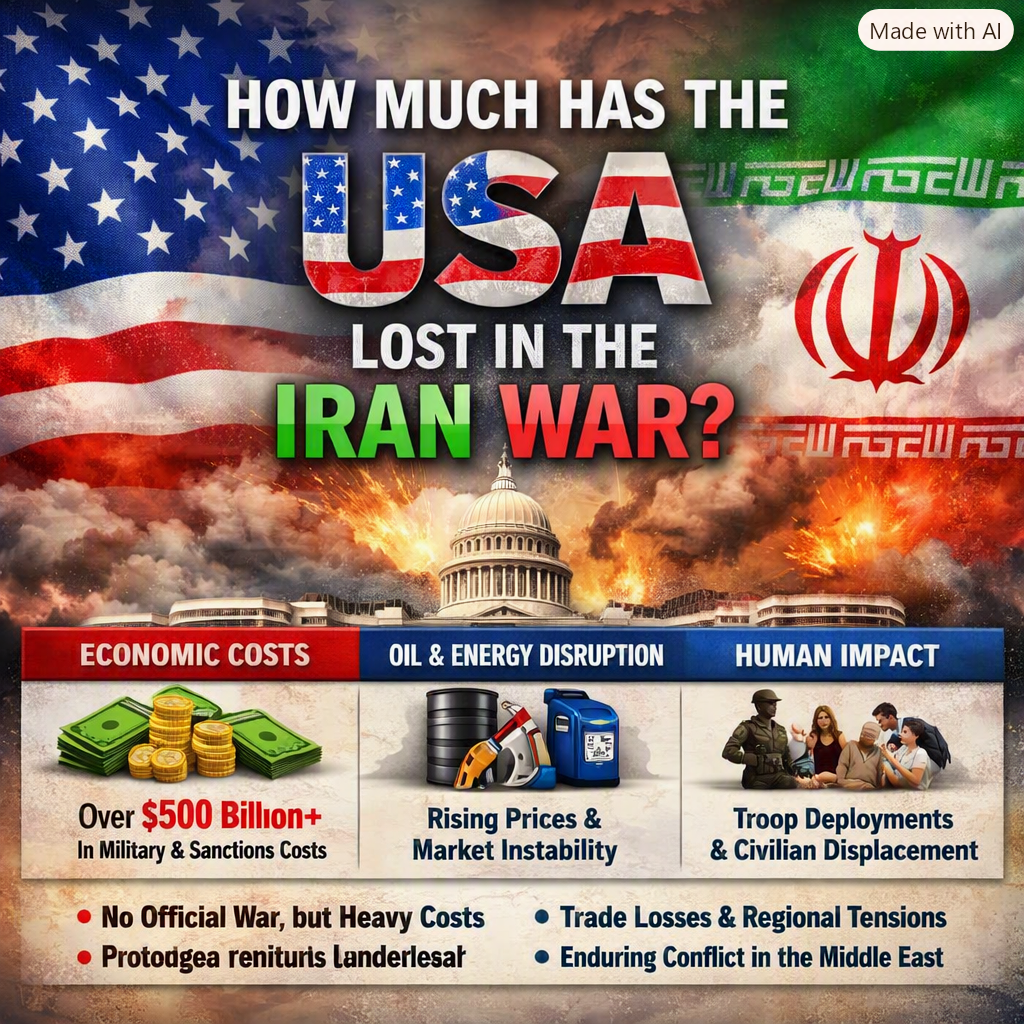
How Much Has the USA Lost in the Iran War $113.3 Billion?
How Much Has the USA Lost in the Iran War?
Complete Cost, Casualties, Military Losses and Economic Impact
Introduction
The 2026 Iran war has become one of the most expensive and strategically complicated military conflicts involving the United States in recent decades. The conflict began after the United States and Israel launched major strikes against Iran on February 28, 2026, triggering Iranian missile and drone attacks against Israel, American military positions, and other targets across the Middle East. What initially appeared likely to be a short campaign developed into a much longer and more difficult confrontation. By August 2026, the United States had suffered military deaths and injuries, lost expensive aircraft and other equipment, spent enormous amounts of money on combat operations and replacement munitions, and faced continuing strategic pressure around the Strait of Hormuz. (Financial Times)
The exact amount that the United States has “lost” is difficult to calculate because war losses include much more than soldiers killed or military equipment destroyed. There is a difference between direct combat spending, the replacement cost of weapons, damaged bases, destroyed aircraft, increased fuel costs, long-term healthcare for wounded personnel, and the broader economic effects of a prolonged Middle Eastern conflict. Different organizations have therefore produced very different estimates depending on what they include. For example, the Center for Strategic and International Studies estimated the initial campaign at approximately $40 billion, while a later Financial Times assessment reported that U.S. military operations and replenishing stockpiles had approached $110 billion. (CSIS)
The human cost is also significant. The latest reporting available in August indicates that at least 18 American service members have died and more than 600 have been wounded during the conflict. The United States has also lost dozens of aircraft and other military assets. The Financial Times reported that 42 U.S. aircraft had been lost by August 12, although individual assessments of the exact equipment losses can change as battle-damage information is reviewed. (Financial Times)
This article examines the American losses from multiple perspectives. It looks at military casualties, aircraft and equipment losses, direct war expenditure, ammunition consumption, damage to American bases, economic consequences, strategic costs, the effect on U.S. military readiness, and the question of whether the United States achieved enough strategic benefits to justify the enormous price. Because the conflict remains fluid, all figures should be understood as estimates available as of August 12, 2026, rather than a final accounting.

When Did the Iran War Begin?
The current U.S.-Iran war began on February 28, 2026, when the United States and Israel launched large-scale military strikes against Iran. The opening campaign targeted Iranian military infrastructure, leadership, missile systems, air defenses, nuclear-related facilities, and other strategic targets. The initial American objective was to severely reduce Iran’s ability to conduct military operations and prevent it from threatening U.S. interests and regional allies. Reuters reported that the war quickly expanded as Iran responded with attacks against Israel, U.S. bases, and Gulf states. (Investing.com)
At the beginning of the conflict, the United States possessed a major technological and military advantage. American forces had access to advanced aircraft, satellites, precision-guided weapons, intelligence systems, missile defenses, aircraft carriers, long-range bombers, and a network of military bases throughout the Middle East. This created expectations in some quarters that Iran’s conventional military capability could be rapidly degraded.
Iran nevertheless demonstrated an ability to retaliate. It used ballistic missiles, cruise missiles, drones, and other weapons against American and allied positions. The attacks forced U.S. forces to devote significant resources to air defense while simultaneously conducting offensive operations. This increased the cost of the campaign because intercepting relatively inexpensive incoming weapons can require extremely expensive defensive missiles and other systems.
The war subsequently expanded beyond the original air campaign. Maritime security became a major issue, particularly around the Strait of Hormuz. As of August 11, Iran said the strategically important waterway would remain closed unless the United States changed its behavior and met Iranian conditions, demonstrating how the conflict had evolved from an air campaign into a broader military, economic, and geopolitical confrontation. (Reuters)

How Many U.S. Soldiers Have Been Killed?
The human cost to American forces is one of the most important measures of the war. According to the latest Financial Times reporting available on August 12, approximately 18 American service members have died during the conflict. This figure represents a substantial human loss even though it is relatively small compared with the casualties suffered by Iran and other participants. (Financial Times)
Earlier in the conflict, U.S. Central Command reported at least 13 American service members killed by March 13, including seven deaths attributed to enemy fire. NPR reported that figure while emphasizing that casualty figures were still developing and could change as the conflict continued. (UPR) The later increase demonstrates why early war casualty statistics should never be treated as final.
Every military death also produces costs that cannot be measured simply in dollars. Families lose loved ones, military units lose experienced personnel, and the armed forces must deal with the emotional and institutional consequences. The government also provides benefits to surviving families, while wounded veterans may require long-term medical treatment and support.
Compared with some major American wars, the number of U.S. deaths remains relatively low. However, the important question is not simply whether the number is historically large or small. It is whether those losses were necessary to achieve the strategic objectives established at the beginning of the conflict. That question remains highly controversial because the war has not produced the decisive political outcome that some American officials initially expected.
How Many U.S. Troops Have Been Wounded?
The number of wounded American personnel is much higher than the number killed. Current reporting indicates that more than 600 U.S. service members have been wounded during the conflict. The Financial Times reported this figure alongside the 18 American deaths and noted that the conflict had imposed a significant human and operational burden on U.S. forces. (Financial Times)
Wounded personnel create a much larger long-term cost than casualty figures alone suggest. Some troops may recover quickly and return to service, while others can require months or years of medical treatment, rehabilitation, psychological care, and disability support. Modern military medicine saves many lives that might previously have been lost, but survival can also mean long-term treatment requirements.
The United States has developed extensive systems for caring for wounded veterans. These systems include military hospitals, rehabilitation facilities, Veterans Affairs programs, disability compensation, mental-health services, and family support. The long-term financial cost of caring for hundreds of wounded service members therefore cannot be fully calculated while the war is still underway.
The military impact is also important. Experienced personnel who are injured may be temporarily or permanently removed from their units. This creates training and replacement requirements. When the same units are deployed repeatedly, maintaining readiness becomes more difficult. Therefore, the reported figure of more than 600 wounded is only the beginning of the human-cost calculation.

How Many U.S. Aircraft Were Lost?
One of the most significant American material losses has been aircraft. The latest Financial Times assessment reported that the United States had lost 42 aircraft during the war. (Financial Times) This is particularly significant because modern U.S. aircraft are extraordinarily expensive and require sophisticated maintenance, trained crews, specialized spare parts, and extensive support infrastructure.
Aircraft losses have included different categories of American military aviation assets. Earlier reporting and analysis identified losses involving surveillance aircraft, drones, helicopters, and combat aircraft. The Center for Strategic and International Studies estimated that American equipment losses were already significant early in the conflict, while later assessments indicated that the overall number of lost aircraft had increased substantially. (Al Jazeera)
The financial value of a destroyed aircraft is not limited to its purchase price. A modern aircraft represents years of research and development, specialized manufacturing, maintenance infrastructure, weapons integration, training, and logistical support. Replacing one aircraft may therefore require much more money and time than simply purchasing another airframe.
Aircraft losses can also reduce military flexibility. The U.S. Air Force and Navy maintain large fleets, so losing dozens of aircraft does not destroy American air power. Nevertheless, combat losses can reduce the number of available platforms, increase pressure on remaining aircraft, and force the Pentagon to accelerate procurement and maintenance programs.
How Much Did the Destroyed U.S. Equipment Cost?
Earlier in the war, the Center for Strategic and International Studies estimated that the United States had suffered approximately $2.3 billion to $2.8 billion in destroyed aerial equipment. That assessment included aircraft and other systems lost during the conflict. (Al Jazeera)
This number was only a snapshot of equipment losses at that stage of the war. It did not represent the total cost of the conflict. It also did not include the enormous expense of weapons fired by American forces, troop deployments, fuel, maintenance, base repairs, medical treatment, or the cost of replacing depleted stockpiles.
The difference between equipment losses and war expenditure is extremely important. If an American aircraft costing tens of millions of dollars is destroyed, the Pentagon must eventually replace it. But the government may also have spent millions of dollars operating that aircraft before it was lost. The aircraft itself is therefore only one part of the total financial burden.
Furthermore, modern warfare can destroy or damage equipment that is not immediately visible in public reports. Radar systems, communications equipment, generators, vehicles, shelters, ammunition storage facilities, maintenance equipment, and other infrastructure may require repairs or replacement. A complete financial assessment can take years after hostilities end.
How Much Has the U.S. Spent on the War?
The estimated financial cost of the war has changed dramatically as the conflict continued. In June, CSIS estimated that the U.S. campaign had cost approximately $40 billion, with a range of about $34 billion to $42 billion. Its calculation included deployment and redeployment, munitions, higher operational tempo, equipment losses, base damage, and increased fuel prices. (CSIS)
However, the conflict subsequently continued and became more expensive. The latest Financial Times assessment published August 12 reported that U.S. military operations and replenishing depleted stockpiles had cost nearly $110 billion. (Financial Times) This enormous difference illustrates how quickly war costs can grow when a campaign lasts longer than expected.
The $110 billion figure should not automatically be interpreted as a final official Pentagon bill. It is an assessment of operational costs and stockpile replenishment, and different accounting methods can produce different totals. Some costs may be counted as normal defense spending, while others may be recorded as emergency expenditures or future procurement requirements.
Nevertheless, even the lower estimates demonstrate that the war is extremely expensive. Spending tens of billions of dollars in a relatively short period means the conflict can influence broader defense priorities. Money used to replenish missiles and aircraft cannot simultaneously be used for other programs without increasing the overall defense budget.
Why Are U.S. Weapons So Expensive?
One reason the American war bill has become so large is the price of modern precision weapons. The United States relies heavily on advanced missiles, guided bombs, long-range strike systems, and defensive interceptors.
CSIS estimated that the first 100 hours of Operation Epic Fury cost approximately $3.7 billion, equivalent to roughly $891 million per day during that initial period. (CSIS) As more weapons were fired and the conflict continued, the expenditure increased dramatically.
The Pentagon reportedly informed Congress that the first six days alone cost approximately $11.3 billion, according to CSIS. The organization also estimated that the first 12 days reached approximately $16.5 billion. (CSIS) These numbers demonstrate the extraordinary intensity of the opening phase.
The cost is not limited to offensive missiles. Defensive systems can also be extremely expensive. When Iran launches a missile or drone, the United States may use an interceptor costing hundreds of thousands or millions of dollars to destroy it. If large numbers of inexpensive drones are intercepted using expensive missiles, the economic exchange can be unfavorable.
This creates one of the central financial challenges of modern warfare: technological superiority does not necessarily mean cheap warfare. The United States can destroy large quantities of enemy equipment, but doing so can require enormous quantities of sophisticated ammunition.
The Cost of Replacing U.S. Missiles
The depletion of American missile stocks is one of the most important hidden costs of the war. The United States entered the conflict with substantial inventories, but sustained high-tempo operations can rapidly consume precision weapons.
CSIS specifically warned that the heavy use of munitions could reduce inventories and create risks for other theaters, including the western Pacific and Ukraine. (CSIS) This is strategically important because the United States is not preparing for only one possible conflict.
If the Pentagon has to replace thousands of missiles after the Iran war, manufacturers may require years to rebuild inventories. Some weapons have complicated production processes, limited suppliers, or specialized components.
The cost of replenishment is therefore more than a simple accounting exercise. It can affect American military readiness. A missile sitting in a warehouse provides strategic value because it is immediately available during a crisis. If that missile has been fired, its replacement may not be available for years.
This means that the war could impose an opportunity cost on the United States. Washington may need to prioritize the Middle East while simultaneously maintaining military readiness in Europe and the Indo-Pacific.
Damage to U.S. Military Bases
American bases across the Middle East have also suffered attacks and damage. Iran targeted U.S. facilities in countries such as Saudi Arabia, Qatar, Bahrain, Kuwait, the United Arab Emirates, and other locations.
Base damage can include destroyed buildings, damaged radar systems, communications infrastructure, aircraft shelters, generators, fuel facilities, and other support equipment. Earlier analysis indicated that damage across multiple American bases had already reached hundreds of millions of dollars. (Reddit)
The financial consequences go beyond rebuilding physical structures. When a base is damaged, personnel may need to be relocated. Aircraft operations may be moved to other facilities. Temporary accommodations, additional transportation, security measures, and emergency repairs all increase costs.
Base attacks can also change American military strategy. A facility that was previously considered secure may become too vulnerable for certain operations. The Pentagon may need to invest in additional missile defenses, hardened structures, dispersal facilities, and alternative bases.
This means that even if the visible physical damage is repaired, the long-term security cost can continue for years. The United States may spend additional money protecting its forces in the region because of lessons learned during the war.
The Strategic Cost of the Strait of Hormuz
The Strait of Hormuz has become one of the most important strategic issues in the conflict. It is a critical route for global energy shipments, and disruption can affect oil markets, shipping costs, insurance prices, and international economic growth.
On August 11, Iran stated that the Strait would remain closed unless the United States met Iranian conditions, including ending the war and addressing frozen Iranian assets. (Reuters) The continuation of the dispute demonstrates that the war has consequences far beyond military bases and aircraft.
For the United States, maintaining freedom of navigation in and around the Strait requires naval forces, aircraft, surveillance systems, missile defenses, and diplomatic resources. Those operations add to the overall cost of the war.
The global economic consequences can also indirectly affect the United States. Higher oil prices can increase gasoline and transportation costs, raise inflation, and make it more expensive to operate military and civilian vehicles. This means the American economic loss can be considerably larger than the Pentagon’s direct war expenditure.
The Economic Cost of Higher Oil Prices
Energy markets react quickly to major disruptions in the Middle East. When traders fear that oil shipments could be interrupted, crude prices can rise because markets price in the possibility of future shortages.
Higher oil prices affect the American economy through gasoline, transportation, manufacturing, aviation, agriculture, and consumer products. Even Americans who are not directly involved in the war can therefore experience financial consequences.
The federal government can also face higher costs when fuel prices increase. The military operates aircraft, ships, vehicles, and bases that consume enormous quantities of fuel. A prolonged increase in energy prices can therefore increase military operating expenses.
Businesses can also pass higher transportation and energy costs to consumers. This can create additional inflationary pressure, complicating the Federal Reserve’s efforts to manage interest rates.
Consequently, the economic cost of the Iran war should not be measured only by the amount spent by the Pentagon. A prolonged disruption to global energy markets could produce a much larger indirect economic burden.
How the War Has Affected U.S. Military Readiness
One of the most serious costs is the potential effect on American military readiness. The United States has global military commitments, meaning weapons and personnel used in Iran are not available for other missions.
The Pentagon must consider Europe, the Indo-Pacific, the Korean Peninsula, the Middle East, and other regions simultaneously. If large quantities of precision missiles are consumed in Iran, replenishing those weapons becomes a priority.
CSIS specifically warned that reduced inventories could create risks in other theaters, including the western Pacific and Ukraine. (CSIS) This means the cost of the war is partly measured in strategic flexibility.
Aircraft losses create similar problems. Even though the U.S. possesses thousands of aircraft, advanced platforms can take years to manufacture. A replacement cannot necessarily be delivered immediately.
The war therefore creates a difficult balancing act. The United States must rebuild its depleted stocks while continuing to deter potential adversaries elsewhere. That may require larger defense budgets, accelerated production, and changes in military procurement priorities.
Is $110 Billion the Final Cost?
Probably not. The $110 billion figure reported in August should be viewed as an estimate of costs accumulated so far rather than a final bill. The war is still developing, and additional military operations could increase the total.
Even after combat ends, expenses will continue. Damaged aircraft will need replacement. Destroyed equipment will have to be rebuilt. Weapons inventories must be replenished. Bases may require reconstruction. Wounded soldiers may require long-term treatment.
Veterans’ benefits can continue for decades. Some service members may experience permanent disabilities or psychological injuries that require long-term government support.
There may also be future interest costs if the federal government borrows money to finance emergency military spending. This is especially important because federal debt is already extremely large.
The true lifetime cost of the war therefore cannot be calculated immediately. A final accounting could ultimately be considerably higher than the amount spent during active combat.
The Cost of Wounded Veterans
Military casualties create long-term financial obligations. Modern American healthcare can save wounded service members who might have died in earlier wars, but surviving severe injuries can require lifelong care.
Some veterans may need surgeries, rehabilitation, prosthetics, medication, physical therapy, or psychological treatment. Others may require assistance with employment and daily activities.
The Department of Veterans Affairs may therefore face increased spending for years after the conflict.
Families can also receive compensation and support when service members are killed or permanently disabled.
These costs are rarely included in the initial estimate of a war because they develop over decades. A conflict that costs $100 billion during combat could therefore create additional billions in future obligations.
The Human Cost Beyond the U.S. Military
American losses must also be understood within the broader human consequences of the war. Thousands of people in Iran and other parts of the region have been killed or injured.
Reuters reported in March that Iranian casualty figures were already in the thousands, while noting that many figures had not been independently verified. (Investing.com) The International Federation of Red Cross and Red Crescent Societies separately reported significant casualties in Iran during the early stages of the war. (Investing.com)
These civilian losses create humanitarian consequences that extend beyond direct military calculations.
Hospitals, schools, housing, roads, electricity systems, and other infrastructure can be damaged during prolonged conflict.
The resulting displacement and economic disruption can last long after missiles stop flying. This matters for the United States because reconstruction, humanitarian assistance, refugee support, and regional stabilization can become additional international responsibilities.
Therefore, the cost of war is not simply the amount Washington spends on bombs and aircraft. It also includes the broader consequences of destabilization.
Did the U.S. Destroy More Than It Lost?
From a purely military equipment perspective, the United States has inflicted enormous damage on Iran. U.S. forces conducted thousands of strikes and destroyed significant portions of Iranian military infrastructure.
The Financial Times reported that the United States had conducted more than 13,000 strikes, caused massive damage to Iran’s military and economy, and eliminated important leadership figures. (Financial Times)
This demonstrates that the United States possesses overwhelming technological and military capabilities.
However, military success is not measured only by how much equipment one side destroys. The ultimate objective is political and strategic. If Iran continues to resist, launches attacks, disrupts shipping, and prevents the United States from achieving its desired political settlement, Washington may still consider the war costly despite inflicting greater physical damage.
This is the difference between tactical success and strategic success. Destroying an enemy’s military assets can be a tactical victory, while achieving the desired political outcome is a strategic victory.
The United States has clearly demonstrated extraordinary destructive capability. The more complicated question is whether that capability has produced a sufficiently favorable political result.
Why Iran’s Resistance Matters
Iran has suffered far greater physical damage than the United States. Its military infrastructure and economy have been heavily attacked.
Nevertheless, Iran has continued to resist. It has maintained missile capabilities, launched attacks against American and allied targets, and used its geographic position to create pressure on global shipping.
This resilience has increased the cost of the war for Washington.
If Iran had surrendered or accepted American conditions quickly, the financial cost might have remained closer to the initial estimates. Instead, continued resistance has required additional deployments, weapons, defensive operations, and diplomatic efforts.
The war therefore illustrates an important principle of modern conflict: overwhelming military superiority does not necessarily guarantee a quick political victory.
The Cost of America’s Global Military Commitments
The United States maintains military forces around the world. This gives Washington extraordinary strategic reach, but it also creates enormous financial obligations.
When a major war begins in the Middle East, forces stationed elsewhere may need to be redirected.
Aircraft carriers, fighter squadrons, bombers, air-defense systems, logistics ships, intelligence assets, and special operations forces can all be moved toward the conflict.
Those deployments require transportation, fuel, maintenance, security, housing, and support.
The Iran war therefore consumes resources that could otherwise support deterrence missions in Europe and Asia. This opportunity cost is difficult to measure but strategically important.
Political Cost Inside the United States
The war also creates political costs for the American government. A conflict costing tens or hundreds of billions of dollars naturally raises questions about congressional oversight and government priorities.
Americans may ask whether military spending should take priority over healthcare, infrastructure, education, debt reduction, or domestic programs.
The political consequences can become especially significant if casualties increase or the war continues without a clear conclusion.
Members of Congress may demand greater transparency about military expenditures and the reasons for continued operations.
The 2026 midterm elections could therefore become an important political test of public attitudes toward the war.
How the War Could Affect the 2026 Midterms
The Iran war could influence congressional elections in several ways. Candidates supporting the administration may argue that military action was necessary to protect American interests.
Opposition candidates may emphasize the financial cost, military casualties, and lack of a decisive political settlement.
Economic effects such as higher gasoline prices could also influence voters.
If the war remains expensive and unpopular, it could become a significant electoral liability.
If the administration presents the conflict as a major military success and keeps casualties relatively low, the political impact could be smaller.
The Difference Between Cost and Loss
It is important to distinguish war cost from war losses.
A $100 billion expenditure is not necessarily money that was destroyed. Much of that money pays American workers, defense contractors, logistics companies, and suppliers.
By contrast, a destroyed aircraft is a physical loss of military capability.
A killed soldier is a human loss that cannot be replaced financially.
A missile fired is a financial expenditure and also a depletion of military inventory.
A damaged base is a physical loss that requires future spending.
This is why there is no single number that perfectly describes “how much America lost.”
A Practical Estimate of U.S. Losses
Based on current reporting, the most useful summary is that the United States has suffered at least tens of billions of dollars in direct and associated costs, with a more recent assessment putting military operations and stockpile replenishment near $110 billion. (Financial Times)
The United States has also suffered around 18 military deaths and more than 600 wounded, according to the latest Financial Times assessment. (Financial Times)
Approximately 42 U.S. aircraft have reportedly been lost, representing billions of dollars in physical military equipment and significant future replacement costs. (Financial Times)
Earlier CSIS analysis estimated the initial campaign at approximately $40 billion, demonstrating how quickly the financial burden has grown as the conflict continued. (CSIS)
These numbers should be treated as a current assessment rather than a final official accounting. The war’s eventual cost will depend on how long fighting continues, how much equipment must be replaced, how much bases cost to rebuild, and how long veterans require medical and financial support.
Could the Total Cost Reach $150 Billion or More?
It is possible. If combat operations continue, the cost will keep increasing.
Every additional day requires fuel, personnel, maintenance, ammunition, intelligence operations, air defense, naval deployments, and logistical support.
If major additional equipment is destroyed, replacement costs could increase substantially.
The Pentagon will also need to replenish weapons inventories after the war. Some replenishment programs may extend for several years.
If long-term veteran costs and interest expenses are included, the lifetime economic burden could eventually exceed the direct wartime expenditure by a considerable amount.
Therefore, $110 billion should not necessarily be interpreted as the upper limit.
Could the War Eventually Cost Hundreds of Billions?
A prolonged conflict could eventually reach several hundred billion dollars in total economic cost, particularly if broader effects are included.
However, it would be misleading to claim that the United States has already lost hundreds of billions without strong evidence.
Direct military expenditure is easier to estimate than indirect costs.
Higher oil prices, financial-market disruption, lost economic productivity, veterans’ care, interest payments, and global trade effects can all add to the total.
If the Strait of Hormuz remains disrupted for a long period, the economic consequences could become particularly large.
The longer the conflict continues, the more likely it becomes that indirect costs will exceed the original military spending.
What Has America Gained From the War?
The United States has gained several military advantages. American forces have destroyed substantial Iranian military infrastructure, weakened missile and air-defense capabilities, eliminated important leadership figures, and demonstrated the ability to conduct sustained long-range operations.
The campaign has also demonstrated American technological superiority.
Washington has gained valuable operational experience concerning Iranian missiles, drones, air defenses, electronic warfare, and regional military networks.
However, military gains must be balanced against financial and human costs.
If the strategic goal was to permanently change Iranian behavior or establish a stable regional order, the assessment becomes more complicated.
The continuation of Iranian resistance suggests that military destruction alone has not solved the political problem.
What Has America Lost Strategically?
The United States has lost aircraft, weapons, money, personnel, and potentially some deterrence credibility.
If adversaries conclude that American military power can destroy infrastructure but cannot force a rapid political settlement, they may become more willing to resist.
At the same time, American allies may question whether U.S. military commitments are sustainable.
The war may also have reduced the inventory of weapons available for other potential conflicts.
These strategic losses are difficult to measure in dollars but can be more important than direct financial expenditure.
What Does the War Mean for Future U.S. Defense Spending?
The Pentagon will likely need to replace lost aircraft, missiles, drones, radar systems, and other equipment.
That could lead to increased defense procurement.
Congress may authorize additional spending to rebuild depleted inventories.
Defense contractors could receive large new orders.
The military may also invest more heavily in missile defense, base protection, hardened facilities, drones, electronic warfare, and long-range strike capabilities.
Therefore, the financial consequences of the war could shape American defense policy for years.
Lessons for the U.S. Military
One major lesson is that expensive military technology can be vulnerable to large numbers of relatively inexpensive weapons.
Iran’s missile and drone attacks forced the United States to use valuable defensive systems.
Another lesson concerns the vulnerability of overseas bases. Concentrating large numbers of aircraft, personnel, and equipment in fixed locations can create attractive targets.
The United States may respond by dispersing forces more widely and investing in hardened infrastructure.
Finally, the war demonstrates the importance of industrial capacity. A military can possess enormous inventories, but prolonged high-intensity warfare can consume them faster than factories can replace them.
The Long-Term Financial Burden
The final cost of the Iran war will continue after the shooting stops.
Aircraft replacement programs may run for years.
Missile production contracts could extend for years.
Veterans’ healthcare may continue for decades.
Base reconstruction may require additional budgets.
Interest on wartime borrowing may continue even longer.
This means that the final historical cost of the conflict will probably not be known immediately after a ceasefire.
Researchers may need many years to calculate the complete economic burden.
Is the United States “Losing” the Iran War?
The answer depends on what “losing” means.
If losing means suffering more military damage than Iran, the answer is clearly no. Iran has suffered enormously greater physical destruction.
If losing means spending too much money, the answer is more complicated. The United States has enormous financial resources, but $110 billion or more is still a significant expenditure.
If losing means failing to achieve political objectives, the answer is still uncertain.
The Financial Times reported that despite massive U.S. military strikes, Iran continued to resist and disrupt key maritime routes. (Financial Times) That suggests that military superiority has not yet produced a decisive political settlement.
Frequently Asked Questions
How much money has the USA lost in the Iran war?
The latest assessment available on August 12, 2026, reported that U.S. military operations and replenishing stockpiles had cost nearly $110 billion. Earlier CSIS estimates were much lower because they covered earlier stages of the conflict. (Financial Times)
How many American soldiers died?
The latest reporting cited approximately 18 U.S. military deaths. (Financial Times)
How many U.S. troops were wounded?
More than 600 American service members have reportedly been wounded. (Financial Times)
How many U.S. aircraft were destroyed?
The latest Financial Times assessment reported approximately 42 U.S. aircraft lost. (Financial Times)
How much U.S. military equipment was destroyed?
Earlier CSIS analysis estimated approximately $2.3 billion to $2.8 billion in destroyed American aerial equipment, but later losses increased the total. (Al Jazeera)
Was the war initially expected to be cheaper?
Yes. Early estimates were much lower. CSIS estimated approximately $3.7 billion during the first 100 hours, while later Pentagon-related reporting placed the first six days at approximately $11.3 billion. (CSIS)
Why is the war so expensive?
The major expenses include missiles, aircraft operations, fuel, troop deployments, air defenses, logistics, base repairs, equipment losses, and replenishing military stockpiles.
Does $110 billion include everything?
No. It is better understood as a current estimate of operational spending and stockpile replenishment. Long-term veteran care, future equipment replacement, interest costs, and broader economic effects could increase the eventual total.
Could the final cost be higher?
Yes. If military operations continue, the cost will continue to increase. Even after combat ends, replacement and veteran-related expenses will remain.
Has Iran lost more than the United States?
In terms of physical destruction and casualties, Iran has suffered far greater losses. However, the United States has experienced significant financial, military, and human costs.
Did the United States lose aircraft worth billions?
Yes. Earlier assessments put American aerial equipment losses at billions of dollars, and later reports indicated the number of lost aircraft had increased. (Al Jazeera)
Is the Strait of Hormuz still a problem?
Yes. On August 11, Iran said it would keep the Strait closed unless the United States changed its position and met Iranian conditions. (Reuters)
Could the war increase U.S. gasoline prices?
Yes. Disruption around the Strait of Hormuz can affect global oil supply and therefore potentially increase gasoline and transportation costs in the United States.
Does the war affect America’s ability to fight elsewhere?
Potentially. Heavy ammunition consumption and aircraft losses can reduce available inventories and require significant replenishment. CSIS warned about potential effects on U.S. readiness in other theaters. (CSIS)
Final Verdict: How Much Has the USA Lost in the Iran War?
The simplest answer is that the United States has lost billions of dollars in military equipment, hundreds of service members have been killed or wounded, dozens of aircraft have reportedly been destroyed, and the overall financial cost has reached an estimated tens of billions to around $110 billion depending on the accounting period and methodology. The latest August 12 assessment from the Financial Times puts U.S. military operations and stockpile replenishment at nearly $110 billion, alongside approximately 18 American deaths, more than 600 wounded, and 42 lost aircraft. (Financial Times)
Earlier estimates demonstrate how quickly the cost expanded. CSIS estimated that the first 100 hours of Operation Epic Fury cost about $3.7 billion. A later estimate placed the first six days at approximately $11.3 billion and the first 12 days at around $16.5 billion. By June, CSIS estimated the campaign’s cost at approximately $40 billion. (CSIS) These figures are not necessarily contradictory because they cover different periods and use different methodologies.
The military losses are also significant. The United States has demonstrated overwhelming technological superiority and has destroyed enormous amounts of Iranian military infrastructure, but it has also lost expensive aircraft and other equipment. Earlier CSIS analysis estimated $2.3 billion to $2.8 billion in destroyed aerial equipment, while the later reported figure of 42 lost aircraft indicates that equipment losses continued after that early assessment. (Al Jazeera)
The human cost is smaller than Iran’s but still serious. Around 18 American service members have reportedly died, while more than 600 have been wounded. Every casualty represents not only a personal tragedy but also long-term consequences for families, military units, healthcare systems, and the Department of Veterans Affairs. (Financial Times)
The most difficult part of calculating the American loss is determining the indirect cost. The United States must replace missiles and aircraft, repair bases, maintain additional forces in the region, support wounded veterans, and potentially deal with higher energy prices and disruptions to international trade. If the Strait of Hormuz remains closed or heavily restricted, the economic consequences could become much larger than the Pentagon’s direct expenditure. Iran’s August 11 statement that it would keep the Strait closed unless Washington met its conditions shows that this issue remains unresolved. (Reuters)
There is also a strategic cost. American military stockpiles have been heavily used, and CSIS warned that depleted inventories could affect U.S. readiness for other potential conflicts, including in the western Pacific and Ukraine. (CSIS) This means that some of the war’s cost is not immediately visible on a government balance sheet. A missile fired today may have to be replaced years later, and the absence of that missile from an inventory can affect future military planning.
Ultimately, whether the United States considers the war a success will depend on its political objectives. Militarily, Washington has demonstrated the ability to inflict extraordinary damage on Iran. Strategically, however, the outcome is much less straightforward. Iran continues to resist, the Strait of Hormuz remains a major source of pressure, and the financial cost has grown dramatically beyond the earliest estimates. The Financial Times described the conflict as costly and inconclusive despite the scale of American military operations. (Financial Times)
As of August 12, 2026, a reasonable current estimate is that the United States has incurred around $110 billion in military operations and stockpile-replenishment costs, while suffering roughly 18 military deaths, more than 600 wounded personnel, and about 42 aircraft lost. These numbers should not be treated as the final lifetime cost because the war is still developing and long-term expenses have not yet been fully calculated. (Financial Times)
The final price could therefore be considerably higher. If fighting continues, every additional week could add billions of dollars in ammunition, fuel, deployments, repairs, and replacement costs. If the conflict eventually ends, the United States will still face years of spending on rebuilding military inventories, replacing aircraft, repairing bases, and caring for veterans.
In other words, America has not simply lost money in the Iran war; it has paid a substantial price in lives, military equipment, ammunition, readiness, and strategic resources. Whether those losses were justified will ultimately depend on whether Washington achieves the political and security objectives that motivated the war in the first place.
For More Information about this article, Please Click Here.
For More Information, Please Click Here.