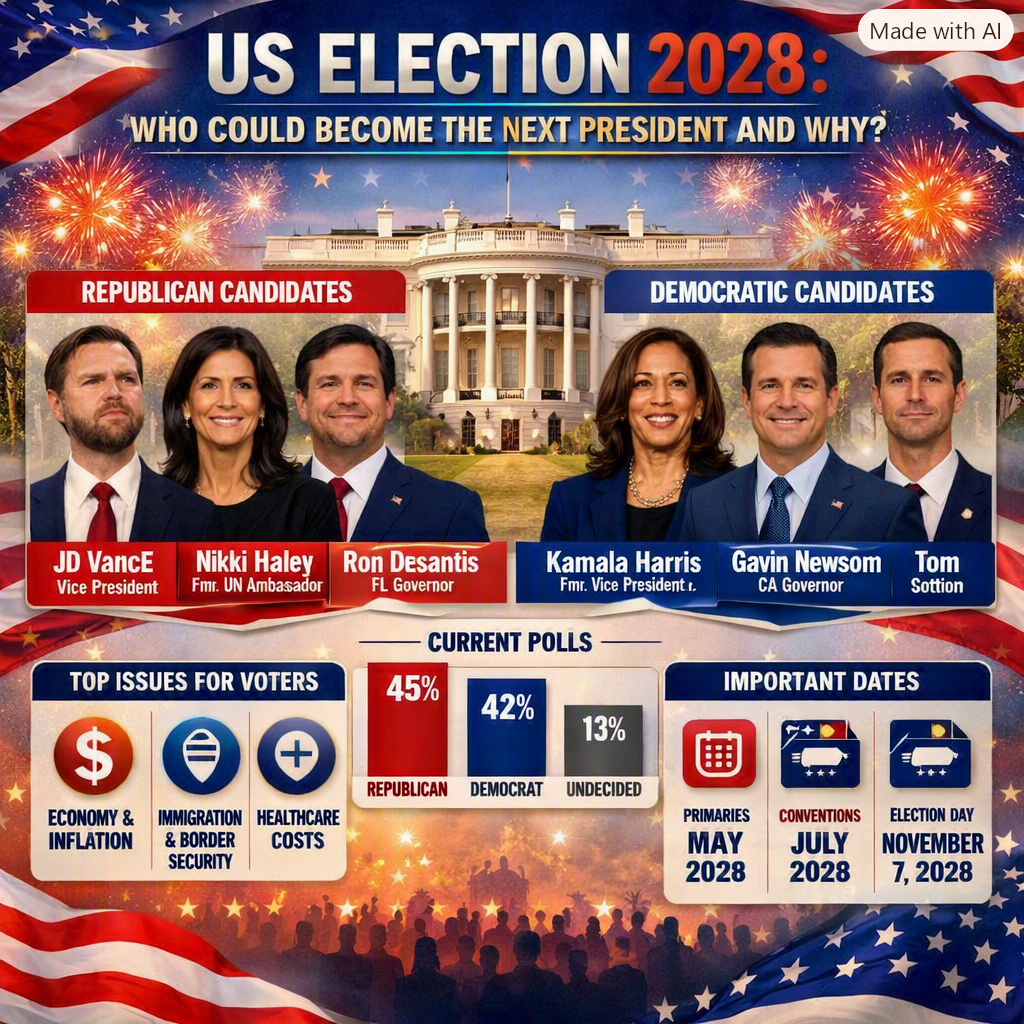
US Election 2028 President : Who Could Become the Next President and Why?
US Election 2028: Who Could Become the Next President and Why?
Introduction
The 2028 United States presidential election is already becoming one of the most closely watched political contests in the country, even though Election Day is still more than two years away. The race is especially important because Donald Trump will not be able to seek another elected presidential term under the Twenty-Second Amendment. That means the Republican Party will have to choose a new presidential candidate capable of carrying forward, changing, or redefining the political coalition that Trump has built. At the same time, Democrats are preparing for another major presidential contest and have a large group of possible candidates who could compete for the nomination.
The Republican succession battle currently attracts significant attention because Vice President JD Vance and Secretary of State Marco Rubio are among the strongest potential contenders. Vance has the obvious advantage of being vice president and maintaining a close relationship with Trump, while Rubio brings years of Senate experience, a previous presidential campaign, and significant foreign-policy credentials. Early polling has produced different results depending on the survey, showing that neither candidate can safely be considered the eventual Republican nominee. A current RealClearPolitics compilation, for example, shows Vance ahead of Rubio in its Republican nomination polling average, while other individual surveys have produced much closer results. (RealClearPolitics)
The Democratic side is even less settled. Gavin Newsom, Kamala Harris, Pete Buttigieg, Alexandria Ocasio-Cortez, Josh Shapiro, Andy Beshear, and other politicians are being discussed as potential candidates. Early surveys have produced different leaders. An Emerson national poll reported in May put Buttigieg at 18%, Newsom at 16%, Ocasio-Cortez at 11%, Harris and Shapiro at 10%, and Beshear at 9%, illustrating how competitive the Democratic field could become. (Scripps News)
The most important point is that early polling should not be treated as a final prediction. Many potential candidates have not officially announced campaigns, voters are not yet paying the same attention they will during the primary season, and major political and economic events could completely change the race. The 2026 midterm elections, the state of the economy, Trump’s approval rating, international conflicts, immigration, abortion, healthcare, and the candidates’ performances could all influence who eventually becomes the next president. As of August 2026, however, JD Vance, Marco Rubio, Gavin Newsom, Kamala Harris, Pete Buttigieg, and several other politicians deserve serious attention.

Why the 2028 Election Could Be Historic
The 2028 election could represent a major generational transition in American politics. For years, presidential politics has been dominated by Donald Trump, Joe Biden, and other older political figures. Trump has reshaped the Republican Party and changed the way conservatives campaign, communicate with voters, and approach issues such as immigration, trade, foreign policy, and the role of government. Once he leaves the presidency, Republicans will have to determine whether they want to continue his political approach through another leader or develop a different version of conservatism.
The Republican succession question is therefore much larger than simply choosing a candidate. The party must decide what it wants to become after Trump. JD Vance is closely associated with Trump’s political movement and could argue that he represents its next generation. Marco Rubio could make a different argument based on experience, national security, international diplomacy, and conservative policy. Other Republicans could attempt to create their own coalition by combining Trump’s economic and immigration policies with a different tone or strategy.
Democrats are facing their own generational debate. Kamala Harris already has presidential and vice-presidential experience, while Gavin Newsom has experience as governor of California. Pete Buttigieg has previously competed in a presidential primary and served in the Cabinet. Josh Shapiro and Andy Beshear have demonstrated that Democrats can win statewide in competitive political environments. Alexandria Ocasio-Cortez represents a younger and more progressive wing of the Democratic Party. These differences could produce a major debate over what type of Democrat can win the White House.
The election could also become historic because of the Electoral College. A candidate does not simply need to receive the most votes nationally; the campaign must build a coalition capable of winning enough states to reach at least 270 electoral votes. Pennsylvania, Michigan, Wisconsin, Arizona, Georgia, Nevada, and North Carolina could once again become central battlegrounds. The candidate who wins the nomination will therefore need more than a strong national following. They will need a strategy that works across several very different regions of the country.

JD Vance: The Natural Republican Successor
JD Vance currently has one of the clearest paths to the Republican nomination. His most obvious advantage is that he is already vice president. The vice presidency gives him national visibility, direct experience inside the administration, and access to a political network that many potential competitors would struggle to build. If Republicans want continuity after Trump’s presidency, Vance can make a powerful argument that he is the person best positioned to carry the movement into the future.
Vance also has a strong relationship with Trump’s political base. He has become closely associated with the populist and nationalist direction of the Republican Party. His political career has developed around issues such as working-class economics, immigration, cultural politics, industrial policy, and skepticism toward some traditional approaches to American foreign policy. If Republican primary voters continue to prioritize Trump’s political agenda, Vance could benefit substantially.
Early polling supports the argument that Vance is a serious frontrunner, although the size of his advantage varies considerably. RealClearPolitics’ current compilation has Vance leading the Republican field, while a May 2026 Overton Insights poll showed Vance at 39% and Rubio at 32% among Republican respondents. Another June survey cited by RealClearPolitics showed Vance at 38% and Rubio at 19%. These differences demonstrate both Vance’s strength and the uncertainty surrounding the early race. (RealClearPolitics)
Vance’s biggest challenge could be the general election. Winning Republican primary voters is different from winning independent voters in Pennsylvania, Michigan, Wisconsin, Arizona, Georgia, and other competitive states. If Vance becomes the nominee, Democrats would likely portray him as a continuation of Trump rather than an independent political figure. Vance would therefore need to convince voters that he represents a new generation of leadership while preserving enough of Trump’s coalition to win the Republican nomination.

Marco Rubio: The Strongest Republican Alternative
Marco Rubio is arguably the most important alternative to JD Vance. Rubio has already spent years on the national political stage. He served in the U.S. Senate, competed for the Republican presidential nomination in 2016, and later became secretary of state. That combination gives him experience in domestic politics, presidential campaigning, and foreign affairs that very few potential Republican candidates can match.
Rubio’s foreign-policy background could become particularly important if international affairs dominate the 2028 election. The United States faces complicated relationships with China, Russia, European allies, Middle Eastern countries, and other major powers. If national security becomes a central concern, Rubio could argue that his experience makes him better prepared to serve as commander in chief.
Rubio has also demonstrated that he can compete directly with Vance. The Republican race has not developed into a one-candidate contest. In the May 2026 Overton Insights survey, Rubio actually led Vance in a hypothetical head-to-head matchup, receiving 42% compared with Vance’s 36%, although 22% were undecided. (Overton Insights) This is an important reminder that early multi-candidate polling does not necessarily tell the entire story of a potential primary.
Rubio’s biggest challenge is his relationship with the Trump movement. If Trump strongly endorses Vance and actively campaigns for him, Rubio could find it difficult to overcome the organizational and political advantages of the vice president. On the other hand, if Republican voters begin looking for a candidate who can maintain conservative policies while offering a different style of leadership, Rubio could become extremely competitive. His ability to attract older Republican voters and voters focused on foreign policy could also be important.

JD Vance vs. Marco Rubio: The Republican Battle
The potential contest between Vance and Rubio could define the Republican Party’s future. Vance represents a younger generation of conservative populism and has the advantage of being Trump’s vice president. Rubio represents a more experienced national politician who has already competed for president and now has one of the most important foreign-policy positions in the government. Both could make a credible case that they are capable of leading the party after Trump.
Vance’s strongest argument would be continuity. He could tell Republican voters that the movement that produced Trump’s victories should not be abandoned simply because Trump cannot run again. He could argue that he understands the concerns of working-class voters, supports strong border policies, and wants to maintain an America-first approach. His age would also allow him to present himself as someone who could lead the party for many years.
Rubio’s argument would likely focus more on experience and electability. He could say that Republicans need a candidate who understands Washington, foreign affairs, the Senate, international alliances, and presidential politics. His previous presidential campaign means he already understands the demands of a national race. If voters become concerned that a more populist candidate might struggle with independents, Rubio could present himself as an alternative.
The race could ultimately depend heavily on Trump’s influence. If Trump clearly selects Vance as his successor, the vice president would probably enter the primary with a major advantage. If Trump remains neutral or gives mixed signals, Rubio could have more room to build support. Current polling demonstrates that the race is not settled, making it too early to say that either candidate is guaranteed to receive the Republican nomination. (RealClearPolitics)
Gavin Newsom: A Major Democratic Possibility
Gavin Newsom is one of the most prominent potential Democratic candidates. As governor of California, he has extensive executive experience and a national political profile. He has also become one of the Democratic Party’s most visible voices against Trump and Republican policies, giving him considerable experience in national political communication.
Newsom’s greatest strength may be his ability to campaign aggressively. He has demonstrated that he is comfortable debating conservative politicians and appearing in national media. A presidential campaign would allow him to argue that Democrats need a candidate who can directly confront Republicans rather than simply respond to their attacks. His supporters could also argue that governing the country’s largest state provides substantial executive experience.
His greatest weakness is California itself. Republicans would almost certainly make California a central issue in a Newsom campaign. They could criticize the state’s housing affordability, taxes, homelessness, regulation, crime, and other problems. Newsom would need to explain why voters in Pennsylvania, Michigan, Wisconsin, Georgia, and other competitive states should believe that his policies can work nationally.
Despite those challenges, Newsom remains a major Democratic possibility. Early polling has frequently placed him near the top of the potential Democratic field. A May Emerson survey placed Newsom at 16%, behind Buttigieg at 18%, while other surveys have produced different results. (Scripps News) This variation means Newsom should be considered a serious contender rather than an inevitable nominee.
Kamala Harris: Could She Return in 2028?
Kamala Harris remains one of the most recognizable potential Democratic candidates. Her experience as vice president and as the Democratic presidential nominee in 2024 gives her a national network, substantial name recognition, and experience running a presidential campaign. Few potential candidates would need less time to introduce themselves to voters.
Harris could make the argument that experience matters. She has already campaigned nationally, debated at the presidential level, served in the White House, and built relationships throughout the Democratic Party. If Democrats believe that her 2024 campaign produced lessons that could be applied to a future election, she could attempt to make a comeback.
The obvious problem is her previous defeat. Democratic voters may decide that the party needs a fresh face after the 2024 election. They could conclude that a candidate who has already lost a presidential contest would face unnecessary baggage in another campaign. Harris would therefore need to convince primary voters that she has a stronger path to victory in 2028 than she did previously.
Early polling shows that Harris remains competitive but does not dominate the field. In the May Emerson national survey, she was at 10%, tied with Josh Shapiro and behind Buttigieg and Newsom. A Michigan Democratic survey, however, showed Harris with 14% definite support compared with 18.5% for Buttigieg and 15.2% for Newsom. (Scripps News) The differences illustrate how open the Democratic contest remains.
Pete Buttigieg and the Next Generation
Pete Buttigieg could become one of the strongest Democratic candidates in 2028. He already has presidential campaign experience from 2020 and served as transportation secretary during the Biden administration. His communication skills, national recognition, and relatively young age could make him particularly attractive to voters looking for generational change.
Buttigieg’s strongest advantage is probably his ability to communicate. He has demonstrated that he can discuss complicated policy issues in a relatively clear manner and can perform well in national media. His previous presidential campaign also showed that he could build a national organization and attract support beyond his home state.
His challenge would be expanding his coalition. Winning a Democratic primary requires support from progressives, moderates, young voters, minority voters, union voters, suburban voters, and working-class voters. Buttigieg would need to demonstrate that his political appeal extends beyond highly educated and suburban Democratic voters.
Early evidence suggests that he should not be ignored. Emerson’s May national survey placed him first among potential Democratic nominees at 18%, while a New Hampshire poll also showed him leading the Democratic field in that early-primary state. (Scripps News) His early strength does not guarantee a nomination, but it demonstrates that he already has a serious national base.
Alexandria Ocasio-Cortez and the Progressive Choice
Alexandria Ocasio-Cortez represents a very different potential direction for the Democratic Party. She has developed an exceptionally strong following among progressive voters and younger Americans. Her political brand is strongly connected to economic inequality, healthcare, climate policy, workers’ rights, housing affordability, and progressive economic reform.
AOC’s greatest strength would be enthusiasm. Presidential campaigns require volunteers, small-dollar donors, social-media engagement, and grassroots energy. She has demonstrated an ability to generate all of these things. If progressive voters become increasingly dissatisfied with establishment Democrats, she could become a powerful candidate.
Her biggest challenge would be winning over moderate voters. A Democratic nominee must eventually compete in states where voters may not share the political views of the party’s progressive base. Republicans would likely use her most controversial positions and statements as evidence that Democrats have moved too far left.
At the same time, the Democratic Party’s political environment may be changing. Recent 2026 Democratic primary contests have shown increased progressive energy, and Reuters reported that progressive candidates have been winning several important primary contests across the country. (Reuters) If that trend continues into 2027, AOC’s position could become considerably stronger.
Josh Shapiro: The Swing-State Argument
Josh Shapiro could become an important Democratic presidential contender because of Pennsylvania. Pennsylvania is one of the most valuable and competitive states in presidential politics, and Shapiro has already demonstrated that he can win statewide there.
His greatest advantage would therefore be electability. Democrats could argue that a candidate who understands Pennsylvania voters may be better positioned to win the Electoral College than a candidate whose support is concentrated in heavily Democratic states. Shapiro could campaign on his ability to appeal to suburban, urban, and working-class voters.
The challenge is national recognition. Shapiro is not as familiar to voters across the country as Harris, Newsom, or Buttigieg. A presidential campaign would require him to spend considerable time introducing himself to voters and building a national fundraising network.
His early numbers show potential. In the Michigan Democratic survey, Shapiro received 3.8% definite support and 2.4% probable support, while the national Emerson survey cited him at around 10%. (Detroit Regional Chamber) Those numbers are not dominant, but they give him a foundation from which a campaign could grow.
Andy Beshear and the Working-Class Strategy
Andy Beshear is another Democrat who could surprise the political establishment. As governor of Kentucky, he has demonstrated that a Democrat can win statewide in a state that is strongly Republican in national elections.
That achievement gives Beshear a powerful argument. Democrats have struggled in some rural and working-class communities, particularly in states that have shifted strongly toward Republicans. Beshear could argue that his style of Democratic politics is capable of rebuilding those relationships.
His campaign could focus on healthcare, education, infrastructure, wages, economic development, and practical government. Instead of emphasizing ideological conflict, he could present himself as a pragmatic governor who has delivered results in a difficult political environment.
The biggest obstacle would be national recognition. Beshear is not yet as well known nationally as Harris, Newsom, or Buttigieg. However, if Democrats begin prioritizing candidates who can win competitive and Republican-leaning states, his profile could rise quickly. Early polling has already shown him gaining support, including 9% in the May Emerson survey. (Scripps News)
Other Republicans Who Could Enter the Race
The Republican field could become considerably larger than Vance and Rubio. Ron DeSantis remains nationally known after his 2024 presidential campaign and his time as governor of Florida. Glenn Youngkin has also been discussed because he demonstrated that Republicans can win statewide in Virginia, a state that has moved toward Democrats in presidential elections.
Tim Scott could potentially appeal to religious conservatives and establishment Republicans, while Sarah Huckabee Sanders could enter the field with experience as governor of Arkansas and a long relationship with the Trump movement. Other senators and governors could also become serious contenders if they perform well during the 2026 midterms.
Donald Trump Jr. and other figures connected to the Trump political family could also attract attention, although being well known does not necessarily translate into a successful presidential campaign. The Republican primary will ultimately depend on fundraising, endorsements, grassroots organization, media performance, and the ability to build support across different factions.
The 2026 midterms could be especially important for identifying new candidates. A Republican governor or senator who delivers an unexpected victory in a competitive state could suddenly become a national figure. Conversely, a candidate who performs poorly or becomes involved in a major controversy could disappear from consideration. The potential field therefore remains much more fluid than current rankings suggest.
Other Democrats Who Could Become Serious Candidates
The Democratic Party also has a long list of potential presidential contenders. Governors and senators from competitive states could become particularly attractive because Democrats are likely to prioritize Electoral College strategy.
Politicians such as Mark Kelly, Ruben Gallego, JB Pritzker, Cory Booker, and others could potentially become part of the conversation. Some may decide not to run, while others could gain momentum because of developments during the 2026 and 2027 political cycles.
One important factor is that potential candidates do not all have the same ideological position. Some Democrats may campaign as moderates or pragmatists, while others may embrace more progressive economic and social policies. This could turn the primary into a debate about the party’s identity.
The Democratic nominee will ultimately need to unite these different groups. A candidate who wins the nomination by appealing only to one faction could struggle in the general election. The most successful nominee may be the politician who can combine enthusiasm with broad electability.
What Early Polling Really Tells Us
Early polling can be useful, but it should be interpreted with caution. Most voters have not spent much time thinking about the 2028 election, and many potential candidates have not even announced that they are running. Name recognition can therefore have a major influence on early results.
The Republican polling illustrates this perfectly. RealClearPolitics currently shows Vance leading the Republican field, but individual surveys have produced dramatically different margins. An Overton Insights survey showed Vance at 39% and Rubio at 32%, while an Echelon survey cited by RealClearPolitics showed Vance at 38% and Rubio at 19%. (RealClearPolitics)
Democratic polling is even more fragmented. Emerson’s national poll placed Buttigieg first, Newsom second, and several other candidates within striking distance. A Michigan Democratic survey produced a different ordering, with Gretchen Whitmer, Buttigieg, Newsom, and Harris competing at the top. (Scripps News)
This is why it would be misleading to say that one candidate is certain to become president. Early polls are better understood as snapshots of name recognition and current political sentiment. The real campaign will involve debates, advertising, endorsements, fundraising, organization, scandals, economic developments, and millions of voters who have not yet made up their minds.
Prediction Markets and What They Indicate
Prediction markets provide another interesting way to study the 2028 election. Instead of asking voters who they prefer, markets allow participants to trade contracts based on possible political outcomes. These markets can change rapidly when major political news occurs.
Recent market data has placed both Vance and Rubio near the top of the potential presidential field, with Gavin Newsom also appearing among the strongest Democratic possibilities. A recent analysis of prediction-market odds described the Vance-Rubio contest as extremely close. (OddsShopper)
Prediction markets should not be treated as guaranteed forecasts. Market participants can be wrong, liquidity can be limited, and expectations can shift dramatically after one major event. A candidate’s market price can rise because of an endorsement or fall because of a controversy without the underlying electoral situation actually changing as much.
Nevertheless, markets are useful because they provide another perspective alongside polling. When polling, betting markets, political reporting, fundraising, and candidate activity all point in the same direction, confidence in a trend becomes stronger. When they disagree, it is a sign that the race remains uncertain.
Why the 2026 Midterms Matter
The 2026 midterm elections could become one of the most important events for the 2028 presidential race. Midterm elections will show whether the party controlling the White House is gaining or losing support and which candidates have the ability to mobilize voters.
If Republicans perform strongly, Vance and Rubio could benefit. A strong Republican result would allow the party to argue that voters want the administration’s political direction to continue. It could also make it easier for Republican candidates to attract donors and endorsements.
If Democrats perform strongly, potential Democratic candidates could gain significant momentum. Governors and senators who win difficult races could suddenly become national contenders. A strong Democratic performance could also encourage voters to believe that the party has a viable path back to the White House.
The midterms will also reveal which issues are most important. Immigration, inflation, housing, healthcare, abortion, taxes, government spending, foreign policy, and crime could all affect the results. Candidates who understand those issues and perform well in the midterms could enter 2027 with a major advantage.
The Economy Could Decide the Election
Economic conditions may ultimately matter more than any candidate’s campaign strategy. Voters regularly evaluate presidents and political parties based on whether they feel financially secure.
Housing affordability could be particularly important. Younger Americans are increasingly concerned about the cost of buying or renting homes. Healthcare, education, wages, groceries, energy prices, and interest rates could also influence political preferences.
If Americans feel that the economy is strong by 2028, the party in power could benefit. A candidate representing continuity could argue that voters should not disrupt successful economic policies. If voters believe that living costs remain too high or economic opportunities are weak, the opposition could have a much easier argument.
The economic situation cannot be predicted accurately from 2026. Recessions, technological changes, international conflicts, interest-rate policies, energy prices, and other factors can dramatically change economic conditions within a few years. This is one of the biggest reasons why current general-election forecasts should be treated cautiously.
Immigration and Border Security
Immigration will probably remain one of the most important issues in the 2028 election. Republicans have made border security a central part of their political message, while Democrats have generally emphasized a combination of border enforcement, legal immigration, humanitarian protections, and immigration reform.
JD Vance would likely make border security an important part of his campaign. He could argue that the Trump administration changed America’s approach to immigration and that Republicans need to continue those policies.
Democrats would probably argue that border security can coexist with legal immigration and humanitarian principles. A Democratic nominee could attempt to shift the debate toward comprehensive immigration reform rather than focusing solely on illegal crossings.
The political importance of immigration will depend heavily on conditions by 2028. If border crossings are substantially lower and the issue becomes less urgent, economic issues could dominate. If immigration remains a major concern for voters, Republicans could have an advantage on the issue.
Abortion and Reproductive Rights
Abortion is likely to remain another major issue in the presidential campaign. Democrats have increasingly emphasized reproductive rights, while Republicans continue to include abortion restrictions and protections for unborn life among their major priorities.
A Democratic candidate could argue that Republican policies threaten women’s reproductive freedom. This message could be particularly effective among suburban women and younger voters.
Republicans would likely emphasize the rights of states, religious and moral concerns, and protections for unborn children. The party could also attempt to focus voters on other issues such as the economy, immigration, and national security.
The issue could become especially important in swing states where voters have moderate or mixed views. Candidates will need to balance their party’s base with the preferences of independent voters. The 2028 debate could therefore be shaped not simply by whether voters support or oppose abortion rights but by how they view specific restrictions and government policies.
Foreign Policy Could Transform the Race
Foreign policy could become much more important if the United States faces a major international crisis before 2028. Conflicts involving China, Russia, the Middle East, Taiwan, or other regions could change what voters expect from the next president.
Marco Rubio could benefit significantly from such an environment because of his position as secretary of state and his extensive experience with international affairs. He could argue that the presidency requires a leader who understands diplomacy, military strategy, alliances, trade, and global competition.
JD Vance could offer a different foreign-policy philosophy. He has become associated with skepticism toward some forms of American intervention overseas and could argue that the United States should prioritize domestic interests and avoid unnecessary wars.
Democratic candidates would likely emphasize alliances, diplomacy, NATO, international institutions, and America’s traditional role in global leadership. The eventual nominee’s position could depend heavily on what international events occur before the primary campaign.
The Electoral College Will Decide the Winner
The most important strategic reality of the presidential election is the Electoral College. Candidates do not simply need to win the national popular vote. They need to build a coalition capable of winning at least 270 electoral votes.
This makes several states extraordinarily important. Pennsylvania, Michigan, Wisconsin, Arizona, Georgia, Nevada, and North Carolina are likely to receive enormous attention from both parties.
A candidate with strong national popularity could still lose if the campaign performs poorly in these states. Conversely, a candidate who is only slightly ahead nationally could win the presidency if the Electoral College map works in their favor.
This means the eventual nominees will need to demonstrate that they can appeal beyond their party’s strongest states. Democrats will need to rebuild support in parts of the Midwest and Sun Belt, while Republicans will need to maintain their growing strength among working-class voters while protecting their support in suburban areas.
Independent Voters Could Decide the Result
Independent voters could once again become decisive in 2028. Both parties have strong bases, but the winner may depend on voters who do not strongly identify with either party.
JD Vance would need to convince independents that he represents more than simply a continuation of Trump’s most controversial political battles. He could emphasize his age, economic policies, national security, and working-class message.
A Democratic nominee would face the opposite challenge. The candidate would need to persuade independents that Democrats can govern effectively and address economic concerns without moving too far toward the party’s progressive wing.
Swing voters may ultimately care less about ideological labels than about prices, jobs, housing, healthcare, immigration, and political stability. The candidate who speaks most effectively to these concerns could gain a decisive advantage.
Can JD Vance Become the Next President?
JD Vance certainly has a realistic path to the presidency. His position as vice president gives him enormous advantages, and his relationship with Trump provides access to a powerful Republican political network.
If Trump remains popular among Republican voters and openly supports Vance, the vice president could become the overwhelming favorite for the Republican nomination. He could campaign as the person best positioned to continue Trump’s political legacy while representing a younger generation.
The major challenge would be the general election. Democrats would likely argue that a Vance presidency would simply extend the Trump era. Vance would need to persuade independents and moderate voters that he offers a new generation of leadership rather than simply a continuation of political conflict.
If the economy is strong and Republicans remain popular by 2028, Vance could have an excellent opportunity. If voters become dissatisfied with the administration, his close association with Trump could become a disadvantage. His future therefore depends not only on his own campaign but also on the political environment created by the next two years.
Can Marco Rubio Become the Next President?
Marco Rubio also has a credible path to the White House. His experience is one of his biggest advantages. He understands Congress, presidential campaigns, foreign affairs, and national political media.
Rubio could appeal to Republican voters who want conservative policies but prefer a candidate with a different communication style. His international experience could also become especially valuable if foreign affairs dominate the 2028 election.
His challenge will be overcoming Vance’s relationship with Trump. If Trump fully endorses Vance, Rubio may need to convince Republican voters that he is more electable or more qualified.
The early evidence suggests that Rubio should not be dismissed. Some surveys have shown him close to Vance or even ahead in hypothetical head-to-head contests. The Republican primary therefore remains open enough that a strong Rubio campaign could potentially change the entire race. (Overton Insights)
Can Gavin Newsom Become the Next President?
Gavin Newsom has several qualities required for a successful presidential campaign. He has executive experience, national recognition, fundraising ability, strong political connections, and experience fighting Republicans in national media.
His challenge will be convincing voters that California’s political model can work nationally. Republicans would likely spend millions highlighting California’s problems, while Newsom would need to emphasize the state’s economic power, technological innovation, environmental policies, and social programs.
Newsom’s national political activity suggests that he is preparing for a possible future role beyond California. However, preparation does not necessarily mean a presidential campaign is guaranteed.
If Democrats decide that they need an aggressive communicator who can directly challenge Republicans, Newsom could become the nominee. If they prioritize swing-state electability or generational change, another candidate could overtake him.
Can Kamala Harris Become the Next President?
Kamala Harris has an unusually strong starting position because she has already served as vice president and run for president. She knows the demands of national campaigning and has an existing network of supporters and donors.
Her strongest argument would be experience. She could tell Democratic voters that she understands the national political landscape better than most potential candidates.
Her biggest challenge is the 2024 election. The Democratic primary electorate may want a new candidate and may worry that Republicans would use the previous election against her.
Harris therefore needs to demonstrate that she has developed a stronger political strategy and can reach voters who did not support her previously. If she succeeds in doing so, she could remain one of the most serious Democratic contenders.
Could a Surprise Candidate Win?
A surprise candidate could absolutely emerge. Presidential politics frequently produces unexpected contenders who initially appear to have little chance.
The 2026 midterms could create new national stars. A governor who wins a difficult state could suddenly become a presidential contender. A senator who delivers an impressive national campaign could attract donors and media attention.
Political crises can also transform campaigns. A recession, major international conflict, significant technological development, or dramatic change in public opinion could make today’s leading candidates less relevant.
The Democratic field in particular could change dramatically because several politicians have not yet committed to running. The Republican field could also expand if prominent governors or senators decide that they have a path against Vance and Rubio.
What Could Change the Race Before 2028?
The first major factor is the economy. A recession or major economic boom could completely change the political environment. Presidents are often judged by economic conditions, even when they have limited control over them.
The second major factor is Trump’s popularity. If Trump remains highly popular among Republicans, his endorsement could determine the Republican nomination. If his popularity declines, Republican candidates may try to establish more independence.
The third factor is the 2026 midterm election. The results will reveal which party has momentum and which politicians can win competitive races.
The fourth factor is foreign policy. A major international crisis could elevate Rubio or another candidate with national-security experience.
The fifth factor is candidate performance. Presidential debates, speeches, fundraising, interviews, scandals, endorsements, and campaign organization can all change a candidate’s position very quickly.
What Would a JD Vance Nomination Mean?
A JD Vance nomination would probably represent a significant degree of continuity with the Trump era. Vance could campaign on immigration restrictions, economic nationalism, cultural conservatism, and a more restrained approach to overseas military involvement.
He could also emphasize generational change. Vance is significantly younger than recent presidents and could argue that the Republican Party is moving into a new era.
Democrats would likely portray him as Trump’s successor and attempt to connect him to the most controversial policies of the administration.
The general election would therefore become a test of whether Trumpism can survive without Trump himself on the ballot.
What Would a Marco Rubio Nomination Mean?
A Marco Rubio nomination could represent a somewhat different Republican future. Rubio would still likely support many conservative and Trump-era policies, but his political style and foreign-policy background could produce a different campaign.
He could emphasize national security, economic growth, immigration, trade, and American leadership abroad.
Rubio could also attempt to broaden the Republican coalition among suburban voters and independents.
His biggest challenge would be convincing Trump-aligned voters that he is sufficiently committed to the movement. If he can accomplish that while also appealing to moderates, he could become an extremely formidable general-election candidate.
What Would a Gavin Newsom Nomination Mean?
A Newsom nomination would likely produce an energetic and confrontational Democratic campaign. Newsom is comfortable criticizing Republicans and defending progressive policies.
He would likely emphasize abortion rights, healthcare, climate policy, economic opportunity, and opposition to Republican government policies.
Republicans would focus heavily on California, attempting to make the election a referendum on the state’s record.
Newsom would therefore need to transform the campaign from a debate about California into a national argument about the future of the United States.
What Would a Kamala Harris Nomination Mean?
A Harris nomination would give Democrats a familiar candidate with substantial national experience.
She could campaign on her record as vice president and on the lessons learned from her previous presidential campaign.
Her major challenge would be convincing voters that the party should return to a candidate who already competed for the presidency.
If Democrats prioritize experience, Harris could become highly competitive. If they prioritize generational change, she could face stronger opposition from younger candidates.
The Role of Young Voters
Young voters could become one of the most important groups in 2028. Issues such as housing affordability, student debt, wages, climate change, technology, artificial intelligence, healthcare, and employment could influence their political choices.
Candidates such as Vance, Buttigieg, and AOC could have advantages because of their relatively younger political profiles.
However, young voters have historically been less consistent in turning out than older voters. The candidate who can convert enthusiasm into actual voter turnout could gain a major advantage.
Both parties will therefore invest heavily in digital campaigns, social media, podcasts, influencers, and other forms of communication that reach younger Americans.
The Role of Working-Class Voters
Working-class voters will also be crucial. Republicans have made significant gains among some working-class groups, while Democrats have been trying to rebuild their coalition with these voters.
Vance’s political message is specifically designed to appeal to working-class Americans. His economic arguments around manufacturing, trade, wages, and industrial policy could help Republicans maintain their support.
Democrats such as Beshear and Shapiro could attempt to compete for these voters by emphasizing practical economic policies rather than ideological issues.
The party that can build a strong working-class coalition while maintaining support among suburban and urban voters could have a major Electoral College advantage.
The Role of Suburban Voters
Suburban voters could once again be a decisive group.
Republicans have made gains among some suburban voters, but Democrats continue to perform strongly in many suburban areas.
Issues such as abortion, education, taxes, crime, immigration, and economic affordability could determine how these voters behave.
A Republican nominee who is too unpopular with suburban moderates could struggle in states such as Pennsylvania, Michigan, Arizona, and Georgia. A Democratic nominee who moves too far away from moderate voters could face similar problems.
This is why the eventual nominees will need to balance their party bases with the preferences of independent and suburban voters.
Social Media and the 2028 Campaign
The 2028 campaign will likely be heavily influenced by digital media.
Candidates will use platforms such as YouTube, TikTok, Instagram, podcasts, livestreams, and other digital channels to communicate directly with voters.
Traditional television advertising will remain important, but digital campaigns will allow candidates to target specific groups with highly customized messages.
Social media can also create problems. A short video clip can become a national controversy within hours.
Candidates will therefore need strong digital strategies while also avoiding unnecessary scandals.
Artificial Intelligence and Technology
Artificial intelligence could become a major campaign issue by 2028. The technology is rapidly changing workplaces, education, cybersecurity, entertainment, manufacturing, and national security.
Republicans and Democrats may disagree over regulation, innovation, labor protections, copyright, national security, and the role of large technology companies.
The next president will also face questions about America’s competition with China in advanced technology.
A candidate with a clear technology policy could appeal to younger voters and business communities.
Healthcare and the Cost of Living
Healthcare remains a major concern for American voters. Rising insurance costs, prescription prices, hospital bills, and access to medical services could influence the 2028 election.
Democrats are likely to emphasize healthcare affordability and government programs.
Republicans may focus on competition, deregulation, private-sector solutions, and reducing government involvement.
The broader cost-of-living crisis will probably connect healthcare with housing, groceries, transportation, and education.
The candidate who can offer voters a credible plan to reduce everyday expenses could gain an important advantage.
The Importance of Fundraising
Money will play a major role in the 2028 presidential race. Successful campaigns require enormous resources for advertising, staff, travel, polling, technology, legal services, and voter organization.
Candidates with strong donor networks will have a major advantage.
Vance and Rubio both have significant national networks. Newsom and Harris also have extensive Democratic fundraising connections.
But grassroots fundraising can be equally important. A candidate who attracts millions of small-dollar donors can demonstrate enthusiasm and build a sustainable campaign.
Fundraising numbers during 2027 will therefore provide important clues about which candidates have become serious contenders.
The Importance of Endorsements
Endorsements can help candidates build credibility.
A Trump endorsement could be particularly powerful in the Republican primary. If Trump supports Vance, other Republican politicians may be reluctant to challenge him.
On the Democratic side, endorsements from governors, senators, labor unions, progressive organizations, and party leaders could influence the primary.
However, endorsements alone do not guarantee victory. Candidates still need to persuade voters.
The strongest campaign will combine endorsements with grassroots organization, fundraising, strong messaging, and effective performance.
Final Prediction: Who Could Become the Next President?
As of August 2026, JD Vance has one of the clearest paths to becoming the next president, but he is not guaranteed to win. His position as vice president, relationship with Trump, and strong support among many Republican voters make him a major contender.
Marco Rubio is probably the strongest alternative. He has demonstrated that he can compete with Vance in early polling, and his experience in national politics and foreign affairs could become extremely valuable. Current polling is inconsistent enough that neither candidate should be treated as a certain Republican nominee. (Overton Insights)
On the Democratic side, Gavin Newsom, Kamala Harris, and Pete Buttigieg are among the most important names to watch, while Alexandria Ocasio-Cortez, Josh Shapiro, Andy Beshear, and other candidates could rise substantially. Early Democratic polling is especially fragmented, with different surveys producing different leaders. (Scripps News)
The eventual winner will probably be determined by factors that are impossible to know with certainty today. The 2026 midterms, economic conditions, Trump’s popularity, international affairs, immigration, abortion, healthcare, housing costs, voter turnout, and the Electoral College map will all shape the campaign. Therefore, the most responsible prediction is that Vance and Rubio currently have strong Republican paths, while Newsom, Harris, and Buttigieg are among the strongest Democratic possibilities, but the race remains wide open.
Early Ranking of Potential 2028 Candidates
1. JD Vance
Vance has the strongest structural advantage among Republicans because he is already vice president. If Trump endorses him and the Republican base remains strongly aligned with the current administration, his nomination prospects could become extremely strong.
2. Marco Rubio
Rubio has extensive national experience and a strong foreign-policy profile. His ability to compete with Vance in early surveys makes him one of the most important Republicans to watch.
3. Gavin Newsom
Newsom has national recognition, executive experience, and strong Democratic fundraising connections. His biggest obstacle is defending his California record in a national campaign.
4. Pete Buttigieg
Buttigieg has presidential campaign experience, communication skills, and a younger profile. Early polling has shown him performing strongly in the Democratic field. (Scripps News)
5. Kamala Harris
Harris remains a serious contender because of her national recognition and previous presidential campaign. Her biggest challenge is overcoming the baggage of her 2024 defeat.
6. Alexandria Ocasio-Cortez
AOC could become a powerful progressive candidate if the Democratic base continues moving toward more aggressive economic and social policies.
7. Josh Shapiro
Shapiro’s strongest argument is his ability to win in Pennsylvania, making him potentially valuable in an Electoral College-focused Democratic strategy.
8. Andy Beshear
Beshear could appeal to Democrats searching for a candidate capable of winning working-class and Republican-leaning voters.
9. Ron DeSantis
DeSantis remains nationally known and could potentially return to the presidential arena, although he would need to rebuild support after his previous campaign.
10. Other Emerging Candidates
The final list could contain candidates who are not currently considered frontrunners. The 2026 midterms and developments during 2027 could create entirely new contenders.
Possible 2028 Presidential Matchups
JD Vance vs. Gavin Newsom
This would be a highly ideological contest. Vance would represent the Republican movement that developed during the Trump era, while Newsom would represent a progressive Democratic alternative.
JD Vance vs. Kamala Harris
This matchup would feature two politicians with vice-presidential experience. It could become a direct referendum on whether voters want the Trump-era Republican direction to continue.
JD Vance vs. Pete Buttigieg
This could become a generational contest between two relatively young national politicians. Both could attempt to present themselves as representatives of a new political era.
Marco Rubio vs. Gavin Newsom
This matchup would provide a major contrast between Republican foreign-policy conservatism and Democratic progressive governance.
Marco Rubio vs. Kamala Harris
Both candidates have extensive national experience and could appeal to voters looking for experienced leadership.
Marco Rubio vs. Pete Buttigieg
This could become an especially interesting contest over foreign policy, economics, generational change, and America’s role in the world.
What Will Determine the Final Winner?
The economy will probably be one of the biggest factors. Voters care deeply about prices, wages, employment, housing, and financial security.
The second major factor will be candidate quality. The eventual nominee must avoid major scandals, communicate effectively, raise money, organize supporters, and maintain discipline.
The third factor will be turnout. Both parties will need to motivate their core voters while convincing independents to participate.
The fourth factor will be swing states. Winning Pennsylvania, Michigan, Wisconsin, Arizona, Georgia, Nevada, and North Carolina could be more important than winning large margins in states that are already safely Democratic or Republican.
The fifth factor will be the political environment. A candidate can run a strong campaign and still lose if voters are deeply dissatisfied with the party in power. Conversely, a favorable economic and political environment can make victory much easier.
Frequently Asked Questions
Who could become the next U.S. president in 2028?
Several politicians could potentially become the next president, including JD Vance, Marco Rubio, Gavin Newsom, Pete Buttigieg, Kamala Harris, Alexandria Ocasio-Cortez, Josh Shapiro, Andy Beshear, and other candidates who may enter the race later.
Who is currently the strongest Republican candidate?
JD Vance currently has one of the strongest positions because he is vice president and closely associated with Trump. Marco Rubio is his most important potential challenger. Early polling is inconsistent, so the Republican race should not be considered settled. (RealClearPolitics)
Who is currently the strongest Democratic candidate?
There is no clear Democratic frontrunner. Pete Buttigieg, Gavin Newsom, Kamala Harris, Alexandria Ocasio-Cortez, Josh Shapiro, and Andy Beshear have all shown potential in early polling. Emerson’s May 2026 survey placed Buttigieg first nationally, but other surveys have produced different results. (Scripps News)
Can JD Vance become president?
Yes. Vance has a realistic path because of his position as vice president, his relationship with Trump, and his support among Republican voters. His biggest challenge will be expanding his support among independents and swing-state voters.
Can Marco Rubio beat JD Vance?
Yes. Rubio has already demonstrated significant support in early surveys. A May 2026 poll even showed Rubio ahead of Vance in a hypothetical head-to-head matchup among Republicans. (Overton Insights)
Can Gavin Newsom become president?
Yes. Newsom has executive experience, national recognition, fundraising potential, and a strong political network. His major challenge would be convincing voters outside California that his policies can work nationally.
Can Kamala Harris run again in 2028?
Yes. Harris remains eligible to seek the presidency in 2028. Her previous campaign gives her substantial national experience, although her 2024 defeat could become an issue during the Democratic primary.
Can Pete Buttigieg win the Democratic nomination?
Yes. Buttigieg has already demonstrated that he can compete nationally. Early polling has shown him leading some Democratic surveys, including a New Hampshire poll. (Metro Weekly)
Could Alexandria Ocasio-Cortez become president?
AOC could become a serious contender if she decides to run and the Democratic primary electorate continues moving toward progressive candidates. Her grassroots support and national profile would give her significant advantages.
Could Josh Shapiro become president?
Yes. Shapiro’s strongest argument is his record in Pennsylvania, one of the country’s most important swing states. If Democrats prioritize Electoral College electability, his profile could increase.
Could Andy Beshear become president?
Beshear could become a strong Democratic candidate if voters prioritize a politician who can win in Republican-leaning territory. His Kentucky record provides an important example of Democratic statewide success.
Can Donald Trump run for president in 2028?
No. The Twenty-Second Amendment limits a person to being elected president twice. Because Trump has already been elected president twice, he cannot seek another elected presidential term.
When is the 2028 U.S. presidential election?
The 2028 presidential election is scheduled for November 7, 2028.
What states could decide the 2028 election?
Pennsylvania, Michigan, Wisconsin, Arizona, Georgia, Nevada, and North Carolina are among the states most likely to receive significant attention because of their Electoral College importance.
Will the 2026 midterms affect the 2028 election?
Yes. The 2026 midterms could dramatically influence the 2028 race by revealing which party has momentum and which politicians can win competitive elections.
Are current 2028 polls reliable?
They are useful for identifying early trends but are not reliable enough to predict the final winner. Many candidates have not officially entered the race, and voters have plenty of time to change their preferences.
Who has the best chance of winning right now?
As of August 2026, JD Vance and Marco Rubio are among the strongest Republican possibilities, while Gavin Newsom, Pete Buttigieg, and Kamala Harris are among the strongest Democratic possibilities. Early polling and prediction markets remain divided, meaning no candidate can reasonably be called a guaranteed winner. (OddsShopper)
Conclusion
The 2028 U.S. presidential election could become one of the most important elections of the decade. Donald Trump’s inability to seek a third elected term guarantees a major transition within the Republican Party, while Democrats are facing their own debate over whether to choose an experienced candidate such as Kamala Harris, a nationally prominent governor such as Gavin Newsom, a younger communicator such as Pete Buttigieg, a progressive figure such as Alexandria Ocasio-Cortez, or another politician who has not yet emerged as a frontrunner.
JD Vance currently has a powerful political position because he is vice president and closely connected to Trump’s movement. If Trump remains influential within the Republican Party and endorses Vance, the vice president could become the Republican nominee. However, Marco Rubio remains a serious alternative, particularly because of his foreign-policy experience and ability to appeal to Republicans who want a different style of leadership. Early polling shows that the Republican race is competitive enough that neither candidate can be considered certain to win. (Overton Insights)
The Democratic race is even harder to predict. Pete Buttigieg has performed strongly in several early surveys, Gavin Newsom remains one of the most nationally visible Democratic politicians, and Kamala Harris has the advantage of previous presidential and vice-presidential experience. AOC could benefit from the growing strength of progressive candidates, while Josh Shapiro and Andy Beshear could appeal to Democrats who prioritize swing-state and working-class electability. Recent 2026 Democratic primary developments suggest that the party’s ideological balance may itself become an important factor in the 2028 nomination battle. (Reuters)
Ultimately, the next president will be determined by events that have not happened yet. The 2026 midterm elections, economic conditions, inflation, housing costs, immigration, abortion, healthcare, foreign policy, technological change, voter turnout, candidate fundraising, campaign debates, endorsements, and the Electoral College map will all influence the final outcome. Current polling can tell us which politicians have early momentum, but it cannot tell us with certainty who will win in November 2028.
For now, the safest assessment is that JD Vance and Marco Rubio are the leading Republican possibilities, while Gavin Newsom, Pete Buttigieg, and Kamala Harris are among the most important Democratic contenders. The race remains wide open enough that another politician could easily emerge over the next two years. The 2026 midterms will provide one of the first major clues about which party has the stronger path, while the 2027 primary campaigns will reveal which candidates can turn early name recognition into genuine national support.
The biggest question is not simply who is leading today. It is who can build the broadest coalition by 2028. The eventual winner will need to unite their party, attract independent voters, perform strongly in the key battleground states, survive an intense primary campaign, and convince Americans that they are the right person to lead the country into the next decade. That makes the 2028 presidential election one of the most unpredictable and potentially consequential political contests in modern American history.
For More Information about this article, Please Click Here.
For More Information, Please Click Here.