UK General Election 2029: Who Has the Best Chance of Winning the Next Election?
UK General Election: Who Has the Best Chance of Winning the Next Election?
Introduction
The next UK general election is already becoming one of the most closely watched political contests in Britain, even though the election does not have to take place until 2029. Under the current rules, the next general election must be held no later than 15 August 2029, although the Prime Minister can request an earlier election. This means there is still significant time for political parties to change their strategies, leadership, policies, and public support before voters eventually go to the polls.
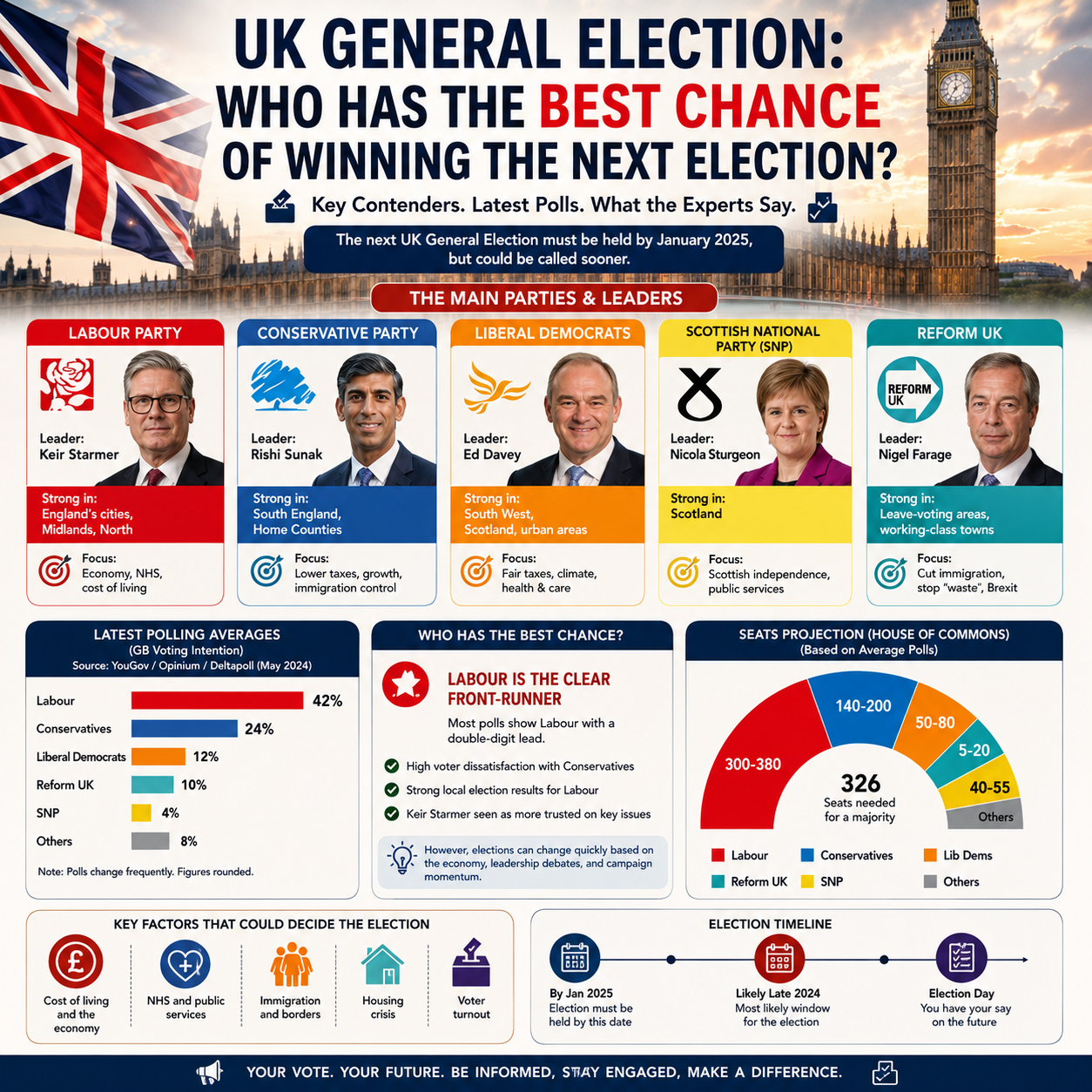
At present, the political picture is unusually competitive. Recent national polling has shown Labour, Reform UK, and the Conservatives competing much more closely than the traditional two-party system might suggest. A YouGov poll conducted on 9–10 August 2026 put Labour on 24%, Reform UK on 22%, the Conservatives on 21%, the Greens on 12%, and the Liberal Democrats on 11%. Another polling tracker using a seven-poll moving average had Labour ahead of Reform UK and the Conservatives, although the margins remained relatively small.
This creates a difficult question: which party currently has the best chance of winning the next general election? Labour has the advantage of being the governing party and still leads some current polls, but Reform UK has demonstrated strong support and has challenged both Labour and the Conservatives. The Conservatives remain a major force because of their established electoral organization and historical strength, while the Liberal Democrats and Greens could play an important role in determining which parties win particular constituencies.
The answer, therefore, is not as simple as naming the party that is currently first in one poll. The UK’s first-past-the-post electoral system means that national vote share does not automatically translate into parliamentary seats. Regional voting patterns, tactical voting, constituency-level competition, leadership popularity, economic conditions, immigration, public services, and the performance of each government before polling day could all change the final result. This article examines the current political landscape and explains which parties appear best positioned to win the next UK general election.

When Is the Next UK General Election?
The timing of the next UK general election is one of the most important factors when considering current political predictions. The previous general election took place on 4 July 2024, when Labour won a large parliamentary majority. Under the current constitutional and legal framework, the Prime Minister can request an election before the maximum period expires. If an earlier election is not called, Parliament’s current timetable means an election must eventually take place by August 2029.
The fact that the election may still be several years away makes today’s polling particularly uncertain. Voters can change their opinions dramatically over a long period, especially when governments face economic challenges, scandals, leadership changes, international crises, or major policy disputes. A party that is performing strongly in 2026 could lose support before the election, while a party currently struggling could recover.
An early election would also create a very different political environment. A Prime Minister might choose an election date based on economic conditions, polling trends, parliamentary circumstances, or the government’s political position. However, calling an election is a major decision because once the campaign begins, parties face intense scrutiny over their records and policy promises.
For voters and political observers, the most sensible approach is therefore to treat current polling as an indication of the political mood rather than a prediction of the final result. The next election could still be years away, and many events will occur before then. Current polling is useful for identifying which parties have momentum, but it cannot guarantee who will form the next government.

The Current Political Landscape
The UK political landscape has changed significantly since the 2024 general election. Labour entered government with a large parliamentary majority, while the Conservatives experienced a major reduction in their number of MPs. The Liberal Democrats also increased their parliamentary presence, and smaller parties became increasingly important in several parts of the country. Since then, Reform UK has emerged as a powerful challenger, while the Greens have also made gains in selected areas.
Recent polling illustrates how competitive the national picture has become. The latest YouGov voting-intention poll available on 12 August 2026 showed Labour at 24%, Reform UK at 22%, and the Conservatives at 21%. The Greens were on 12% and the Liberal Democrats on 11%. The closeness of the top three parties demonstrates that no single party currently has a clear national lead large enough to make the next election outcome obvious.
Other polling has produced slightly different results. Ipsos reported a three-point Labour lead over Reform UK in polling conducted from 30 July to 4 August, while Opinium also described Labour as holding a narrow lead with Reform UK close behind and the Conservatives in third. These differences are normal because pollsters use different methodologies, samples, and fieldwork periods.
The most important lesson from the current polling is that the UK may be heading toward a highly fragmented election. Instead of a straightforward Labour-versus-Conservative contest, Reform UK could win substantial support, while the Greens and Liberal Democrats may influence constituency outcomes. That means the party that finishes first in national vote share may not necessarily win the most seats.

Labour’s Chances of Winning
Labour remains one of the strongest contenders for the next general election because it currently holds government and has the advantage of incumbency. Governing parties have an opportunity to demonstrate their record over several years, implement policies, respond to economic conditions, and present themselves as the experienced choice for voters. Labour also begins from the advantage of having won a commanding majority in 2024.
However, being the governing party also creates major risks. Voters can judge Labour on its actual performance rather than simply on campaign promises. Economic growth, household finances, taxation, public services, immigration, housing, healthcare, crime, and government spending could all influence whether voters decide that Labour deserves another term.
Current polling provides some encouragement for Labour. YouGov’s latest August 2026 poll placed Labour first with 24%, while Ipsos and Opinium have also shown Labour competitive at the top of the field. YouGov’s July polling, meanwhile, showed how quickly the picture can change, with Reform UK temporarily moving ahead. This suggests Labour has support but cannot assume that it will remain ahead.
Labour’s biggest advantage could ultimately be its ability to convert support into seats. If the party maintains strong support in constituencies where it already has an organizational advantage, it may be able to win a large number of MPs even without a huge national vote share. However, if Reform UK, Conservatives, Greens, and Liberal Democrats successfully challenge Labour in different regions, Labour could lose many seats despite remaining competitive nationally.

Reform UK’s Chances of Winning
Reform UK is arguably the most important challenger to the established political parties in the current political landscape. Its support has grown substantially in recent years, and current polling regularly places it near the top of the national voting-intention tables. In some recent polls, Reform UK has led Labour and the Conservatives, while other polls have shown it narrowly behind Labour.
One of Reform UK’s major strengths is its ability to attract voters who are dissatisfied with the traditional parties. Immigration, national sovereignty, taxation, government spending, public services, and political dissatisfaction are among the issues that can motivate its supporters. The party’s challenge is to convert broad national support into a large number of parliamentary constituencies under Britain’s first-past-the-post system.
A high national vote share does not automatically guarantee a large parliamentary representation. If Reform UK’s support is spread relatively evenly across many constituencies, it may finish second in numerous seats without winning them. On the other hand, if its support becomes concentrated strongly enough in specific regions and constituencies, it could win a significant number of seats and potentially become the largest party.
The party’s future therefore depends heavily on whether it can broaden its appeal while building a strong constituency-level organization. Leadership, candidate quality, policy credibility, local campaigning, and tactical voting could all determine whether Reform UK turns its current polling strength into parliamentary power. Its current position means it cannot be dismissed as a minor party, but claiming that it is certain to win the next election would be premature.
Conservative Party’s Chances of Winning
The Conservative Party remains a major player despite its difficult position in current polling. Historically, the Conservatives have been one of Britain’s two dominant governing parties, and they possess a nationwide organization, a large political infrastructure, and a long-established voter base. The party also has experience campaigning across England, Scotland, and Wales and has traditionally been competitive in many constituencies.
The major challenge for the Conservatives is that they are currently competing against Reform UK for many voters on the political right. Recent YouGov polling put the Conservatives at 21%, only one point behind Reform UK and three points behind Labour. This illustrates both the party’s continuing strength and its vulnerability. If Reform UK takes a substantial share of traditional Conservative support, the Conservatives could struggle to regain many seats.
The Conservatives could nevertheless recover before the next election. A new political strategy, stronger leadership, improved economic conditions, or a successful campaign against Reform UK could bring former Conservative voters back. Political parties have several years to rebuild their support, and voters who currently support Reform UK may eventually decide that a Conservative government offers a more realistic route to government.
The Conservatives also benefit from the fact that the UK’s electoral system rewards constituency-level strength. Even if the party does not lead the national vote, it could win a substantial number of seats if its support remains concentrated in areas where it is already competitive. Whether it can return to government will depend largely on whether it can prevent Reform UK from dividing the right-of-centre vote.
Liberal Democrats and Their Influence
The Liberal Democrats are unlikely to be the leading contender for becoming the largest party based on current national polling, but they could still have a major impact on the next election. Their support is often concentrated geographically, meaning that a relatively modest national vote share can translate into a significant number of parliamentary seats in the right constituencies.
The party’s strength has historically been particularly noticeable in areas where it has developed strong local organizations and established relationships with voters. This means national polling figures should not be used alone to estimate the Liberal Democrats’ parliamentary performance. A party can win seats with strong local campaigns even when its nationwide support is much lower than that of Labour or Reform UK.
The Liberal Democrats could also benefit from tactical voting. If voters in particular constituencies view one candidate as the strongest challenger to another party, they may change their preferred vote. Tactical voting could be especially important in three-way or four-way contests involving Labour, Conservatives, Reform UK, and Liberal Democrats.
The party could therefore become an important influence on the final result even if it does not come close to winning the most votes nationally. Its constituency-level victories could determine whether Labour or another party reaches a parliamentary majority. This is one reason why predicting the next government requires much more than looking at the national percentage figures.
The Green Party’s Growing Importance
The Green Party has also become more important in British politics. Although its national vote share remains below the largest parties in most polls, the Greens have demonstrated an ability to attract voters who want stronger environmental policies and a different political approach. Their support can be particularly important in areas where Labour faces competition from the left.
Recent polling has shown the Greens regularly reaching around the low double digits nationally. The latest YouGov poll available on 12 August 2026 put the Greens on 12%, while other recent polls have produced similar or somewhat different figures.
The key question is whether Green support can translate into more Westminster seats. Like Reform UK and the Liberal Democrats, the Greens face the challenge of converting votes into constituencies under the first-past-the-post system. A party can receive millions of votes nationally but win relatively few seats if its support is not concentrated geographically.
Nevertheless, Green growth could have an indirect impact on the election. In constituencies where Labour and Green voters overlap heavily, even a small shift could change the winner. This makes the Green Party relevant to the overall electoral calculation, particularly in urban and progressive areas.
Why the First-Past-the-Post System Matters
The UK’s general election system is based primarily on first-past-the-post voting. Each constituency elects one MP, and the candidate who receives the most votes wins that constituency. The party that wins the most constituencies is normally best placed to form the government. This means the national vote share and number of parliamentary seats can be dramatically different.
This system is extremely important when analyzing the chances of Labour, Reform UK, Conservatives, Liberal Democrats, and Greens. Imagine a party receives 25% of the national vote but comes second in many constituencies. It could win fewer seats than another party that receives a similar or even slightly lower national vote share but has more concentrated support.
The current political environment could make this effect particularly significant. If Labour, Reform UK, and Conservatives all receive around 20–25% of the national vote, many constituencies could become highly competitive. Small changes in local support could determine dozens of seats, while tactical voting could further alter the outcome.
Therefore, saying that a party is “winning the polls” is not the same as saying it is certain to win the election. A complete prediction requires constituency-level modeling, regional polling, voter concentration, candidate strength, and potential tactical voting. National polls are useful, but they are only one part of the picture.
What Current Polls Tell Us
Opinion polls provide an important snapshot of public opinion. The latest YouGov poll conducted on 9–10 August 2026 showed Labour on 24%, Reform UK on 22%, Conservatives on 21%, Greens on 12%, and Liberal Democrats on 11%. The three largest parties were therefore separated by only three percentage points, illustrating just how competitive the national picture currently is.
Other polls show similar competition but not identical rankings. Ipsos reported Labour leading Reform UK by three points in its latest survey, while Opinium described Labour as holding a narrow lead with Reform UK close behind. A seven-poll moving average tracked by PollCheck on 12 August also placed Labour ahead of Reform UK and the Conservatives, although the differences remained relatively modest.
The variation between polls is important. If one poll places Reform UK first and another places Labour first, that does not necessarily mean one pollster is wrong. Differences in sampling, fieldwork dates, weighting, turnout assumptions, and methodology can produce different results. Looking at several polls together generally provides a better understanding of the broader trend.
The current evidence therefore suggests a competitive three-party race rather than a settled election. Labour appears to have a slight advantage in several recent measures, but Reform UK remains close and the Conservatives are not far behind. At this stage, the most accurate conclusion is that the race remains open.
Leadership and Its Impact on the Election
Political leadership will be one of the biggest factors in determining the next general election. Voters do not only choose parties; they also evaluate the people who seek to become Prime Minister. A leader’s public image, communication style, trustworthiness, economic credibility, and ability to handle crises can influence undecided voters.
Leadership changes can also dramatically alter polling. A party that appears unpopular under one leader may recover under another, while a leader who initially performs well may lose support after facing government responsibilities. This is particularly relevant because the next election may still be several years away.
The current political environment demonstrates why leadership ratings should be monitored alongside voting-intention polls. Voters may prefer one leader personally while still supporting another party, or they may change their vote depending on which candidates appear strongest in their constituency.
Leadership debates could also become significant during the eventual campaign. If the election develops into a close contest between Labour, Reform UK, and Conservatives, televised debates and major interviews could influence undecided voters. The ability of each leader to present credible solutions to major national problems could become decisive.
The Economy Could Decide the Election
Economic conditions are likely to be among the most important issues at the next election. Voters often judge governments based on household finances, wages, employment, taxation, housing costs, inflation, and the broader health of the economy. If people feel financially secure, an incumbent government may benefit; if living costs remain difficult, voters may look for alternatives.
For Labour, economic performance represents both an opportunity and a risk. If the government can demonstrate stronger growth, improving public finances, better wages, and improved living standards, it could strengthen its argument for another term. If economic difficulties persist, opposition parties could use them to argue that a change of government is necessary.
Reform UK and the Conservatives will also seek to present themselves as credible economic alternatives. Their challenge will be to convince voters that their proposed tax, spending, and economic policies are realistic and sustainable. Strong rhetoric may attract attention, but general election voters also tend to examine whether proposed policies can actually be implemented.
Because the election is not yet scheduled, economic conditions at polling time are impossible to know. A recession, recovery, inflation shock, housing boom, or major improvement in wages could change the political environment substantially. For this reason, economic forecasts several years before an election should be treated cautiously.
Immigration and Border Policy
Immigration is another issue that could have a major influence on the next UK general election. It has become particularly important in debates about national identity, public services, housing, employment, border control, and government spending. Reform UK has built much of its political appeal around concerns about immigration and border policy, putting pressure on both Labour and the Conservatives.
Labour faces the challenge of demonstrating that it can manage immigration effectively while balancing economic requirements, international obligations, and public concerns. The Conservatives may attempt to rebuild support by emphasizing stricter immigration controls, while Reform UK is likely to argue for even more substantial changes.
The political importance of immigration will depend on what happens before the election. Changes in legal migration, asylum applications, border enforcement, international agreements, and public attitudes could all influence voter priorities. A major immigration-related event close to polling day could potentially reshape the campaign.
However, immigration is unlikely to be the only issue that determines the election. Voters have different priorities, and economic conditions, healthcare, housing, education, crime, taxation, and public services could all compete for attention. The party that successfully combines its position on immigration with a credible broader governing programme may gain an advantage.
Healthcare and Public Services
Healthcare is likely to remain a major election issue because the National Health Service affects millions of people directly. Waiting times, access to GPs, hospital capacity, staffing, social care, and healthcare funding can influence voters across political backgrounds.
For the governing party, public services present a difficult challenge. Improvements can provide evidence that government policies are working, but persistent problems can become powerful opposition arguments. Labour will therefore have an incentive to demonstrate measurable improvements before the next election.
The Conservatives and Reform UK can use dissatisfaction with public services to argue that the existing government has failed to deliver sufficient change. The Liberal Democrats and Greens may also focus heavily on healthcare and social care, particularly in constituencies where these issues are prominent.
Ultimately, healthcare policy will be judged not only by promises but by people’s personal experiences. A voter who sees shorter waiting times or better access to treatment may become more positive toward the government, while someone experiencing long delays may become more willing to support an alternative.
Housing and Cost of Living
Housing affordability and the cost of living could become another decisive issue. Younger voters in particular may focus on house prices, rents, mortgage costs, wages, and the availability of affordable housing. Older voters may be more concerned about pensions, energy bills, taxation, and the cost of maintaining their homes.
Political parties are likely to propose different solutions. Labour may emphasize housebuilding and planning reform, while Conservatives and Reform UK may focus on different combinations of tax policy, migration, development, and home ownership. The Liberal Democrats and Greens may also emphasize housing supply and affordability.
The challenge for every party is that housing policy involves difficult trade-offs. Building more homes can be politically controversial in local communities, while restricting development can contribute to higher prices and rents. A credible policy must therefore address both supply and affordability without creating unrealistic expectations.
If housing and living costs remain major concerns when the election arrives, parties that can offer practical and credible solutions could benefit. However, as with the economy and healthcare, today’s situation may change considerably before voters eventually cast their ballots.
Could Tactical Voting Change the Result?
Tactical voting could be extremely important in the next general election because the political landscape is becoming more fragmented. When several parties compete closely in the same constituency, voters may decide to support a candidate they consider most capable of defeating a less-preferred party.
For example, a voter who normally supports one party may vote for another candidate if they believe that candidate has the strongest chance of winning locally. This can produce constituency results that look very different from national voting-intention figures.
Tactical voting could particularly affect contests involving Labour, Conservatives, Reform UK, Liberal Democrats, and Greens. In some areas, the main competition may be Labour versus Reform UK. In others, it could be Conservative versus Reform UK, Labour versus Liberal Democrats, or Labour versus Greens. Each constituency may therefore develop its own political dynamics.
This makes constituency-level polling increasingly important as the election approaches. National polls can show the overall political mood, but local polling and previous election results can reveal where parties are actually competitive. If tactical voting becomes widespread, it could significantly influence which party wins the largest number of seats.
Could Reform UK Actually Form the Next Government?
Reform UK’s current polling strength means the possibility of the party becoming the largest party cannot simply be ignored. If its support continues to grow and becomes concentrated in winnable constituencies, it could potentially win a large number of seats.
However, becoming the largest party requires more than achieving a strong national vote share. Reform UK must build a strong constituency organization, select credible candidates, maintain a disciplined campaign, and avoid internal controversies that could damage its reputation. It must also overcome the challenge of competing against Conservatives in areas where the two parties appeal to similar voters.
The party’s position is therefore both promising and uncertain. Its current national support demonstrates that it has become a serious political force, but the first-past-the-post system creates a major test. A 20–25% national vote share could produce very different parliamentary outcomes depending on how that support is distributed.
If Reform UK can turn its current polling into concentrated constituency victories, it could become the largest party or play a major role in determining who forms the government. If its support remains geographically dispersed and it finishes second in many seats, its parliamentary representation could be much smaller than its national vote share suggests.
Could Labour Remain the Largest Party?
Labour has a strong possibility of remaining the largest party because it currently leads several national polling measures and has the advantage of incumbency. It also begins with a large number of parliamentary seats from the 2024 election. If Labour can maintain support in its traditional constituencies while limiting losses to Reform UK, Conservatives, Greens, and Liberal Democrats, it could remain the largest party.
The challenge is that governing parties often face difficult mid-term periods. Voters may become frustrated with policy decisions, economic problems, public service performance, or broken promises. Labour must therefore convert its current position into a sustained political recovery rather than relying on the 2024 result.
Recent polling offers mixed but generally competitive evidence. YouGov’s latest poll puts Labour first, while Ipsos and Opinium also show Labour close to or at the top. However, earlier polling in 2026 showed Reform UK leading in some surveys, demonstrating that Labour’s position can change quickly.
Labour therefore has a realistic path to remaining the largest party, but it cannot take that outcome for granted. Its prospects will depend heavily on economic performance, government popularity, leadership, policy delivery, and the distribution of opposition votes.
Could There Be a Hung Parliament?
A hung parliament is a realistic possibility if the major parties remain closely matched. A hung parliament occurs when no party wins enough seats to command an overall majority in the House of Commons. In such a situation, the largest party may attempt to form a minority government or seek support from other parties.
The possibility of a hung parliament increases when national support is divided among several parties. If Labour, Reform UK, and Conservatives each win significant numbers of constituencies, while Liberal Democrats and Greens also make gains, no single party may reach the required parliamentary majority.
The first-past-the-post system can sometimes produce a clear majority even when the national vote is fragmented. But if constituency contests are unusually close, the result could become much more uncertain. Small changes in local voting patterns could determine whether one party reaches a majority.
A hung parliament would create a very different political situation from the large Labour majority that followed the 2024 election. Parties would have to negotiate parliamentary support, and smaller parties could gain considerable influence. This possibility is one reason current national polling should not be interpreted as a simple prediction of which party will govern.
What Could Change Before the Election?
The biggest reason to avoid making a definitive prediction is that several years may remain before the next election. Political events can transform public opinion quickly. Leadership changes, economic crises, international events, scandals, major policy successes, or unexpected social movements could completely alter the electoral landscape.
A party currently leading the polls could lose support if it makes unpopular decisions. An opposition party currently behind could recover through a successful leadership campaign or a shift in public priorities. Voters who are currently undecided could also become more important as the election approaches.
The political environment could also change because of new parties, electoral alliances, candidate changes, or tactical voting arrangements. The emergence of a strong new political movement could divide existing voter groups even further.
Therefore, the best approach is to treat the current situation as a snapshot. Polling in August 2026 can tell us which parties are competitive now, but it cannot tell us exactly what British voters will think in 2028 or 2029. The final campaign will take place in circumstances that cannot yet be predicted.
Who Has the Best Chance of Winning Right Now?
Based on current polling, Labour has a slight claim to being the party with the strongest position at this moment. The latest YouGov poll put Labour first with 24%, while Ipsos and Opinium also showed Labour highly competitive. A seven-poll moving average likewise placed Labour ahead of Reform UK and the Conservatives.
Reform UK is arguably the strongest challenger. Its support is close to Labour’s in several polls, and it has demonstrated that it can lead national voting intention at times. If Reform UK continues to grow and successfully converts its national support into constituency victories, it could potentially become the largest party.
The Conservatives remain a significant contender but currently face the difficult problem of competition from Reform UK. Their ability to recover will depend on whether they can rebuild support among right-of-centre voters and prevent Reform UK from taking too much of their traditional base.
The most accurate current ranking, therefore, would be Labour as a narrow front-runner, Reform UK as a very close challenger, and Conservatives as a significant but currently somewhat weaker contender. However, this is a snapshot rather than a forecast of the final election result. The race remains genuinely open.
What Would Each Party Need to Do to Win?
For Labour, the priority would be maintaining public confidence in its record of government. Economic stability, visible improvements in public services, credible management of immigration, and effective leadership could help Labour strengthen its position. It would also need to prevent significant losses to Reform UK in working-class constituencies and to the Greens or Liberal Democrats in other areas.
For Reform UK, the central challenge is converting national enthusiasm into constituency victories. It would need strong candidates, disciplined campaigning, a broad policy platform, and enough organizational strength to compete across hundreds of constituencies. It would also need to manage competition with the Conservatives without allowing the centre-right vote to fragment so much that Labour benefits.
For the Conservatives, rebuilding trust and distinguishing themselves from Reform UK would be crucial. They need to convince former Conservative voters that the party offers a credible alternative government. A strong economic message, effective leadership, and successful constituency campaigns could help them recover.
For the Liberal Democrats and Greens, the goal would be to concentrate resources in constituencies where they have realistic chances of winning. Because first-past-the-post rewards geographical concentration, both parties can gain influence without leading national polling. Their success could also have an indirect impact on which larger party wins the election.
Final Prediction: Who Is Most Likely to Win?
At the moment, Labour appears to have the best chance of being the largest party at the next UK general election, but the advantage is extremely narrow. The latest available polling shows Labour only slightly ahead of Reform UK and the Conservatives, while other recent surveys have sometimes placed Reform UK first. This means there is no clear runaway favorite.
Reform UK should be considered the biggest threat to Labour’s position. Its ability to attract voters from the Conservatives and other parties has changed the structure of British politics. If its support continues to rise and becomes concentrated in constituencies where it can win, the party could outperform expectations.
The Conservatives cannot be ruled out either. Although their current polling position is weaker than their traditional status might suggest, they have a nationwide organization and a large historical voter base. If the party successfully rebuilds its image and reduces competition from Reform UK, it could become much more competitive before the election.
Overall, the current evidence suggests a three-way contest in which Labour has a small advantage, Reform UK is close behind, and the Conservatives remain capable of recovery. The Liberal Democrats and Greens could determine the result in many individual constituencies. With the election potentially not taking place until 2029, the political situation is still too fluid for anyone to confidently declare a winner.
Frequently Asked Questions
Who is currently most likely to win the next UK general election?
As of August 2026, Labour has a slight advantage in several recent national polls, making it reasonable to describe Labour as the current narrow front-runner. However, Reform UK is very close and has led some recent polls, while the Conservatives remain competitive. Current polling should not be treated as a guaranteed election prediction.
When is the next UK general election?
The next UK general election must be held no later than 15 August 2029 under the current parliamentary timetable, although an earlier election can be called. The exact date has not been fixed at this stage.
Could Reform UK win the next election?
Yes, Reform UK has a realistic path to becoming the largest party, particularly if its current polling support continues and translates into constituency victories. However, the first-past-the-post system means that national vote share alone is not enough.
Could Labour lose the next election?
Yes. Although Labour is currently competitive and leads several recent polls, it faces strong competition from Reform UK and the Conservatives. Government performance, economic conditions, leadership, and constituency-level voting could all influence whether Labour remains the largest party.
Why can a party win more votes but fewer seats?
The UK uses first-past-the-post elections for House of Commons constituencies. A party needs to finish first in individual constituencies rather than simply maximizing its national percentage. Therefore, a party with widely distributed support can win many votes without winning many seats.
Are current opinion polls reliable?
Opinion polls are useful indicators of public opinion but are not guarantees of election results. Different pollsters can produce different figures because they use different methodologies, samples, weighting systems, and assumptions about turnout.
Could there be a hung parliament?
Yes. The current fragmented political environment makes a hung parliament possible. If Labour, Reform UK, Conservatives, Liberal Democrats, and Greens divide constituency victories among themselves, no party could potentially secure an overall majority.
What issues could decide the election?
Likely major issues include the economy, cost of living, immigration, healthcare, housing, taxation, public services, crime, and political leadership. The importance of each issue could change considerably before the election.
Will the Conservatives recover?
They certainly have the opportunity to recover because the election is still potentially years away. Their success will depend on leadership, policy credibility, economic conditions, constituency campaigning, and their ability to compete with Reform UK for right-of-centre voters.
Can the Liberal Democrats influence who becomes Prime Minister?
Yes. Even if the Liberal Democrats do not win the largest number of seats, they could win enough constituencies to affect the balance of power, especially in a close or hung parliament. Their constituency-level performance could therefore matter significantly.
Can the Green Party influence the result?
Yes. The Greens may influence the result by winning seats directly or by changing the distribution of progressive votes in closely contested constituencies. Their national vote share is also an important indicator of changing voter preferences.
Should current polling be used to predict the final winner?
Current polling can be used to identify the strongest parties and current trends, but it should not be treated as a final prediction. The next election may still be several years away, leaving considerable time for political conditions and voter preferences to change.
Conclusion
The next UK general election is shaping up to be one of the most unpredictable contests in modern British politics. Labour currently has a narrow advantage in several recent polls, but Reform UK is extremely close and has occasionally moved into first place. The Conservatives remain within striking distance, while the Liberal Democrats and Greens could influence the result through their strong performances in specific constituencies.
The latest polling provides a useful snapshot of the current situation. YouGov’s 9–10 August 2026 survey placed Labour on 24%, Reform UK on 22%, and the Conservatives on 21%, with the Greens and Liberal Democrats further behind. Ipsos and Opinium have also shown a close contest near the top of the table. These numbers demonstrate that there is currently no party with an overwhelming national lead.
Labour currently has the strongest overall position because it is the governing party and appears to have a small national polling advantage. However, Reform UK’s rise means Labour cannot assume it will retain power. The Conservatives could also recover, particularly if they succeed in rebuilding support and reducing the electoral impact of Reform UK. The final outcome will depend heavily on how national support is distributed across constituencies.
The most reasonable conclusion in August 2026 is therefore that Labour is the narrow current front-runner, Reform UK is its closest challenger, and the Conservatives remain a potential comeback contender. But with the next general election not required until 2029, predicting the final winner with confidence would be premature. Economic conditions, leadership, public services, immigration, housing, tactical voting, and unexpected political events could completely reshape the race before British voters finally decide who will form the next government.
For More Information about this article, Please Click Here.
For More Information, Please Click Here.