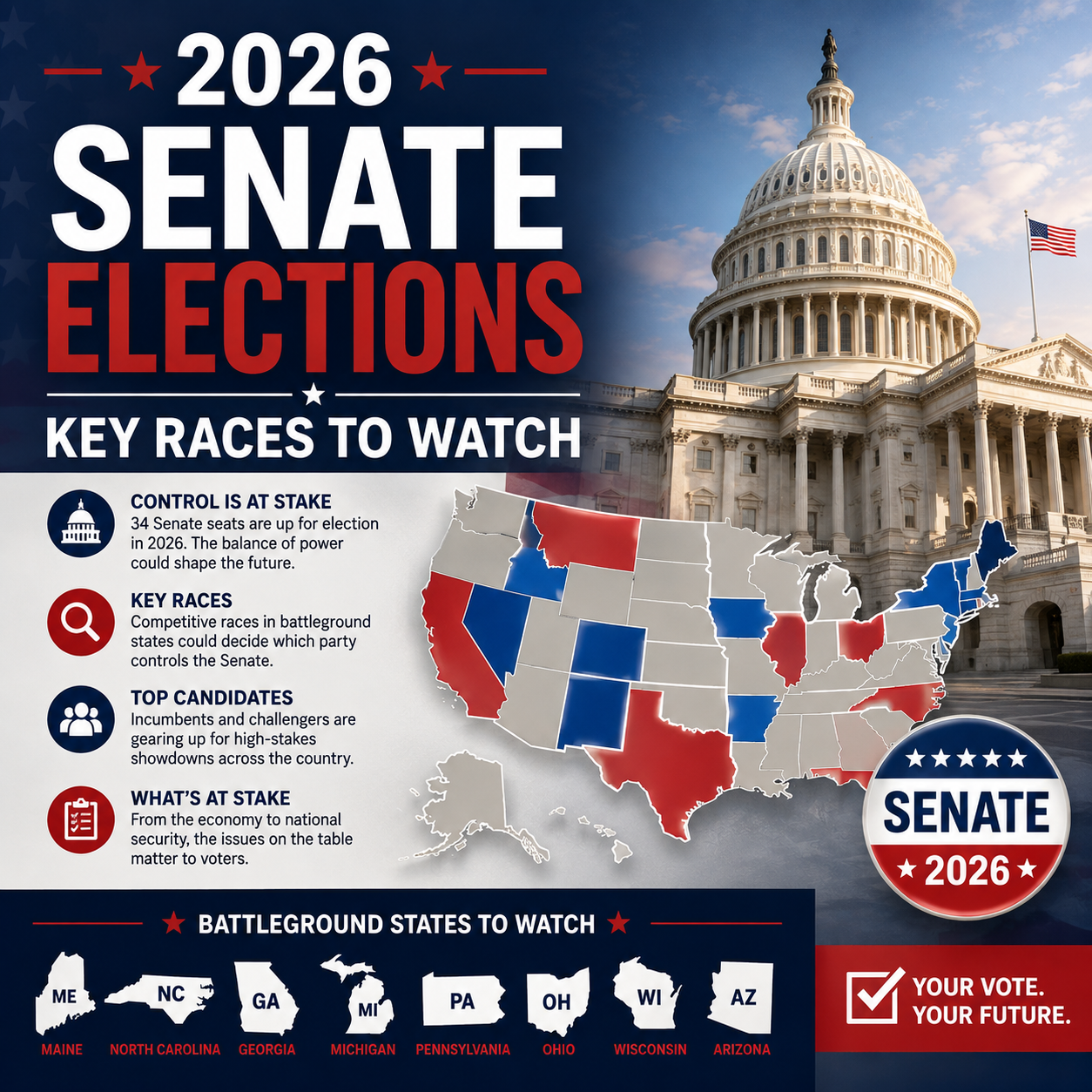
2026 Senate Elections: Key Races to Watch
The 2026 U.S. Senate elections are shaping up to be one of the most closely watched parts of the midterm election cycle. On November 3, 2026, voters across the country will decide 35 Senate races, including regular elections and special elections for vacant seats. The outcome will determine whether Republicans maintain control of the Senate or Democrats manage to take back the chamber. Republicans currently hold a 53–47 Senate majority, meaning Democrats need a net gain of four seats to control the chamber. Republicans, meanwhile, can afford to lose two seats and still retain a majority.
The Senate map is especially interesting because both parties are defending vulnerable seats, while several open-seat contests have created opportunities for challengers. Republicans have a numerical advantage entering the election, but Democrats are attempting to expand the battlefield into states that have traditionally been considered safer for the GOP. Recent race ratings and campaign developments have made states such as Texas, Iowa, Maine, Michigan, Georgia, North Carolina, Alaska, Ohio, Nebraska, Minnesota, and New Hampshire important to watch.
Unlike the House, where all 435 voting seats are contested every two years, only one class of Senate seats is normally elected during each cycle. Senators serve six-year terms, with elections staggered across three classes. In 2026, 35 Senate seats are being contested, creating a smaller but potentially decisive battlefield.
For voters trying to understand the 2026 Senate elections, the most important question is not simply which candidate is leading in a particular poll. The bigger question is which combination of races could change the balance of power in Washington. This guide examines the key Senate races, the states that could determine control of the chamber, the candidates and political dynamics worth watching, and the factors that could shape the final results.

Why the 2026 Senate Elections Matter
The Senate plays a central role in the federal government. Senators vote on legislation, presidential nominations, treaties, budgets, and other major national decisions. Because Senate control can influence which bills receive consideration and which nominees receive confirmation, even a small change in the chamber’s party balance can have significant consequences for federal policy.
The current Republican majority means Democrats face a difficult mathematical challenge. According to Ballotpedia’s current overview, Democrats need to gain a net four seats to win a Senate majority, while Republicans can lose two seats and still remain in control. That makes several Republican-held seats especially important for Democrats, while Democratic incumbents and open Democratic seats are priorities for Republicans seeking to protect or expand their majority.
The 2026 Senate campaign is also taking place in an unusual political environment. Traditionally Republican states are attracting more Democratic attention than they might in a typical cycle. Recent reporting indicates that races in Texas and Iowa have moved into the competitive category, while Alaska, Kansas, Mississippi, Nebraska, and Ohio are also receiving increased attention.
This means the Senate battlefield is broader than many observers initially expected. Instead of focusing only on a handful of traditional swing states, both parties are being forced to consider contests across different regions of the country. The final Senate outcome could therefore depend on a combination of classic battlegrounds and unexpected contests in states that normally lean strongly toward one party.

The Overall 2026 Senate Map
There are 35 Senate elections taking place during the 2026 cycle. Eleven incumbent senators—four Democrats and seven Republicans—have announced that they will not seek reelection, creating a significant number of open-seat contests. Open seats can be particularly important because there is no incumbent benefiting from existing name recognition, established campaign organization, or a previous statewide voting record.
The current battlefield includes both Democratic-held and Republican-held seats. Ballotpedia identifies 12 Senate seats as battlegrounds, with Democrats defending three of those seats and Republicans defending nine. This illustrates the basic strategic challenge facing both parties: Democrats have more opportunities to attack Republican seats, but Republicans also have opportunities to gain ground in Democratic-held territory.
Race ratings can change significantly during a campaign. Fundraising, polling, candidate quality, scandals, national political conditions, debates, and unexpected events can all move a race from safe to competitive or from competitive to relatively comfortable. For that reason, voters should treat race ratings as snapshots rather than guarantees.
The most important Senate races are therefore not necessarily the same as the races that receive the most television advertising. A race can matter because it is genuinely competitive, because it is an open seat, or because it represents a potential final piece of the mathematical path to a Senate majority.

Maine Senate Race
Maine is one of the most closely watched Senate contests of 2026 because Republican Senator Susan Collins is seeking reelection in a state that has a history of supporting Democratic candidates in federal elections. Collins has nevertheless demonstrated unusual strength in Maine and has survived several difficult political environments, making the race particularly interesting.
Democrats have selected Troy Jackson as their nominee after a campaign that has drawn significant attention. Recent polling and political analysis suggest that the race could be extremely close. The Washington Post reported in August that Jackson had moved ahead of Collins in some polling, while other analysts continue to view Maine as a highly competitive contest.
The race illustrates an important feature of Senate politics: state-level political identity can sometimes matter more than national party trends. Collins has built a reputation as a more independent-minded Republican, and that history has helped her maintain support in a state where Democrats can perform strongly. Jackson, meanwhile, will need to convince Maine voters that he can provide effective representation while making the election a referendum on the national political environment.
Maine could become one of the most important Democratic targets of the entire 2026 cycle. If Democrats are able to defeat Collins, they would take a major step toward reducing the Republican Senate majority. If Collins survives another difficult election, Republicans would have successfully defended one of the party’s most closely watched seats.

Michigan Senate Race
Michigan is another crucial Senate battleground because the state has become highly competitive in recent national elections. The seat is open after Democratic Senator Gary Peters announced that he would not seek reelection. An open seat eliminates the advantage of incumbency and creates an opportunity for Republicans to compete for a position that Democrats have held.
Democratic candidate Abdul El-Sayed has emerged as an important figure in the race, while Republicans are treating the contest as a major opportunity. Recent national analysis has identified Michigan as one of the races that could help determine Senate control. The state’s political balance makes the contest especially important for both parties.
Michigan voters have demonstrated that they can move between parties, making candidate quality and campaign organization particularly important. Economic conditions, manufacturing, auto industry policy, labor issues, health care, immigration, and national political questions are all likely to influence the campaign.
For Democrats, holding Michigan is essential because losing an open seat would make the path to a Senate majority more difficult. Republicans, on the other hand, see Michigan as a potential pickup that could strengthen their control of the chamber. The final campaign could become one of the most expensive and closely watched Senate contests in the country.
Georgia Senate Race
Georgia is another major race to watch because Democratic Senator Jon Ossoff is seeking reelection in a state that has become one of the most competitive political battlegrounds in America. Georgia was closely contested in both the 2020 and 2024 presidential elections, making the Senate race particularly important to both parties.
Ossoff first won his Senate seat through a January 2021 runoff after defeating Republican David Perdue. His reelection campaign is expected to attract significant Republican attention, although former Governor Brian Kemp chose not to enter the race. Republican candidates have included U.S. Representatives Buddy Carter and Mike Collins, along with other contenders.
The Georgia race could depend heavily on turnout among suburban voters, Black voters, younger voters, and rural communities. The state’s political transformation over the past decade has made Georgia a place where relatively small changes in turnout or voter preferences can have major consequences.
For Democrats, defending Ossoff’s seat is critical because Georgia is one of the Democratic-held seats that Republicans could target in their effort to expand their majority. For Republicans, defeating Ossoff would provide an important pickup in a state where the party has regained significant strength in recent elections.
North Carolina Senate Race
North Carolina is another important battleground because Republican Senator Thom Tillis is not seeking reelection, creating an open Senate seat. Open contests are often unpredictable because both parties can build campaigns around new candidates without facing an incumbent’s established record.
Former Democratic Governor Roy Cooper entered the race and became the Democratic nominee, giving Democrats a well-known statewide candidate. Republicans have nominated Michael Whatley, a former Republican National Committee chairman who received support from President Donald Trump.
North Carolina has a slight Republican lean at the federal level, but Democrats have remained competitive in statewide races. Cooper’s previous statewide victories make him a stronger Democratic candidate than the party might have had in a less competitive environment.
The race will likely receive significant national attention because Republicans cannot take the seat for granted, while Democrats see it as one of their clearest opportunities to gain ground. The final result could depend on suburban voters, turnout in the state’s major metropolitan areas, and the broader national political climate.
Texas Senate Race
Texas has become one of the most surprising Senate races of 2026. For years, Republicans have generally enjoyed a strong advantage in statewide Texas elections, but demographic changes and competitive statewide campaigns have encouraged Democrats to invest more heavily in the state.
The 2026 contest is an open-seat race involving Republican Attorney General Ken Paxton and Democratic state Representative James Talarico. Recent reporting indicates that the race has moved into the toss-up category according to the Cook Political Report, making Texas one of the most unexpected battlegrounds of the cycle.
The Texas contest is important not only because of the Senate seat itself but also because it could demonstrate whether Democrats can compete seriously in traditionally Republican states. A Democratic victory would represent a major political shift and could dramatically alter the national conversation about the future of Texas politics.
At the same time, the race remains challenging for Democrats. Texas has a large Republican base, and statewide campaigns require enormous financial resources because of the state’s size and expensive media markets. The final outcome may depend on turnout among urban, suburban, and rural voters as well as the ability of each campaign to reach millions of potential voters.
Iowa Senate Race
Iowa is another traditionally Republican state where Democrats are hoping to create a competitive Senate race. Senator Joni Ernst is not seeking a third term, creating an open seat and removing the advantages of incumbency.
The Democratic candidate is Rob Sand, Iowa’s state auditor, while Republicans are represented by Zach Lahn. Recent reporting has suggested that the race has become significantly more competitive than many observers expected earlier in the cycle. The Cook Political Report has moved the contest into the toss-up category, highlighting the changing Senate landscape.
Iowa has not been an easy state for Democrats in recent federal elections, which makes the race particularly important. A Democratic victory would require the party to perform well among voters who have increasingly supported Republican candidates at the federal level.
The campaign could also be shaped by economic issues, agriculture, rural concerns, health care, and national political sentiment. If Democrats can win Iowa, they would demonstrate that the 2026 Senate map has expanded far beyond traditional Democratic targets.
Alaska Senate Race
Alaska is another race that has developed into an unusual contest. Republican Senator Dan Sullivan is seeking reelection, but Democratic former Representative Mary Peltola is mounting a serious challenge. Alaska’s unique election system and political culture make the race different from many other Senate contests.
The state’s all-party primary took place in August, with Sullivan and Peltola among the candidates advancing toward the November ranked-choice general election. The Alaska contest has attracted national attention because Democrats see an opportunity in a state that has long leaned Republican in federal elections.
Ranked-choice voting means Alaska voters will not necessarily experience the same type of general election found in most states. The system can make candidate strategy, second-choice preferences, and campaign coalitions especially important.
Alaska’s economy, energy industry, federal land policy, cost of living, and relationship with the federal government are likely to remain central campaign themes. Because the state has a relatively small population but unusual political dynamics, the race could become one of the most distinctive Senate contests of 2026.
Ohio Senate Race
Ohio is another Republican-leaning state where Democrats are attempting to make the Senate race competitive. Republican Senator Jon Husted is running to retain the seat, while Democrats are looking for ways to regain ground in a state that once regularly served as a national swing state.
Ohio has moved significantly toward Republicans in recent federal elections, but Democrats continue to see opportunities because of the state’s large working-class electorate and competitive statewide political history. The race has attracted attention as Democrats attempt to challenge Republican dominance.
Economic issues, manufacturing, trade, energy, health care, and working-class voters are likely to play major roles in the campaign. Ohio’s political geography also means that candidates must appeal to voters in large metropolitan areas while remaining competitive in smaller cities, suburbs, and rural communities.
A Democratic victory in Ohio would be strategically valuable because it would force Republicans to defend a state that has become much more conservative. A Republican win, meanwhile, would reinforce the party’s recent strength and make Democratic efforts to regain Senate control more difficult.
Nebraska Senate Race
Nebraska is not normally considered a competitive state for Senate Democrats, but the presence of independent candidate Dan Osborn has changed the political conversation. Osborn previously challenged Republican Senator Deb Fischer in 2024 and performed better than many observers expected.
The independent candidate is again drawing attention in 2026, this time challenging Republican Senator Pete Ricketts. Nebraska remains a strongly Republican state, but Osborn’s independent campaign gives voters an alternative outside the traditional two-party structure.
The key question is whether Osborn can reproduce the coalition that made his 2024 campaign competitive. Independent candidates face a different set of challenges from major-party candidates, including fundraising, organization, ballot access, and persuading voters who normally choose one of the two major parties.
Nebraska therefore represents an example of why Senate races cannot always be understood through the Democratic-versus-Republican framework alone. If Osborn becomes competitive, the race could force Republicans to spend resources defending a state that would normally be considered relatively safe.
Minnesota Senate Race
Minnesota is another state worth watching because Democratic Senator Tina Smith’s retirement created an open seat. The state has generally leaned Democratic in federal elections, but Republicans have remained competitive in several statewide contests.
An open seat creates uncertainty because there is no incumbent with an established statewide campaign operation. Both parties have an opportunity to introduce a new candidate and redefine the political debate around the office.
Recent polling has suggested that the Minnesota race could be relatively close, although it has not attracted the same level of attention as the most competitive Republican-held seats.
For Republicans, Minnesota represents an opportunity to expand the Senate battlefield into Democratic territory. For Democrats, protecting the seat is important because losing it would add another obstacle to their attempt to reclaim the chamber.
New Hampshire Senate Race
New Hampshire is another Democratic-held open seat attracting attention after Senator Jeanne Shaheen announced that she would not seek reelection. The state has a history of competitive elections and has produced both Democratic and Republican statewide winners.
Republicans initially hoped former Governor Chris Sununu might enter the race, but he declined to run. His decision changed the Republican field and reduced expectations of a particularly strong GOP challenge. Former Senator John Sununu and former Massachusetts Senator Scott Brown have both been associated with the Republican effort.
The state’s independent-minded electorate makes candidate reputation particularly important. New Hampshire voters have often shown a willingness to split their tickets and consider individual candidates rather than simply voting along party lines.
Although the race may not be among the absolute closest Senate contests, it could become more important if the national environment shifts. If Republicans begin winning multiple Democratic-held seats, New Hampshire could become part of the broader conversation about Senate control.
Kansas Senate Race
Kansas is another Republican state where Democrats are trying to create an unexpectedly competitive Senate contest. Republican Senator Roger Marshall is seeking reelection, while Democratic candidate Adam Hamilton is challenging him.
Kansas remains a strongly Republican state, meaning Democrats face a difficult path. However, a competitive national environment can encourage Democrats to invest in states that would normally receive less attention.
The race is particularly useful for understanding how broad the 2026 Senate map has become. Recent analysis has included Kansas among Republican strongholds where Democrats are attempting to create competitive contests.
Even if Democrats do not ultimately win Kansas, forcing Republicans to spend money and campaign time there could have strategic consequences. Political parties have limited resources, so every additional competitive state can influence how campaigns allocate money, staff, advertising, and candidate visits.
Mississippi Senate Race
Mississippi is another Republican-leaning state receiving more Democratic attention in 2026. Republican Senator Cindy Hyde-Smith is defending her seat, while Democrat Scott Colom is seeking to make the race competitive.
Mississippi remains a challenging environment for Democrats at the federal level, but the party is attempting to capitalize on changing political conditions and voter concerns. Economic issues, health care, education, infrastructure, and rural development could become important campaign themes.
The race is unlikely to be treated the same way as Maine, Texas, or Michigan unless the political environment changes dramatically. Nevertheless, its inclusion among states receiving increased Democratic attention shows how broad the Senate battlefield has become.
For Republicans, Mississippi is a seat they would strongly prefer to keep out of serious danger. For Democrats, the objective may initially be to make the race competitive enough to force Republican spending and create another possible path to an unexpected Senate gain.
Florida Senate Race
Florida’s 2026 Senate election is also worth monitoring after the state’s August primary elections. Republican Senator Ashley Moody will face Democratic state Representative Angie Nixon in the general election. The primary results have added another important statewide contest to the national Senate picture.
Florida has become more Republican in recent statewide elections, but its large and diverse electorate means Democrats continue to view the state as strategically important. The state has major urban centers, large numbers of retirees, a substantial Hispanic population, and a rapidly changing political environment.
The Senate campaign is likely to focus on the economy, immigration, health care, housing costs, education, and national political issues. Both candidates will need to build broad coalitions rather than relying on one demographic group.
Florida’s size also makes it an expensive state for campaigns. Even if the race does not become one of the closest contests in the country, the outcome could provide important information about the broader political direction of the state.
South Carolina Senate Race
South Carolina has become an especially unusual Senate story following the death of Senator Lindsey Graham. The vacancy created a special election and an unexpected Republican contest between interim Senator Darline Graham and Representative Ralph Norman.
The Republican runoff has attracted national attention because President Donald Trump has endorsed Darline Graham. Recent reporting describes the contest as a test of Trump’s influence within the Republican Party, particularly because both candidates are competing to demonstrate their conservative credentials.
The Democratic nominee is Annie Andrews, but South Carolina remains a strongly Republican state. The more important immediate question is therefore which Republican candidate emerges from the runoff and what the result says about the direction of the state’s Republican electorate.
The race is also unusual because it demonstrates how unexpected vacancies can alter an election map. A seat that was not originally expected to be open can suddenly become part of the national political conversation, particularly when the vacancy involves a well-known senator.
The Role of Donald Trump in the 2026 Senate Races
President Donald Trump is expected to remain an important factor in Republican Senate campaigns. His endorsements can influence Republican primary contests, fundraising, media coverage, and voter enthusiasm. The South Carolina race is a particularly clear example, with Trump actively supporting Darline Graham in the Republican runoff.
Trump’s influence, however, does not automatically guarantee victory for every endorsed candidate. Primary voters can respond differently to endorsements depending on the state and candidate. In some contests, Trump’s backing may help unify Republican voters; in others, candidates may compete over who can best represent the party’s agenda.
Democrats will also attempt to make the 2026 election a referendum on the national political environment. The strength or weakness of the president’s approval ratings, economic conditions, foreign policy developments, and other national issues could influence Senate races thousands of miles away from Washington.
Ultimately, Senate candidates must balance national politics with state-specific concerns. A campaign that focuses entirely on Washington may miss local voters’ priorities, while a campaign that ignores national issues may fail to capitalize on the broader political environment.
How Polling Could Affect the Senate Race
Polling will receive enormous attention during the final months of the 2026 campaign. Polls can provide useful information about voter preferences, but they should not be treated as predictions of the final result.
A poll is a snapshot taken at a particular time. Voters can change their minds, undecided voters can break toward one candidate, and turnout can differ from expectations. Polling errors can also occur because of sampling problems, response rates, weighting assumptions, and difficulty predicting which voters will actually participate.
The 2026 Senate cycle already illustrates how quickly race assessments can change. Recent polling and race ratings have shown increased competitiveness in places such as Texas and Iowa, while Maine and Michigan remain central to discussions about Senate control.
For voters, it is better to look at multiple polls and broader trends rather than focusing on one survey. Poll averages, independent race ratings, fundraising, candidate quality, and the political environment can provide a more complete picture.
Why Open Senate Seats Matter
Open seats are often among the most interesting contests because there is no incumbent seeking reelection. In 2026, 11 Senate incumbents have announced that they will not seek reelection, including seven Republicans and four Democrats.
An incumbent normally enters a campaign with advantages such as name recognition, an established donor network, previous campaign organization, and a record of serving the state. When that incumbent retires, both parties can compete for a fresh start.
Open seats are especially important when the departing senator belongs to the party that normally dominates the state. A party may have a strong history in a state but still struggle to find a candidate capable of reproducing the incumbent’s coalition.
Michigan, North Carolina, Iowa, Minnesota, Texas, and other states illustrate why open seats deserve close attention. Several of these contests could determine whether the Senate majority changes hands.
What Could Determine Senate Control?
The Senate majority could ultimately be decided by a relatively small number of races. Democrats need a net gain of four seats, which means they cannot simply win every close Republican-held contest. They also need to protect their own vulnerable seats.
Republicans have a somewhat easier mathematical position because they start with 53 seats. However, defending a large number of competitive seats can create serious problems if the national political environment turns against them.
The key races could therefore form a chain. If Republicans hold Maine, Michigan, Georgia, and other Democratic targets while also defending their own vulnerable seats, Democrats may struggle to reach four net gains. If Democrats win several Republican-held seats such as Texas or Iowa while holding their own competitive seats, the path becomes much more realistic.
This is why individual Senate races should not be viewed in isolation. Every result changes the number of seats each party needs to win elsewhere. A surprising victory in one state can dramatically change the strategic importance of another race.
What Voters Should Watch Before Election Day
As November approaches, voters should watch for changes in candidate quality, major endorsements, fundraising, polling, debates, advertising, and campaign organization. A race that looks safe in the summer can become competitive in the fall.
Voters should also pay attention to major developments affecting the economy. Inflation, employment, wages, housing costs, and consumer confidence can influence how voters evaluate the party in power.
National events can also reshape Senate races. Foreign policy crises, major legislation, government shutdowns, Supreme Court decisions, or controversies involving political leaders can quickly change the issues dominating the campaign.
Most importantly, voters should focus on verified information rather than viral social media claims. Election information can change rapidly, and inaccurate claims about candidates, voting rules, or polling can create confusion.
Final Thoughts on the 2026 Senate Elections
The 2026 Senate elections are set to be one of the most important parts of the U.S. midterm elections. With 35 Senate seats being contested and Republicans entering the cycle with a 53–47 majority, Democrats face a difficult but potentially achievable path to reclaiming the chamber.
Maine, Michigan, Georgia, North Carolina, Texas, Iowa, Alaska, Ohio, Nebraska, Minnesota, and New Hampshire are among the states that deserve particular attention. Some are competitive because of vulnerable incumbents, while others are important because of retirements, open seats, unusual candidates, or changing political trends.
The biggest surprise of the 2026 cycle may be the expansion of the Senate battlefield. Traditionally Republican states such as Texas and Iowa are attracting serious Democratic attention, while Alaska, Kansas, Mississippi, Nebraska, and Ohio are also being discussed as potential opportunities.
Ultimately, Senate control may come down to only a handful of votes across several states. That makes every competitive race important. For voters, the best way to prepare is to understand the candidates, examine the issues, check official election information, and avoid relying solely on national campaign narratives.
The 2026 Senate elections will not simply determine which candidates win individual states. They will help determine which political party controls one of the most powerful institutions in the federal government. As Election Day approaches on November 3, 2026, these key races will provide some of the clearest signals about the political direction of the United States heading into 2027 and the 2028 presidential election.
For More Information about this article, Please Click Here.
For More Information, Please Click Here.