2026 US Midterm Elections: Which Party Has the Best Chance of Winning?
2026 US Midterm Elections: Which Party Has the Best Chance of Winning?
Introduction
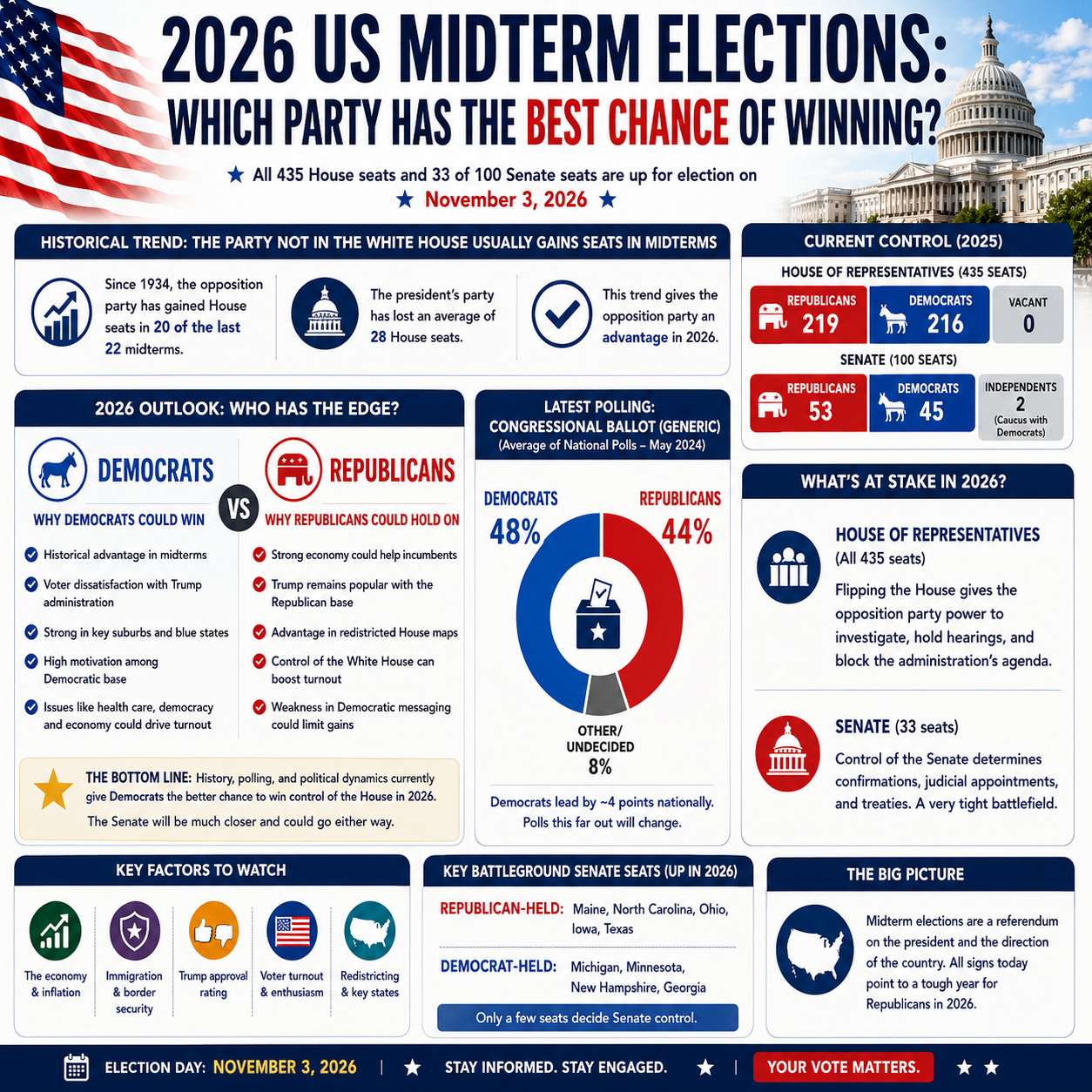
The 2026 United States midterm elections are shaping up to be one of the most closely watched congressional elections in recent American political history. Voters will choose members of the U.S. House of Representatives, a large portion of the U.S. Senate, governors, and thousands of state and local officials. Although President Donald Trump will not be on the ballot, his presidency is expected to play a major role in the election because midterms often become a referendum on the party controlling the White House. Current polling suggests Democrats have an advantage in the national congressional vote, while Republicans retain important structural advantages, particularly in the Senate. (Time)
The central question is whether Democrats can turn their current polling advantage into control of Congress or whether Republicans can hold their majorities. At the moment, the answer is not simple. Democrats appear to have a stronger position in the House, where Republicans have only a narrow majority and where the party in power historically tends to lose seats during midterm elections. Republicans, however, begin with a more favorable Senate map and therefore have a stronger chance of retaining Senate control even if Democrats perform well nationally. (The Washington Post)
The latest national polling provides an important clue. Generic congressional ballot surveys ask voters whether they would prefer a Democratic or Republican candidate for Congress in their district. Recent polling averages have shown Democrats ahead nationally, although the exact size of that advantage varies among pollsters and over time. Nate Silver’s polling tracker is monitoring this measure continuously because the generic ballot is one of the most important indicators of the national political environment. (Silver Bulletin)
The 2026 election is scheduled for November 3, 2026, with all 435 House seats and 35 Senate seats on the ballot. Because the House and Senate have very different electoral maps, it is entirely possible for Democrats to win one chamber while Republicans retain the other. This creates several possible outcomes, including a Democratic House with a Republican Senate, Democratic control of both chambers, continued Republican control of both, or a much closer Senate where one or two races determine control.
Based on the evidence available in August 2026, Democrats currently have the stronger chance of winning the House, while Republicans remain competitive and perhaps better positioned to retain the Senate. The overall balance of power will depend on turnout, economic conditions, presidential approval, candidate quality, competitive Senate races, and the performance of both parties in the final weeks of the campaign.

What Are the 2026 US Midterm Elections?
The U.S. midterm elections take place halfway through a president’s four-year term. Unlike presidential elections, voters do not elect a president during the midterms. Instead, the elections determine the composition of Congress and numerous state and local governments.
In 2026, voters will elect all 435 members of the House of Representatives. House members serve two-year terms, meaning every seat is contested during every congressional election. This makes the House particularly sensitive to changes in national public opinion.
The Senate works differently. Senators serve six-year terms, and approximately one-third of the Senate is elected every two years. In 2026, 35 Senate seats are scheduled for election. The Senate map is especially important because the seats being contested are not evenly distributed between Democrats and Republicans. Republicans are defending more seats overall, but several Democratic seats are located in states that voted for Donald Trump in the 2024 presidential election. This creates a complicated strategic situation for both parties. (Wikipedia)
The 2026 elections will also include gubernatorial and state legislative contests. These races can influence future policy, redistricting, abortion legislation, education, taxation, and election administration. Consequently, the midterms are not simply a contest for control of Congress; they are a nationwide political test for both parties.

Why Midterms Usually Hurt the President’s Party
One of the most important historical patterns in American politics is that the president’s party frequently loses seats during midterm elections. Voters who are satisfied with a president may still use midterms to express dissatisfaction with the administration, while opposition-party voters often have greater motivation to participate.
This pattern does not guarantee that Democrats will win in 2026. Elections are affected by unusual circumstances, candidates, economic conditions, major events, and turnout. However, historical midterm patterns give Democrats an important reason for optimism.
Republicans currently control the White House, meaning they are the party that must defend the presidency’s political record. If voters are unhappy with the administration, Democrats can argue that Congress needs a different balance of power.
Republicans, however, can make the opposite argument. They can tell voters that Democratic control of Congress would create political gridlock and prevent the president from implementing his agenda. The Republican campaign is therefore likely to emphasize the importance of maintaining congressional majorities.

Democrats’ Current Position
Democrats Have a National Polling Advantage
One of the strongest arguments for Democrats is their current position on the generic congressional ballot. Recent polling has generally shown Democratic candidates ahead of Republican candidates nationally.
A generic ballot advantage does not automatically translate into a House majority because House elections are decided district by district. However, it is an important indication of the national political environment. Recent trackers have continued to show Democrats with an advantage, although the exact margin changes as new surveys are released. (Race to the WH)
A Democratic advantage of several percentage points could be enough to produce a significant House seat gain if it is distributed efficiently across competitive districts.
Democrats therefore have a strong reason to believe that they can take advantage of Republican vulnerability in suburban districts and competitive areas.
Democrats Want to Retake the House
The House is probably Democrats’ clearest opportunity in 2026. Republicans currently have only a narrow advantage, meaning Democrats do not need an enormous national wave to take control.
Recent analysis has emphasized that Democrats could potentially flip enough Republican-held districts to win the chamber. At the same time, Republican strategists argue that the GOP’s narrow majority does not necessarily mean Democrats are guaranteed to win because many competitive districts may remain difficult for Democrats. (The Washington Post)
The House campaign will therefore be heavily concentrated in a relatively small number of competitive districts. Both parties will spend enormous amounts of money in these areas.
If Democrats win most of the competitive seats currently rated as toss-ups or leaning Republican, they could regain the Speakership. If Republicans hold those seats, they could retain control despite Democrats winning the national popular vote for Congress.

Republicans’ Current Position
Republicans Have an Important Structural Advantage in the Senate
Republicans face a more complicated situation in the Senate. The party has more seats to defend in 2026, but the map itself is considered relatively favorable to Republicans.
Democrats must gain multiple Republican-held seats while protecting their own vulnerable seats. Several Democratic incumbents or open seats are located in states where Republicans are competitive or where Donald Trump performed strongly in the 2024 presidential election.
The Senate map therefore gives Republicans a stronger defensive position than the House map. The University of Virginia’s Sabato’s Crystal Ball has highlighted the importance of the individual Senate races and continues to rate the overall Senate control contest as competitive. (Center for Politics)
This means Republicans could potentially lose ground in the House while maintaining control of the Senate.
Republicans Can Still Benefit From Incumbency
Republican incumbents have several advantages. They can raise money, maintain existing campaign organizations, and point to their voting records. In competitive states, incumbency can be valuable because voters may prefer a familiar candidate.
Republicans can also use national issues to motivate their supporters. Immigration, crime, taxes, government spending, national security, and opposition to Democratic policies are likely to remain important parts of the Republican campaign.
The party’s challenge is that it must defend the record of the Trump administration. If voters view the administration positively, Republican candidates can benefit. If voters are dissatisfied, Democrats can use the election as a referendum on the president.
The House of Representatives: Who Has the Better Chance?
Democrats Currently Have the Edge
Of the two chambers, Democrats appear to have the clearer opportunity to win control of the House.
The main reason is simple: the Republican majority is narrow. Democrats do not need to make enormous gains to take control. A relatively modest shift in national voting patterns could change the balance of power.
Current House forecasts and ratings show a substantial number of competitive seats. The Cook Political Report maintains ratings for all 435 House districts, while other election models are continuously adjusting their predictions based on polling and political developments. (Cook Political Report)
Democrats therefore have a realistic path to the House majority.
Why Republicans Could Still Hold the House
A Democratic polling advantage does not guarantee a Democratic House. Republicans can retain vulnerable seats if their candidates outperform the national party or if Democratic turnout is weaker than expected.
Redistricting is another factor. Congressional district boundaries determine the political composition of each seat, and changes to district maps can create opportunities or obstacles for either party.
Recent analysis has also pointed out that Republicans could potentially retain the House even while trailing Democrats in national polling. (The Washington Post)
This is why the House should be described as a competitive Democratic opportunity rather than a guaranteed Democratic victory.
The Senate: A Different Story
Republicans May Be Better Positioned
The Senate is more complicated than the House because of the states involved.
Democrats are defending seats in several states that are competitive at the presidential level. Michigan and Georgia are particularly important because Democrats must protect those seats while trying to gain Republican-held seats elsewhere. (Wikipedia)
Republicans, meanwhile, have several vulnerable seats but also have opportunities to defend them in states where the Republican presidential candidate performed well.
The result is a Senate map that may favor Republicans even if Democrats win the national congressional vote.
Why Democrats Need a Strong Election
For Democrats to take the Senate, they need to win several Republican-held seats while avoiding losses of their own.
That is a difficult task because Senate elections are statewide. A Democratic candidate cannot rely on winning only a few cities or suburban districts. They must build a coalition capable of winning the entire state.
States such as Georgia, Michigan, North Carolina, Maine, and other competitive states could therefore become central to the Senate battle.
The Generic Congressional Ballot
What Is the Generic Ballot?
The generic congressional ballot asks voters which party they would support for Congress without necessarily naming specific candidates.
For example, a poll may ask:
“If the election for Congress were held today, would you vote for the Democratic candidate or Republican candidate in your district?”
The results provide an indication of the national political environment.
The generic ballot is useful because House elections occur across the entire country. If Democrats consistently lead by several points, that suggests they may be positioned to win more House seats.
However, it has limitations. Congressional elections are local contests. Candidate quality, district boundaries, incumbency, fundraising, and local issues can all affect individual results.
Trump’s Impact on the 2026 Midterms
Trump Will Still Be a Central Figure
Although Donald Trump will not appear on the ballot, he is likely to remain one of the most important figures in the 2026 midterms.
Republican candidates may campaign alongside him and emphasize the achievements of his administration. Democratic candidates are likely to argue that the election is an opportunity for voters to provide a check on presidential power.
The strength of Trump’s approval rating could therefore have a major effect on Republican candidates.
If Trump remains popular among Republican voters, he can help drive turnout and fundraising. If his approval rating remains weak, Democratic candidates can use that dissatisfaction to motivate voters.
The Election Could Become a Referendum on Trump
Midterm elections frequently become referendums on the president. This is especially likely when the president is politically polarizing.
Democrats can frame the election as a choice between continuing Trump’s agenda and providing congressional oversight.
Republicans can frame it as a choice between implementing Trump’s policies and allowing Democrats to obstruct the administration.
This competing framing will be central to the campaign.
The Economy and the 2026 Election
Economic Conditions Could Decide Everything
Economic performance is one of the most powerful factors influencing elections.
Voters care about inflation, wages, employment, housing costs, interest rates, energy prices, and household financial security.
If Americans feel financially comfortable in late 2026, Republicans may benefit because they control the White House.
If voters feel that the economy is deteriorating, Democrats could gain significantly.
The economy can also influence turnout. People who feel financially secure may be less politically motivated, while voters experiencing financial pressure may be more likely to participate.
Inflation and Cost of Living
The cost of living is likely to be one of the most important issues.
Even if inflation declines, voters may continue to feel that prices are too high because lower inflation does not mean prices return to previous levels.
Both parties will attempt to explain these economic pressures in ways favorable to themselves.
Republicans may blame previous Democratic policies, while Democrats may blame the Trump administration.
The party that successfully convinces voters that it can improve household finances will have an important advantage.
Immigration and Border Security
Immigration is another major issue that could shape the election.
Republicans have traditionally emphasized border security and stricter immigration enforcement. Democrats have generally supported a combination of border security and legal immigration reforms.
The political importance of immigration depends heavily on public perceptions of the border situation.
If voters believe the Trump administration has successfully improved border security, Republicans may benefit.
If voters believe the administration’s policies have created humanitarian or economic problems, Democrats could gain support.
Immigration is especially important because it can motivate voters who otherwise may not participate strongly in midterm elections.
Abortion and Reproductive Rights
Abortion remains one of the most important issues for Democratic voters and could play a major role in 2026.
Since the Supreme Court’s decision overturning Roe v. Wade, abortion policy has become increasingly important in state and federal elections.
Democrats often argue that reproductive rights are under threat and that voters need to elect Democratic candidates to protect access.
Republicans generally emphasize state authority, restrictions, and protections for unborn children, although Republican candidates differ in how they discuss the issue.
The issue could be particularly powerful among suburban and younger voters.
Healthcare
Healthcare is another major electoral issue.
Democrats can campaign on protecting healthcare access, lowering costs, and strengthening public programs.
Republicans can emphasize competition, private-sector solutions, and concerns about government spending.
Healthcare becomes especially important when voters are worried about prescription drug prices, insurance costs, hospital access, and medical debt.
A strong Democratic healthcare message could help the party in suburban and older communities.
Republicans, meanwhile, will attempt to prevent Democrats from portraying them as opposed to healthcare affordability.
The Role of Young Voters
Young voters could be decisive in 2026.
Younger Americans tend to have different political priorities from older voters. Issues such as student debt, housing affordability, climate change, abortion rights, wages, healthcare, and technology regulation can be particularly important.
Democrats have traditionally had an advantage among younger voters, but turnout is often the challenge.
Young people vote at lower rates than older Americans, especially during midterm elections.
If Democrats can increase youth turnout, they could benefit substantially.
Republicans may attempt to appeal to younger voters through economic issues, free speech, technology, entrepreneurship, and opposition to what they describe as excessive government regulation.
Suburban Voters
Suburban voters will likely be among the most important groups in competitive House districts.
Many suburban communities contain large numbers of college-educated and middle-income voters who can swing between parties.
In recent elections, Democrats have performed strongly in many suburban areas, particularly among college-educated voters.
Republicans have attempted to regain suburban support by emphasizing economic concerns, crime, immigration, and parental rights.
The party that performs best in competitive suburbs could determine control of the House.
Rural America
Rural voters remain an important Republican constituency.
Republicans generally perform strongly in rural areas, while Democrats often struggle to win large numbers of rural counties.
However, Democrats do not necessarily need to win rural America to win Congress.
Instead, they need to avoid losing competitive rural and small-town districts by overwhelming margins.
Republicans will attempt to maximize rural turnout and use cultural issues to maintain their advantage.
The Importance of Candidate Quality
Candidate quality can make a major difference in Senate elections.
A strong candidate can outperform the national party in a competitive state.
A weak candidate can lose even in a state that normally favors their party.
This is particularly important in Senate elections because each race is statewide.
The 2026 primaries will therefore receive significant attention. Candidates who emerge from contentious primaries must then unite their party before the general election.
Senate Races to Watch
Several Senate races are likely to receive national attention.
Georgia
Georgia has become one of the country’s most competitive political states.
Democratic incumbent Jon Ossoff is facing a difficult political environment because Georgia remains closely divided.
The state could become one of the most important Senate contests of 2026.
Michigan
Michigan is another critical state.
Democrats are defending a Senate seat in a state that Donald Trump won narrowly in 2024.
That creates a significant challenge for Democrats.
Republicans will attempt to make the race a referendum on the national Democratic Party, while Democrats will emphasize their candidate and state-level concerns.
North Carolina
North Carolina is traditionally Republican at the presidential level but remains competitive in statewide elections.
The retirement of Republican Senator Thom Tillis has created an open-seat contest.
An open seat can become much more competitive because neither party has an incumbent advantage.
Maine
Maine is also important because Republican Senator Susan Collins has historically demonstrated an ability to win in a state that often supports Democratic presidential candidates.
Her race could be closely watched if Democrats see an opportunity to gain a Republican-held seat.
California and Redistricting
California could play an important role in determining House control.
Changes to congressional district maps can create new competitive districts.
Recent political developments in California have created potential opportunities for Democrats in several House districts. Political analysts are watching districts including California’s 1st, 6th, 22nd, and 48th as potentially important contests. (San Francisco Chronicle)
Democrats could gain multiple seats if they perform strongly in California.
Republicans, however, will attempt to defend their incumbents and minimize losses.
The Role of Redistricting
Redistricting can significantly influence House elections.
Every ten years, congressional districts are redrawn based on the census.
The resulting maps can make some districts safer for one party and create new competitive districts.
In 2026, redistricting remains important because changes to district boundaries can alter the number of seats each party can realistically win.
This means national polling alone cannot explain the House race.
A party could gain several points nationally but see a smaller-than-expected seat gain if its votes are concentrated in districts it already wins comfortably.
Could Democrats Win Both Chambers?
Yes, but Democrats would need a strong national election.
Winning the House appears more achievable because Republicans have a narrow majority.
Winning the Senate requires a more difficult combination of victories.
Democrats would need to protect vulnerable incumbents and win several Republican-held seats.
A strong Democratic wave could make this possible.
If the generic ballot advantage expands significantly and Democrats perform well in competitive states, they could potentially win both chambers.
However, the current Senate map makes that more difficult than simply winning the House.
Could Republicans Keep Both Chambers?
Yes.
Republicans could retain both chambers if their candidates outperform national Democratic polling.
The House is the more difficult chamber to defend because the Republican majority is narrow.
The Senate is more favorable because of the electoral map.
Republicans therefore have a realistic path to keeping control of Congress, especially if the economy improves, Trump’s approval rises, and Democratic turnout remains weak.
Could We Get a Divided Congress?
A divided Congress is one of the most realistic scenarios.
For example:
Scenario 1: Democrats win House, Republicans keep Senate.
Scenario 2: Republicans keep House and Senate.
Scenario 3: Democrats win both chambers.
Scenario 4: Republicans win House while Democrats unexpectedly capture Senate.
The first scenario is particularly plausible because the House and Senate maps are so different.
A Democratic House and Republican Senate would create significant political conflict during the final years of Trump’s presidency.
What a Democratic House Would Mean
If Democrats win the House, they would gain significant oversight power.
The House controls committees that can investigate executive branch actions.
Democrats could hold hearings, investigate administration policies, and potentially block parts of the Republican legislative agenda.
The Speaker of the House would become one of the most important political figures in Washington.
A Democratic House could therefore significantly change the political environment even if Republicans retained the Senate.
What a Republican Senate Would Mean
If Republicans retain the Senate, they would continue to have substantial influence over legislation and presidential appointments.
The Senate plays a particularly important role in confirming federal judges and executive officials.
Republican Senate control would therefore allow the administration to maintain significant influence over the federal judiciary and executive branch.
A Democratic House and Republican Senate could produce intense political competition.
What a Democratic Senate Would Mean
If Democrats win the Senate, they could gain greater control over congressional legislation and confirmations.
However, their ability to implement their agenda would still depend heavily on the House and presidential veto power.
If Democrats won both chambers but Trump remained president, the United States could enter a period of significant legislative conflict.
The Importance of Turnout
Turnout could determine the election.
Midterm elections traditionally have lower participation than presidential elections.
This creates opportunities for highly motivated political groups.
Democrats may have an advantage if abortion rights, opposition to Trump, and economic concerns generate strong turnout.
Republicans may benefit if immigration, crime, taxes, and support for Trump motivate their voters.
The party that successfully gets its supporters to vote will have a major advantage.
Election Night Could Be Extremely Close
The final result may not be known immediately.
Competitive Senate races can take time to count, especially when margins are narrow.
House control can also depend on a small number of districts.
The 2026 election could therefore produce several days of uncertainty.
Close elections may lead to recounts and legal challenges, although most races are ultimately resolved through established state election procedures.
What Polls Can and Cannot Tell Us
Polls provide valuable information but are not perfect predictions.
They can identify national trends and shifts in voter preferences.
However, polling errors remain possible.
A poll showing Democrats ahead by five points does not mean Democrats will necessarily win by five points.
Pollsters must estimate turnout, which can be particularly difficult in midterms.
The electorate is different from the electorate in presidential elections.
Why Turnout Models Matter
A poll of all registered voters may show a different result from a poll of likely voters.
This is because not every registered voter will participate.
If Democrats have more support among voters who are less likely to vote, their actual election performance could be weaker than their polling numbers.
The opposite could happen for Republicans.
Turnout models are therefore among the most important uncertainties in the 2026 election.
What Republicans Need to Do
Republicans need to maintain their coalition.
Their strongest voters are likely to be motivated by Trump, immigration, taxes, national security, and conservative cultural issues.
However, Republicans also need to appeal to independent voters.
If the party focuses too heavily on issues that energize its base but alienate moderates, it could lose competitive suburban districts.
Republicans also need to defend vulnerable Senate seats with strong candidates.
What Democrats Need to Do
Democrats need to convert national dissatisfaction with Republicans into actual votes.
They must avoid relying exclusively on anti-Trump sentiment.
Voters also want solutions to economic and social problems.
Democrats therefore need strong messages on wages, housing, healthcare, inflation, education, and reproductive rights.
They also need to keep their coalition united.
Which Party Has the Best Chance of Winning the House?
Democrats currently have the better chance of winning the House.
Their national polling position is stronger, Republicans have only a narrow majority, and historical midterm patterns favor the opposition party.
However, the House race remains competitive.
Republicans can retain control if they hold vulnerable seats and benefit from favorable district maps or stronger-than-expected turnout.
The House is therefore best described as Democratic-leaning but competitive rather than guaranteed.
Which Party Has the Best Chance of Winning the Senate?
The Senate is more difficult to predict.
Republicans currently have a stronger structural position because of the Senate map.
Democrats must defend vulnerable seats while gaining multiple Republican-held seats.
Some Republican seats are competitive, but Democrats need to win several of them.
Current forecasting organizations continue to treat Senate control as a highly competitive contest. (ECIKS.org)
Therefore, Republicans have a reasonable chance of retaining Senate control even if Democrats win the national congressional vote.
Which Party Has the Best Chance of Controlling Congress?
This is where the answer becomes more complicated.
If forced to choose based on current evidence, Democrats have a better chance of controlling at least one chamber, particularly the House.
Republicans, however, have a strong chance of maintaining Senate control.
Therefore, the most plausible competitive scenario is a divided Congress.
A Democratic House combined with a Republican Senate would represent a significant shift in Washington without giving either party complete control.
Current Forecasts and Election Models
Election forecasting models are closely monitoring the 2026 races.
Nate Silver’s FLIPR model provides continuously updated odds for House, Senate, and gubernatorial races. (Silver Bulletin)
Race to the WH also provides forecasts for individual Senate races and estimates each party’s chance of winning Senate control through repeated simulations. (Race to the WH)
270toWin maintains interactive House and Senate maps and adjusts its ratings as the political environment changes. (270toWin.com)
These models should not be treated as guarantees. They are probability estimates based on available information.
Why Forecasts Can Change Quickly
Election forecasts can change because new polls appear.
A candidate can make a major campaign mistake.
An economic crisis can emerge.
A major international event can change voter priorities.
A scandal can damage a party.
A popular policy can improve a president’s approval.
All of these events can alter election probabilities.
This is why August forecasts should not be treated as final predictions for November.
The Role of Independent Voters
Independent voters could determine many competitive races.
Independents are not necessarily politically moderate, but they are less consistently attached to either major party.
Their views on Trump, the economy, immigration, abortion, and healthcare could determine which party wins swing districts.
Candidates will therefore spend significant resources trying to appeal to independent voters.
Why Pennsylvania Could Matter
Pennsylvania is an important battleground because it contains competitive statewide politics and numerous House districts.
Both parties will pay close attention to Pennsylvania because changes in turnout among suburban, urban, and rural voters can significantly affect congressional outcomes.
The state also reflects the broader national political divide.
Why Arizona Could Matter
Arizona has become one of the most competitive states in American politics.
Its growing suburban population, independent voters, and closely divided electorate make it important for Senate and House races.
Republicans have historically had strength in the state, but Democrats have made significant gains among suburban voters.
The 2026 races could therefore be highly competitive.
Why Wisconsin Could Matter
Wisconsin is another critical battleground.
Its statewide elections have frequently been decided by narrow margins.
Voter turnout in Milwaukee, Madison, and rural Wisconsin could determine the results.
The state’s Senate and House races could therefore contribute to the national balance of power.
Why Nevada Could Matter
Nevada is another competitive state where economic issues are particularly important.
Housing costs, tourism, wages, and inflation could influence voters.
Democrats have traditionally benefited from strong support in Las Vegas, while Republicans have gained support in rural areas.
A close Senate race could make Nevada important to control of Congress.
Why North Carolina Could Matter
North Carolina may be one of the most important Senate states.
Republican Senator Thom Tillis is retiring, creating an open seat.
Open-seat Senate races are often more competitive because voters do not have an incumbent seeking reelection.
Both parties will therefore invest heavily in North Carolina.
The Biggest Democratic Advantage
The biggest Democratic advantage is the national political environment.
If voters remain dissatisfied with the Republican administration, Democrats can benefit from the traditional midterm backlash.
Their House opportunity is especially strong because Republicans have a narrow majority.
The Biggest Republican Advantage
The biggest Republican advantage is the Senate map and incumbency.
Republicans do not necessarily need to win the national popular vote to maintain Senate control.
They simply need to win enough individual Senate races.
That creates an important structural advantage.
The Biggest Risk for Democrats
The biggest Democratic risk is failing to turn national popularity into actual victories.
If Democratic voters are enthusiastic in polls but fail to turn out, Republicans could hold competitive districts.
Democrats also risk losing vulnerable Senate seats.
The Biggest Risk for Republicans
The biggest Republican risk is a national anti-incumbent wave.
If voters strongly reject the Trump administration, Republican House candidates could lose competitive districts.
Republicans could also suffer if suburban voters move heavily toward Democrats.
Could Democrats Win a Wave Election?
Yes.
If Democrats expand their generic ballot lead substantially and maintain strong turnout, the election could become a Democratic wave.
A wave would make many currently Republican-leaning House districts competitive.
It could also allow Democrats to win several Senate seats.
However, the Senate map would still make a Democratic sweep difficult.
Could Republicans Experience a Wave?
Yes.
If the economy improves, Trump’s approval increases, and Republican turnout becomes very strong, Republicans could outperform current expectations.
A Republican wave could allow the party to strengthen its House majority and defend vulnerable Senate seats.
What Happens If the Economy Improves?
An improving economy could benefit Republicans because they control the White House.
Voters often reward the governing party when they believe economic conditions are improving.
However, the timing matters.
If economic improvement happens shortly before the election, voters may not immediately feel the benefits.
What Happens If the Economy Gets Worse?
A deteriorating economy could create serious problems for Republicans.
Democrats could argue that the administration has failed to protect household finances.
Economic dissatisfaction could strengthen Democratic turnout.
This would make a House takeover more likely.
Final Prediction
Based on the current political environment in August 2026, Democrats appear to have the best chance of winning the House of Representatives, while Republicans remain better positioned to defend the Senate.
The latest evidence shows Democrats leading the generic congressional ballot, while multiple election analysts continue to describe the House as highly competitive. (Silver Bulletin)
The Senate is different. Republicans have a more favorable map and Democrats must overcome several difficult races. (Center for Politics)
Therefore, the most likely broad outcome at this stage may be divided government: Democrats taking the House while Republicans retain the Senate.
But this is not a certainty.
The 2026 election is still being shaped by primaries, candidate selections, economic conditions, presidential approval, campaign spending, and major political events.
A major change in the national environment could produce a completely different result.
Frequently Asked Questions
Which party is currently favored in the 2026 midterms?
Democrats currently have the stronger position in national congressional polling and appear better positioned to win the House. Republicans, however, have an important advantage in the Senate because of the map.
Will Democrats win the House?
Democrats currently have a strong opportunity to take the House, but it is not guaranteed. Republicans have a narrow majority and could retain control if they defend enough competitive districts.
Will Republicans keep the Senate?
Republicans currently have a credible path to retaining the Senate. The map is considered more favorable to Republicans than the House map is, although several Senate races remain highly competitive.
Can Democrats win both the House and Senate?
Yes. Democrats could win both chambers if they perform strongly nationally, protect their vulnerable Senate seats, and flip enough Republican-held Senate seats.
Can Republicans keep both chambers?
Yes. Republicans could retain both chambers if they perform better than current polling suggests and successfully defend competitive House and Senate seats.
Who is likely to control Congress after the election?
At this stage, a divided Congress is a realistic possibility. Democrats appear better positioned in the House, while Republicans have a stronger Senate position.
Is Donald Trump running in the 2026 midterms?
No. The 2026 elections are congressional and state elections, not a presidential election. However, Trump is expected to play a major role in the campaign because he is president during the midterm election.
Why are the 2026 midterms important?
They will determine which party controls Congress during the final two years of Trump’s presidency. The results will influence legislation, investigations, federal appointments, budgets, and the political environment leading into the 2028 presidential election.
What is the biggest issue in the 2026 election?
The economy and cost of living are likely to be among the biggest issues, but immigration, healthcare, abortion, taxes, crime, and Trump’s presidency will also be extremely important.
What is the generic congressional ballot?
It is a national polling question asking voters whether they prefer a Democratic or Republican candidate for Congress. It is one of the main indicators used to evaluate the national House environment.
Can Democrats win even if Republicans receive more votes?
Yes. House elections are determined by individual congressional districts. The national popular vote does not directly determine which party controls the House.
Can Republicans win the Senate without winning the national popular vote?
Yes. Senate elections are decided state by state. A party can win Senate control by winning enough individual states even if it receives fewer votes nationally.
Conclusion
The 2026 U.S. midterm elections are currently too close and complicated to produce a certain winner, but the political landscape provides some clear indications. Democrats currently have the strongest chance of winning the House of Representatives, largely because Republicans hold only a narrow majority and Democrats have recently maintained an advantage in generic congressional polling. (Silver Bulletin)
The Senate presents a different challenge. Republicans have a relatively favorable Senate map, while Democrats must defend several difficult seats and win multiple Republican-held contests. This gives Republicans a meaningful advantage even if Democrats perform well nationally. (Center for Politics)
The most likely outcome at this stage is therefore not necessarily a complete Democratic or Republican victory. A Democratic House combined with a Republican Senate is a realistic possibility, although both parties have credible paths to controlling both chambers.
Ultimately, the election will be decided by a combination of national mood and individual races. Trump’s approval, the economy, inflation, immigration, abortion, healthcare, candidate quality, turnout, and local campaign dynamics will all matter. The party that successfully converts its national support into victories in competitive districts and states will control Congress.
For now, the clearest conclusion is that Democrats have the edge in the House, Republicans have the edge in the Senate, and neither party can confidently claim that it will control Congress after November 2026. With the election still ahead, the political environment could change significantly before voters make their final decisions. (Silver Bulletin)
For More Information about this article, Please Click Here.
For More Information, Please Click Here.