Will Democrats Win the US House in 2026? Latest Polls and Predictions
Will Democrats Win the US House in 2026? Latest Polls and Predictions
Introduction
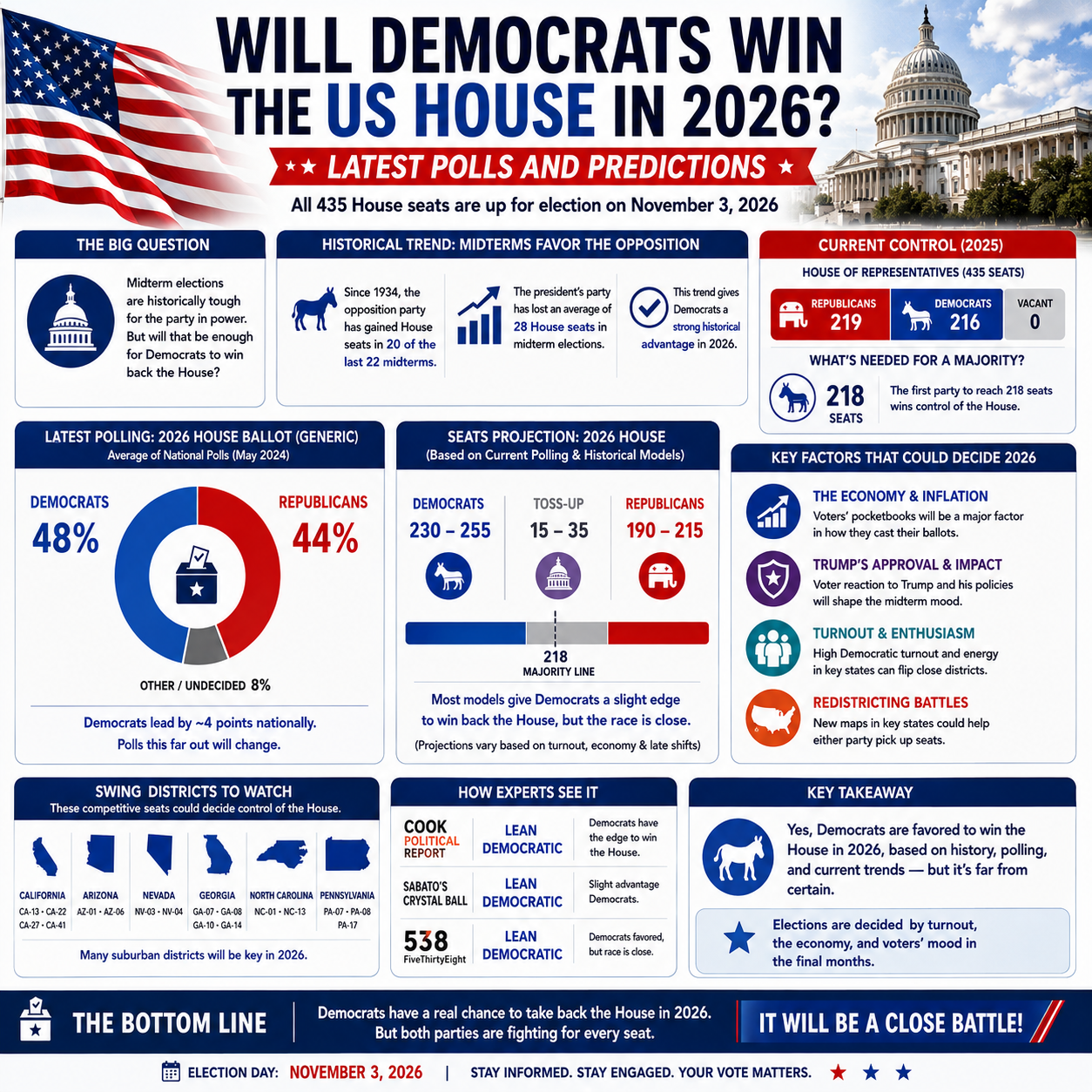
The 2026 U.S. House of Representatives election is becoming one of the most closely watched congressional contests in the country. All 435 voting House seats are scheduled to be contested on November 3, 2026, and the result will determine which party controls the chamber during the final portion of President Donald Trump’s current term. Because the Republican majority is extremely narrow, Democrats do not need to produce an enormous national landslide to take control. They need to win a relatively small number of competitive districts while protecting their own vulnerable seats. Current polling and forecasting indicators suggest that Democrats are in a strong position, although Republicans still have a realistic path to holding the chamber. (Ballotpedia)
The most important evidence currently favoring Democrats is the national political environment. Recent generic congressional ballot polling has consistently shown Democrats ahead of Republicans, although the exact size of that advantage varies depending on the poll and methodology. ActiVote’s August 9 survey, for example, found Democrats leading Republicans by 5 percentage points among likely midterm voters. Other polling averages have produced larger Democratic advantages, demonstrating that the overall environment is currently more favorable to Democrats than it was during the 2024 election. (ActiVote)
Election forecasting models are also giving Democrats an advantage. Nate Silver’s FLIPR model, which tracks House, Senate, and gubernatorial contests, is currently showing a political environment favorable to Democratic candidates. Prediction markets are even more bullish on a Democratic House takeover: Kalshi’s current House-control market gives Democrats roughly an 86% chance of winning the chamber and Republicans about a 14% chance. These numbers can change considerably before Election Day, so they should be viewed as probabilities rather than guarantees. (Silver Bulletin)
The central question, therefore, is not whether Democrats have a path to winning the House. They clearly do. The bigger question is whether their current advantage will survive the remaining months of campaigning. Economic conditions, President Trump’s approval rating, candidate quality, turnout, redistricting, fundraising, abortion, immigration, and the performance of individual candidates could all change the race. Based on the evidence available on August 12, 2026, Democrats are currently favored to win the House, but Republicans should not yet be considered eliminated from the contest.

What Is at Stake in the 2026 House Election?
The House of Representatives consists of 435 voting members, with every seat appearing on the ballot during a regular congressional election. Unlike the Senate, where only roughly one-third of seats are contested every two years, every House district is competitive in the sense that voters choose their representative in every election cycle. To control the chamber, a political party generally needs at least 218 seats. This makes even a small number of competitive districts extremely important because control of Congress can come down to only a handful of races. (Ballotpedia)
The Republican Party enters the 2026 election with a narrow House majority. That creates a difficult defensive situation because Democrats do not have to win dozens of Republican districts to change control. A relatively small number of Democratic victories in competitive Republican-held seats could be enough to put Democrats above the 218-seat threshold. At the same time, Democrats must avoid losing their own vulnerable districts, because a few unexpected defeats could offset their gains elsewhere.
Control of the House matters because the chamber has substantial power over legislation, federal spending, investigations, oversight, and the political agenda. If Republicans retain the House, the Trump administration would have a much easier time working with Congress to advance its priorities. If Democrats win, the House could become a major source of opposition to the administration, with Democratic committee chairs gaining significant oversight responsibilities and the Speaker becoming one of the most influential figures in Washington.
The House result will also influence the political environment leading toward the 2028 presidential election. A Democratic House would give the party an opportunity to challenge Republican policies and demonstrate its ability to govern. A Republican victory would allow the GOP to argue that voters had endorsed the Trump administration’s direction. For both parties, therefore, the 2026 House election is more than a contest over 435 individual seats; it is a national test of political strength.

Latest Generic Congressional Ballot Polls
The generic congressional ballot is one of the most widely watched indicators of the House race. Instead of asking voters about specific candidates, pollsters ask whether they would prefer a Democratic or Republican candidate for Congress. This measure does not predict individual districts perfectly, but it provides a useful picture of the national political environment. The current data show Democrats with a meaningful advantage, although different polling organizations produce different margins depending on their samples and likely-voter assumptions. (Silver Bulletin)
One recent example is ActiVote’s August 9, 2026 survey. The poll found Democrats ahead of Republicans by 5 percentage points among likely midterm voters. The survey was conducted between July 29 and August 8 among 1,000 likely midterm voters, with an expected error of approximately 3.1 percentage points. Although a single poll should never be interpreted as a final prediction, it reinforces the broader pattern showing Democrats ahead nationally. (ActiVote)
Other polling averages have shown an even stronger Democratic advantage. Silver Bulletin maintains a continuously updated generic-ballot tracker designed to combine available congressional polling into a broader measure of voter preference. Because the tracker is updated as new polls arrive, its precise margin can change from day to day. The important point is that Democrats have generally maintained a lead rather than merely appearing ahead in one isolated survey. (Silver Bulletin)
This national advantage gives Democrats an important starting point, but it does not automatically translate into 218 House seats. Congressional votes are distributed among individual districts, meaning geography matters enormously. Democrats could win the national House vote by several percentage points and still receive a smaller seat gain than expected if their votes are concentrated in districts they already win comfortably. Conversely, an efficient distribution of votes could allow them to gain many seats with a relatively modest national advantage.

Why Democrats Are Currently Favored
The first major reason Democrats are favored is their position in national polling. When a party consistently leads the generic congressional ballot, it indicates that voters are generally more receptive to that party’s congressional candidates. Democrats currently benefit from this environment, while Republicans are attempting to defend a narrow majority. If the polling advantage survives until November, many Republican-held competitive districts could become difficult to defend. (Silver Bulletin)
The second reason is the historical tendency for the president’s party to struggle during midterm elections. Midterms frequently allow voters who are dissatisfied with the White House to express that dissatisfaction without directly choosing a new president. Opposition-party voters can also become particularly motivated because they view Congress as an opportunity to provide a check on the administration. This historical pattern does not guarantee a Democratic victory, but it provides Democrats with a favorable structural environment.
The third reason is the narrow Republican majority. If Republicans held a much larger House majority, Democrats would need an enormous national swing to take control. Instead, the current balance means that only a limited number of districts need to change hands. That makes Democrats particularly sensitive to even moderate national shifts. If the current Democratic advantage remains several points above the Republican position, the number of vulnerable GOP districts could expand significantly.
The fourth reason is the growing evidence from individual elections and political contests that Democrats may be performing better than they did in 2024. Multistate’s analysis of 42 contested state legislative special elections in 2026 found Democrats running a median 10.4 percentage points ahead of their 2024 presidential baseline. Special elections have important limitations because turnout and circumstances differ from November, but repeated Democratic overperformance provides another indication that the political environment may currently favor the party. (MultiState)

Why Republicans Could Still Keep the House
Despite the Democratic advantage, Republicans still have a possible route to retaining the House. The first requirement would be a change in the national political environment. If Democratic support declines and Republican support increases during the final months, many currently competitive districts could move back toward the GOP. Polling conducted in August cannot account for every event that will happen before November, and a major change in voter sentiment could quickly make the House race more competitive. (The Washington Post)
Republicans can also benefit from candidate-specific advantages. House elections are not simply national party contests. An incumbent with strong local support can sometimes survive in a difficult national environment, while a weak challenger can fail to capitalize on favorable conditions. Republicans therefore have an opportunity to defend vulnerable districts by emphasizing local issues, personal records, constituent services, and differences between individual candidates rather than allowing every race to become a referendum on the national party.
Another Republican advantage comes from the geographic distribution of voters. Democrats tend to receive enormous margins in some urban districts, while Republicans can dominate rural areas. Because House seats are decided individually, a party’s national vote percentage does not translate directly into seats. Republicans could potentially survive a substantial Democratic national advantage if Democratic votes are concentrated inefficiently and Republicans hold their competitive suburban and exurban districts.
Republicans also have the ability to campaign on issues that remain popular among their core supporters. Immigration, border security, taxes, crime, national security, government spending, and opposition to Democratic policies can motivate Republican voters. If the GOP succeeds in making these issues more important than Trump’s approval rating or the broader midterm environment, Republicans could narrow the Democratic advantage and make the House race much closer.
Donald Trump’s Impact on the House Election
Donald Trump will not personally be running for a House seat, but his presidency will be one of the biggest factors in the election. Republican candidates will inevitably be associated with the administration, particularly when they defend policies supported by the president. This creates both an advantage and a disadvantage for Republicans. A popular Trump could help drive Republican turnout and fundraising, while an unpopular Trump could make vulnerable House candidates easier targets for Democrats. (Time)
Democrats are likely to nationalize many House races by presenting Republican candidates as supporters of Trump’s agenda. Instead of allowing candidates to focus entirely on local issues, Democratic campaigns can argue that voters are choosing whether to continue Republican control of Congress. This strategy could be especially effective in suburban districts where voters may be less attached to the Republican Party itself.
Republicans will likely attempt to do the opposite. They can argue that Democratic control of the House would create gridlock and prevent the administration from implementing its policies. Republican candidates can also emphasize issues such as immigration, inflation, crime, taxes, and government spending, attempting to make the election about policy outcomes rather than Trump’s personal popularity.
Trump’s approval rating will therefore remain a critical indicator throughout the campaign. If his approval improves significantly, Republicans could become more competitive. If his approval remains weak or declines further, Democrats would have a stronger opportunity to turn the election into a referendum. The relationship between presidential approval and House outcomes is not perfect, but it is an important part of understanding the 2026 environment.
The Economy and Cost of Living
Economic conditions may ultimately be more important than any individual political issue. Voters routinely evaluate elections through their personal financial experiences. Grocery prices, housing costs, wages, employment, interest rates, healthcare expenses, and household purchasing power can all influence how voters judge the party in power. If Americans believe the economy is improving, Republicans could receive a significant boost because they control the White House. If voters remain financially frustrated, Democrats can use that dissatisfaction to strengthen their case for change.
Inflation is particularly important because falling inflation does not necessarily mean that prices return to previous levels. Even when the inflation rate decreases, households can still feel pressure from the higher prices accumulated during earlier periods. Democrats can therefore focus on affordability and household expenses, while Republicans can argue that their policies are improving economic conditions and that voters should give the administration more time.
Housing is another potentially powerful issue, especially among younger voters and middle-income families. High home prices, mortgage costs, and rents can create dissatisfaction even when unemployment remains relatively low. Democrats can propose measures designed to increase housing supply and affordability, while Republicans can emphasize deregulation, construction, and private-sector economic growth.
The economic narrative that voters accept could determine the direction of the House election. Republicans need voters to believe that conditions are improving or that the administration’s policies are moving the economy in the right direction. Democrats need voters to believe that economic problems remain serious and that Republican policies are not adequately addressing them. Whichever argument proves more persuasive could affect dozens of competitive House races.
Abortion and Reproductive Rights
Abortion remains one of the most important issues for Democratic voters and could have a significant influence on turnout in the 2026 House election. Since the Supreme Court overturned the federal constitutional protection established by Roe v. Wade, abortion policy has become a major electoral issue. Democratic candidates can argue that Republican control of Congress could lead to additional restrictions, while Republicans generally emphasize protections for unborn children and the authority of states to regulate abortion.
The importance of abortion varies considerably by district. In strongly conservative districts, Republican candidates may benefit from emphasizing their opposition to abortion rights. In suburban and politically competitive districts, however, the issue can be more complicated. Some voters who otherwise support Republican economic policies may oppose strict abortion restrictions, while some Democratic voters may be particularly motivated by concerns about reproductive healthcare.
Abortion can also affect turnout among women and younger voters. Democrats have used reproductive rights as a major mobilization issue in recent elections, particularly in states where voters have directly considered abortion-related measures. If the issue becomes more prominent during the final months of 2026, it could help Democrats maintain enthusiasm among groups that traditionally participate at lower rates in midterms.
Republicans therefore face a strategic challenge. They need to maintain support among conservative voters while appealing to independents and suburban voters who may have different views on abortion. Democrats face a similar challenge because they need to use the issue to increase turnout without allowing Republicans to redirect the election toward other issues where they may be stronger.
Immigration and Border Security
Immigration is another issue that could significantly influence House races. Republicans have made border security and immigration enforcement central elements of their political platform, arguing that stronger enforcement is necessary to protect national security and control illegal immigration. If voters believe the Trump administration has improved border security, Republican candidates could benefit from the issue.
Democrats can respond by emphasizing legal immigration, border management, humanitarian concerns, and comprehensive immigration reform. They can also argue that immigration policy should combine effective enforcement with practical legal pathways. The effectiveness of that message will depend heavily on the specific concerns of voters in each district.
Immigration has particular power because it can motivate voters who might otherwise pay little attention to midterm elections. Republican campaigns are likely to use the issue to energize their base and encourage turnout. Democrats may attempt to shift the focus toward economic concerns and other issues that polls show matter more to independent voters.
The political effect of immigration will also depend on events at the border and developments during the campaign. If immigration becomes a dominant news story, Republicans may gain an advantage. If voters become more focused on economic issues, healthcare, abortion, or concerns about the administration, immigration may play a smaller role.
Young Voters and Democratic Turnout
Young voters could become an important part of the Democratic strategy. Younger Americans have generally leaned Democratic in national elections, but their participation in midterm elections tends to be lower than that of older voters. This creates a challenge for Democrats because their favorable demographic coalition does not automatically translate into votes.
Housing affordability is particularly important for younger Americans. Many younger voters face difficulty buying homes, paying rent, managing student debt, and building financial security. Democrats can attempt to connect these concerns to their broader economic message. Republicans can counter by emphasizing economic growth, entrepreneurship, lower taxes, and reduced regulation.
Climate policy and reproductive rights may also motivate younger voters. These issues can generate strong political enthusiasm among younger Democrats, particularly when campaigns successfully connect national policy debates with everyday concerns. However, Democrats must ensure that enthusiasm translates into actual participation because midterm elections historically produce lower youth turnout.
If Democrats successfully mobilize younger voters in major metropolitan areas and college communities, they could improve their performance in competitive districts. If youth participation is significantly lower than expected, the Democratic national polling advantage could translate into fewer actual House victories.
Suburban Voters Could Decide the House
Suburban voters are among the most important groups in the 2026 House election. Many competitive congressional districts are located in suburbs surrounding major cities, where voters are often more politically diverse than those in heavily urban or rural areas. These districts can swing between parties depending on the national political environment.
Democrats have recently performed strongly among many college-educated suburban voters. Issues such as abortion, healthcare, education, and concerns about political polarization can help Democrats in these communities. If suburban voters continue moving toward Democratic candidates, Republicans could lose several seats that they need to maintain their House majority.
Republicans are attempting to improve their suburban performance by emphasizing inflation, crime, immigration, parental rights, taxes, and economic concerns. The party does not necessarily need to win every suburban district. It simply needs to keep enough Republican voters and independents in its coalition to prevent Democrats from flipping a large number of seats.
The suburban vote will therefore be one of the clearest indicators of the final House result. If Democrats are winning suburban districts by larger margins than expected, a Democratic majority becomes increasingly likely. If Republicans stabilize their suburban support, the House race could tighten significantly.
Rural America and Republican Strength
Republicans continue to have a major advantage across much of rural America. Many rural districts have become strongly Republican in federal elections, making them difficult targets for Democrats. This means Democrats generally do not need to win large numbers of rural districts to take the House; instead, they need to avoid losing competitive districts where rural and suburban voters are combined.
Republican campaigns can use rural issues to strengthen turnout. Agriculture, energy production, gun rights, government regulation, healthcare access, and infrastructure are all issues that can be particularly relevant in rural communities. Strong Republican turnout in these areas can offset Democratic advantages in large cities.
Democrats can attempt to improve their rural performance by focusing on economic issues rather than purely national cultural debates. Infrastructure investment, rural healthcare, agricultural support, broadband access, and job creation can provide Democrats with opportunities to reduce Republican margins.
Nevertheless, the geographic structure of the House means Republicans remain strongly positioned in many rural districts. The Democratic path to a majority is more likely to depend on suburban and competitive districts than on sweeping gains across rural America.
Redistricting and the House Map
Redistricting is one of the most important factors complicating the national polling picture. House seats are determined by congressional district boundaries, and those boundaries can significantly influence which party has an advantage in individual races. Although the major nationwide redistricting process normally follows the census, several states are dealing with map changes and redistricting developments ahead of the 2026 election. (Ballotpedia)
Redistricting can create new opportunities for either party. A district that previously favored Democrats can become more Republican after boundaries change, while Republican-held districts can also become more competitive. This means that a national Democratic polling lead does not automatically translate into the number of House seats Democrats might expect.
Alabama provides a current example of how redistricting can affect individual races. Republicans have selected state Representative Rhett Marques to challenge Democratic Representative Shomari Figures in Alabama’s 2nd District, following a redrawn congressional map that is considered more favorable to Republicans. The race demonstrates how changes to district boundaries can create opportunities even when the national environment favors the other party. (Reuters)
Because redistricting varies by state, national analysts must examine individual districts carefully. This is why organizations such as Cook Political Report and Sabato’s Crystal Ball maintain district-level ratings instead of relying exclusively on national polling. Their assessments help identify where the actual battle for 218 seats is taking place. (Cook Political Report)
What Election Forecast Models Are Saying
Election forecasting models provide another way to evaluate the House race. Nate Silver’s FLIPR model tracks individual Senate, House, and gubernatorial races and incorporates polling and other electoral information. The latest model was updated on August 11, 2026, and is currently showing a political environment favorable to Democrats in the House. (Silver Bulletin)
Prediction markets are also pointing strongly toward a Democratic House. Kalshi’s current House-control market shows Democrats at roughly 86% and Republicans at about 14%. This is a substantial difference and indicates that traders currently believe a Democratic takeover is considerably more likely than a Republican hold. However, market probabilities can move rapidly in response to new polling, campaign developments, and political news. (Kalshi)
Race to the WH also maintains a House forecast based on district-level information. Its model considers factors including recent electoral history, polling, fundraising, and other indicators across the 435 House races. The advantage of such models is that they attempt to translate national and district-specific information into an actual estimate of House control. (Race to the WH)
Sabato’s Crystal Ball and Cook Political Report provide another important layer of analysis by rating individual House districts. Sabato’s House ratings were updated on August 10, while Cook maintains ratings for all 435 seats. When multiple independent sources are examining the map and reaching broadly similar conclusions, it provides more confidence that Democrats currently have the advantage. (Center for Politics)
Why Polling Can Still Be Wrong
Even strong polling advantages do not guarantee election victories. Polls are estimates of public opinion, and their accuracy depends on sample quality, turnout assumptions, weighting methods, and the ability of pollsters to identify likely voters. Midterm elections are particularly difficult because the electorate is smaller and different from the electorate in presidential years.
Turnout is one of the biggest uncertainties. A poll may show Democrats with a strong advantage among likely voters, but if Democratic voters are less likely to participate than expected, the actual result could be weaker. The opposite is also possible. If Democratic enthusiasm is stronger than expected, the party could outperform the polls.
Late-breaking events can also change the political environment. Economic developments, international crises, major policy announcements, scandals, candidate controversies, or unexpected campaign successes can shift voter preferences quickly. August polling therefore provides an important snapshot but not a final forecast.
Polling errors can also occur because national surveys do not perfectly capture individual districts. A party can perform differently across geographic regions, demographic groups, and types of communities. For the House, district-level polling and race ratings are therefore particularly valuable.
The Importance of Candidate Quality
Candidate quality can make a major difference in close House races. An experienced incumbent with strong local connections can sometimes survive even when the national environment is unfavorable. Such candidates may have established fundraising networks, name recognition, campaign organizations, and relationships with local voters.
Conversely, a weak candidate can create problems for a party that is otherwise well positioned nationally. Primary contests can produce candidates who appeal strongly to the party base but struggle with independents in the general election. This is especially important in competitive suburban districts.
Democrats therefore need to select candidates capable of taking advantage of their favorable national environment. They cannot simply assume that every Republican-held swing district will move automatically toward them. Strong candidates need to build local organizations, raise money, and develop messages tailored to their districts.
Republicans face the same challenge from the opposite direction. The party’s best opportunity is to recruit candidates who can separate themselves from national controversies and appeal to moderate voters. If Republican incumbents successfully emphasize local accomplishments and constituent relationships, they may outperform the broader GOP polling numbers.
Fundraising and Campaign Spending
Money will play an important role in the final months of the House campaign. Competitive congressional races require substantial resources for advertising, staff, polling, travel, voter outreach, digital campaigns, and get-out-the-vote operations. Both national party committees are likely to concentrate resources heavily on the districts that could determine control of the chamber.
Democrats’ current polling advantage should help attract donors who believe the party has a realistic opportunity to take the House. Republican candidates, however, can also raise significant amounts of money by emphasizing the possibility of a Democratic takeover and encouraging supporters to help defend the majority.
Advertising will become particularly important as Election Day approaches. Democrats are likely to emphasize Trump’s presidency, economic concerns, abortion, healthcare, and the argument that Congress needs a check on the administration. Republicans are likely to emphasize immigration, crime, taxes, economic policies, and the consequences of giving Democrats control.
The effectiveness of campaign spending depends on where the money is used. Spending heavily in safe districts does little to change the national outcome. Both parties therefore need to identify the relatively small group of competitive districts where additional advertising and organization could make the difference between victory and defeat.
The Most Important Swing States
Several states are likely to contain House districts that could influence control of Congress. California, New York, Pennsylvania, Michigan, Arizona, Georgia, North Carolina, Nevada, and other politically competitive states are likely to receive substantial attention from national campaigns. The precise importance of each state will depend on which districts are classified as competitive as the election approaches.
California and New York are particularly significant because they have large congressional delegations. Even a relatively small shift in several suburban districts can produce multiple House seat changes. Democrats are likely to look for opportunities in Republican-held suburban districts, while Republicans will focus on defending the seats they already hold.
Pennsylvania and Michigan are also important because they contain a mixture of urban, suburban, and rural communities. Their congressional districts can reflect broader national shifts. A strong Democratic performance in metropolitan areas combined with competitive suburban margins could produce significant Democratic gains.
Arizona, Georgia, North Carolina, and Nevada offer another group of important battlegrounds. These states have become increasingly competitive in federal elections, and their congressional districts can move with the national environment. Strong turnout in cities, suburbs, and rural areas will determine how many seats each party can win.
Could Democrats Win a Large House Majority?
Democrats are currently favored to win the House, but winning a large majority is a different question. A large Democratic majority would require their current national advantage to remain strong or even grow during the final months of the campaign. If the generic-ballot margin reaches unusually high levels and Democrats perform strongly across competitive districts, the party could gain substantially more than the minimum number of seats required.
The possibility of a large majority becomes more realistic if Republican-held districts that currently lean Republican begin moving toward Democrats. House forecasting models classify districts according to their expected competitiveness, and a national wave can cause many of these districts to move at the same time. A few additional points of Democratic support could therefore have a disproportionately large effect on the final seat count.
However, Democrats should not assume that a national lead automatically produces a huge majority. Many Democratic votes are concentrated in heavily Democratic urban districts, where additional votes do not generate additional seats. The efficiency of the Democratic vote will therefore be important.
At this stage, the strongest conclusion is that Democrats have a credible path to a majority rather than a guaranteed path to a landslide. If the current environment remains stable, a Democratic takeover looks more likely than a massive Democratic wave. The size of the eventual majority will depend heavily on the final national margin and district-specific outcomes.
Could Republicans Still Retain the House?
Republicans can still retain the House, but they currently face a more difficult path. The party would probably need the national political environment to improve significantly between now and Election Day. A reduction in the Democratic generic-ballot advantage would immediately make many competitive districts more favorable to Republicans.
An improving economy could be one of the biggest opportunities for Republicans. If voters begin feeling substantially better about household finances, employment, prices, and economic growth, the administration could receive more credit. Republican candidates could then campaign on continuing the current direction rather than asking voters to change course.
Republicans also need to maintain strong turnout among their core voters. Midterm elections are heavily influenced by enthusiasm because fewer people participate than in presidential elections. If Republican voters are highly motivated while Democratic enthusiasm declines, the current polling gap could become less meaningful.
Finally, Republicans need to defend their most vulnerable incumbents. Holding a handful of competitive seats could be enough to prevent Democrats from reaching 218. The GOP therefore does not necessarily need to reverse the entire national Democratic advantage; it may only need to outperform the Democratic vote enough in the decisive districts.
What Democrats Need to Do to Win
Democrats currently have the advantage, but they still need an effective campaign strategy. The first priority is maintaining their national polling position. If their generic-ballot lead remains substantial through September and October, the party will have a strong foundation for winning competitive districts.
The second priority is turnout. Democrats need to motivate younger voters, suburban voters, women concerned about reproductive rights, and other groups that can support Democratic candidates but may not participate at high rates in midterm elections. A polling advantage means little if the party’s supporters do not actually vote.
The third priority is candidate quality and local messaging. Democrats need candidates who can appeal beyond the traditional Democratic base. In competitive districts, voters may care more about local economic conditions, schools, healthcare, infrastructure, and public safety than national party arguments.
The fourth priority is avoiding complacency. Strong forecasts can create a false sense of security among supporters. Democrats need to continue fundraising, organizing, advertising, and campaigning until the final votes are counted. The House majority could ultimately depend on a very small number of districts.
What Republicans Need to Do to Win
Republicans’ first objective is to reduce the Democratic national advantage. If the generic congressional ballot moves significantly closer, the House map will immediately become more competitive. The GOP therefore needs to convince independent and suburban voters that maintaining Republican control is preferable to giving Democrats power.
Republicans also need to emphasize issues where they believe they have an advantage. Immigration, border security, taxes, crime, government spending, and economic growth can motivate conservative voters and potentially persuade independents. The party will likely attempt to make these issues more prominent than Democratic attacks on Trump.
Another Republican priority will be protecting suburban incumbents. The GOP cannot afford to lose large numbers of suburban districts if it wants to retain the House. Republican candidates will need to balance support for the administration with appeals to voters who may be uncomfortable with Trump’s most controversial policies.
Finally, Republicans need strong turnout. Their path to victory becomes much easier if conservative voters are highly motivated and Democratic turnout underperforms. Because the House majority may depend on only a few districts, even modest turnout differences could have major consequences.
Three Possible Outcomes for the 2026 House
The first and currently most plausible outcome is a Democratic House victory. Under this scenario, Democrats maintain their national polling advantage, flip enough Republican-held districts, protect their vulnerable seats, and reach at least 218 members. This would make the House a major center of opposition to the Trump administration and significantly change the balance of power in Washington.
The second outcome is a narrow Republican hold. This would probably require Republicans to perform better than current polling suggests. The generic-ballot gap would need to shrink, Republican incumbents would need to outperform expectations, and Democratic turnout would need to be weaker than anticipated. The GOP could potentially retain the chamber without winning the national popular vote by a large margin.
The third outcome is a Democratic wave. In this scenario, the current Democratic advantage grows rather than shrinks. Competitive Republican districts would fall across several states, and Democrats could win a much larger majority than the minimum 218 seats required. Such an outcome would represent a major midterm rejection of the governing party.
A fourth possibility is an extremely narrow result in which control depends on one or two districts that remain unresolved after Election Day. Given the closeness of the current House balance, even a small number of recounts or delayed results could attract enormous national attention. The final House majority may ultimately be determined by races that receive relatively little attention today.
What the Latest Prediction Says
The strongest current prediction is that Democrats will win the House. This conclusion is supported by several independent indicators rather than a single poll. Democrats have a meaningful generic-ballot advantage, the Republican majority is narrow, historical midterm patterns favor the opposition party, and forecasting systems currently lean toward Democratic control. (Silver Bulletin)
The prediction-market evidence is particularly striking. Kalshi’s current House-control market puts Democrats at approximately 86% and Republicans at about 14%. A probability of 86% does not mean Democrats are certain to win; it means the current market assessment sees a Democratic victory as much more likely than a Republican victory. Political developments between now and November could change these odds substantially. (Kalshi)
The polling picture is also favorable. ActiVote’s latest survey shows Democrats ahead by five points, while Silver Bulletin continues to track a broader Democratic advantage in its generic-ballot average. The exact margin should not be treated as fixed because new polls are released regularly and methodologies differ. Still, the consistent Democratic lead is an important signal. (ActiVote)
The biggest uncertainty is whether today’s political environment will remain in place. If the election were held under the conditions reflected in current polling and forecasts, Democrats would be the clear favorite to take the House. But November is still ahead, and several months of campaigning remain. The final prediction should therefore be expressed as a strong Democratic advantage rather than a certainty.
Final Prediction: Will Democrats Win the House?
Based on the latest available evidence as of August 12, 2026, Democrats are more likely than Republicans to win control of the U.S. House of Representatives. Their national polling advantage, the narrow Republican majority, favorable midterm dynamics, special-election performance, and current forecasting models all point in the same general direction. (ActiVote)
The current prediction is therefore that Democrats will reach the 218-seat threshold and regain control of the House. The most important factor supporting this prediction is not simply one large poll but the combination of national polling and district-level conditions. Current House ratings from major political analysts continue to provide a framework in which Democrats have numerous opportunities to gain Republican-held seats. (Cook Political Report)
However, Republicans still have a credible path to victory. If the economy improves, Trump’s approval rises, immigration becomes a dominant issue, Democratic turnout weakens, or Republican candidates outperform expectations, the House race could tighten. Redistricting could also protect some Republican seats that would otherwise be vulnerable. The Alabama 2nd District illustrates how changes to district boundaries can alter individual races even within a favorable national environment for Democrats. (Reuters)
My current overall assessment is therefore Democrats favored to win the House, Republicans still capable of holding it, and the final margin likely to depend on a relatively small number of competitive districts. If current polling conditions remain broadly unchanged through October, a Democratic House majority should be considered the most likely outcome. If the national environment shifts substantially before November 3, however, the prediction could change.
Frequently Asked Questions
Will Democrats win the US House in 2026?
Democrats currently have the better chance of winning the U.S. House in 2026. The national generic congressional ballot is favorable to Democrats, the Republican majority is narrow, and several current forecasting systems point toward a Democratic takeover. However, the election is not guaranteed because House races are decided individually and the political environment can change before November.
How many seats do Democrats need to win the House?
Democrats need to reach at least 218 voting seats to control the House. Because Republicans currently hold only a narrow majority, Democrats need a relatively small net gain rather than a huge national landslide. This is one of the main reasons Democrats are currently considered strong favorites.
What are the latest 2026 House polls showing?
Recent generic congressional ballot polling shows Democrats ahead of Republicans. ActiVote’s latest August survey found Democrats leading by five percentage points among likely midterm voters, while other polling averages have shown larger Democratic advantages. The precise margin changes as new polls are released. (ActiVote)
What are prediction markets saying about the House?
Kalshi’s current House-control market gives Democrats approximately an 86% chance of winning control and Republicans about a 14% chance. This represents a strong Democratic advantage, although prediction-market probabilities can change as new information becomes available. (Kalshi)
Can Republicans still win the House?
Yes. Republicans can still retain the House if the national environment improves, Democratic turnout underperforms, Republican candidates perform strongly, or several vulnerable GOP incumbents survive. The current Democratic advantage makes a Republican victory more difficult, but it does not make one impossible.
Why are Democrats favored in the 2026 House election?
Democrats are favored because they currently lead national congressional polling, Republicans have only a narrow majority, midterm elections often hurt the president’s party, and several election models currently show favorable conditions for Democrats. These factors together create a strong Democratic starting position.
Does Donald Trump affect the House election?
Yes. Although Trump is not personally running for the House, his presidency is likely to be one of the central issues in the election. Republican candidates can benefit if voters approve of his administration, while Democrats can benefit if voters want Congress to provide a check on his policies.
Could Democrats win a large majority?
They could, but a large Democratic majority is less certain than a Democratic victory itself. A large majority would probably require the current Democratic national advantage to remain strong or increase, causing additional Republican-held districts to become competitive.
What issues could decide the election?
The economy, inflation, housing costs, immigration, abortion, healthcare, crime, taxes, government spending, and Trump’s approval rating could all influence the election. Different issues will matter more in different congressional districts.
When will the 2026 House election take place?
The 2026 U.S. House election is scheduled for November 3, 2026. Voters will choose representatives in all 435 congressional districts, along with participating in other federal, state, and local elections.
Conclusion
The 2026 U.S. House election currently favors Democrats, and the latest evidence suggests that the party has a realistic and increasingly strong path to regaining control of Congress’s lower chamber. Democrats are ahead in the generic congressional ballot, several special-election results have shown Democratic overperformance, and major forecasting systems are currently more favorable to Democrats than Republicans. (ActiVote)
The narrow Republican majority makes the Democratic opportunity even stronger. Democrats do not need to win every competitive district or produce an extraordinary national landslide. They need to flip enough Republican-held seats to reach 218 while protecting their own vulnerable districts. Current conditions suggest that this is achievable if today’s political environment remains relatively stable.
Republicans, however, still have time to change the race. The election is months away, and the economy, Trump’s approval rating, immigration, candidate quality, turnout, fundraising, and redistricting could all affect the final result. The GOP also has strong support in rural America and can potentially defend several vulnerable districts through strong incumbents and local campaigns. (The Washington Post)
Current prediction: Democrats are favored to win the U.S. House in 2026. The current polling and forecasting environment makes a Democratic takeover more likely than a Republican hold, but the size of the Democratic majority remains uncertain. If the current Democratic advantage survives through September and October, Democrats should have enough opportunities to reach the 218-seat threshold. If the political environment changes significantly before Election Day, Republicans could still make the race competitive. For now, however, the evidence points toward a Democratic House majority in 2026.
For More Information about this article, Please Click Here.
For More Information, Please Click Here.