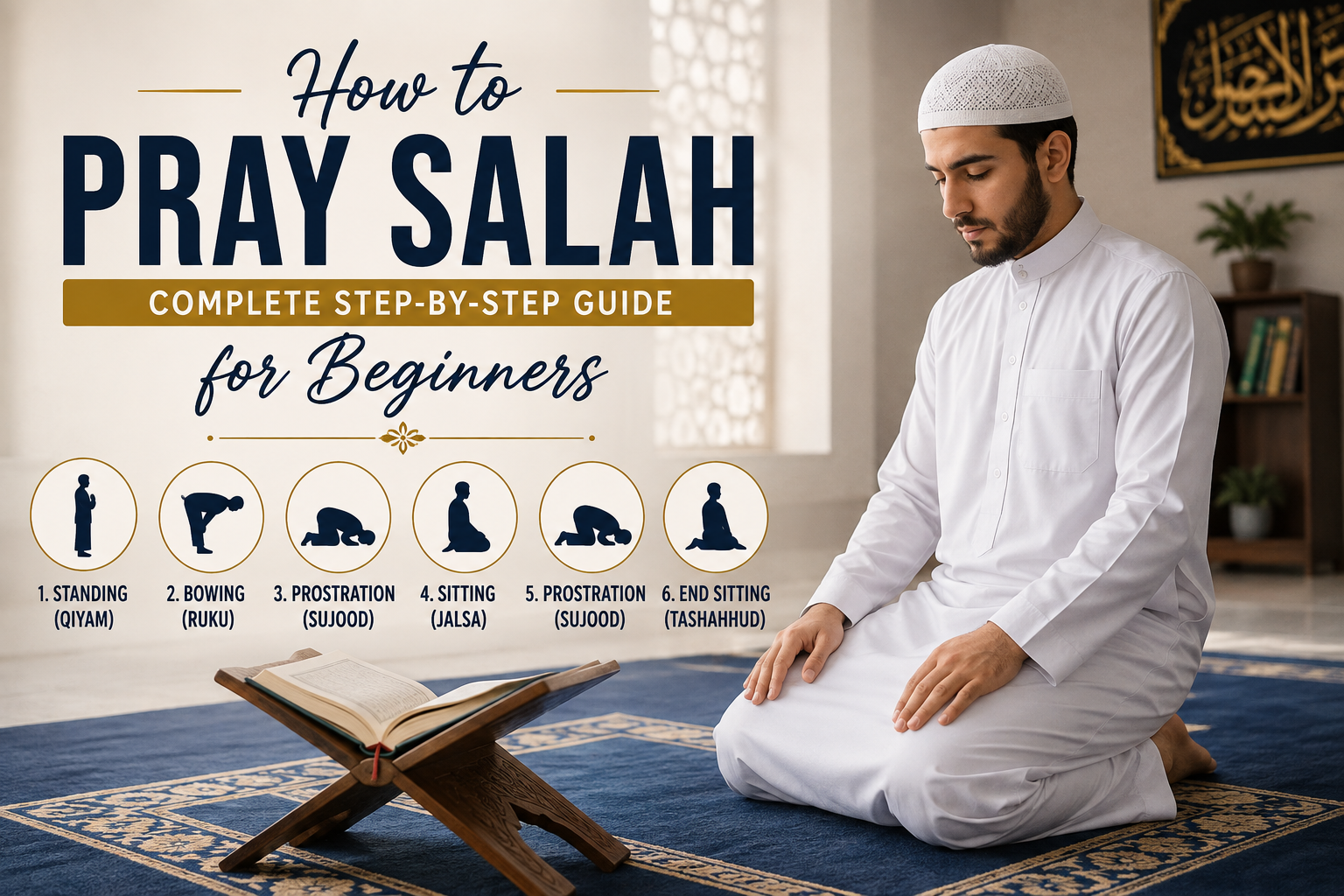
How to Pray Salah: Complete Step-by-Step Guide for Beginners
How to Pray Salah: Complete Step-by-Step Guide for Beginners
Introduction
Learning how to pray Salah is an important step for every Muslim, especially for beginners and new Muslims who are starting to understand the basics of Islamic worship. Salah, also known as Namaz, is performed five times a day and is one of the Five Pillars of Islam. Although the prayer may seem difficult at first because it includes specific movements, Arabic recitations, and different numbers of Rak’ahs, it becomes much easier when learned step by step. With regular practice and patience, beginners can gradually become comfortable with the complete prayer process.
Salah is more than simply standing, bowing, and prostrating. It is a form of worship through which Muslims remember Allah, praise Him, ask for forgiveness, seek guidance, and express their gratitude. Each prayer provides an opportunity to step away from daily responsibilities and focus on Allah. Understanding the meaning and purpose of Salah can make the learning process more meaningful and help beginners develop concentration and sincerity during prayer.
This complete beginner’s guide explains how to pray Salah step by step, starting with the basic preparation required before prayer and continuing through the different movements, recitations, Rak’ahs, and ending of Salah. It also explains the five daily prayers, common mistakes beginners should avoid, and practical tips for learning prayer more easily. Whether you are a new Muslim or simply want to improve your understanding of Salah, this guide will help you build a clear foundation for performing the daily prayers.
What Is Salah?
Salah, also known as Namaz or Islamic prayer, is the formal act of worship that Muslims perform five times every day. It is one of the Five Pillars of Islam and has a central place in a Muslim’s daily life. Through Salah, Muslims worship Allah, remember Him, express gratitude, seek forgiveness, and ask for guidance. It is not simply a series of physical movements; it combines recitation, remembrance, humility, and devotion. During Salah, Muslims temporarily leave behind their daily distractions and focus their hearts and minds on worshipping Allah.
The five obligatory daily prayers are Fajr, Dhuhr, Asr, Maghrib, and Isha. Each prayer has its own prescribed time based on the position of the sun, so prayer times vary depending on the location and season. Fajr is performed around dawn, Dhuhr after midday, Asr during the afternoon, Maghrib after sunset, and Isha during the night. Muslims face the Qiblah, the direction of the Ka’bah in Makkah, while performing Salah. Before praying, they normally perform Wudu when purification is required and make the intention to perform the particular prayer.
Salah follows a specific sequence that includes standing, reciting verses from the Qur’an, bowing in Ruku, standing again, and prostrating in Sujood. Muslims recite Surah Al-Fatihah and other Qur’anic passages during the prayer, along with specific praises and supplications. The number of obligatory Rak’ahs varies between the five prayers, with Fajr having two, Dhuhr four, Asr four, Maghrib three, and Isha four. For beginners, learning all these movements and recitations may take some time, but practicing regularly and learning one part at a time makes the process much easier.
Why Is Salah Important in Islam?
Salah is one of the most important acts of worship in Islam and one of the Five Pillars of Islam. Muslims perform five obligatory prayers every day, making Salah a regular part of their relationship with Allah. Through prayer, Muslims remember Allah, praise Him, seek forgiveness, ask for guidance, and express their gratitude. Unlike occasional acts of worship, the five daily prayers provide regular moments throughout the day when a Muslim can step away from worldly activities and focus on their faith.
Salah also helps develop discipline, patience, humility, and spiritual awareness. Since each prayer has a specific time, Muslims learn to organize their daily lives around their religious responsibilities. The physical actions of standing, bowing, and prostrating also represent submission and humility before Allah. During Sujood, a Muslim places themselves in a position of complete humility and turns directly toward Allah. Regular prayer can therefore help a person become more conscious of their actions and strengthen their connection with their faith.
Another important purpose of Salah is to provide spiritual comfort and a sense of peace. Muslims can turn to Allah during both difficult and happy moments, asking for forgiveness, guidance, strength, and mercy. Salah also brings Muslims together when performed in congregation, as people from different backgrounds stand side by side facing the same Qiblah. For beginners, understanding why Salah is important can make learning its movements and recitations more meaningful and encourage them to develop a consistent habit of prayer.
The Five Daily Prayers and Their Rak’ahs
Muslims are required to perform five obligatory prayers every day: Fajr, Dhuhr, Asr, Maghrib, and Isha. Each prayer has a specific time and a different number of obligatory Rak’ahs, which are individual units of prayer. Fajr is the dawn prayer and has 2 obligatory Rak’ahs, while Dhuhr is the midday prayer and has 4 obligatory Rak’ahs. Asr is the afternoon prayer and also contains 4 obligatory Rak’ahs. Maghrib is performed after sunset and has 3 obligatory Rak’ahs, while Isha is the night prayer and has 4 obligatory Rak’ahs. Together, these five prayers contain 17 obligatory Rak’ahs each day.
The prayer times are determined by the position of the sun and therefore change throughout the year and vary from one location to another. Fajr begins at dawn before sunrise, Dhuhr begins after midday, Asr occurs later in the afternoon, Maghrib begins after sunset, and Isha takes place during the night. For example, Muslims living in London, New York, Toronto, or Sydney will have different prayer times because of their geographical locations and seasonal changes. Beginners should use a reliable local prayer timetable, mosque schedule, or trusted prayer-time service to determine the correct times.
In addition to the obligatory Rak’ahs, Muslims may perform Sunnah and voluntary prayers associated with the daily prayers. These additional prayers have their own rulings and details, which can vary according to recognized Islamic schools of jurisprudence. Beginners should first concentrate on learning the five obligatory prayers correctly rather than becoming overwhelmed by additional details. Once the basic prayers become familiar, they can gradually learn about Sunnah prayers, Witr, and other voluntary acts of worship to develop their daily prayer routine further.
What to Do Before Praying Salah
Before performing Salah, a Muslim needs to make sure that the basic requirements for prayer are fulfilled. The prayer time must have started, and the person should be in a state of ritual purity. When Wudu is required, it should be performed before Salah. The body, clothing, and place of prayer should also meet the required cleanliness conditions. A Muslim should wear appropriate clothing that covers the required parts of the body and choose a clean and suitable place where the prayer can be performed peacefully.
Another important preparation is facing the Qiblah, which is the direction of the Ka’bah in Makkah. Muslims around the world face the Qiblah during Salah. Today, beginners can easily determine the direction using a reliable Qiblah compass, Islamic app, or by asking at a local mosque. Before beginning the prayer, the worshipper should also have the intention, or Niyyah, in their heart for the specific prayer they are about to perform. The intention does not need to be complicated or spoken aloud; knowing which prayer you are performing and intending to worship Allah is sufficient.
It is also helpful to prepare mentally before starting Salah. Put away unnecessary distractions, silence your phone, and give yourself enough time so that you do not feel rushed. Take a moment to focus on Allah and remember that you are about to perform an important act of worship. Beginners should also make sure they know which prayer they are performing and have learned the basic recitations and movements required for it. Good preparation makes Salah easier to perform with calmness, concentration, and humility.
How to Perform Wudu Before Salah
Wudu is the ritual purification that Muslims perform before Salah when purification is required. It prepares a person physically and spiritually for prayer and is an important part of preparing for worship. Before beginning Wudu, a Muslim should have the intention to purify themselves for prayer and begin by saying “Bismillah,” meaning “In the name of Allah.” The hands are then washed, followed by rinsing the mouth and cleaning the nose according to the established method. The face is washed thoroughly, and then the arms are washed, including the elbows.
After washing the arms, the person wipes over the head with wet hands according to the method they follow, followed by wiping the ears. The feet are then washed, including the ankles and the areas between the toes. Each part should be washed properly without unnecessary waste of water. The exact details of Wudu can differ slightly between recognized Islamic schools of jurisprudence, but the essential purpose is the same: to achieve the required state of ritual purity before performing Salah.
Once Wudu is completed, the person is ready to pray as long as the other conditions of Salah are fulfilled. It is important to remember that Wudu does not necessarily have to be repeated before every prayer if it remains valid. However, certain actions or conditions can invalidate Wudu, after which it must be performed again. Beginners should learn the basic actions of Wudu carefully and practice them until the process becomes familiar and easy to perform before each daily prayer.
How to Pray Salah Step by Step
To begin Salah, make sure you have completed the necessary preparation, including Wudu when required, appropriate clothing, a clean prayer place, and facing the Qiblah. Make the intention in your heart for the specific prayer you are about to perform. Begin the prayer by raising your hands according to the Sunnah practice you follow and saying “Allahu Akbar,” meaning “Allah is the Greatest.” Remain standing and recite the opening supplication according to your practice, followed by Surah Al-Fatihah and another portion of the Qur’an in the Rak’ahs where it is prescribed. The recitation should be performed calmly and with attention to the meaning.
After the standing recitation, say “Allahu Akbar” and move into Ruku, the bowing position. In Ruku, maintain a stable posture and recite the established remembrance, commonly “Subhana Rabbiyal-‘Azim.” Then rise from Ruku while saying the appropriate praise and stand upright for a moment. Next, say “Allahu Akbar” and move into Sujood, or prostration, where the worshipper humbles themselves before Allah. Recite the established remembrance, commonly “Subhana Rabbiyal-A’la,” then sit briefly between the two prostrations before performing the second Sujood. These movements together form the basic structure of a Rak’ah.
After completing the required number of Rak’ahs for the particular prayer, the worshipper sits for Tashahhud and completes the prescribed recitations and supplications. The prayer is then concluded with Salam, turning the head to the right and then the left while saying “As-salamu ‘alaykum wa rahmatullah.” The number of Rak’ahs depends on the prayer: Fajr has two obligatory Rak’ahs, Dhuhr and Asr have four each, Maghrib has three, and Isha has four. Beginners should learn each part gradually, practice the movements and Arabic recitations regularly, and consult a qualified teacher or scholar for details that differ between recognized schools of Islamic jurisprudence.
How to Pray Fajr, Dhuhr, Asr, Maghrib and Isha
The five daily prayers are Fajr, Dhuhr, Asr, Maghrib, and Isha, and each has a different number of obligatory Rak’ahs. Fajr consists of two obligatory Rak’ahs and is performed at dawn before sunrise. Dhuhr consists of four obligatory Rak’ahs and is performed after midday, while Asr also consists of four obligatory Rak’ahs and is performed in the afternoon. Maghrib consists of three obligatory Rak’ahs and begins after sunset, while Isha consists of four obligatory Rak’ahs and is performed at night. The exact beginning and ending times of these prayers change according to location and season, so Muslims should use a reliable local prayer timetable.
The basic structure of each prayer is similar. The worshipper begins with the intention and Takbir, then stands and recites Surah Al-Fatihah and additional Qur’anic verses where applicable. This is followed by Ruku, standing after Ruku, two Sujoods with a sitting position between them, and then continuing to the next Rak’ah. After the appropriate Rak’ahs, the worshipper sits for Tashahhud and completes the prayer with Salam. The specific recitation patterns can differ between the first two and later Rak’ahs, and there are also recognized differences in some details between Islamic schools of jurisprudence.
For a beginner, it is best to learn the prayers gradually rather than trying to memorize everything at once. Start by becoming comfortable with the two-Rak’ah structure used in Fajr, then learn how the four-Rak’ah prayers such as Dhuhr, Asr, and Isha continue after the second Rak’ah, and finally learn the three-Rak’ah structure of Maghrib. Once the basic sequence is familiar, beginners can learn the Sunnah prayers and other additional acts of worship. A qualified teacher or knowledgeable imam can also demonstrate the prayer and help correct pronunciation, posture, and other details.
Common Mistakes Beginners Should Avoid
One common mistake beginners make when learning Salah is rushing through the prayer. Some new Muslims try to complete the movements as quickly as possible and may not pause properly between standing, Ruku, and Sujood. Salah should be performed calmly, with each position given enough time to be completed correctly. Beginners should also avoid becoming overly focused on memorizing everything immediately. It is better to learn the essential recitations and movements gradually and practice them regularly until they become familiar.
Another common mistake is not paying attention to the preparation for prayer. Beginners may forget to check the prayer time, perform Wudu when required, face the Qiblah, or wear appropriate clothing. It is also important to learn Surah Al-Fatihah carefully because it is a fundamental part of Salah. Pronunciation can take time to improve, especially for someone who does not speak Arabic, so beginners should practice with a reliable teacher or qualified source rather than becoming discouraged by early mistakes.
Beginners should also avoid becoming confused or worried when they encounter differences in certain prayer details. There are recognized differences among Islamic schools of jurisprudence regarding some aspects of Salah, and seeing another Muslim perform a particular action differently does not necessarily mean that one person is praying incorrectly. Instead, beginners should follow a reliable teacher or recognized school consistently while learning. Most importantly, do not let fear of making mistakes prevent you from praying; continue learning, ask knowledgeable people for guidance, and improve your Salah through regular practice.
Tips for Learning Salah as a Beginner
The best way to learn Salah as a beginner is to take it one step at a time instead of trying to memorize the entire prayer in a single day. Start by learning the names and basic Rak’ahs of the five daily prayers, then focus on Wudu and the main movements of Salah, such as standing, Ruku, and Sujood. After becoming comfortable with the movements, gradually memorize the essential Arabic recitations, beginning with Surah Al-Fatihah and the common phrases said during Ruku and Sujood. Regular short practice sessions are often easier and more effective than trying to learn everything at once.
It is also helpful to understand the meaning of what you recite. Learning the English meaning of Surah Al-Fatihah and the other supplications can help you understand what you are saying and improve your concentration during prayer. You can listen to reliable Qur’an recitations to improve your Arabic pronunciation and practice repeating the words slowly. A qualified teacher, imam, or knowledgeable Muslim can also demonstrate the prayer and correct your pronunciation and movements. If you are a new Muslim, attending a local mosque or beginner-friendly Islamic class can make the learning process much easier.
Most importantly, be patient and consistent while learning Salah. You may forget a phrase, make a movement incorrectly, or struggle with Arabic pronunciation at first, but these difficulties are normal for beginners. Keep practicing and avoid becoming discouraged. Setting reminders for the five prayer times, preparing your prayer area in advance, and following a consistent daily routine can help you develop the habit. As your confidence grows, you can gradually learn additional Sunnah prayers, supplications, and details of Salah while continuing to improve your understanding and concentration.
Frequently Asked Questions About Salah
How many times do Muslims pray each day?
Muslims are required to perform five obligatory prayers each day: Fajr, Dhuhr, Asr, Maghrib, and Isha. Each prayer has its own prescribed time and number of obligatory Rak’ahs. Fajr has two obligatory Rak’ahs, Dhuhr and Asr have four each, Maghrib has three, and Isha has four. The exact prayer times change according to location and season, so Muslims should check a reliable local prayer timetable.
Do I need Wudu before every Salah?
A Muslim needs to be in the required state of ritual purity to perform Salah. If a person’s Wudu remains valid, they do not necessarily need to perform it again before every prayer. However, if Wudu is invalidated, it must be performed again before praying. Beginners should learn the actions that invalidate Wudu and make sure they are properly purified before Salah.
What should a beginner learn first for Salah?
Beginners should first learn how to perform Wudu, face the Qiblah, make the intention, and understand the basic sequence of Salah. They should then focus on memorizing Surah Al-Fatihah and the essential phrases used during the prayer. Learning gradually and practicing every day can make Salah easier to remember and help build confidence.
Can I learn Salah if I do not know Arabic?
Yes. Many Muslims around the world do not speak Arabic as their first language, yet they learn the required Arabic recitations for Salah. A beginner can learn the pronunciation gradually while also studying the English meaning of the words. If there is uncertainty about a specific ruling or difficulty during the learning process, it is best to ask a qualified Islamic teacher or scholar for guidance.
Conclusion
Learning how to pray Salah is an important journey for every Muslim, especially for beginners who are still becoming familiar with the different prayer times, Rak’ahs, movements, and Arabic recitations. Although Salah may seem difficult at first, learning it step by step makes the process much easier. Starting with Wudu, understanding the basic requirements, learning the prayer movements, and gradually memorizing Surah Al-Fatihah and the essential supplications can help beginners build a strong foundation.
The five daily prayers—Fajr, Dhuhr, Asr, Maghrib, and Isha—provide Muslims with regular opportunities to remember Allah and strengthen their faith throughout the day. Beginners should focus on performing Salah with calmness and sincerity rather than becoming worried about learning everything perfectly immediately. Regular practice, understanding the meanings of the recitations, and learning from reliable Islamic teachers can gradually improve both confidence and concentration during prayer.
Most importantly, learning Salah is a continuous process that requires patience and consistency. If you make mistakes while learning, do not become discouraged; continue practicing and seek guidance whenever you are unsure about a particular aspect of prayer. With time, the movements and recitations will become more familiar, and Salah can become a meaningful and peaceful part of your daily life and relationship with Allah.
Tags
How to Pray Salah
Salah for Beginners
How to Pray Salah Step by Step
How to Perform Salah
How to Pray Namaz
Islamic Prayer Guide
Muslim Prayer Guide
Five Daily Prayers
Fajr Prayer
Dhuhr Prayer
Asr Prayer
Maghrib Prayer
Isha Prayer
Salah Rak’ahs
Wudu Before Salah
How to Perform Wudu
Prayer in Islam
Learn Salah
Salah Tutorial
New Muslim Prayer Guide
For More Information About Salah Please Click Here.!
For More Details About Salah Please Click Here.!