

Most people carry a vivid mental image of Lucifer red skin, horns, a pitchfork, ruling hell like a king. But here is the startling reality: not a single one of those details comes from the Bible. They come from medieval art, literary imagination, and centuries of cultural layering that slowly replaced Scripture with storytelling. If you want the biblically accurate Lucifer, you have to go back to the original Hebrew text, and what you will find there will challenge almost everything you assumed was settled theology.
This article strips away more than a thousand years of religious tradition and cultural myth to reveal what Scripture actually says about Lucifer, his identity, his original glory, his catastrophic fall, and the profound theological warning his story carries for every human being alive today. Prepare for a close examination of Isaiah 14, Ezekiel 28, the history of Bible translation, and the crucial distinction between what the text says and what tradition added. The truth is far more layered and far more powerful than any pop culture version ever told you.
Biblically Accurate Understanding of Lucifer’s Identity

Common Misconceptions About Lucifer in Modern Culture
Before examining what Scripture says, it helps to clear the ground by identifying what Scripture does not say. Popular culture has constructed an entire theological framework around Lucifer that has almost no direct biblical foundation. These are the most widespread misconceptions that circulate even within church communities:
- Lucifer is depicted in the Bible as a red-skinned, horned figure with a pitchfork the Bible contains no such physical description anywhere
- The name “Lucifer” appears dozens of times throughout Scripture in reality, it appears exactly once in the King James Version, in Isaiah 14:12
- Lucifer and Satan are explicitly identified as the same being in Scripture the Bible never makes this direct identification
- Lucifer rules hell as its king Scripture never portrays him ruling hell; he is cast down and destined for judgment
- Lucifer has always been evil from the beginning the biblical text describes a being of extraordinary beauty and wisdom before any fall occurred
These misconceptions did not emerge from careful Bible study. They grew from medieval morality plays, Dante’s Inferno, Milton’s Paradise Lost, and centuries of artistic tradition that was eventually absorbed as biblical fact by millions of people who never questioned its origins.
What Scripture Actually Reveals About Lucifer?
Scripture’s actual treatment of Lucifer is remarkably brief. Isaiah 14:12 stands as the sole verse in most English Bible translations using the name “Lucifer” as a proper designation. Ezekiel 28:12-17 provides complementary imagery, though it is addressed to the King of Tyre. Beyond these two passages, direct references are sparse. What the Bible does reveal, however, is theologically stunning a being of staggering beauty and wisdom who held a position of unparalleled honor in the heavenly order, only to be destroyed by the very gifts God had given him.
The Isaiah passage appears within a larger taunt poem directed against the King of Babylon, while Ezekiel’s passage addresses the King of Tyre. Whether these texts describe a purely human ruler, a fallen angelic being, or both through a technique of dual fulfillment is a genuine scholarly debate that has not been fully resolved. What is not debated is that the imagery employed brightness, height, beauty, and catastrophic fall points to a spiritual reality that transcends any single historical king.
The Hebrew Original: Helel and Its True Meaning
Here is where the story becomes linguistically critical. The Hebrew Bible never uses the word “Lucifer” at all. The word that appears in Isaiah 14:12 in the original Hebrew text is Helel (הֵילֵל), or more fully “Helel ben Shachar” meaning “shining one, son of the dawn.” The root verb halal means “to shine” or “to boast,” and the word as used in Isaiah 14 is a poetic epithet describing brilliant luminosity, almost certainly referencing the planet Venus as the brightest object visible in the pre-dawn sky.
This is not a minor footnote. The word Helel appears exactly once in the entire Hebrew Bible, only in Isaiah 14:12. It is not scattered across Genesis, Psalms, or Revelation. It is a single, unique occurrence of a descriptive phrase not a personal name, not a theological title, and certainly not the proper name of a cosmic villain. The morning star imagery was chosen deliberately by Isaiah because Venus burns brilliantly just before sunrise, then vanishes completely when the sun rises. The metaphor was devastating in its precision: this brilliant being who thought he could outshine everything was extinguished the moment a greater light appeared.
Jerome’s Latin Vulgate and the Birth of ‘Lucifer’

The name “Lucifer” entered Christian vocabulary through a single translation decision made in the late fourth century. Around 383 AD, a scholar named Jerome was commissioned to produce a definitive Latin translation of the Bible, which became known as the Vulgate. When Jerome reached Isaiah 14:12 and encountered the Hebrew word Helel, he translated it using the Latin word “Lucifer” composed of lux (light) and ferre (to bear), literally meaning “light-bearer” or “light-bringer.”
This was not an error in isolation. Romans already used the word “Lucifer” as the personified name for Venus in its morning appearance. It was a linguistically reasonable choice, since both Helel and Lucifer referenced the morning star. However, Jerome used “Lucifer” as a proper name rather than a descriptive phrase. That decision elevating a poetic description to a personal name set in motion centuries of theological consequences that would permanently embed the word “Lucifer” into Western Christian consciousness as the name of a fallen angelic being.
How the King James Bible Preserved and Popularized the Name Lucifer?
The 1611 Translators’ Decision to Retain Jerome’s Latin Word

When the King James Bible was completed in 1611, the translators faced a choice at Isaiah 14:12. They could render the Hebrew Helel as “morning star” or “shining one” accurate English translations of the original or they could retain Jerome’s Latin “Lucifer,” which had by then become deeply embedded in English-speaking theological tradition. They chose to retain “Lucifer.”
The KJV translators were not working from ignorance. They were highly learned scholars who understood Latin and Hebrew. Their decision to keep “Lucifer” was a deliberate choice to honor the translational tradition that their readers would recognize, rather than introduce a phrase that might seem unfamiliar in such a theologically sensitive passage. The result was that “Lucifer” , a Latin word, not a Hebrew one, became the permanent name for this figure in the most widely distributed English Bible in history.
Why Other English Bibles Before the KJV Translated It Differently?
Not all pre-KJV English translations followed Jerome’s lead. The Coverdale Bible of 1535 used the phrase “O Lucifer, thou son of the morning,” while the Geneva Bible of 1560, which was enormously influential among Puritans and the early English Reformation, translated the verse differently in its marginal notes and annotations, emphasizing the Babylonian king context more than the angelic identification. The Bishops’ Bible of 1568 also retained Lucifer, following the Vulgate tradition.
What this demonstrates is that the retention of “Lucifer” was not the only available option. Other translators had shown that the original Hebrew could be rendered in ways that did not assign a proper name to the figure. The KJV’s enormous authority and widespread adoption ultimately made their choice the dominant one.
How the KJV’s Dominance Cemented ‘Lucifer’ in Protestant Consciousness?
For roughly three centuries, the King James Bible was not just the preferred English Bible it was, for many Protestant communities, the only English Bible. Its language shaped sermons, hymns, theological creeds, and popular imagination on a scale that no subsequent translation has matched. When the KJV called Isaiah 14:12’s figure “Lucifer,” that word was not merely a translation choice. It became the theological reality for hundreds of millions of English-speaking Christians across generations.
Preachers preached on “Lucifer.” Theologians wrote about “Lucifer.” Poets invoked “Lucifer.” The name became inseparable from Christian teaching about the devil’s origins, pride, and fall from heaven all built on a single Latin word that the Hebrew never used. By the time anyone questioned the translation, the cultural weight behind “Lucifer” was so immense that many believers treated any challenge to it as an attack on the faith itself.
Modern Translations’ Departure: Morning Star in the NIV, ESV, and NASB

Beginning in the twentieth century, as biblical scholarship deepened its engagement with Hebrew textual analysis, major modern translations began translating the Hebrew Helel as it actually reads, rather than carrying Jerome’s Latin forward. The NIV, ESV, NASB, and most other contemporary translations now render Isaiah 14:12 with phrases like “morning star,” “day star,” or “shining one” rather than “Lucifer.”
This shift was driven by textual accuracy, not theological liberalism, though some KJV traditionalists have interpreted it as an erasure of Satan’s identity from Scripture. In reality, these translations are simply honoring what the Hebrew text literally says. The theological question of whether Isaiah 14 describes a fallen angelic being, a Babylonian king, or both remains open regardless of how the Hebrew word is translated.
What the Translation Debate Reveals About Interpretive Tradition vs. Textual Accuracy?
The Lucifer translation debate exposes a tension that runs through all biblical interpretation: the difference between what a text says and what centuries of tradition have taught the text to mean. When Jerome chose “Lucifer,” he made a linguistically defensible translation of a Hebrew brightness metaphor. When the KJV retained it, they honored an established tradition. When modern translations return to “morning star,” they honor the original Hebrew.
None of these decisions were made carelessly. But the outcome is that “Lucifer” as a theological concept carries enormous weight that the original Hebrew word Helel was never designed to bear. Recognizing this does not dissolve the reality of a fallen angelic adversary. It simply calls believers to be more careful about distinguishing what Scripture explicitly states from what tradition has layered onto Scripture across the centuries.
Biblically Accurate Description of Lucifer’s Appearance

Lucifer’s Pre-Fall Glory According to Ezekiel
If Isaiah 14 gives us the narrative of a fall, Ezekiel 28:12-17 gives us the most detailed portrait of what this being looked like before that fall occurred. The passage, addressed to the King of Tyre but widely understood to contain language that transcends any human ruler, describes a being of extraordinary, almost incomprehensible beauty:
- He was described as the “seal of perfection” full of wisdom and perfect in beauty
- He was adorned with every precious stone: ruby, topaz, emerald, chrysolite, onyx, jasper, sapphire, turquoise, and beryl
- He walked among the fiery stones on God’s holy mountain
- He was an anointed cherub one of the highest orders of angelic beings placed there by God himself
- He was blameless in his ways from the day he was created
This is not a monster. This is not a grotesque creature. The biblically accurate Lucifer before his fall was a being of such dazzling beauty and wisdom that human language struggles to contain the description. The precious stones that adorned him represent brilliance, glory, and royal honor. His position as an anointed cherub on the holy mountain of God places him in the innermost circle of divine presence. He was not merely an angel, he was among the most exalted of all created beings.
The Morning Star Imagery in Isaiah’s Prophecy
The morning star imagery in Isaiah 14 is one of the most carefully chosen metaphors in all of prophetic Scripture. Venus, the morning star, is the brightest object in the pre-dawn sky. It outshines every other star. It appears to rule the darkness just before sunrise. But when the sun rises, Venus becomes invisible and overwhelmed by a greater light. Its brilliance was always borrowed light, always dependent on the sun’s reflection, always destined to be eclipsed.
Isaiah chose this image with surgical precision. Lucifer’s brilliance was real but derivative. His beauty, wisdom, and position were all gifts reflections of God’s own glory bestowed on a created being. The moment he refused to acknowledge that derivative nature and reached for independent glory equal to the Creator, he suffered the fate of the morning star at sunrise: extinguished by the very light he thought he could rival.
Does Lucifer Possess Physical Form After His Fall?
This is a question Scripture addresses with deliberate silence. The Bible does not provide a physical description of Lucifer or Satan in his fallen state. What it does describe are his activities: he prowls like a lion (1 Peter 5:8), he disguises himself as an angel of light (2 Corinthians 11:14), he accuses believers before God (Revelation 12:10). None of these descriptions involve horns, a tail, red skin, or a pitchfork.
The silence is itself instructive. God chose not to provide a physical portrait of evil’s current form, perhaps because the most dangerous thing about spiritual adversaries is not their appearance but their activity, their deception, and their influence on human pride and self-will.
What Biblical Silence Tells Us Lucifer Is Not?
The Bible’s silence about Lucifer’s physical appearance after his fall is not an accident. It is important information in itself. Specifically, the following attributes commonly assigned to Lucifer or Satan in popular culture have no biblical basis whatsoever:
- Horns and cloven hooves these derive from the Greek god Pan and were absorbed into European folklore during the medieval period
- Bat-like wings Dante’s Inferno placed Lucifer at the center of hell with bat wings; this is literature, not Scripture
- Red skin this originated in Victorian theatrical productions, particularly operatic performances, where red costumes were chosen for dramatic visibility on stage
- A pitchfork a theatrical prop with no scriptural foundation
- Ruling hell as a king Scripture depicts him as cast down and ultimately judged, not enthroned
What biblical silence tells us is that God did not want his people picturing evil in these theatrical terms. The real danger is not something you can identify by looking at it. It is something far more subtle: the interior movement of pride and self-exaltation that begins in the hidden places of the will.
Critical Distinction Between Lucifer and Satan in Scripture
Biblical Evidence Supporting Their Distinction
Here is where this subject becomes theologically explosive, even by scholarly standards. The Bible never directly and explicitly equates Lucifer with Satan in a single, unambiguous statement. The names never appear together in Scripture with an identifying link between them. Isaiah 14:4 explicitly establishes its context as a taunt against the human King of Babylon. The cosmic imagery that follows may transcend that historical figure, but the passage does not identify its primary subject as Satan or as the angel who fell before creation.
The New Testament does not resolve this through explicit statements either. Luke 10:18 records Jesus saying he saw Satan fall like lightning from heaven, and early church fathers connected this to Isaiah 14:12 but that connection is interpretive, not textually explicit. Revelation 12 describes a great red dragon being thrown from heaven, and verse 9 identifies this figure as “the ancient serpent called the devil, or Satan.” This passage comes closer than any other to a direct identification, but even here, the name Lucifer never appears.
How Christian Tradition Merged These Figures?
The merging of Lucifer and Satan into a single identity did not happen in a single moment; it accumulated gradually across centuries of theology, commentary, preaching, and art. Early church fathers, including Origen and Tertullian, began connecting Isaiah 14 with Satan’s pre-creation fall. By the time of Augustine in the fifth century, the identification had become standard teaching in much of Western Christianity. The medieval period simply inherited and amplified this merged identity, cementing it through Dante’s Inferno and later through Milton’s Paradise Lost, both of which portrayed “Lucifer” as Satan himself in his pre-fallen glory.
What is crucial to understand is that these works were literature and theological commentary, not Scripture. They were powerfully written and enormously influential, but they were never authoritative in the way the Bible itself is. When millions of people absorbed them as biblical truth, the cultural mythology they created gradually displaced the actual biblical text in the popular imagination.
Protestant Reformers’ Rejection of the Equation
During the Protestant Reformation of the sixteenth century, some of the most significant theological minds of the era questioned whether Isaiah 14 was primarily about a fallen angel at all. Martin Luther argued strongly that the passage was a political taunt against the historical King of Babylon and that reading it as a cosmic biography of Satan required reading into the text more than it actually contains. John Calvin similarly emphasized the Babylonian king’s historical context, though he acknowledged the passage may carry spiritual dimensions.
This was a remarkable development. The Reformers who championed sola scriptura Scripture alone as the final authority were willing to push back against a theological tradition that had stood for over a thousand years, precisely because they found insufficient direct textual evidence to support the equation. Their position did not deny the reality of Satan’s existence or his fall. It simply insisted that Isaiah 14 might not be the passage that describes it.
Why Does This Theological Distinction Matters Today?
Doctrinal precision in this area matters for several important reasons. When we automatically read every mention of fallen beings or spiritual evil as references to a single, fully-described entity called “Lucifer-Satan,” we risk practicing eisegesis reading our preconceived framework into the text rather than allowing the text to speak on its own terms. This hermeneutical error can compound across generations, creating theological positions that feel biblical but rest primarily on tradition.
Recognizing that “Lucifer” might be a morning star metaphor for a Babylonian king does not diminish the reality of Satan. The New Testament is entirely clear about spiritual adversaries and the reality of a fallen kingdom opposed to God. What it does is call believers to maintain hermeneutical honesty about what Scripture explicitly states versus what centuries of interpretive tradition have added to it.
Biblically Accurate Account of Lucifer’s Fall and Significance
The Narrative of the Fallen Angel in Scripture
The narrative of the fall, whether describing a Babylonian king’s arrogance or an angelic rebellion before creation, follows a precise and devastating arc. Ezekiel 28:15 places the moment of corruption with striking clarity: “You were blameless in your ways from the day you were created till wickedness was found in you.” This was not a being who was always corrupt. He was created blameless. The fall was a departure from an original state of genuine perfection which makes it all the more theologically significant.
Isaiah 14 then narrates the aftermath of that pride: a being who had climbed to the heights of creation found himself hurled downward with irresistible force. The very qualities that made his position so elevated made his fall so catastrophic. There was no middle ground. The being who sat nearest the source of all light and rejected that proximity did not simply lose his glow he was cast into darkness.
Lucifer’s Five ‘I Will’ Declarations of Pride
Isaiah 14:13-14 records what many theologians have called the five “I will” statements a sequence of declarations that reveal the precise anatomy of Lucifer’s rebellion. These are not vague statements of dissatisfaction. They are specific, escalating claims of autonomous self-elevation:
- “I will ascend to the heavens” claiming access to heights not assigned to him
- “I will raise my throne above the stars of God” seeking dominion over other angelic beings
- “I will sit enthroned on the mount of assembly” claiming the position of divine ruler
- “I will ascend above the tops of the clouds” transcending the limits of his created nature
- “I will make myself like the Most High” the culminating declaration of self-deification
Notice the progression. Each statement builds on the last. The rebellion did not begin with a single dramatic act of defiance. It began with the internal movement of a will that decided its God-given position was insufficient and that its God-given gifts were a platform for self-elevation rather than a trust from the Creator. The five “I will” statements are the theological anatomy of pride at its most extreme and most destructive.
The Nature of Sin: Pride in God-Given Perfection
One of the most theologically profound aspects of this narrative is that Lucifer’s fall did not originate from any external corruption or temptation. There was nothing and no one to tempt him. He was the first tempter. His sin emerged entirely from within from a will turned inward on itself, taking credit for gifts it had received rather than holding them in grateful stewardship.
This reveals something critical about the nature of pride as a category of sin. Pride is not most dangerous in those who have little. It is most dangerous for those who have been given much. Lucifer’s beauty was real. His wisdom was genuine. His position was exalted. His sin was in concluding that these gifts were grounds for self-exaltation rather than occasions for deeper gratitude and worship. The perfection God gave him became the very platform from which he launched his rebellion.
Catastrophic Consequences of Angelic Rebellion
The consequences described in Isaiah 14 and echoed across the New Testament are total and final. The passage declares that he is cast down to the earth, brought to the pit, made a spectacle for those who see him, and ultimately stripped of every honor he once possessed. Those who look at him will marvel that this is the being who shook kingdoms. The contrast between his former glory and his future judgment is one of Scripture’s most devastating contrasts.
Hebrews 2:16 notes that God does not help angels, a statement that implies angelic rebellion carries no provision for restoration. The fall of angelic beings is final in a way that human sin is not. This makes the gospel’s offer of redemption to human beings all the more extraordinary, and it places the angelic narrative in stark contrast with the human story of grace.
The Scope of Rebellion: One-Third of Angels
Revelation 12:4 describes the dragon’s tail sweeping a third of the stars from the sky, a passage widely interpreted as referring to the angelic rebellion and the number of heavenly beings who followed Lucifer’s departure from their original created purpose. Whether this figure is literal or symbolic, it conveys a rebellion of enormous scope. This was not an individual act of defiance. It was a cosmic catastrophe involving vast numbers of created beings who chose self-will over submission to their Creator.
The fallen angels who followed this rebellion are not neutral spiritual entities. They are, according to Ephesians 6:12, organized into a hierarchy of spiritual powers opposed to God and humanity rulers, authorities, and powers of darkness that operate within a structured spiritual warfare context. The original rebellion had cosmic consequences that extend to the present moment.
Artistic Evolution of Lucifer’s Image Throughout History
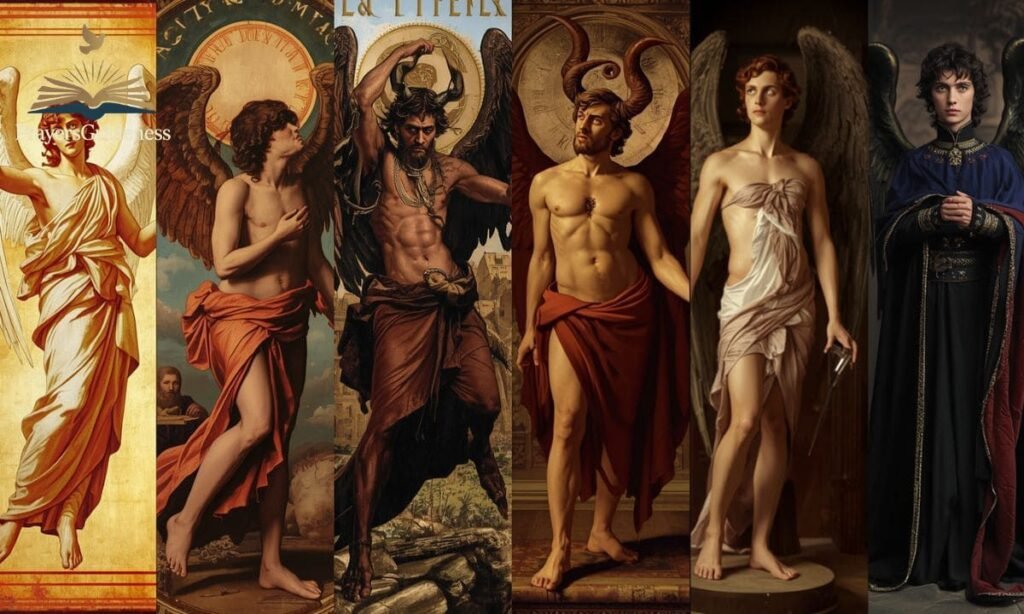
Early Medieval Period: The Ethereal Blue Angel
Early medieval Christian art generally depicted Lucifer with imagery that retained some memory of his original angelic nature. In illuminated manuscripts and early iconography, he often appeared as a luminous, blue-tinted angelic figure, beautiful but twisted, retaining the form of an angel while conveying spiritual corruption through subtle visual distortions. This period’s art was closer to the biblical description than later representations would be, though it was already departing from the Hebrew text’s actual silence on his post-fall appearance.
High Medieval Transformation to Grotesque Forms
By the High Middle Ages, artistic depictions shifted dramatically toward grotesque and frightening imagery. The Church of this period used visual art as a primary teaching tool for a largely illiterate population, and the contrast between pre-fall beauty and post-fall corruption was rendered in increasingly exaggerated physical terms. Twisted bodies, dark colors, monstrous proportions, and features borrowed from pagan mythology began to replace the luminous angelic form of earlier centuries. This was moral teaching through visual shock effective for its purpose, but increasingly divorced from biblical description.
Renaissance Romanticization: Milton’s Tragic Rebel
The Renaissance introduced something entirely new: a romanticized Lucifer. John Milton’s Paradise Lost (1667) portrayed him as a complex, eloquent, and in some ways sympathetic tragic hero, a being of genuine intelligence, charisma, and dignity who chose rebellion over submission. Milton gave him some of literature’s most memorable speeches, including the famous declaration “Better to reign in Hell than serve in Heaven” a line that appears nowhere in Scripture but has been quoted as near-biblical truth by millions.
Milton was writing literary theology, not Scripture. His Lucifer tells us more about seventeenth-century literary ideals of the heroic tragic figure than about the biblical text. But his influence on Western Christian imagination was so profound that many believers absorbed his portrait as the definitive version, displacing the sparse biblical description almost entirely.
Victorian Era Through Modern: The Theatrical Red Devil
The red-horned devil so ubiquitous in modern popular culture can be traced with surprising precision to Victorian theatrical productions. Gounod’s opera Faust, produced in the mid-nineteenth century, used red costuming for its devil character primarily for dramatic visibility on stage; bright red stood out against the dark stage backgrounds of the era. This aesthetic choice was so visually effective that it spread rapidly through theatrical and eventually print culture, until the red devil became the universal symbol for Lucifer or Satan in Western imagery.
By the time mass media, Hollywood, and streaming television entered the picture, the red devil aesthetic had been supplemented with the romanticized rebel of Milton, creating the contemporary cultural Lucifer: attractive, morally ambiguous, charismatic, and almost nothing like the Hebrew text’s description of Helel ben Shachar.
Contrasts Between Artistic and Biblical Portrayals
The gap between what the Bible actually says and what centuries of art have portrayed is one of the most dramatic examples of how cultural storytelling can replace textual foundation:
- Biblical Lucifer: A being of extraordinary beauty and wisdom, adorned with precious stones, holding a position of supreme honor near the throne of God, who fell through pride
- Artistic Lucifer: Ranges from grotesque monster to blue angel to romanticized rebel to red-horned theatrical villain, shaped entirely by the artistic, cultural, and moral priorities of each era
Understanding this contrast matters because recovering the biblically accurate portrait of Lucifer recovers something the artistic versions obscure: the warning is not about an external monster you can identify by looking at it. It is about an internal movement of pride that began in the most beautiful and gifted created being who ever existed.
Jesus Christ as the True Morning Star: The Ultimate Contrast with Lucifer
Revelation 22:16 and Christ’s Claim to the Morning Star Title
One of the most theologically stunning moments in all of Scripture occurs in Revelation 22:16, where Jesus Christ declares of himself: “I am the Root and the Offspring of David, and the bright Morning Star.” The same title morning star that Isaiah used as a metaphor for Lucifer’s brilliance and fall is now claimed by Jesus Christ as his own identity. This is not accidental. It is a deliberate theological contrast woven into the fabric of biblical revelation.
Lucifer reached for the morning star identity through pride and self-exaltation. He grasped at glory that was not his to claim. Christ is the true Morning Star not one who seized the title but one who holds it by the right of nature and received it through the path of humility, suffering, and resurrection.
What Lucifer Seized by Pride, Christ Received Through Humility?
Philippians 2:5-11 provides the theological counterpoint to Isaiah 14’s five “I will” declarations. Where Lucifer said “I will ascend,” Christ “made himself nothing, taking the very nature of a servant.” Where Lucifer said “I will make myself like the Most High,” Christ “humbled himself by becoming obedient to death, even death on a cross.” Where Lucifer grasped for glory, Christ received it as the Father’s gift: “Therefore God exalted him to the highest place and gave him the name that is above every name.”
The contrast is not subtle. It is the central theological architecture of the gospel. Pride reaches upward and falls. Humility descends and is raised. What Lucifer attempted to take, Christ received through the opposite path and received it permanently, without any possibility of loss.
The Theological Significance of Two Beings Sharing One Title
That the same title morning star belongs to both Lucifer’s poetic description and Christ’s self-designation creates one of Scripture’s most powerful implicit contrasts. The morning star in Isaiah 14 is a being of brilliance who fell because his light was borrowed and he refused to acknowledge it. The Morning Star in Revelation 22 is the source of all light, the one whose brilliance is underived, original, and eternal.
Every human being faces a version of this choice: to treat the gifts, abilities, and positions they have received as grounds for self-exaltation, or to hold them as trusts from a Creator whose light infinitely surpasses any reflected glory. Lucifer chose the first path. The outcome was absolute and permanent. Christ models the second path and invites every human being into a story whose ending is resurrection rather than ruin.
How the Gospel Offers What Fallen Angels Never Received: Redemption?
Hebrews 2:16 is remarkable in what it reveals: “For surely it is not angels he helps, but Abraham’s descendants.” The gospel’s provision of redemption, forgiveness, and restoration is extended to human beings, not to fallen angels. This is not a small detail. It means that the story Lucifer began by creating perfection corrupted by pride does not have the same ending for humanity that it had for him.
Human beings who have chosen pride and self-will over dependence on God are offered what angelic rebels were not: a way back through the cross of Jesus Christ. The fall that Lucifer initiated was met by an intervention in human history that could not be reversed the incarnation, death, and resurrection of the Son of God. Where Lucifer’s story ends in permanent judgment, the human story is invited to end in permanent redemption.
Living in the Light of the True Morning Star: Practical Application for Believers
Understanding the biblically accurate Lucifer is not an academic exercise. It has direct and pressing implications for everyday life as a follower of Jesus Christ:
- Recognize pride as the original sin Lucifer did not begin by committing an obviously wicked act. He began with an interior movement of the will that took credit for gifts he had received. This is the temptation most likely to go unrecognized in your own life.
- Hold your gifts as trusts, not trophies. Talent, intelligence, spiritual gifts, ministry success, and relational influence are all things you received. The temptation to treat them as achievements for which you deserve credit is precisely the temptation that destroyed the most gifted being God ever created.
- Embrace dependence as strength The gospel does not call you to self-sufficiency. It calls you to the kind of joyful dependence that Christ himself modeled, and which the Father rewarded with exaltation beyond description.
- Walk in the light of the true Morning Star Where Lucifer’s light was borrowed and ultimately extinguished, Christ’s light is inexhaustible. Living in a relationship with him is the only alternative to the pride that ultimately destroys everything it touches.
Theological Insights from a Biblically Accurate Lucifer
The Paradox of Created Perfection and Free Will
Lucifer’s fall creates one of theology’s most persistent puzzles: how can a being created perfectly choose evil? Classical theology distinguishes between two kinds of creaturely perfection. Integrity perfection describes a being created without flaw but still capable of choosing wrongly the perfection of a genuine free agent. Confirmed perfection describes a being established permanently in goodness, incapable of falling. Lucifer possessed the first kind. Faithful angels, after their period of testing, received the second.
This means genuine freedom requires genuine risk. A created being who cannot choose wrongly is not truly free; it is programming, not moral agency. God created beings with genuine freedom, and genuine freedom made Lucifer’s rebellion possible. This does not make God the author of evil. It means that genuine love and genuine obedience require genuine alternatives, and genuine alternatives include the catastrophic possibility that a perfect being might choose to depart from perfection.
The Origin of Evil Within a Perfect Being
Perhaps the most unsettling implication of Lucifer’s story is that evil did not require external corruption to begin. There was no tempter before the tempter. His rebellion arose entirely from within from a will that turned inward on itself, from a creature who looked at his own gifts and decided they were grounds for self-exaltation rather than worship. Evil’s first cause, within the biblical narrative, is a created will that chose to credit itself for what it had received.
This has profound implications for understanding human sin. The external pressures, cultural influences, and relational damage that shape human choices are real, but they are not the ultimate source of moral failure. The original source of evil is a will that turns away from its Maker and inward toward itself. That is the movement Lucifer pioneered, and it is the movement every human heart must be guarded against.
Pride’s Specific Temptation: Giftedness and Position
Lucifer’s story carries a specific warning for a specific category of person: the gifted, the successful, the spiritually mature, the highly positioned. His sin did not arise despite his gifts, it arose because of them. The more beauty, wisdom, and proximity to God he possessed, the more precisely his temptation targeted his identity rather than his actions. He was not tempted to steal or lie. He was tempted to accept a false identity, one that treated his gifts as his own achievement rather than God’s bestowal.
This makes Lucifer’s warning most pressing not for the marginalized or the struggling but for those who have received much. Proverbs 16:18 declares that pride goes before destruction. Lucifer is the supreme biblical illustration of that proverb, preserved in Scripture as a permanent warning to every human heart that has been entrusted with gifts, abilities, or spiritual position.
Cosmic Implications: Corrupting Others and Spiritual Warfare
The rebellion Lucifer initiated did not remain a private matter between one created being and his Creator. It swept one-third of angelic beings into defection, it introduced temptation into the human story through the serpent in Eden, and it established a spiritual kingdom opposed to God that continues to operate in human history. Ephesians 6:12 describes “rulers,” “authorities,” and “powers of darkness” , a structured hierarchy of spiritual opposition that traces its origin to the first act of created pride.
This is why understanding Lucifer biblically matters practically. Spiritual warfare is not an abstract theological concept. It is the ongoing consequence of a cosmic rebellion that began when the most gifted created being chose self-exaltation over worship. Recognizing its reality, its structure, and its ultimate defeat through Christ shapes how believers engage with the full range of spiritual opposition they encounter in their lives.
Lessons for Humanity: Humility and Dependence on God
The biblically accurate Lucifer ultimately serves as one of Scripture’s most instructive negative examples. His story, stripped of all cultural mythology, teaches several irreplaceable lessons:
- Gifts are trusts, not trophies everything you have been given was given, not earned, and treating it as the basis for self-exaltation is the foundational error of the most gifted being God created
- Position increases vulnerability closeness to God’s presence and work is not a guarantee of faithfulness; it is an opportunity for greater pride or greater humility
- Internal sin is the most dangerous kind the movement that destroyed Lucifer was not visible to others; it was an interior turning of the will that preceded any external act
- Humility is not weakness but wisdom the path of humility that Christ modeled is the only path that leads to genuine and permanent exaltation
Who is Lucifer in the Bible?
Lucifer, in the Bible, is primarily a figure identified through a single Latin word used in Isaiah 14:12 of the King James Version to translate the Hebrew “Helel” meaning “shining one” or “morning star.” Whether this figure is exclusively the human King of Babylon, an angelic being who fell before creation, or both through prophetic dual fulfillment is debated among scholars.
What Scripture consistently presents is a being of extraordinary original beauty and wisdom who fell through pride, and whose story serves as a warning against the corruption of God-given gifts through self-exaltation. The name “Lucifer” itself was never in the original Hebrew text and entered the Bible through Jerome’s fourth-century Latin translation.
The Fall of Lucifer in the Bible
The fall of Lucifer as described in Isaiah 14:12-15 and Ezekiel 28:12-17 follows a precise narrative arc. He was created blameless, adorned with every precious stone, positioned as an anointed cherub on God’s holy mountain. Pride entered when he began to credit his own beauty and wisdom as his own achievement rather than God’s gift. The five “I will” declarations of Isaiah 14:13-14 trace the escalating movement of that pride from a desire for greater position to the climactic declaration of self-deification:
“I will make myself the most High.” The result was total and permanent: cast from his exalted position, brought to ruin, destined for ultimate judgment. Luke 10:18 records Jesus stating he saw Satan fall like lightning from heaven, which many theologians connect to this original rebellion. Revelation 12:9 identifies a great dragon thrown from heaven as “the ancient serpent called the devil, or Satan,” completing the New Testament’s witness to the reality of a cosmic fall that Scripture traces back to the pride of a created being who refused to hold his gifts as gifts.
Frequently Asked Questions
What does “Lucifer” literally mean in the Bible?
The word “Lucifer” comes from the Latin, combining lux (light) and ferre (to bear), meaning “light-bearer” or “light-bringer.” It was Jerome’s Latin translation of the Hebrew word Helel, which means “shining one” or “morning star” and referred to Venus before sunrise.
How many times does the name Lucifer appear in the Bible?
The name “Lucifer” appears exactly once in the King James Bible, in Isaiah 14:12. Modern translations such as the NIV, ESV, and NASB do not use the word “Lucifer” at all, rendering the Hebrew Helel as “morning star” or “day star.”
Are Lucifer and Satan the same being in the Bible?
The Bible never directly and explicitly equates Lucifer and Satan in a single unambiguous statement. This identification developed through centuries of theological tradition, interpretation, and church teaching rather than from an explicit biblical declaration linking the two names.
What did Lucifer look like before his fall?
According to Ezekiel 28:12-17, he was described as the “seal of perfection,” adorned with every precious stone, full of wisdom and perfect in beauty, and blameless from the day of his creation. He walked among fiery stones on God’s holy mountain as an anointed cherub.
Where does the red devil image of Lucifer come from?
The red-horned devil image has no biblical basis. It originated primarily in Victorian theatrical productions, particularly Gounod’s opera Faust, where costume designers chose red for dramatic visibility. Horns and cloven hooves came from pagan Greek imagery of the god Pan, absorbed into European folklore during the medieval period.
What were Lucifer’s five “I will” statements?
The five declarations in Isaiah 14:13-14 are: I will ascend to the heavens; I will raise my throne above the stars of God; I will sit on the mount of assembly; I will ascend above the tops of the clouds; I will make myself like the Most High. These represent the anatomy of pride escalating to self-deification.
Why is Jesus also called the “Morning Star”?
In Revelation 22:16, Jesus Christ calls himself “the bright Morning Star.” This is a deliberate theological contrast with Isaiah 14’s use of the same imagery for Lucifer. Where Lucifer grasped for that title through pride and fell, Christ held it by right and received the Father’s exaltation through humility and obedience.
Conclusion
The biblically accurate Lucifer is not the red-horned monster of Halloween costumes, the romanticized rebel of Paradise Lost, or the charismatic antihero of streaming television. He is something far more theologically significant and far more personally challenging: a being of staggering God-given beauty and wisdom who was destroyed by the decision to treat those gifts as his own achievement. That warning is not directed primarily at the wicked. It is directed at the gifted at everyone who has received much and faces the ever-present temptation to take credit for what was given.
The gospel answers this story with an entirely different arc. Where pride reaches upward and falls, humility descends and is raised. Where Lucifer’s brilliance was extinguished the moment it tried to rival the source of all light, Christ the true Morning Star offers his light as a permanent gift to every human being willing to receive it with open hands rather than grasping fists. Study Isaiah 14, Ezekiel 28, and Revelation 22 together, and you will find not just the story of a fallen angel but the clearest possible portrait of the only two paths every human heart can take.