
Most people picture angels as soft, glowing figures with white wings and gentle smiles but that image comes from art, not the Bible. When real people in Scripture encountered angels, their first response was terror, not comfort, and the angel’s first words were almost always “do not be afraid.”
This article strips away centuries of artistic invention and examines what the Bible actually reveals about angels, their terrifying appearances, their ranked hierarchy, their specific roles, and the profound truths their descriptions carry about the God they serve.
The Biblical Foundation of Angels
Before examining specific angel types, every serious study of angels must start with what Scripture establishes as foundational. Angels are not inventions of medieval imagination. They appear throughout the entire biblical narrative from Genesis to Revelation as established participants in God’s cosmic order.
What Scripture Reveals About Angels?
The Bible introduces angels without explanation or apology. They simply appear in gardens, in deserts, in bedrooms, in prison cells, and around God’s throne as beings whose existence is assumed rather than argued.
Several foundational truths emerge from the full sweep of Scripture:
- Angels are created beings not eternal, not divine, and not to be worshipped (Colossians 1:16, Revelation 22:8-9)
- They were present at creation, described in Job 38:7 as “morning stars” who “shouted for joy” when God laid earth’s foundations
- They exist in vast, uncountable numbers Hebrews 12:22 references “thousands upon thousands of angels in joyful assembly”
- They are organized into ranks, classes, and functions under God’s sovereign authority
- They operate at God’s command, not independently
The Etymology and Meaning of ‘Angel’
The English word “angel” comes from the Greek angelos, which itself translates the Hebrew mal’akh. Both words carry the same core meaning: messenger. This etymology is not incidental; it defines what these beings fundamentally are. Their identity is inseparable from their function. They exist to carry God’s messages, execute God’s commands, and serve those who belong to God.
Understanding this word choice reshapes how we read every angel encounter in Scripture. The focus should always fall on the message delivered, not on the being delivering it.
Angels as Spiritual Beings and Ministering Spirits
Hebrews 1:14 provides the clearest New Testament definition of angels: “Are not all angels ministering spirits sent to serve those who will inherit salvation?”
Three words in that sentence deserve careful attention. They are spirits incorporeal by essence, not bound by physical limitations. They are ministering their existence is oriented toward service, not independent action. And they are sent to operate under divine authority, dispatched by God for specific purposes.
This definition cuts through centuries of mythology. Angels are not semi-divine beings with their own agendas. They are God’s servants, dispatched with precision, and accountable to the One who sends them.
Biblically Accurate Angels and Their Roles
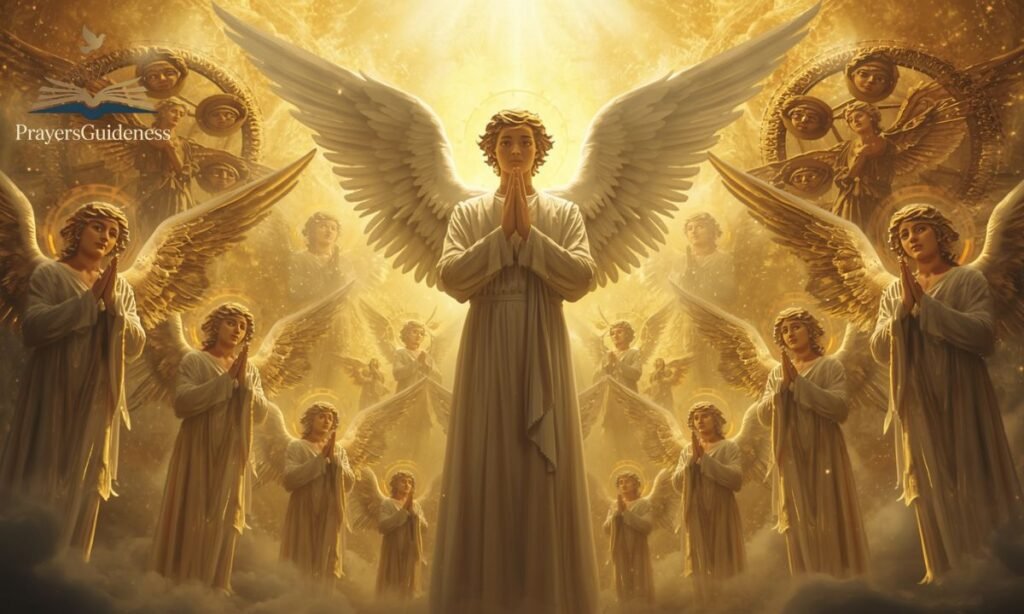
Scripture assigns angels a wide range of specific roles that collectively reveal how deeply involved they are in the ongoing story of human history and divine redemption.
Roles angels perform throughout Scripture:
- Messengers delivering God’s word to individuals (Gabriel to Mary in Luke 1:26-38; to Zechariah in Luke 1:11-20)
- Worshippers continually glorifying God around His throne (Isaiah 6:3; Revelation 4:8)
- Warriors fighting in cosmic spiritual warfare (Daniel 10:13; Revelation 12:7-9)
- Protectors guarding God’s people from harm (Psalm 91:11; Daniel 6:22)
- Executors of judgment carrying out divine justice on nations and individuals (2 Kings 19:35; Acts 12:23)
- Ministers to believers serving and strengthening God’s people (Matthew 4:11; Luke 22:43)
- Announcers heralding key moments in salvation history (Luke 2:10-14; Matthew 28:5-7)
This breadth of function explains why angels appear in such dramatically different contexts throughout Scripture from intimate bedside appearances to mass military executions. Each role serves a distinct purpose in God’s overarching plan.
Description of Angels in the Bible KJV
The King James Version preserves some of the most vivid and detailed angel descriptions in the English biblical tradition. Reading these passages directly dismantles the soft cultural image almost immediately.
Key KJV descriptions include:
Isaiah 6:2 “Above it stood the seraphims: each one had six wings; with twain he covered his face, and with twain he covered his feet, and with twain he did fly.”
Ezekiel 1:16 “The appearance of the wheels and their work was like unto the colour of a beryl: and they four had one likeness: and their appearance and their work was as if it were a wheel in the middle of a wheel.”
Daniel 10:6 “His body also was like the beryl, and his face as the appearance of lightning, and his eyes as lamps of fire, and his arms and his feet like in colour to polished brass, and the voice of his words like the voice of a multitude.”
Revelation 10:1 “And I saw another mighty angel come down from heaven, clothed with a cloud: and a rainbow was upon his head, and his face was as it were the sun, and his feet as pillars of fire.”
These are not soft, glowing figures. They are beings whose forms defy natural categories: fire, lightning, wheels, multiple faces, bodies covered in eyes. The KJV preserves the full weight of these descriptions without softening them.
The Angelic Hierarchy: God’s Organized Order of Heavenly Beings
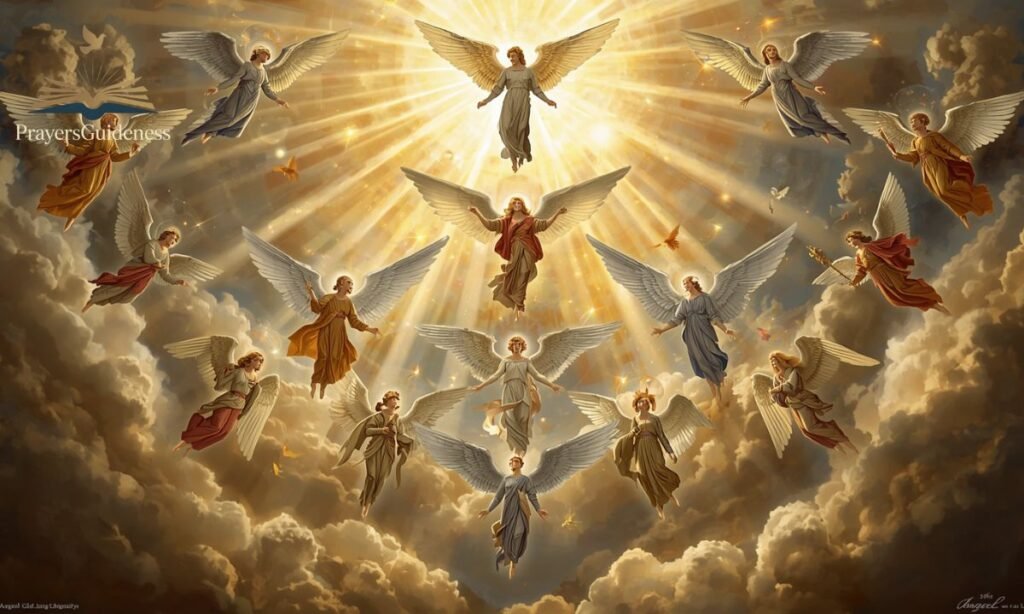
One of the most overlooked dimensions of biblical angelology is that angels are not a uniform, undifferentiated group. Scripture repeatedly indicates that they exist within a structured hierarchy reflecting God’s sovereign order.
Biblical Evidence for Angelic Ranks
Paul references multiple tiers of angelic authority in two key letters. Colossians 1:16 lists “thrones or powers or rulers or authorities” among created things through and for Christ. Ephesians 6:12 warns of “rulers, authorities, powers of this dark world and spiritual forces of evil in the heavenly realms” indicating the same ranked structure exists among fallen angels as well.
These are not decorative terms. They indicate organized classes with distinct functions and levels of authority within the celestial hierarchy.
The Pseudo-Dionysius Framework and Its Influence
The most influential systematic organization of angel ranks comes from Pseudo-Dionysius the Areopagite’s fifth-century work De Coelesti Hierarchia (On the Celestial Hierarchy). He organized angels into three tiers of three orders each:
First Tier (Closest to God):
- Seraphim burning worshippers before God’s throne
- Cherubim guardians of God’s holiness
- Thrones (Ophanim) bearers of God’s throne
Second Tier:
- Dominions governors of lower angels
- Virtues controllers of natural elements
- Powers restrainers of evil forces
Third Tier (Closest to Humanity):
- Principalities guardians of nations and groups
- Archangels chief messengers for highest missions
- Angels general messengers and ministers
Why Does This Hierarchy Matters?
This organized structure reflects a foundational biblical theme: God is a God of order, not chaos. The angelic hierarchy is not a theological curiosity; it reveals that even in the unseen spiritual realm, God’s sovereignty expresses itself through structured authority, delegated roles, and purposeful organization.
Contrasting Biblical Angels with Popular Culture
The distance between the biblical angel and the cultural angel is not small. It is vast, and closing that gap requires honest examination of how the transformation happened.
How Modern Media Misrepresents Angels?
The cultural angel did not appear overnight. Its evolution took centuries:
- Renaissance art introduced soft-featured young figures and the now-ubiquitous chubby baby angels properly called putti in Italian who bear no resemblance to any biblical description
- Milton’s Paradise Lost gave angels dialogue, personalities, and dramatic arcs that read like characters in a novel rather than servants of God
- Victorian literature romanticized angels into comforting domestic figures, emphasizing emotional warmth over divine terror
- Hollywood completed the transformation from the bumbling Clarence in It’s a Wonderful Life to the warm, maternal angels of Touched by an Angel, the message became: angels are here to make you feel better
Each layer of cultural reinterpretation moved further from what Scripture actually describes and closer to what human comfort prefers.
Why Angels Say ‘Fear Not’ in Scripture?
The phrase “do not be afraid” or “fear not” appears in nearly every biblical angel encounter Luke 1:30, Luke 2:10, Matthew 28:5, Judges 6:23, Daniel 10:12. This consistency is deeply revealing.
Angels do not begin their messages with reassurance because they are being polite. They begin with reassurance because the humans before them are overwhelmed, shaking, and in some cases falling face-down as though dead. The angel’s appearance itself triggers profound terror.
This tells us something important: the biblical angel is not designed to be comforting by appearance. Its form carries the weight of divine holiness. The reassurance must come before the message because without it, the recipient would be incapable of receiving anything.
Archangels: The Named Messengers of Heaven
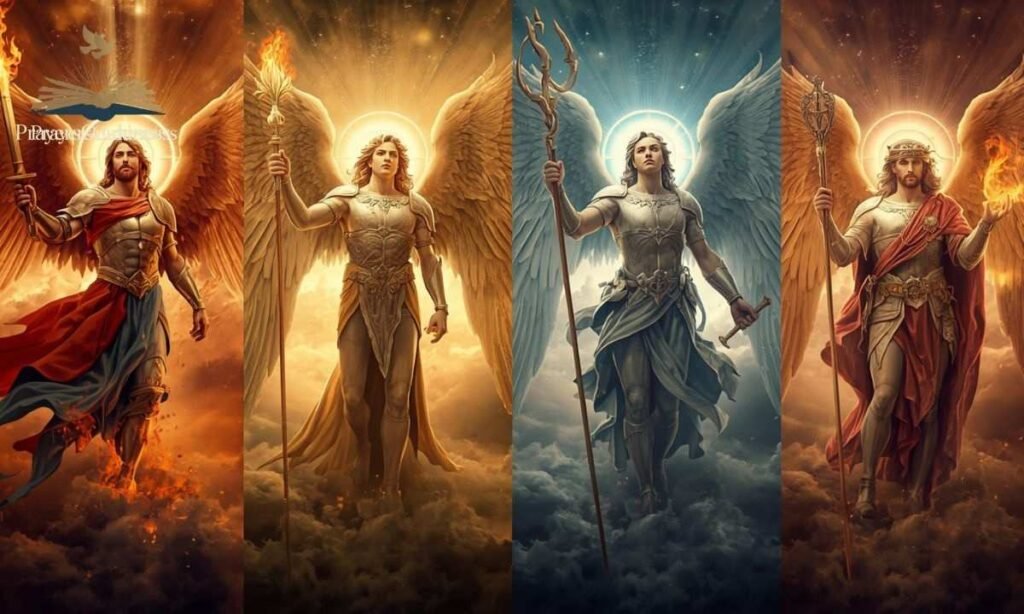
Among the vast host of angels, a small number are distinguished by name in Scripture. Being named given an individual identity signals elevated rank and assignment to uniquely significant missions.
Michael: The Warrior Prince
Michael is the only angel Scripture explicitly identifies as an archangel. His name means “Who is like God?” a declaration that functions as both a question and a war cry, asserting God’s incomparable supremacy.
Michael appears three times in the Old Testament twice in Daniel (10:13, 12:1) as a warrior prince fighting on behalf of Israel against demonic opposition and twice in the New Testament. Jude 1:9 reveals his restraint, deferring even in dispute with Satan to God’s authority rather than exercising independent judgment. Revelation 12:7-9 depicts him leading God’s angelic armies in cosmic warfare against the dragon.
Michael is not a gentle guardian. He is the commander of heaven’s military forces dispatched for battles that determine the outcomes of nations and ages.
Gabriel: God’s Chief Herald
Gabriel’s name means “God is my strength” or “mighty one of God.” His role in Scripture is announcement specifically, the announcement of events that change the entire course of human history.
He appears to Daniel in chapters 8 and 9, explaining visions that span centuries of prophetic history. In the New Testament, he stands before Zechariah in the temple to announce the birth of John the Baptist (Luke 1:11-20), and then six months later appears to Mary in Nazareth to deliver the most significant announcement in all of human history that she will conceive the Son of God (Luke 1:26-38).
The Unique Role of Named Angels
Why are most angels unnamed while a few are specifically identified? The pattern suggests that angels receive names in Scripture when their individual assignments have particular significance for salvation history. Being named is not a rank promotion, it is a narrative marker, signaling to the reader that this particular encounter matters in ways that require the messenger to be remembered.
Seraphim: The Fiery Worshipers at God’s Throne
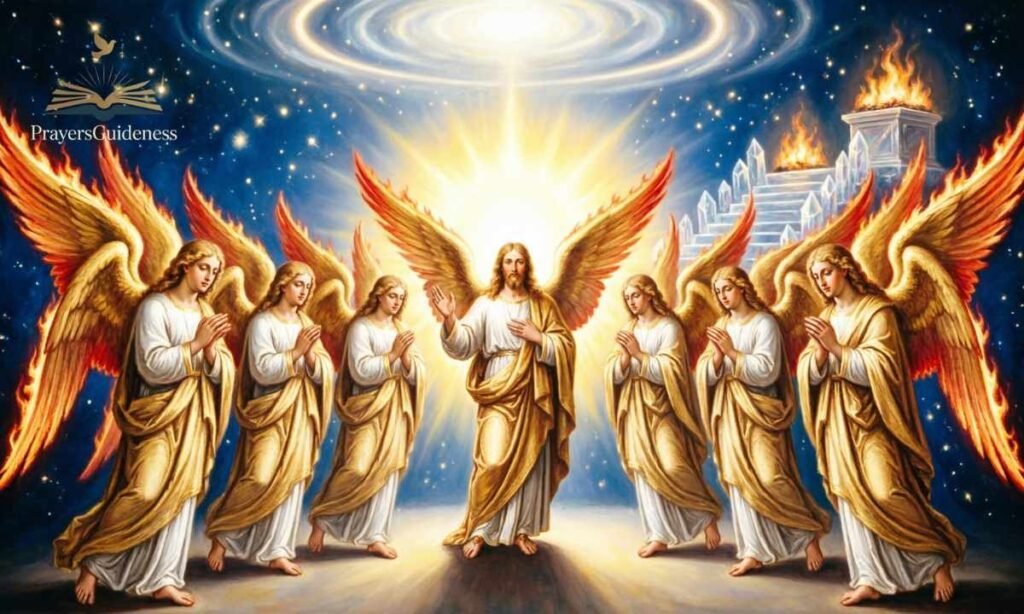
Isaiah 6 contains the only direct biblical description of seraphim. The word itself comes from a Hebrew root meaning “to burn.” These are not gentle creatures. They are beings whose very nature is associated with fire consuming, purifying, holy fire.
The Six Wings and Their Symbolic Meaning
Isaiah 6:2 describes each seraph with six wings, each pair serving a distinct function:
- Two wings to cover the face even these powerful beings cannot look directly at God’s full glory
- Two wings to cover the feet a posture of humility before absolute holiness
- Two wings to fly readiness for immediate obedience and service
The wing arrangement itself is a theological statement. The greatest created beings in God’s immediate presence spend four of their six wings in acts of reverence and humility, and only two in active service. Worship precedes work. Reverence precedes action.
The Threefold Holy Proclamation
The seraphim cry to one another in Isaiah 6:3: “Holy, holy, holy is the Lord Almighty; the whole earth is full of His glory.” The threefold repetition known in Jewish tradition as the Trisagion is the most emphatic form of superlative in biblical Hebrew. It does not mean merely “very holy.” It means holiness of an entirely different and absolute category. The voice is so powerful it shakes the doorposts and thresholds of the heavenly temple.
Seraphim’s Role in Purification
After Isaiah’s terrified cry of unworthiness, a seraph takes a burning coal from the altar with tongs and touches it to Isaiah’s lips. This act of burning purification is the precondition for prophetic ministry. Before the prophet can speak for God, he must be cleansed by the fire of God’s holiness. The seraph is the agent of that transformation.
Cherubim: The Multi-Faced Guardians of Holy Places
Cherubim appear more frequently in Scripture than any other named angel type. Yet they bear no resemblance whatsoever to the chubby winged babies of Renaissance art; those are putti, figures from classical mythology that artists incorporated into Christian imagery during the Renaissance. Biblical cherubim are terrifying guardians of divine holiness.
Cherubim Guarding the Garden of Eden
Genesis 3:24 records the first biblical mention of cherubim: “He placed on the east side of the Garden of Eden cherubim and a flaming sword flashing back and forth to guard the way to the tree of life.” Their assignment is pure enforcement preventing sinful humanity from accessing eternal life before the redemption story has reached its conclusion.
The Four Faces and Their Significance
Ezekiel 10 describes cherubim with four faces: a human face, a lion’s face, an ox’s face, and an eagle’s face. Early church interpreters saw these as representing the full breadth of created life, human wisdom, royal strength, sacrificial service, and sovereign elevation. Whether that interpretation is precise or not, the imagery communicates beings whose nature transcends any single created category.
Cherubim on the Ark of the Covenant
Exodus 25:18-20 commands Moses to place two golden cherubim on the mercy seat of the Ark of the Covenant, their wings spread over it and their faces turned toward each other. The mercy seat, the place where atonement was made annually on Yom Kippur, is guarded by cherubim, just as they guarded Eden. Holiness requires protection. Access to God requires mediation.
Eyes Symbolizing God’s Omniscience
Ezekiel 10:12 describes the cherubim’s entire bodies including their backs, hands, and wings as covered with eyes. This imagery recurs in Revelation 4:6-8 with the four living creatures around God’s throne. Eyes throughout Scripture represent knowledge, awareness, and perception. A being covered in eyes speaks of omnidirectional awareness nothing escapes its sight. In context, these eyes reflect the omniscience of the God they serve.
Living Creatures and Ophanim: The Most Mysterious Angels
No category of biblical angels has captured modern imagination more dramatically than the ophanim the wheel beings of Ezekiel’s vision. They are the primary source of the “biblically accurate angels” phenomenon that spread across internet culture, because their description seems so alien to human experience that it borders on incomprehensible.
Ezekiel’s Vision of the Living Creatures
Ezekiel 1:4-14 describes four living creatures emerging from a storm cloud of flashing lightning. Each had four faces, four wings, straight legs with calves’ feet that sparkled like polished bronze, and human hands under their wings. They moved in perfect unity, never turning as they moved, always facing all four directions simultaneously.
This is not human anatomy. This is not animal anatomy. This is a being whose form defies every natural category and that is precisely the point. These creatures serve a God whose nature transcends every human category, and their forms reflect that transcendence.
The Wheel Angels: Ophanim Explained
Alongside the living creatures, Ezekiel sees four wheels on the ground. Each wheel intersects with another at right angles, creating a “wheel within a wheel” formation (Ezekiel 1:16). These are the ophanim, a Hebrew word simply meaning “wheels.” The wheels move in whatever direction the living creatures move, without turning. Their rims are tall and full of eyes all around. The spirit of the living creatures is in the wheels.
These are not mechanical devices. They are living angelic beings whose form is so far removed from human experience that the prophet can only describe them through extended comparison and analogy.
Wheels Within Wheels Covered With Eyes
The detail of eyes covering the rims of the wheels connects the ophanim to the same theological symbolism as the cherubim omnidirectional awareness, total knowledge, nothing hidden from their sight. The wheels within wheels may represent the intersection of God’s providential activity across multiple dimensions of reality simultaneously earthly events and heavenly purposes turning together in perfect coordination.
The Relationship Between Living Creatures and Cherubim
Ezekiel 10:20 makes the identification explicit: “These were the living creatures I had seen beneath the God of Israel by the Kebar River, and I realized that they were cherubim.” The four living creatures of Ezekiel 1 and the cherubim of Ezekiel 10 are the same beings. This connection ties the most visually extreme biblical angel description back to the guardians of Eden and the Ark beings whose entire existence is oriented toward protecting and serving the holiness of God.
General Angels: The Messengers Throughout Scripture
Beyond the specialized classes seraphim, cherubim, ophanim, archangels Scripture describes countless general angels who appear as God’s messengers throughout the biblical narrative.
Angels Appearing in Human Form
The most striking and practically significant detail about general angels is their capacity to appear completely human. Genesis 18 records three men arriving at Abraham’s tent; only the narrative reveals them as the Lord and two angels. Genesis 19 describes two angels entering Sodom and sitting in the city square, initially appearing to Lot as ordinary travelers.
Hebrews 13:2 applies this truth directly to believers: “Do not forget to show hospitality to strangers, for by doing so some people have entertained angels without knowing it.” This is not metaphorical. It is a genuine warning that angels can appear as completely ordinary people, with no visible wings, no glowing light, and no indication of their true nature.
The Mighty Acts Angels Perform
Scripture records angels performing acts that demonstrate power operating far beyond any human capacity:
- A single angel destroyed 185,000 Assyrian soldiers in a single night (2 Kings 19:35)
- An angel shut the mouths of lions in Daniel’s den (Daniel 6:22)
- Angels released the apostles from locked prison cells (Acts 5:19, Acts 12:7-10)
- An angel struck down Herod Agrippa for accepting divine worship (Acts 12:23)
- An angel strengthened Jesus in the Garden of Gethsemane (Luke 22:43)
Angels Holding Swords as Warriors
The warrior dimension of angels appears repeatedly in Scripture. The angel opposing Balaam stood in the road with a drawn sword (Numbers 22:23). The commander of the Lord’s army appeared to Joshua before the battle of Jericho with a sword drawn in his hand (Joshua 5:13-14). Cherubim guards Eden with a flaming sword. Angels will accompany Christ at His return as a conquering army (Matthew 25:31, 2 Thessalonians 1:7).
The Angel of the Lord: Messenger, Theophany, or Pre-Incarnate Christ?
Among all angel categories in Scripture, none is more theologically significant than “the Angel of the Lord.” This figure appears throughout the Old Testament in ways that consistently blur the line between messenger and the One who sends.
Biblical Appearances of the Angel of the Lord
The Angel of the Lord appears at pivotal moments throughout the Old Testament:
- He speaks to Hagar in the wilderness (Genesis 16:7-13) and she names the place “You are the God who sees me”
- He calls to Abraham from heaven during the binding of Isaac (Genesis 22:11-18) and speaks with full divine authority, swearing by Himself
- He appears in the burning bush and declares to Moses “I am the God of your father” (Exodus 3:2-6)
- He appears to Gideon (Judges 6:11-24) and receives worship without redirecting it
- He appears to Manoah and his wife (Judges 13) and when asked His name, replies “It is beyond understanding”
Is the Angel of the Lord a Pre-Incarnate Christ?
The pattern across these appearances is consistent and striking: this angel speaks as God, accepts worship that other angels refuse (Revelation 22:8-9), uses the first person divine “I AM,” and is sometimes directly equated with God by those who encounter Him.
Many theologians including Justin Martyr, Origen, and numerous modern scholars have identified the Angel of the Lord as a Christophany: a pre-incarnate appearance of the second person of the Trinity. No created angel in Scripture accepts worship or speaks in God’s first-person voice without correction. Only the Angel of the Lord consistently does both.
This remains a subject of scholarly debate, but the theological weight of the evidence points toward something more than a created messenger and studying these appearances deepens both our understanding of Christ and our reading of the Old Testament.
Angels in the Life and Ministry of Christ
The ministry of Jesus Christ is surrounded by angelic activity from beginning to end. This reveals that the Incarnation was a cosmic event that mobilized the entire heavenly host.
Angelic Announcements of Jesus’ Birth
Gabriel’s appearance to Mary in Luke 1:26-38 is the central angelic announcement of the New Testament. But the angelic activity surrounding the birth of Christ extends further:
- Gabriel announces John the Baptist’s birth to Zechariah in the temple (Luke 1:11-20)
- An angel appears to Joseph in a dream, confirming Mary’s pregnancy (Matthew 1:20-21)
- An angel of the Lord appears to shepherds in the field, immediately joined by “a great company of the heavenly host” a vast angelic army praising God (Luke 2:9-14)
Angels Ministering to Jesus During His Earthly Life
After Jesus’ forty days of wilderness temptation, Matthew 4:11 records: “Then the devil left him, and angels came and attended him.” At the darkest moment before the crucifixion, Luke 22:43 records that “an angel from heaven appeared to him and strengthened him” in Gethsemane. He who could have called twelve legions of angels (Matthew 26:53) instead received their quiet service.
Angels at the Resurrection and Ascension
The resurrection is announced by angels. Matthew 28:2-7 describes an angel whose “appearance was like lightning and his clothing white as snow” the guards “shook and became like dead men.” At the Ascension, two angels appear beside the watching disciples and declare that the same Jesus they saw ascending will return in the same way (Acts 1:10-11).
Jesus’ Teaching About Angels and Judgment
Jesus refers to His own “Father’s angels” (Matthew 13:41) who will execute the final harvest of judgment. He warns that “their angels in heaven always see the face of my Father” regarding children (Matthew 18:10). He confirms angelic joy over repentant sinners (Luke 15:10). Jesus treats angelic reality not as mythology but as present, active, and operationally significant.
Angelic Activity in Acts and the Early Church
The book of Acts demonstrates that angelic activity did not cease with the ascension of Christ.
Angels Guiding the Spread of the Gospel
Philip receives direction from an angel of the Lord to travel south on the road from Jerusalem to Gaza where he encounters and baptizes the Ethiopian eunuch, bringing the gospel to Africa (Acts 8:26). Cornelius, a Roman centurion, receives a vision of an angel instructing him to send for Peter initiating the first formal opening of the gospel to Gentiles (Acts 10:3-8). Angels are active agents in the geographic and demographic expansion of the gospel.
Angels Executing Divine Judgment
Acts 12:23 records that Herod Agrippa I, after accepting the crowd’s worship without deflecting it to God, was “immediately” struck by an angel of the Lord and died. This single verse places angelic judicial execution in the middle of early church history demonstrating that the God who dispatched angels as executors of judgment in the Old Testament remained fully operational in the New.
Paul’s Theological Insights About Angels
Paul builds angels into his theological framework. Colossians 1:16 establishes that angels are created beings made through and for Christ. Ephesians 6:12 names the ranked structure of spiritual opposition. Galatians 1:8 states that even if an angel from heaven preached a different gospel, it is accursed. For Paul, angels are real, ranked, powerful, and entirely subordinate to Christ and the gospel.
Angels in the Book of Revelation
No biblical book contains more angel appearances than Revelation. From chapter 1 through chapter 22, angels serve as messengers, warriors, administrators of judgment, and worshippers.
Seven Angels With Seven Trumpets
Revelation 8-9 describes seven angels standing before God and receiving seven trumpets. Each trumpet blast initiates a specific catastrophic judgment upon the earth. These angels do not act independently; they wait for divine instruction, then execute with precision. Their sequence reveals that even final judgment is orderly, structured, and under God’s complete sovereignty.
Angels Pouring Out God’s Wrath
Revelation 16 describes seven angels pouring out seven bowls of God’s wrath upon the earth. Each bowl corresponds to a specific judgment. The specificity and deliberate sequence again emphasizes that angelic judgment is not random; it is the precise execution of divine justice.
Michael’s War Against the Dragon
Revelation 12:7-9 records the most explicit cosmic battle in Scripture: “Then war broke out in heaven. Michael and his angels fought against the dragon, and the dragon and his angels fought back. But he was not strong enough, and they lost their place in heaven.” Michael leads God’s forces in the decisive expulsion of Satan from the heavenly realm.
The Angel Binding Satan
Revelation 20:1-3 describes an angel coming down from heaven with a key to the Abyss and a great chain, seizing the dragon and binding him for a thousand years. This single unnamed angel accomplishes what entire human civilizations have failed to do: restrain the enemy of souls. The power differential demonstrates the absolute sovereignty of God over all spiritual opposition.
The Biblical Truth About Guardian Angels
No angel-related question is searched more frequently than this: do we each have a guardian angel?
What Scripture Actually Teaches About Personal Protection?
Psalm 91:11 “For He will command His angels concerning you to guard you in all your ways” clearly establishes that angels are commanded to guard human beings. What it does not establish is a one-to-one permanent assignment of a specific angel to a specific individual. Matthew 18:10 is the verse that comes closest to that idea: “their angels always see the face of my Father” regarding children suggests individual association, though interpreters have debated for centuries whether this means permanent personal guardians.
Communal Versus Individual Angelic Ministry
The clearest pattern in Scripture is that angelic protection is granted to God’s people collectively, with specific individuals receiving angelic ministry at particular moments of need. Elisha’s servant sees the mountain covered with horses and chariots of fire as a collective protective force (2 Kings 6:17). Peter is released from prison by an angel at a specific moment of crisis (Acts 12:7-10), not by a permanent personal guardian.
Angels Assigned to Nations and Groups
Daniel 10 reveals the larger dimension of angelic assignment. The “prince of the Persian kingdom” who withstands the angelic messenger is a demonic entity assigned to that nation, while Michael is “the great prince who protects your people” a national assignment. Revelation 1-3 addresses angels of specific churches. Angelic assignment operates at multiple levels simultaneously: cosmic, national, communal, and in at least some cases individual.
Satan’s Fall and the Origin of Fallen Angels
Understanding biblically accurate angels requires confronting the reality that not all angels remained loyal.
Satan as a Fallen Cherub
Ezekiel 28:14 addresses “the anointed guardian cherub” who “walked among the fiery stones” on God’s holy mountain. The description transcends any human king; no earthly monarch was in Eden or walked among divine fire. It describes a being of extraordinary beauty, wisdom, and proximity to God who was corrupted by pride. This is consistent with the understanding that Satan was originally among the highest class of angelic beings, a cherub stationed in God’s immediate presence.
The Meaning of ‘Satan’ and ‘Lucifer’
“Satan” comes from the Hebrew ha-satan, meaning “the adversary” or “the accuser.” It describes his function as the one who opposes God’s purposes and accuses God’s people. “Lucifer” comes from Jerome’s 4th-century Latin Vulgate translation of the Hebrew Helel in Isaiah 14:12 a word meaning “shining one” or “morning star,” describing the planet Venus at its most brilliant. The name “Lucifer” as a personal identifier entered Western Christian consciousness through this translation, not through the original Hebrew text.
Pride as the Root of Angelic Rebellion
Isaiah 14:13-14 records five “I will” declarations: ascending to heaven, raising the throne above God’s stars, sitting on the mount of assembly, ascending above the clouds, and making oneself like the Most High. Each declaration moves further from the creature’s proper relationship with the Creator from service toward sovereignty, from dependence toward independence. Pride, according to Proverbs 16:18, goes before destruction. Satan is the supreme biblical illustration.
Other Fallen Angels: Demons and Spiritual Rebellion
Satan’s fall was not solitary. Scripture documents a broader rebellion.
The Sons of God in Genesis Six
Genesis 6:1-4 describes “sons of God” who took human women as wives, producing the Nephilim. The phrase “sons of God” (bene Elohim) in its Old Testament usage consistently refers to angelic beings (Job 1:6, 2:1, 38:7). The passage suggests a transgression of created boundaries by angelic beings, an interpretation confirmed by the New Testament.
Angels Bound in Chains of Darkness
Both 2 Peter 2:4 and Jude 1:6 reference angels who “did not keep their positions of authority but abandoned their proper dwelling” and are now “kept in darkness, bound with everlasting chains for judgment on the great Day.” These passages describe the judicial imprisonment of specific fallen angels who crossed a particular boundary of rebellion.
Demons and Unclean Spirits in the New Testament
The Gospels document extensive demonic activity of unclean spirits possessing people, causing illness, and distorting behavior. Jesus expels them with authority, often provoking declarations of His divine identity from the demons themselves (Mark 1:24, Mark 5:7). Paul’s spiritual warfare framework in Ephesians 6:12 reveals that these are part of a structured spiritual opposition: rulers, authorities, powers, and spiritual forces operating in organized opposition to God’s purposes.
Angels in the Bible Appearance
Gathering the full biblical data on angelic appearance produces a picture dramatically different from any artistic tradition.
What the Bible says angels look like:
- In human form, completely indistinguishable from ordinary men (Genesis 18-19; Hebrews 13:2)
- With faces and forms like lightning, eyes like flaming torches, limbs like polished bronze (Daniel 10:5-6)
- Clothed in dazzling white or radiant garments (Matthew 28:3; Acts 1:10; Revelation 15:6)
- Surrounded by overwhelming light that causes humans to collapse (Revelation 1:17; Daniel 10:9)
- With six wings (seraphim, Isaiah 6:2; Revelation 4:8)
- With four wings and four faces (cherubim, Ezekiel 10:21)
- As vast intersecting wheels of fire covered with eyes (ophanim, Ezekiel 1)
- Enormous in scale one angel in Revelation 10:1-2 stands with one foot on the sea and one on the land
What the Bible never says about angels:
- Halos a later artistic convention borrowing from Roman and Greek depictions of divinity
- Feathered white wings on otherwise human-looking bodies this specific combination appears nowhere in Scripture
- Female gender every named and described angel in canonical Scripture is referred to with masculine pronouns
- Harps as standard equipment this image comes from Revelation’s description of the twenty-four elders, not angels
- Earning their wings a pure cultural invention with no scriptural basis whatsoever
Biblically Accurate Angels Tattoo
The “biblically accurate angel” visual aesthetic has become one of the most distinctive and searched tattoo concepts in recent years. What drives this interest is the sheer visual power of the scriptural descriptions of beings covered in eyes, intersecting wheels of fire, six-winged creatures veiling their faces in the presence of God.
The most popular elements used in biblically accurate angel tattoos include:
- Ophanim wheel designs concentric intersecting wheels covered with eyes, often rendered in fine-line detailed black ink
- Seraphim forms six-winged beings, often simplified into geometric or illustrative styles with the three wing pairs clearly differentiated
- Cherubim faces the four faces (human, lion, ox, eagle) arranged symmetrically, often as a chest or back piece
- Eyes motifs the recurring eye imagery from Ezekiel and Revelation rendered as standalone elements or integrated into larger designs
- Daniel 10 figure the radiant, lightning-faced being in polished bronze, rendered in detailed portrait style
For believers, these tattoos carry genuine theological weight, a permanent reminder that the spiritual realm is real, vast, organized, and operating under the sovereignty of a God whose messengers alone inspire holy terror.
Frequently Asked Questions
What do biblically accurate angels actually look like?
Biblical angels range from beings indistinguishable from ordinary humans to multi-faced, six-winged, fire-covered creatures whose appearance causes people to collapse in terror. Their form varies entirely by type and assignment.
Are cherubim the same as the chubby baby angels in art?
No. Biblical cherubim are terrifying four-faced, four-winged guardians covered in eyes. The chubby winged babies are putti figures borrowed from classical Roman art during the Renaissance with no biblical basis.
Do we each have a guardian angel?
Scripture confirms angels guard God’s people (Psalm 91:11), but the Bible never explicitly teaches a permanent one-to-one angelic assignment for every individual believer.
Are Lucifer and Satan the same being?
Most Christian tradition identifies them as the same, but Scripture never directly equates them. “Lucifer” entered the Bible through Jerome’s 4th-century Latin translation of the Hebrew word Helel.
Why do angels say “Fear not” whenever they appear?
Because their true appearance genuinely overwhelms humans when angels reveal their glory, the consistent biblical response is people collapsing as though dead, making reassurance a necessary first step.
How many angels are there according to the Bible?
Scripture never gives a precise number but uses language suggesting an uncountable multitude Revelation 5:11 references “ten thousand times ten thousand,” a Greek expression meaning beyond counting.
What is the Angel of the Lord in the Old Testament?
The Angel of the Lord speaks as God, accepts worship without redirecting it, and uses first-person divine language patterns that lead many theologians to identify Him as a pre-incarnate appearance of Christ.
Conclusion
The biblically accurate angel is nothing like the cultural invention; it is a being of fire, lightning, and incomprehensible form whose appearance alone reduces strong people to trembling. Every detail Scripture gives about their appearance, their ranks, and their roles points back to the absolute holiness and sovereign power of the God they serve.
Returning to what the Bible actually says about angels does not make them less wonderful, it makes them far more so. And in studying these extraordinary beings, we ultimately encounter the God who created them, commands them, and dispatched them in service of those He loves.

1 thought on “Understanding Biblically Accurate Angels: Their True Nature and Significance in Scripture”