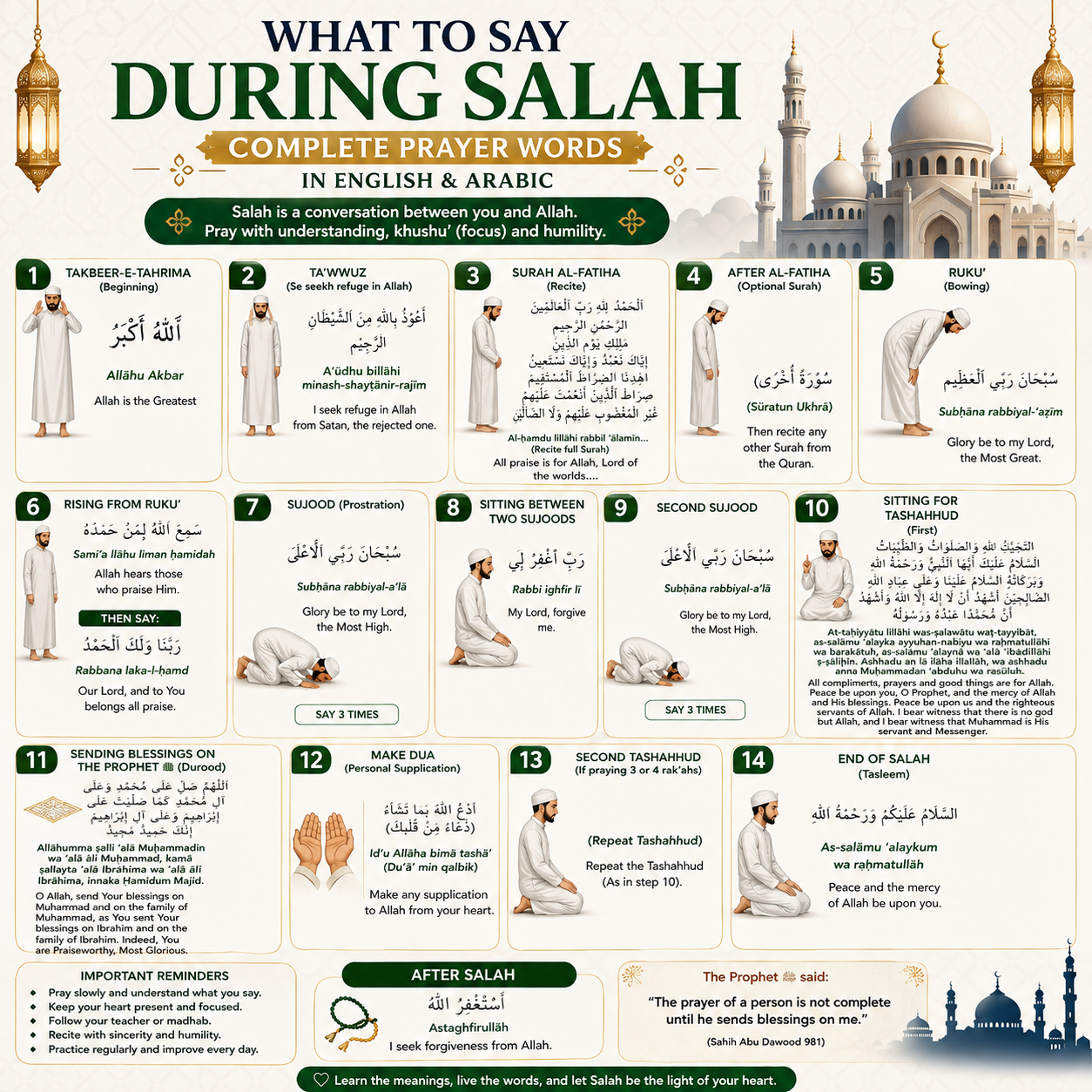
What to Say During Salah
What to Say During Salah: Complete Prayer Words in English & Arabic
Introduction to the Words Recited During Salah
The words recited during Salah are an essential part of Islamic prayer and help Muslims remember and worship Allah throughout each part of the prayer. Salah includes specific phrases, Quranic verses, supplications, and praises that are recited while standing, bowing, prostrating, and sitting. Learning these words is especially important for beginners because understanding their meaning can make prayer more focused and meaningful.
During Salah, Muslims recite phrases such as “Allahu Akbar,” which means “Allah is the Greatest,” as they move between different positions. Surah Al-Fatihah is recited while standing, followed by additional Quranic verses or a Surah in the appropriate prayers. In Ruku, Muslims glorify Allah, while Sujood includes specific words of praise and submission. The final sitting includes the Tashahhud, Durood, and supplications before the prayer ends.
The Arabic wording of Salah is traditionally preserved because the Quran and established prayer recitations are recited in Arabic. However, understanding the English meaning can help Muslims appreciate what they are saying. Learning the translation does not replace the Arabic recitation required in Salah, but it can improve concentration and awareness during worship.
For beginners, it is helpful to learn the recitations gradually rather than trying to memorize everything at once. Start with the essential phrases and Surah Al-Fatihah, then learn the remaining supplications and recitations step by step. By understanding both the Arabic words and their meanings, Muslims can perform Salah with greater confidence, concentration, and devotion.

What to Say When Making the Intention (Niyyah)
The intention, or Niyyah, is the purpose a Muslim has in the heart before beginning Salah. A person should know which prayer they are about to perform, such as Fajr, Dhuhr, Asr, Maghrib, or Isha, and intend to worship Allah by performing that prayer. Niyyah is primarily an action of the heart and does not require a specific sentence to be spoken aloud.
For example, before praying Fajr, a Muslim can simply have the sincere intention in their heart that they are going to perform the Fajr prayer for the sake of Allah. The same principle applies to the other obligatory prayers. If a person is praying a Sunnah or voluntary prayer, they should similarly intend the particular prayer they are performing.
There are differences among Islamic schools regarding whether verbally stating the intention is recommended or necessary. Many scholars emphasize that the intention is fundamentally in the heart, while some communities commonly teach a verbal formulation as a way of helping a person focus. Beginners should follow the practice taught by a trusted qualified scholar or the Islamic school they follow.
The important point is sincerity and awareness of the prayer being performed. Once the intention is established, the Muslim can begin Salah with Takbir by saying “Allahu Akbar.” Understanding that Niyyah is about sincerely intending the worship helps beginners avoid unnecessary worry about memorizing a particular Arabic sentence before starting the prayer.

Takbir: “Allahu Akbar”
“Allahu Akbar” (الله أكبر) means “Allah is the Greatest.” It is one of the most important phrases in Salah and is used to indicate transitions between different positions of the prayer. The first Takbir, called Takbirat al-Ihram, marks the beginning of Salah. After making the intention, the worshipper raises their hands according to the established practice and says “Allahu Akbar” to enter the prayer.
During Salah, Takbir is also recited when moving from one position to another, such as going from standing into Ruku, moving into Sujood, and rising from Sujood. These Takbirs help connect the different physical positions of prayer with remembrance of Allah. The exact details of hand placement and movement can vary among Islamic schools and established traditions.
When saying “Allahu Akbar,” the words should be pronounced clearly and with attention to their meaning. A Muslim should remember that Allah is greater than everything else and that Salah is an act of worship dedicated to Him. Saying the Takbir with concentration can help a person leave worldly distractions behind and focus on prayer.
For beginners, learning the pronunciation and meaning of “Allahu Akbar” is an important early step in learning Salah. It is useful to practice the phrase correctly and understand when it is recited throughout the prayer. With regular practice, the Takbirs and movements of Salah become easier to remember and perform confidently.
What to Say While Standing (Qiyam)
Qiyam is the standing position in Salah, during which a Muslim stands respectfully before Allah and recites specific words and verses. After the opening Takbir, the worshipper generally recites the opening supplication, followed by seeking refuge with Allah and then saying the Bismillah before reciting Surah Al-Fatihah. The exact order and details can vary slightly according to the Islamic school being followed.
The most important recitation during Qiyam is Surah Al-Fatihah, which is recited in every Rak’ah where its recitation is required. It contains praise of Allah, recognition of His mercy and authority, and a request for guidance to the straight path. In prayers where additional Quranic recitation is performed, another Surah or verses from the Quran are recited after Al-Fatihah.
While standing, a Muslim should recite calmly and with concentration rather than rushing through the words. Understanding the meaning of the Quranic verses can help improve khushu, or attentiveness and humility, during Salah. The Arabic recitation is maintained in the prayer, while learning the English translation can help the worshipper understand what is being said.
Qiyam is therefore an important part of Salah because it combines physical standing with Quranic recitation and remembrance of Allah. Beginners should first focus on learning Surah Al-Fatihah correctly, then gradually memorize the other required supplications and short Surahs. Practicing regularly can make the standing portion of Salah easier and more meaningful.

Thana: Opening Supplication
Thana is the opening supplication recited at the beginning of Salah after the first Takbir and before reciting Surah Al-Fatihah. A commonly recited Thana begins with “Subhanak Allahumma wa bihamdika”, praising Allah and declaring His perfection. It is a supplication of glorification and helps the worshipper begin the prayer with humility and focused attention.
The commonly recited Arabic wording is: “Subhanaka Allahumma wa bihamdika, wa tabarakasmuka, wa ta’ala jadduka, wa la ilaha ghayruk.” Its meaning is approximately: “Glory is to You, O Allah, and praise is Yours; blessed is Your name, exalted is Your majesty, and there is no deity except You.” Learning the meaning can help a Muslim understand the words rather than reciting them without awareness.
Thana is generally considered a Sunnah supplication rather than one of the essential pillars of Salah. There are also other authentic opening supplications that have been reported from the Prophet Muhammad ﷺ. Muslims may follow the opening supplication taught by their trusted scholar or Islamic school, and beginners do not need to become anxious if they are still learning it.
After reciting Thana, the worshipper continues with the remaining opening recitations before beginning Surah Al-Fatihah. Learning Thana gradually can help beginners become familiar with the complete sequence of Salah. More importantly, its words encourage the worshipper to recognize Allah’s greatness and begin prayer with sincerity, praise, and humility.
Ta’awwudh and Tasmiyah
Ta’awwudh is the practice of seeking protection in Allah from Satan before beginning Quranic recitation. A commonly recited phrase is “A’udhu billahi min ash-shaytanir-rajim,” meaning “I seek refuge in Allah from the accursed Satan.” It reminds the worshipper to turn to Allah for protection and helps prepare the mind for focused Quranic recitation during Salah.
Tasmiyah refers to saying “Bismillahir-Rahmanir-Rahim,” meaning “In the name of Allah, the Most Merciful, the Especially Merciful.” It is recited before Surah Al-Fatihah and is closely associated with beginning Quranic recitation. The exact ruling and whether it is recited aloud or quietly can differ among Islamic schools and prayer traditions.
Both Ta’awwudh and Tasmiyah help create a focused transition into the recitation of the Quran. The worshipper should say them calmly and understand their general meaning rather than rushing through the words. Learning their pronunciation and meanings can help beginners develop greater concentration and awareness during Salah.
After these opening recitations, the worshipper proceeds to Surah Al-Fatihah, which is a central part of the prayer. Beginners should gradually learn the Arabic pronunciation accurately while also studying the English meaning. When there are differences in the detailed method, following a trusted qualified scholar or established local Islamic tradition can help ensure that Salah is performed correctly.
Surah Al-Fatihah in Arabic and English
Surah Al-Fatihah is the opening chapter of the Quran and one of the most important recitations in Salah. It is recited during the standing position of prayer according to the applicable Islamic ruling. The Surah contains praise of Allah, recognition of His mercy and authority, and a sincere request for guidance to the straight path. Understanding its meaning can help Muslims develop greater concentration and humility during prayer.
Arabic:
بِسْمِ اللَّهِ الرَّحْمَنِ الرَّحِيمِ
الْحَمْدُ لِلَّهِ رَبِّ الْعَالَمِينَ
الرَّحْمَنِ الرَّحِيمِ
مَالِكِ يَوْمِ الدِّينِ
إِيَّاكَ نَعْبُدُ وَإِيَّاكَ نَسْتَعِينُ
اهْدِنَا الصِّرَاطَ الْمُسْتَقِيمَ
صِرَاطَ الَّذِينَ أَنْعَمْتَ عَلَيْهِمْ غَيْرِ الْمَغْضُوبِ عَلَيْهِمْ وَلَا الضَّالِّينَ
English meaning:
“In the name of Allah, the Most Merciful, the Especially Merciful. All praise belongs to Allah, Lord of the worlds. The Most Merciful, the Especially Merciful. Master of the Day of Judgment. You alone we worship, and You alone we ask for help. Guide us to the straight path, the path of those You have blessed, not those who have earned Your anger, nor those who have gone astray.”
For beginners, learning Surah Al-Fatihah accurately should be a priority because of its central role in Salah. The Arabic should be learned with proper pronunciation, while the English meaning can help the worshipper understand the message being recited. Muslims should follow the recitation method taught by a qualified teacher or trusted Islamic authority, especially when learning pronunciation and detailed rulings about Salah.
What to Recite After Surah Al-Fatihah
After reciting Surah Al-Fatihah during Salah, the worshipper may recite another Surah or a selection of Quranic verses in the Rak’ahs where additional recitation is prescribed or recommended. Common short Surahs include Surah Al-Ikhlas, Surah Al-Falaq, Surah An-Nas, and Surah Al-Kawthar. Beginners often start with shorter Surahs because they are easier to memorize and practice.
The additional Quranic recitation should be performed in Arabic during Salah. Muslims can study the English translation separately to understand the meaning and message of the verses. Learning the meaning can improve concentration and help the worshipper reflect on what is being recited, but the translation itself does not replace the Arabic Quranic recitation in Salah.
The amount and placement of additional recitation can vary depending on the prayer and Islamic school. In the commonly practiced method, an additional Surah or verses are recited after Al-Fatihah in the first two Rak’ahs of obligatory prayers, while the details differ for other types of prayer. Muslims should follow the established method taught by a trusted scholar or qualified Quran teacher.
When choosing what to recite, beginners should focus on accuracy rather than trying to memorize many Surahs at once. Regular practice of short Surahs, along with learning their meanings, can make Salah easier and more meaningful. Over time, memorizing additional portions of the Quran gives Muslims more options for recitation and helps them maintain variety in their prayers.
What to Say During Ruku
Ruku is the bowing position in Salah that comes after the standing recitation. When moving into Ruku, the worshipper says “Allahu Akbar” and then bows with humility before Allah. The back is kept reasonably straight, and the hands are placed on the knees according to the established method. This position represents submission, humility, and recognition of Allah’s greatness.
While in Ruku, the commonly recited phrase is “Subhana Rabbiyal Adheem” (سُبْحَانَ رَبِّيَ الْعَظِيمِ), meaning “Glory is to my Lord, the Most Great.” It is commonly recited three times, although the number can vary in voluntary prayer. The worshipper should say it calmly and focus on the greatness and perfection of Allah.
Ruku is not simply a physical movement; it is also an opportunity to express humility and glorify Allah. Muslims should avoid rushing through this position and should remain still for an appropriate moment before rising. Proper pronunciation of the Arabic words is important, especially for beginners who are learning the complete Salah.
After completing Ruku, the worshipper rises to a standing position and recites the appropriate words before moving into Sujood. Learning the words and movements together helps beginners understand the complete sequence of Salah. Regular practice can make Ruku and its recitation natural while maintaining the required focus and respect during prayer.
What to Say When Rising From Ruku
When rising from Ruku, the worshipper moves back to a standing position and recites “Sami‘Allahu liman hamidah” (سَمِعَ اللَّهُ لِمَنْ حَمِدَهُ), which means “Allah hears the one who praises Him.” This phrase is said while rising from the bowing position. The movement should be performed calmly rather than hurriedly.
After reaching the standing position, the worshipper commonly says “Rabbana wa lakal-hamd” (رَبَّنَا وَلَكَ الْحَمْدُ), meaning “Our Lord, and to You belongs all praise.” Other authentic forms of praise are also reported. The exact practice can vary depending on the Islamic school and whether the person is praying individually or behind an imam.
This moment between Ruku and Sujood is important because it combines movement with praise and remembrance of Allah. The worshipper should stand upright and remain settled before moving into the next position. Taking time to maintain stillness helps preserve the proper form and attentiveness of Salah.
For beginners, it is useful to memorize both phrases along with their meanings. Understanding that these words express praise and recognition of Allah can help improve concentration during prayer. Once the standing position after Ruku is completed, the worshipper says the appropriate Takbir and moves into Sujood.
What to Say During Sujood
Sujood, or prostration, is one of the most important positions in Salah. When moving into Sujood, the worshipper says “Allahu Akbar” and then prostrates with humility before Allah. The forehead and nose, hands, knees, and toes are placed on the ground according to the established method. The worshipper should remain calm and settled in this position rather than rushing through it.
During Sujood, the commonly recited phrase is “Subhana Rabbiyal A‘la” (سُبْحَانَ رَبِّيَ الْأَعْلَى), meaning “Glory is to my Lord, the Most High.” It is commonly recited three times. This phrase expresses the perfection and greatness of Allah while the worshipper is in a position of complete humility and submission.
Sujood is also a special time for sincere supplication. Muslims may make appropriate Du’a during prostration, particularly in voluntary prayers, following the guidance of their Islamic school. The worshipper should focus on Allah and avoid rushing, allowing enough time to maintain stillness and concentration.
For beginners, learning “Subhana Rabbiyal A‘la” and understanding its meaning is an important part of learning Salah. Practicing the phrase together with the correct movement can make prayer easier to perform. After completing Sujood, the worshipper rises while saying “Allahu Akbar” and moves to the sitting position between the two prostrations.
What to Say Between the Two Sujoods
After the first Sujood, the worshipper rises to a sitting position while saying “Allahu Akbar.” This sitting position is called the sitting between the two prostrations. The worshipper should sit calmly and remain settled before performing the second Sujood. Taking a brief moment of stillness helps maintain the proper sequence and attentiveness of Salah.
A commonly recited supplication in this position is “Rabbighfir li” (رَبِّ اغْفِرْ لِي), meaning “My Lord, forgive me.” Some authentic supplications contain additional words asking Allah for mercy, guidance, well-being, and provision. Beginners can start by memorizing the short phrase and gradually learn the longer authentic supplications.
The sitting between the two Sujoods is an opportunity to ask Allah for forgiveness and mercy. The worshipper should say the supplication with sincerity and awareness rather than treating it as words that must simply be repeated. The body should remain still and the prayer should continue at a calm and respectful pace.
After completing the supplication, the worshipper says “Allahu Akbar” and moves into the second Sujood. Learning this short supplication, along with its meaning and pronunciation, helps beginners understand what they are saying throughout Salah. With regular practice, the transition between the two prostrations becomes natural and easy to remember.
What to Say During the Final Sitting (Qa’dah)
The final sitting, known as Qa’dah, is the sitting position near the end of Salah. After completing the required prostrations of the final Rak’ah, the worshipper sits and recites specific supplications before ending the prayer. The exact sitting posture can vary according to Islamic school and established practice, but the worshipper should remain calm and focused.
During the final sitting, the worshipper first recites the Tashahhud, which contains testimony of faith and greetings of peace and blessings upon the Prophet Muhammad ﷺ. After Tashahhud, Durood Ibrahim is commonly recited, followed by a suitable supplication asking Allah for goodness, forgiveness, protection, or other beneficial matters.
The final sitting is an important opportunity to remember Allah and make sincere Du’a before completing Salah. Muslims should learn the Arabic recitations accurately and understand their meanings where possible. For beginners, it can be helpful to memorize Tashahhud first, followed by Durood Ibrahim and a short authentic supplication.
After completing the recitations, the worshipper ends Salah by turning the head to the right and then to the left while saying “As-salamu alaykum wa rahmatullah” each time. This concludes the prayer. Learning the final sitting step by step helps beginners complete Salah confidently and understand the significance of the words they recite.
Tashahhud in Arabic and English
The Tashahhud is a significant recitation made while sitting during Salah, particularly in the final sitting. It contains praise of Allah, greetings of peace, and the testimony of faith. Muslims should learn its Arabic wording accurately because it is part of the established prayer recitation, while understanding the English meaning can help improve concentration and awareness.
Arabic:
التَّحِيَّاتُ لِلَّهِ وَالصَّلَوَاتُ وَالطَّيِّبَاتُ، السَّلَامُ عَلَيْكَ أَيُّهَا النَّبِيُّ وَرَحْمَةُ اللَّهِ وَبَرَكَاتُهُ، السَّلَامُ عَلَيْنَا وَعَلَى عِبَادِ اللَّهِ الصَّالِحِينَ، أَشْهَدُ أَنْ لَا إِلَهَ إِلَّا اللَّهُ، وَأَشْهَدُ أَنَّ مُحَمَّدًا عَبْدُهُ وَرَسُولُهُ.
English meaning:
“All greetings, prayers, and good things are for Allah. Peace be upon you, O Prophet, and the mercy of Allah and His blessings. Peace be upon us and upon the righteous servants of Allah. I testify that there is no deity except Allah, and I testify that Muhammad is His servant and Messenger.”
The Tashahhud expresses important beliefs of Islam, including the worship of Allah alone and recognition of Prophet Muhammad ﷺ as His servant and Messenger. Its words also include greetings of peace and blessings. Reflecting on these meanings can help the worshipper maintain humility and focus during the final sitting.
There are authentic variations in the wording of Tashahhud reported in the Sunnah, so Muslims may encounter slightly different versions. Beginners should learn one authentic version accurately from a trusted Quran teacher or qualified scholar and practice its pronunciation regularly. After Tashahhud, the worshipper normally continues with Durood Ibrahim before making the final supplication and ending Salah.
Durood Ibrahim in Arabic and English
Durood Ibrahim is a well-known supplication recited after the Tashahhud during the final sitting of Salah. It asks Allah to send blessings and peace upon Prophet Muhammad ﷺ and his family, just as He blessed Prophet Ibrahim عليه السلام and his family. Learning this supplication is an important part of completing the final recitations of Salah.
Arabic:
اللَّهُمَّ صَلِّ عَلَىٰ مُحَمَّدٍ وَعَلَىٰ آلِ مُحَمَّدٍ، كَمَا صَلَّيْتَ عَلَىٰ إِبْرَاهِيمَ وَعَلَىٰ آلِ إِبْرَاهِيمَ، إِنَّكَ حَمِيدٌ مَجِيدٌ.
اللَّهُمَّ بَارِكْ عَلَىٰ مُحَمَّدٍ وَعَلَىٰ آلِ مُحَمَّدٍ، كَمَا بَارَكْتَ عَلَىٰ إِبْرَاهِيمَ وَعَلَىٰ آلِ إِبْرَاهِيمَ، إِنَّكَ حَمِيدٌ مَجِيدٌ.
English meaning:
“O Allah, send Your blessings upon Muhammad and upon the family of Muhammad, as You sent blessings upon Ibrahim and upon the family of Ibrahim. Indeed, You are Praiseworthy and Glorious. O Allah, bless Muhammad and the family of Muhammad, as You blessed Ibrahim and the family of Ibrahim. Indeed, You are Praiseworthy and Glorious.”
The Durood reminds Muslims of the honor and importance of sending blessings upon the Prophet Muhammad ﷺ. Its wording also connects the prayer of Muslims with the legacy of Prophet Ibrahim عليه السلام. Understanding the meaning can help worshippers recite it with greater attention rather than simply memorizing the Arabic words.
There are authentic variations in the wording of this supplication, so Muslims may encounter slightly different versions in different prayer guides. Beginners should learn an authentic version from a reliable teacher or trusted Islamic source and practice its pronunciation carefully. After Durood Ibrahim, the worshipper can recite an appropriate supplication before concluding Salah with Salam.
Dua After Durood
After reciting Durood Ibrahim in the final sitting of Salah, the worshipper may make a sincere Dua before ending the prayer with Salam. The Prophet Muhammad ﷺ taught several supplications for this part of Salah, including asking Allah for protection from the punishment of Hell, the punishment of the grave, the trials of life and death, and the trial of the Dajjal. A commonly recited Dua is: “Allahumma inni a’udhu bika min ‘adhabi jahannam, wa min ‘adhabil-qabr, wa min fitnatil-mahya wal-mamat, wa min sharri fitnatil-masihid-dajjal.”
The meaning is: “O Allah, I seek refuge in You from the punishment of Hell, from the punishment of the grave, from the trials of life and death, and from the evil trial of the false messiah (Dajjal).” This supplication teaches Muslims to seek Allah’s protection from serious difficulties in this life and the Hereafter. Understanding the meaning can help the worshipper make the Dua with sincerity and concentration.
There are also other authentic supplications that can be recited before completing Salah. Muslims can ask Allah for forgiveness, mercy, guidance, protection, and goodness. Beginners should first learn one authentic Dua correctly and gradually learn additional supplications. The exact rulings regarding making personal Dua in Salah can differ among Islamic schools, so following a trusted qualified scholar is recommended.
After completing the chosen Dua, the worshipper concludes Salah with Salam by turning the head to the right and then to the left, saying “As-salamu alaykum wa rahmatullah.” Learning the Dua after Durood helps complete the final sitting of Salah with remembrance, humility, and sincere reliance upon Allah.
What to Say Before Ending Salah
Before ending Salah, the worshipper completes the final sitting by reciting the Tashahhud, followed by Durood Ibrahim and an appropriate Dua. This final part of the prayer is an opportunity to praise Allah, send blessings upon Prophet Muhammad ﷺ, and ask Allah for forgiveness, protection, guidance, and other forms of goodness. The worshipper should remain calm and focused during these recitations.
One well-known Dua before ending Salah is the supplication seeking protection from the punishment of Hell, the punishment of the grave, the trials of life and death, and the trial of the Dajjal. Muslims may also recite other authentic supplications taught in the Sunnah. Learning the Arabic wording and understanding its meaning can help make the final moments of Salah more meaningful.
After completing the final Dua, the worshipper prepares to conclude the prayer with Salam. The head is turned toward the right while saying “As-salamu alaykum wa rahmatullah,” meaning “Peace and the mercy of Allah be upon you.” The greeting is then repeated while turning toward the left. This marks the completion of Salah.
Beginners should learn the final sitting gradually, starting with the Tashahhud and then learning Durood and a reliable Dua. It is important not to rush these recitations or become unnecessarily worried about minor differences in practice. Following an authentic method taught by a trusted scholar or qualified teacher can help ensure that the prayer is performed with confidence and proper attention.
How to Say Salam at the End of Salah
At the end of Salah, the worshipper concludes the prayer with Salam, a greeting of peace. After completing the final sitting, including Tashahhud, Durood Ibrahim, and the chosen Dua, the person turns their head toward the right and says “As-salamu alaykum wa rahmatullah”. This means “Peace and the mercy of Allah be upon you.”
The worshipper then turns the head toward the left and repeats “As-salamu alaykum wa rahmatullah.” The greeting is directed toward those on either side, including fellow worshippers and the angels. The movement should be calm and clear rather than rushed, allowing the person to properly complete the prayer.
Salam marks the completion of Salah and brings the formal prayer to an end. Muslims should learn the Arabic wording and its meaning so they can perform this final part with understanding and concentration. The exact movement and some details can vary slightly according to Islamic schools and established traditions.
For beginners, the final sequence is simple to remember: complete the final sitting, recite the required supplications, turn to the right and say the Salam, then turn to the left and repeat it. Practicing this sequence regularly helps make the conclusion of Salah natural, confident, and properly organized.
Complete Salah Recitation Order for Beginners
For beginners, learning the recitation order of Salah step by step makes prayer much easier to understand and memorize. After making the intention, the worshipper begins with the opening Takbir, “Allahu Akbar,” and then stands in Qiyam. The opening supplication (Thana), Ta’awwudh, Tasmiyah, and Surah Al-Fatihah are recited according to the prayer method being followed. In the first two Rak’ahs of obligatory prayers, an additional Surah or Quranic verses are commonly recited after Al-Fatihah.
After the standing recitation, the worshipper says “Allahu Akbar” and moves into Ruku. In Ruku, the common glorification is “Subhana Rabbiyal Adheem.” The worshipper then rises while reciting “Sami’Allahu liman hamidah,” followed by “Rabbana wa lakal-hamd.” After standing upright, the worshipper says Takbir and moves into the first Sujood, where “Subhana Rabbiyal A’la” is commonly recited. The worshipper then sits between the two Sujoods and may say “Rabbighfir li,” before performing the second Sujood.
After completing the required Rak’ahs, the worshipper sits for Tashahhud. In the final sitting, Tashahhud is followed by Durood Ibrahim and an appropriate Dua before concluding the prayer. The exact recitation sequence can vary slightly depending on the type of Salah and Islamic school, so beginners should learn the method taught by a trusted qualified scholar or teacher.
Finally, the worshipper ends Salah by turning the head toward the right and saying “As-salamu alaykum wa rahmatullah,” then turning toward the left and repeating the same greeting. Beginners should focus on learning the essential recitations gradually rather than trying to memorize everything at once. Regular practice, accurate pronunciation, and understanding the meanings can make the complete Salah sequence easier and more meaningful.
Common Mistakes When Reciting During Salah
One common mistake when reciting during Salah is rushing through the words without proper pronunciation or understanding. Quranic verses and essential supplications should be recited carefully and calmly. Beginners may find some Arabic words difficult at first, so regular practice with a qualified Quran teacher can help improve pronunciation and reduce errors.
Another mistake is forgetting or mixing up the order of the recitations. For example, a person may become confused about when to recite Surah Al-Fatihah, an additional Surah, the words of Ruku, or the supplications during Sujood. Learning the prayer sequence step by step and practicing each section separately can make the complete order easier to remember.
Some worshippers also become overly worried about minor pronunciation mistakes or differences in established prayer practices. Islamic schools can differ regarding certain details of recitation, such as whether particular phrases are said aloud or quietly. Beginners should follow a reliable method taught by a trusted scholar instead of constantly changing their practice because of conflicting information.
Finally, reciting without understanding the meaning can make it harder to maintain concentration during Salah. Learning the English meaning of the Arabic words can help a Muslim reflect on the praise, supplications, and declarations being made. With patience, regular practice, and sincere attention, beginners can gradually improve their recitation and perform Salah with greater confidence and focus.
Frequently Asked Questions About Salah Recitations
What should a beginner learn first for Salah?
A beginner should start with the essential recitations, especially Takbir (“Allahu Akbar”), Surah Al-Fatihah, the words recited in Ruku and Sujood, Tashahhud, and the final Salam. Learning these gradually is easier than trying to memorize the entire prayer at once. Understanding the English meanings can also help improve concentration.
Do Salah recitations have to be in Arabic?
The Quranic verses and established Arabic recitations of Salah are traditionally performed in Arabic. English translations are useful for understanding the meanings, but they do not replace the Arabic recitation during Salah. Beginners who are still learning should make a sincere effort to learn the required Arabic words correctly.
What should I say in Ruku and Sujood?
In Ruku, a commonly recited phrase is “Subhana Rabbiyal Adheem,” meaning “Glory is to my Lord, the Most Great.” In Sujood, a commonly recited phrase is “Subhana Rabbiyal A’la,” meaning “Glory is to my Lord, the Most High.” These phrases are normally repeated, commonly three times.
What is recited in the final sitting?
The final sitting generally includes Tashahhud, followed by Durood Ibrahim and an appropriate Dua before the prayer is concluded. There are authentic variations in some supplications, so Muslims may follow the version taught by a trusted qualified scholar or teacher.
What if I make a mistake while reciting Salah?
Small mistakes can happen, especially when someone is learning. A beginner should continue learning proper pronunciation and seek guidance from a qualified Quran teacher if needed. The detailed ruling for different types of mistakes can vary, so significant or repeated concerns should be discussed with a trusted Islamic scholar rather than relying on assumptions.
Conclusion
Learning the words recited during Salah is an important part of developing a strong and meaningful prayer routine. From the opening Takbir and Surah Al-Fatihah to the words of Ruku, Sujood, Tashahhud, Durood, and the final Salam, each recitation has a specific place and purpose. Understanding the meanings of these words can help Muslims pray with greater concentration and awareness.
Beginners do not need to memorize everything at once. It is better to learn the essential recitations gradually, practice their Arabic pronunciation, and understand their English meanings. Starting with Surah Al-Fatihah, Takbir, the words of Ruku and Sujood, and Tashahhud can provide a strong foundation for learning the complete prayer.
It is also important to remember that some details of Salah recitation can differ among recognized Islamic schools and traditions. When there is uncertainty, Muslims should follow a reliable method taught by a qualified scholar or trusted Quran teacher. This helps prevent confusion and allows beginners to develop confidence in their prayer.
Ultimately, Salah is more than memorizing Arabic words and movements. It is an act of worship, remembrance, humility, and communication with Allah. By learning the recitations carefully, understanding their meanings, and practicing regularly, Muslims can perform Salah with greater confidence, focus, and devotion.
For More Information about this article, Please Click Here.
For More Information, Please Click Here.