
Have you ever felt a strong inner conviction that something in your life needed to change? That quiet but firm nudge pulling you back toward truth? That, in many ways, is what the Bible calls a rebuke. It’s not a punishment, it’s a gift from a God who loves you too much to let you stay on the wrong path.
The word rebuke appears dozens of times throughout Scripture, and every instance carries the same core truth: correction rooted in love. Understanding what it truly means in the Bible can transform how you respond to God’s discipline and how you treat others who need your honest, caring voice.
What Does Rebuke Mean in the Bible?
Biblical Definition of Rebuke
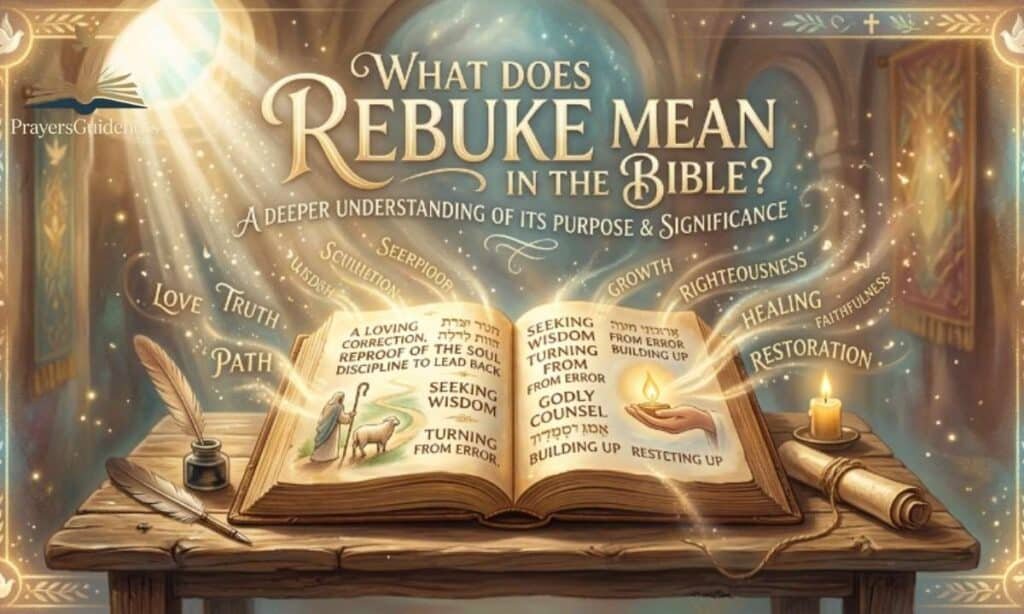
In the Bible, rebuke means to firmly correct, warn, or confront someone with truth not to shame them, but to restore them. It is a deliberate act of love aimed at turning a person away from sin and back toward righteousness.
The concept is beautifully captured in Proverbs 27:5: “Better is open correction than hidden love.” This verse reveals something counterintuitive: staying silent when someone is sinning is not kindness. Real love speaks up.
Biblical correction always has a purpose: restoration, not humiliation. It calls a person to repentance and offers them a path back to God. A close synonym used in Scripture is “admonish” to warn someone gently but firmly for their own benefit.
Hebrew and Greek Words for Rebuke
The original languages of the Bible give us a richer picture of what rebuke truly means.
In the Old Testament, two primary Hebrew words are used:
- Yakach means to prove, correct, convince, or reason with someone. This word appears when prophets confront kings and nations about their sin. It is logical, instructional correction that seeks repentance, not punishment.
- Ga’ar means to rebuke with authority, often connected to God commanding or restraining. Psalm 106:9 uses this word when God commands the Red Sea and its parts, showing the raw power behind divine authority.
In the New Testament, two Greek words carry the idea:
- Epitimao means to charge sternly or admonish. This is the exact word used when Jesus confronts demons and the wind in the Gospels.
- Elegcho means to expose, convict, or bring to light. This appears in John 16:8 and 2 Timothy 3:16, where Scripture itself is described as useful for correcting believers.
Together, these words show that correction in Scripture is both logical and authoritative always in service of truth and love.
Why Does God Rebuke People?
God Rebukes Those He Loves
This is perhaps the most important truth about divine correction: God corrects the people He loves. Revelation 3:19 says plainly, “Those whom I love I rebuke and discipline.” If God is correcting you, it is not a sign of rejection it is a sign that you matter to Him.
Proverbs 3:11–12 reinforces this: “My son, do not despise the Lord’s discipline… because the Lord disciplines those he loves, as a father the son he delights in.” A father who never corrects his child doesn’t love him; he neglects him. God’s correction is the opposite of neglect.
The Purpose of Divine Rebuke
God rebukes with a clear goal in mind: to bring His people back into alignment with His truth and protect them from the consequences of sin. His correction is never about crushing you, it’s about shaping you.
Hebrews 12:11 acknowledges the difficulty of this process: “No discipline seems pleasant at the time, but painful. Later on, however, it produces a harvest of righteousness and peace.” The short-term discomfort of correction leads to long-term spiritual growth.
God corrects through three primary channels:
- His Word Scripture convicts and corrects (2 Timothy 3:16–17)
- The Holy Spirit who guides believers into truth (John 16:13)
- Life circumstances difficult seasons that reveal blind spots and call us to reflection
How Did Jesus Use Rebuke in the Bible?
Jesus Rebuked People
Jesus rebuked both individuals and crowds throughout His ministry, and every correction came from a place of love and truth. He confronted the scribes and Pharisees for their hypocrisy and spiritual pride (Matthew 23:13–36). He stopped those who prevented children from coming to Him (Mark 10:14). He corrected His own disciples when their thinking was wrong not to discourage them, but to realign them with God’s purpose.
Jesus Rebuked Demons
One of the most powerful demonstrations of Jesus’ authority is seen in His rebuke of unclean spirits. In Mark 1:25, Jesus commands a demon: “Be quiet! Come out of him!” The Greek word used here is epitimao, the same word for authoritative command. The demon obeyed immediately.
This shows that words spoken with divine authority carry real spiritual power over the forces of darkness.
Jesus Rebuked the Wind and Waves
In Mark 4:39, during a violent storm on the Sea of Galilee, Jesus stood and rebuked the wind and said to the waves, “Quiet! Be still!” The storm immediately ceased. This remarkable act shows that Jesus’ word brings order, peace, and calm even in physical chaos.
What Does “Rebuke in Jesus’ Name” Mean?
Is Rebuking in Jesus’ Name Biblical?
The phrase “I rebuke you in Jesus’ name” is widely used in Christian prayer and spiritual warfare. It is grounded in the biblical principle that believers act under Jesus’ authority, not their own.
In Zechariah 3:2, God Himself says, “The Lord deals with you, Satan.” In Jude 1:9, even the archangel Michael did not confront the devil in his own authority but said, “The Lord deal with you.”
This teaches an important lesson: spiritual authority is not about the volume of your voice or the strength of your personality. It flows from the authority of Jesus Christ.
When Do Christians Use This Phrase?
Christians typically use this phrase in three contexts:
- During prayer, when resisting spiritual attacks or temptation
- In spiritual warfare, when confronting demonic oppression
- When interceding for others who are under spiritual bondage
The key is that the rebuke is always directed under Christ’s lordship not as a magic formula, but as an acknowledgment that all authority belongs to Him.
What Does It Mean to Rebuke the Devil?
Bible Verses About Resisting Satan
Scripture is clear that believers have a responsibility to resist the enemy. James 4:7 says, “Resist the devil, and he will flee from you.” 1 Peter 5:8–9 calls believers to be alert and stand firm in faith against the schemes of the enemy.
Zechariah 3:2 and Jude 1:9 together show that rebuking Satan is something done under God’s authority, not independently.
Can Christians Rebuke Demons?
The New Testament shows that believers do have authority over evil spirits in Jesus’ name. Luke 10:17–19 records the disciples returning and saying, “Lord, even the demons submit to us in your name.” Jesus confirms this authority.
However, the model from Jude 1:9 is important: the authority rests in Christ, not in the believer’s own spiritual status. Christians rebuke evil not by personal power but by invoking the name and authority of Jesus.
How to Rebuke Someone Biblically?
Rebuke with Love and Humility
The spirit of biblical rebuke is never superiority, it’s care. Galatians 6:1 gives the clearest instruction: “Brothers and sisters, if someone is caught in a sin, you who live by the Spirit should restore that person gently. But watch yourselves, or you also may be tempted.”
Before you correct someone, check your own heart. Are you doing this for their good, or to prove a point? Humility is not optional in biblical correction, it’s required.
Use Scripture, Not Personal Opinion
A correction grounded in personal preference or emotions is manipulation. A correction grounded in Scripture is truth spoken in love. 2 Timothy 4:2 instructs: “Preach the word; be prepared in season and out of season; correct, rebuke and encourage with great patience and careful instruction.”
When confronting someone, point to God’s Word, not your own feelings about their behavior. This removes pride from the equation and puts truth at the center.
When Should You Rebuke Someone?
Not every situation calls for rebuke, and Scripture offers wisdom on discernment:
- When a fellow believer is caught in clear, ongoing sin (Matthew 18:15)
- When false teaching is spreading and endangering others (Titus 1:13)
- When someone you love is heading toward serious spiritual harm
- After you have examined your own heart and motives first
Titus 3:10 also reminds us that there are limits: warn a divisive person once, then twice and if they refuse to listen, step away. You are responsible for speaking the truth, not for forcing change.
Examples of Rebuke in the Bible
Nathan Rebukes David
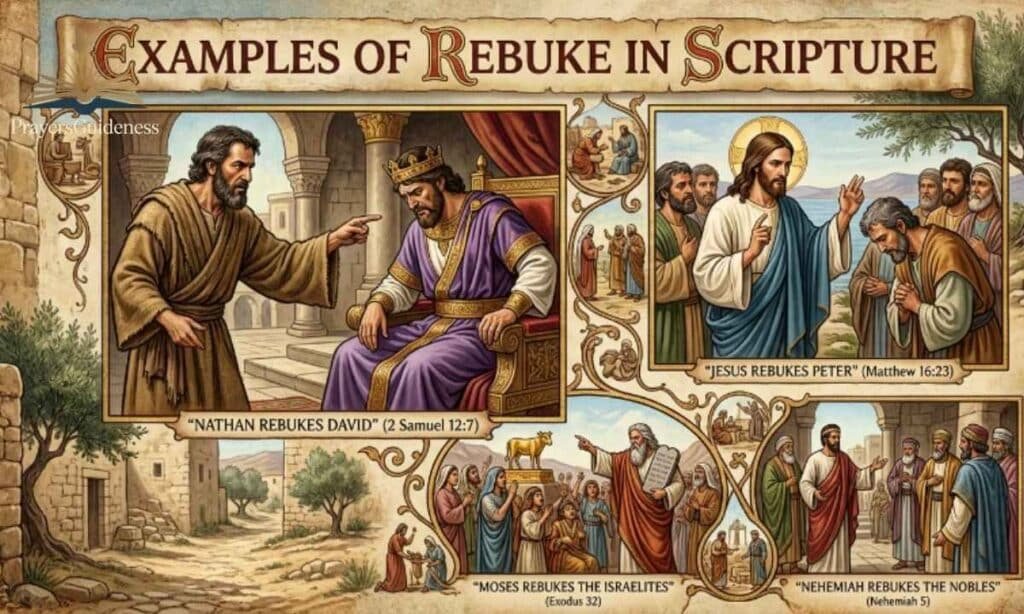
One of the most powerful examples of rebuke in Scripture is Nathan’s confrontation of King David in 2 Samuel 12:1–14. David had committed adultery with Bathsheba and arranged the death of her husband Uriah. Rather than accuse David directly, Nathan told a parable about a rich man who stole a poor man’s only lamb. David’s anger flared until Nathan delivered the blow: “You are the man!”
David’s response was immediate and genuine: “I have sinned against the Lord” (2 Samuel 12:13). Nathan’s rebuke, delivered with wisdom and courage, opened the door to repentance and restoration.
Jesus Rebukes Peter
In Matthew 16:21–23, after Jesus told His disciples about His coming death, Peter pulled Him aside and said, “Never, Lord! This shall never happen to you!” Jesus turned to him and said, “Get behind me, Satan! You are a stumbling block to me.”
This was a sharp and jarring rebuke. But Jesus did not abandon Peter. He continued to pour into him. The correction wasn’t rejected. Peter remained one of Jesus’ closest disciples and went on to lead the early church.
Paul Rebukes Peter
In Galatians 2:11–14, Paul openly rebuked Peter for withdrawing from Gentile believers when Jewish Christians arrived from Jerusalem. Peter’s behavior was hypocritical and threatened to undermine the gospel message.
Paul confronted him “to his face” directly, publicly, and clearly. This example shows that even church leaders are not above correction, and that truth sometimes requires uncomfortable courage.
Rebuke vs Correction vs Reproof
These three terms are related but carry different weights. Here’s how they compare:
| Term | Meaning | Tone | Purpose |
| Rebuke | Sharp, direct confrontation of sin or error | Firm, urgent | To stop harmful behavior immediately |
| Correction | Adjusting someone’s course with teaching | Instructional, steady | To realign thinking and behavior over time |
| Reproof | Exposing fault, often through conviction | Convicting, honest | To make someone aware of wrongdoing |
All three appear together in 2 Timothy 3:16–17: “All Scripture is God-breathed and is useful for teaching, rebuking, correcting and training in righteousness.” They work together as tools of spiritual growth with rebuke being the most immediate and direct of the three.
Bible Verses About Rebuke
These key scriptures capture the full picture of what rebuke means in the Bible:
- Proverbs 3:11–12 “Do not despise the Lord’s discipline… because the Lord disciplines those he loves.”
- Revelation 3:19 “Those whom I love I rebuke and discipline. So be earnest and repent.”
- Proverbs 27:5 “Better is open rebuke than hidden love.”
- 2 Timothy 3:16–17 “All Scripture is… useful for teaching, rebuking, correcting and training in righteousness.”
- Hebrews 12:11 “No discipline seems pleasant at the time… Later on, it produces a harvest of righteousness and peace.”
- Proverbs 9:8 “Correct the wise and they will love you.”
- 1 Timothy 5:20 “Those who sin are to be rebuked publicly, so that others may take warning.”
- Luke 17:3 “If your brother or sister sins against you, correct them; and if they repent, forgive them.”
- Zechariah 3:2 “The Lord said to Satan, ‘The Lord rebuke you, Satan!’”
- Proverbs 15:32 “Whoever ignores correction despises themselves, but whoever heeds correction gains understanding.”
The Spiritual Power of Accepting Rebuke
Many people instinctively resist correction. Pride makes rebuke feel like an attack. But Scripture consistently teaches that the ability to receive correction is a mark of wisdom and maturity.
Proverbs 9:8–9 puts it plainly: a wise person grows when corrected, while a fool rejects it and stays stuck. Accepting correction with humility is not weakness; it is one of the fastest paths to spiritual growth available to a believer.
If you are currently experiencing what feels like God’s correction through His Word, through the Holy Spirit, or through a trusted person in your life lean in. Don’t turn away. God’s correction is not rejection. It’s an invitation to go deeper.
Just as understanding the meaning behind names can reveal something of God’s character and design like exploring the Alora name meaning in the Bible or the Damian meaning in the Bible understanding the meaning of rebuke opens a window into how God actively works in our lives.
Frequently Asked Questions
Is Rebuke a Form of Punishment?
No. Biblical rebuke is correction motivated by love, not punishment for past wrongs. Its goal is always restoration and growth, not condemnation.
How Should Christians Respond to Rebuke?
With humility and openness. Pray about it, examine your heart, and ask God whether the correction is from Him then respond with repentance if needed.
What Happens When God Rebukes You?
You may feel conviction, discomfort, or a deep sense that something needs to change. This is not rejection, it is God drawing you closer and protecting you from greater harm.
Is Rebuking Someone a Sin?
No, when done with love, humility, and scriptural grounding. In fact, failing to speak truth when someone is in sin can be the greater failure (Ezekiel 3:18).
What Is the Difference Between Rebuke and Judgment?
Correction seeks to restore a person to righteousness; judgment declares a verdict on them. Biblical correction leaves room for repentance and grace. Judgment, as Jesus warns in Matthew 7:1, is reserved for God alone.
Conclusion
Rebuke, rightly understood, is one of the most loving things one person can experience from God or others. Throughout the Bible from Nathan’s bold confrontation of David to Jesus’ firm words to Peter God consistently uses correction not to tear people down, but to lift them back up. It is a correction shaped by love and guided by truth.
If you are walking through a season where God seems to be correcting you, take heart. His work in your life is proof that He is still shaping you, still calling you forward, and still committed to your growth. Receive it with humility, respond with repentance, and trust that on the other side of correction lies the harvest of righteousness He has always intended for your life.

1 thought on “Rebuke Meaning in the Bible: Understanding God’s Correction and Discipline”