

Numbers in the Bible are rarely just numbers. From Genesis to Revelation, God wove specific digits into the fabric of Scripture to carry meaning, reveal patterns, and point to deeper truths. One of the most significant among them is the number 5, a number that appears repeatedly across both the Old and New Testaments in ways that are hard to dismiss as coincidence.
So what exactly does the number 5 mean in the Christian Bible? At its core, it represents God’s grace, favor, and provision toward humanity. But the depth of this symbolism goes far beyond a single definition and this guide unpacks all of it, from key Scripture passages to its spiritual relevance for believers today.
What Is the Biblical Meaning of Number 5?
In biblical numerology, the number 5 is most consistently linked to God’s grace and goodness. Grace, in the biblical sense, means receiving blessings we haven’t earned. It is God’s undeserved kindness freely extended to humanity. And the number 5 shows up at almost every major moment in Scripture where that grace is on full display.
The word “five” appears 345 times across 270 verses in the King James Bible 300 times in the Old Testament and 45 times in the New Testament. That’s not a minor detail. It’s a number deeply woven into God’s Word, consistently connected to His mercy, provision, and covenant relationship with humanity.
The Connection Between Number 5 and God’s Grace
One of the clearest ways to see this connection is through multiplication. Five multiplied by itself equals 25, a number that scholars have associated with “grace upon grace,” a phrase found in John 1:16. This isn’t a coincidence in biblical numerology; it reinforces that the number 5 sits at the center of God’s generous and undeserved love.
Early Church Fathers, including Augustine, reflected on the use of numbers in Scripture as part of God’s creative order. The recurring appearance of 5 in moments of divine provision, covenant-making, and redemption tells a consistent story: God gives more than we deserve, more than we expect, and precisely when we need it most.
Number 5 Symbolism in the Bible
Grace and God’s Favor
The most dominant symbolic meaning of 5 in Scripture is grace. This appears in layers throughout both Testaments. The five books of Moses lay down God’s law yet within that law, His grace is the undercurrent. The five Levitical offerings give sinful people a path back to God. The five loaves Jesus multiplied showed that divine favor can make the impossible overflow.
Grace, by definition, is a favor that isn’t earned. And every time the number 5 appears in a significant biblical context, that same idea resurfaces: God steps in not because humanity deserved it, but because of who He is.
God’s Relationship With Humanity
Beyond grace, the number 5 also symbolizes the bridge between God and people. The Ten Commandments are split into two groups of five: the first five govern humanity’s relationship with God, and the second five govern relationships between people. That structure isn’t accidental. It reflects a divine design for how love and law should flow: vertically toward God, then horizontally toward others.
This pattern repeats throughout Scripture, reinforcing that 5 is a number tied to relationship, responsibility, and restoration.
Important Examples of Number 5 in the Bible
The Five Books of Moses
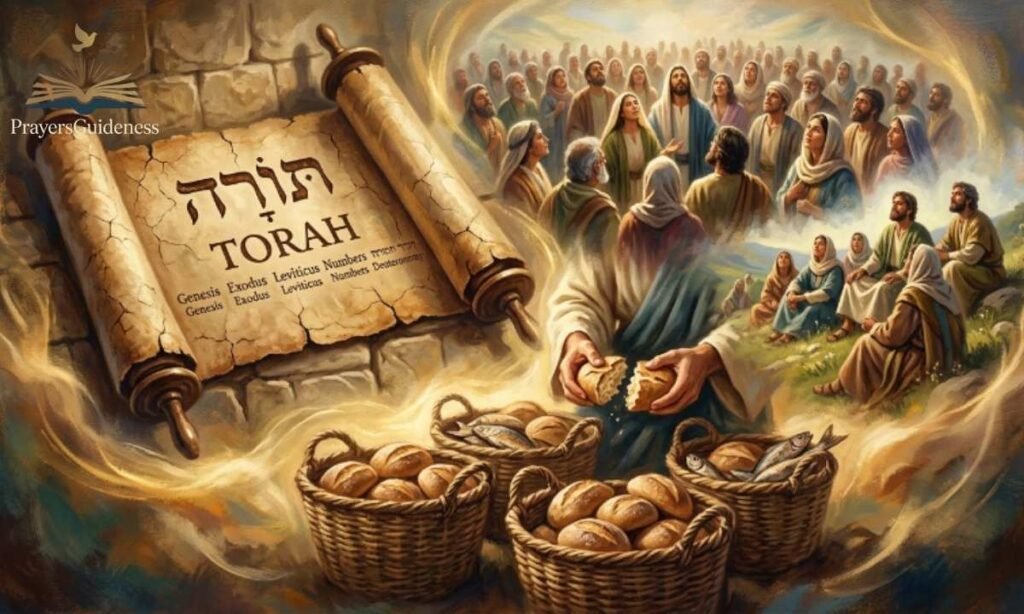
The most foundational example is the Pentateuch, the first five books of the Bible: Genesis, Exodus, Leviticus, Numbers, and Deuteronomy. The very word “Pentateuch” comes from the Greek word for five (penta). Moses, who wrote more of the Old Testament than any other author, gave the world five books that lay the theological foundation for all of Scripture.
These five books contain God’s law, His covenant with Abraham, the Exodus narrative, and the formation of Israel as God’s people. They are not merely historical records; they are the written expression of God’s grace toward the people He chose, guided, and sustained despite their repeated failures.
The apostle John also wrote exactly five books centered on grace and eternal life: the Gospel of John, 1 John, 2 John, 3 John, and Revelation. This parallel between Moses and John, two of Scripture’s most prolific voices further anchors the number 5 to divine revelation and grace.
Jesus Feeding the 5,000 With Five Loaves
One of the most well-known miracles in the Gospels is recorded in Matthew 14:17 Jesus taking five loaves of bread and two fish to feed a crowd of 5,000 people. What started as an impossibly small amount became more than enough, with twelve baskets of leftovers remaining.
The symbolism here is rich. The number 5 appears twice: five loaves and a crowd of five thousand and the result is miraculous abundance. This miracle illustrates precisely what grace does: it takes what is insufficient in human hands and multiplies it in God’s. It’s one of the clearest New Testament pictures of divine provision rooted in the symbolism of 5.
Five Wise and Five Foolish Virgins
In Matthew 25:1–13, Jesus tells the Parable of the Ten Virgins five described as wise and five as foolish. The wise virgins prepared oil for their lamps before the bridegroom arrived; the foolish ones did not. When the moment came, only the prepared ones entered.
This parable carries a dual message. On one level, it’s a call to spiritual readiness and watchfulness. On another, the split of five and five reflects balance and moral responsibility, a reminder that grace is freely offered, but our response to it matters. The number 5 here is tied to both preparation and the opportunity for God’s favor.
The Five Wounds of Christ
One of the most profound and often overlooked appearances of the number 5 in the New Testament is in the crucifixion of Jesus. During His death on the cross, Christ suffered five distinct wounds:
- Two wounds in His hands (from the nails)
- Two wounds in His feet (from the nails)
- One wound in His side (from the soldier’s spear John 19:34)
These five wounds are not simply historical details. Theologically, they represent the ultimate expression of costly grace, the point at which God’s favor toward humanity was displayed most completely. Through these five wounds, redemption was made available to all who believe. Many Christian traditions have reflected on the five wounds of Christ as a symbol of sacrificial love and the price of salvation.
The Five-Fold Ministry
In Ephesians 4:11–12, the apostle Paul describes five specific ministry roles that Christ gave to the Church:
- Apostles those sent to establish and expand the faith
- Prophets those who speak God’s word with clarity and conviction
- Evangelists those who share the Gospel with the lost
- Pastors (Shepherds) those who care for and guide the flock
- Teachers those who ground believers in biblical truth
These five roles, often called the five-fold ministry, are designed to work together to equip believers and build up the body of Christ. Once again, the number 5 surfaces at a moment of divine design this time in the structure of the Church itself. This is not a minor footnote; it is God’s blueprint for how His grace is to be extended through human hands across generations.
The Five Offerings in Leviticus
God instructed the Israelites to bring five distinct types of offerings, described in the first chapters of Leviticus:
| Offering | Purpose |
| Burnt Offering | Complete dedication and worship of God |
| Grain Offering | Thanksgiving and surrender of daily provision |
| Peace Offering | Communion and fellowship with God |
| Sin Offering | Atonement for unintentional sin |
| Guilt (Trespass) Offering | Restitution and cleansing for specific wrongs |
Each offering reflects a different dimension of God’s grace: His willingness to forgive, restore, and maintain relationships with His people. Together, these five offerings painted a forward-pointing picture of Jesus Christ, who would ultimately fulfill them all in His one perfect sacrifice on the cross.
What Does Number 5 Mean Spiritually?
Spiritual Growth and Faith
Spiritually, the number 5 is connected to transformation and divine intervention. It often appears in seasons of change moments when God is redirecting, renewing, or stretching a believer’s faith. The five senses of the human body, the five fingers on each hand, and the five toes on each foot all point to a God who created human beings with intention and purpose.
Many Christians believe that encountering the number 5 during prayer, Scripture reading, or significant life moments is a gentle reminder of God’s active presence. It calls believers back to the core of their faith: that grace is real, that God provides, and that His favor is not dependent on human performance.
Spiritually, 5 invites believers to:
- Trust God’s provision even when resources seem small
- Embrace grace rather than relying on personal effort alone
- Step into seasons of growth with confidence in God’s guidance
- Recognize that God’s hand is at work even in ordinary moments
- Remain spiritually prepared, as the parable of the virgins teaches
What Does Seeing the Number 5 Mean According to the Bible?
The Bible does not directly instruct believers to look for meaning in numbers they encounter in daily life. However, for those already grounded in Scripture, the repeated appearance of 5 can serve as a meaningful reminder of biblical truth.
If the number 5 keeps catching your attention on a clock, in Scripture, in everyday life many Christians interpret it as a prompt to reflect on God’s grace in their current situation. Are you in a season where you feel under-resourced, overlooked, or overwhelmed? The biblical pattern of 5 says that God’s grace is sufficient. What is small in your hands can become more than enough in His.
It’s worth noting, however, that this kind of reflection should always be anchored in Scripture and prayer, not in superstitious thinking or personal interpretation alone. If you’re exploring other significant biblical numbers and their spiritual meanings, you might also find it meaningful to study the 444 meaning in the Bible or the deeply layered 777 meaning in the Bible each carrying its own rich pattern of divine symbolism.
The Tabernacle and the Number 5
The construction of the Tabernacle God’s dwelling place among the Israelites in the wilderness is filled with measurements and materials that reflect the number 5. God’s detailed instructions in Exodus reveal:
- 5 curtains sewn together to form the outer covering
- 5 pillars supporting the entrance
- 5 bars used to hold the wall frames
- 5 ingredients in the holy anointing oil (Exodus 30:23–25)
The holy anointing oil, which was used to consecrate the furniture and priests of the Tabernacle, was made from five specific components and the proportions of each spice were in exact multiples of five. This oil represented God’s grace poured out to set apart what was holy.
The Tabernacle itself was the physical representation of God’s presence among His people. The fact that its design is saturated with the number 5 is a powerful statement: grace is not an afterthought in God’s plan. It is the very architecture of His dwelling.
David’s Five Smooth Stones
In 1 Samuel 17:40, when young David went to face the Philistine giant Goliath, he chose five smooth stones from a stream and placed them in his shepherd’s bag. He used only one to bring Goliath down but he chose five.
Biblical scholars have reflected on this choice as a picture of human weakness empowered by divine strength. David didn’t rely on armor or conventional weapons. He relied on God’s favor. The five stones represent readiness and trust a willingness to step into impossible situations when God’s grace is your foundation. The number 5 here points not to David’s strength, but to God’s.
Common Misconceptions About Number 5 in Christianity

Biblical Symbolism vs. Numerology
One of the most important distinctions to make is the difference between biblical symbolism and secular or occult numerology. These are not the same thing, and confusing them can lead to misinterpretation of Scripture.
Biblical numerology refers to the patterns and meanings associated with numbers as they appear organically in the text of Scripture. It is observed through careful Bible study, cross-referencing, and theological reflection not through mystical formulas or fortune-telling.
Secular numerology, by contrast, assigns personal life predictions and spiritual powers to numbers based on systems unconnected to Scripture. This practice is not endorsed by the Bible and can actually lead believers away from sound doctrine.
Here’s a simple way to think about the difference:
| Biblical Symbolism | Secular Numerology | |
| Source | Scripture and theology | Mystical tradition |
| Purpose | Understanding God’s Word | Personal prediction |
| Approach | Grounded in Bible study | Based on personal birth details |
| Recommended? | Yes, with discernment | No not biblically endorsed |
The number 5’s association with grace in the Bible is not a formula for predicting outcomes. It is a recurring motif that helps readers recognize God’s character and consistency throughout Scripture. Theologians across denominations consistently advise approaching biblical numerology with intellectual humility and spiritual discernment, always keeping the central message of Christ as the primary focus.
Frequently Asked Questions
What does the number 5 mean in the Bible?
The number 5 in the Bible primarily represents God’s grace, goodness, and undeserved favor toward humanity. It appears repeatedly in Scripture from the five books of Moses to the five wounds of Christ each time pointing to God’s provision and mercy.
Is the number 5 mentioned often in the Bible?
Yes. The word “five” appears 345 times across 270 verses in the King James Bible, making it one of the more frequently referenced numbers in all of Scripture.
What is the spiritual meaning of 5 loaves in the Bible?
The five loaves in Matthew 14:17 represent divine multiplication through grace. What was insufficient in human hands became overwhelmingly abundant in Jesus’ hands, a picture of how God’s favor transforms what we bring to Him.
Does the number 5 appear in the New Testament?
Yes. Key New Testament appearances include the miracle of the five loaves, the parable of the five wise and five foolish virgins, the five wounds of Christ, and the five-fold ministry gifts described in Ephesians 4:11.
Should Christians focus on biblical numbers in their faith?
Biblical numbers can be a meaningful tool for deeper Scripture study, but they should never replace the core teachings of Christ and the Gospel. Use them as lenses to understand the text more fully, not as mystical codes to decode daily life.
Conclusion
The number 5 is one of the Bible’s most consistent and meaningful symbols, a quiet but powerful thread running through Scripture from Genesis to Revelation. Wherever it appears, it points to the same reality: God’s grace is active, intentional, and abundantly greater than anything human effort could produce.
From the five books of Moses to the five wounds of Christ, from the five offerings in Leviticus to the five-fold ministry of the Church, the pattern is clear. God designed these moments with purpose, and understanding them can deepen your faith, your reading of Scripture, and your awareness of how grace operates in your own life. The number 5 isn’t just a number it’s a reminder that you are loved by a God who gives far more than you could ever deserve.

1 thought on “What Does the Number 5 Mean in the Bible?”