
Have you ever carried a heavy weight in your chest long after you said sorry to God? That crushing feeling like you’re still guilty, still broken, still too far gone is something millions of Christians wrestle with daily. Understanding what condemnation truly means in the Bible can be the difference between living free and living trapped.
This article breaks down the biblical meaning of condemnation, explains Romans 8:1 in plain language, and shows you how to tell the difference between healthy conviction from the Holy Spirit and the soul-crushing lies of condemnation so you can walk in the freedom Christ died to give you.
What Does Condemnation Mean in the Bible?
Simple Definition of Condemnation
In its simplest form, condemnation in the Bible means being declared guilty and sentenced to punishment. It’s not just feeling bad about something you did, it’s a legal and spiritual verdict that says: you are unfit, guilty, and deserving of judgment.
Biblically, condemnation carries the idea of being “doomed” cut off from God’s presence and facing the consequences of sin. It’s the opposite of justification. When God justifies a sinner through faith in Christ, He removes condemnation entirely. When someone refuses that gift, they remain under it.
Greek and Biblical Context of Condemnation
In the New Testament, the primary Greek word for condemnation is katakrima (κατάκριμα), which refers to the sentence or penalty that follows a guilty verdict, not just the judgment process itself. It appears in key passages like Romans 5:16, 5:18, and 8:1.
Another related word is krima (κρίμα), which refers to the act of judging or the judgment rendered. There are slight differences between these terms, but both carry the idea of a verdict against a person, with katakrima specifically suggesting the punishment that follows the sentence.
In the Old Testament, the Hebrew word rasha (רָשַׁע) means “to declare wrong” or “to condemn” used in legal, ethical, and religious contexts (Deuteronomy 25:1; Job 40:8). So from Genesis to Revelation, condemnation has always been about a divine verdict, not merely a feeling.
Biblical Meaning of Condemnation (Romans 8:1 Explained)
Meaning of Romans 8:1 in Context
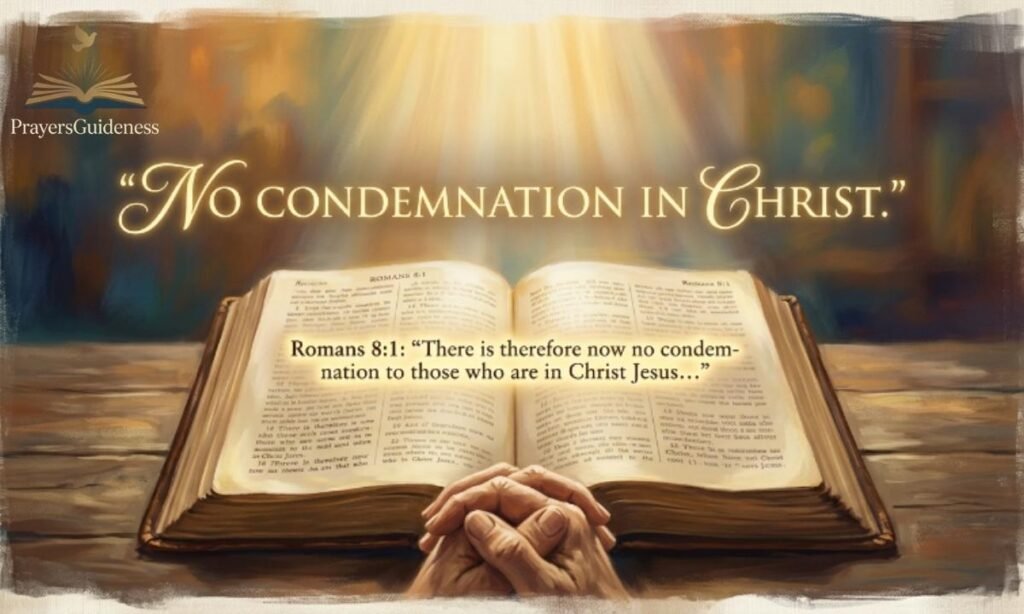
Romans 8:1 is arguably the most powerful verse on condemnation in the entire Bible: “There is therefore now no condemnation for those who are in Christ Jesus.”
The word “therefore” is crucial; it connects back to everything Paul argued in Romans 5–7. In Romans 7, Paul describes the painful inner war between sin and the desire to obey God. He cries out, “Who will deliver me from this body of death?” Then Romans 8 answers: Jesus Christ.
The word “now” is equally important. This isn’t a future promise, it’s a present reality. Right now. Today. Not after you get your life together. Not after you stop struggling. Now.
“No Condemnation in Christ” Explained
Though the Law condemns all mankind, believers in Jesus Christ have this promise: “There is therefore now no condemnation for those who are in Christ Jesus” (Romans 8:1). This is not a minor footnote in Scripture; it is the foundational declaration of what the gospel accomplishes.
Being “in Christ Jesus” is the key phrase. It means you are united with Him through faith His righteousness covers you, His death satisfied God’s justice on your behalf, and His resurrection proves the verdict has been sealed. Those who have been made right with God by faith in Christ are not condemned (John 5:24; Romans 8:1–4; Colossians 2:14), but those who refuse to believe in Jesus are condemned already (John 3:18).
So condemnation is not your portion as a believer. It never was.
Condemnation vs Conviction in the Bible
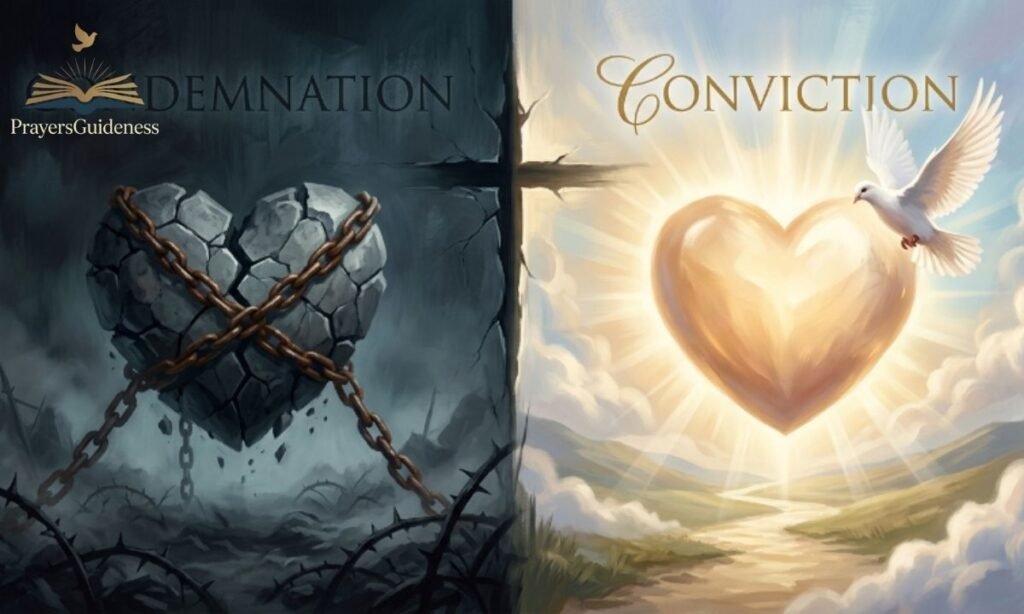
This is where so many Christians get confused and the confusion causes tremendous spiritual pain. Knowing the difference between condemnation and conviction is absolutely essential for your freedom.
What Is Condemnation?
Condemnation is a verdict. It says you are guilty, worthless, beyond repair, and beyond forgiveness. Condemnation focuses on making you feel worthless, unredeemable, and distant from God. It is a form of spiritual bondage that keeps people from experiencing the freedom offered through Christ.
Condemnation does not lead anywhere good. It spirals from guilt to shame to hopelessness to distance from God. It whispers: “You’ll never change. God is done with you. Look at what you did.”
What Is Conviction?
Conviction is entirely different. Conviction is known in the Bible as Godly sorrow. God’s Word tells us that Godly sorrow leads us to repentance (Romans 2:4). Conviction is God’s loving hand steering us back to the path that leads to life.
The Holy Spirit convicts us not to destroy us, but to restore us. When we offend God or do something out of His will, the Holy Spirit gives us a feeling through our conscience that something is off. God doesn’t allow this just so we’ll feel bad about ourselves. The purpose of conviction is to grant us a chance to turn around and do things God’s way.
Conviction says: “What you did was wrong, come back to Me, and I will forgive you.”
Key Differences Between Conviction and Condemnation
Here is a simple comparison to help you tell them apart:
| Feature | Conviction | Condemnation |
| Source | Holy Spirit | Satan / Self |
| Focus | The sin (specific) | Your identity (total) |
| Tone | Gentle, corrective | Harsh, crushing |
| Result | Repentance, peace | Shame, hopelessness |
| Direction | Draws you to God | Pushes you away from God |
| Scripture | 2 Corinthians 7:10 | Revelation 12:10 |
The big difference between conviction and condemnation is that one is from God’s conviction and the other is not condemnation. It really is that simple, even when it doesn’t feel that way.
How to Know If You Are Experiencing Conviction or Condemnation?
Signs of Conviction From the Holy Spirit
You may be experiencing conviction from the Holy Spirit if:
- You feel specific awareness of a particular sin or wrong action
- There is sorrow, but also a pull toward God not away from Him
- You feel a desire to confess, make things right, or change
- The feeling subsides when you repent and receive forgiveness
- You sense hope that things can be different
- The voice is gentle, not cruel
You will know it is conviction from God when it leads you back to Him. That directional pull is the clearest signal.
Signs of Condemnation
You may be experiencing condemnation if:
- You feel like a total failure, not just guilty about one thing
- You feel distant from God and believe He doesn’t want to hear from you
- The feelings don’t go away even after genuine repentance
- You are haunted by old sins that are already forgiven
- You feel hopeless, ashamed, and unworthy of grace
- The inner voice is accusatory and relentless
Condemnation bombards you with relentless accusations, reminding you of past sins, failures, and shortcomings. It seeks to distort your perception of God’s character, making you doubt His forgiveness and love (Revelation 12:10). It leaves you feeling hopeless, unable to see a way forward or believe in God’s mercy.
You will know it is condemnation from Satan when it leads you away from God.
Does God Condemn Christians? What the Bible Teaches
God’s Judgment vs God’s Mercy
This is a question that keeps many believers up at night: Does God look at me with judgment or with mercy?
The answer from Scripture is clear. God is just He does not ignore sin. But for those who are in Christ Jesus, His justice has already been satisfied at the cross. Jesus bore the full weight of God’s righteous judgment so that you wouldn’t have to. God’s mercy and His justice are not in conflict; they meet perfectly at Calvary.
The purpose of the coming of Jesus Christ was “not to condemn the world, but that the world might be saved through him” (John 3:17). God’s posture toward believers is not one of a prosecutor, it is one of a Father who loves His children and wants them restored.
Biblical Evidence of Grace for Believers
The Bible is overflowing with evidence that God’s heart toward His children is gracious:
- Romans 8:33–34 “Who shall bring any charge against God’s elect? It is God who justifies. Who is to condemn?”
- 1 John 1:9 “If we confess our sins, He is faithful and just to forgive us our sins and to cleanse us from all unrighteousness.”
- Hebrews 4:16 “Let us then approach God’s throne of grace with confidence, so that we may receive mercy.”
- Isaiah 30:18 The Lord longs to be gracious to you; He rises to show compassion.
God’s grace is not a license to sin, it is a door back to Him every time you fall.
Why Do Christians Feel Condemned After Forgiveness?
Guilt and Past Mistakes
One of the most painful experiences a Christian can have is receiving forgiveness and still feeling guilty. You said sorry. You meant it. You confessed. And yet the weight is still there.
This is often because our feelings lag behind our spiritual reality. The truth is, the moment you confessed, God forgave you completely (1 John 1:9). But your emotions haven’t caught up yet. Feelings are not always an accurate measure of spiritual truth. The answer is not to trust your feelings, it is to trust God’s Word over your feelings, even when it’s hard.
Also, for people carrying deep shame from serious sins or long patterns of failure, the mind can become conditioned to self-punishment. You may feel like forgiveness is too easy, like you don’t deserve it unless you suffer long enough. That thought is not from God.
Spiritual Warfare and Accusation
There is also a spiritual dimension that cannot be ignored. Satan is described as the “accuser of the brethren” in Revelation 12:10, constantly seeking to discourage and imprison us with shame and guilt.
When you come to God and receive forgiveness, the enemy often doubles down. He knows he cannot take your salvation so he tries to steal your peace. He will replay your worst moments, whisper that you’re not really forgiven, and convince you that God is disappointed in you. That voice is not God. Condemnation tells you, “You are such a failure! Look at what you did!” while conviction tells you, “Come to me… and I will forgive you!”
Recognize the source. Resist it with Scripture.
Guilt, Shame, and Condemnation: Key Differences
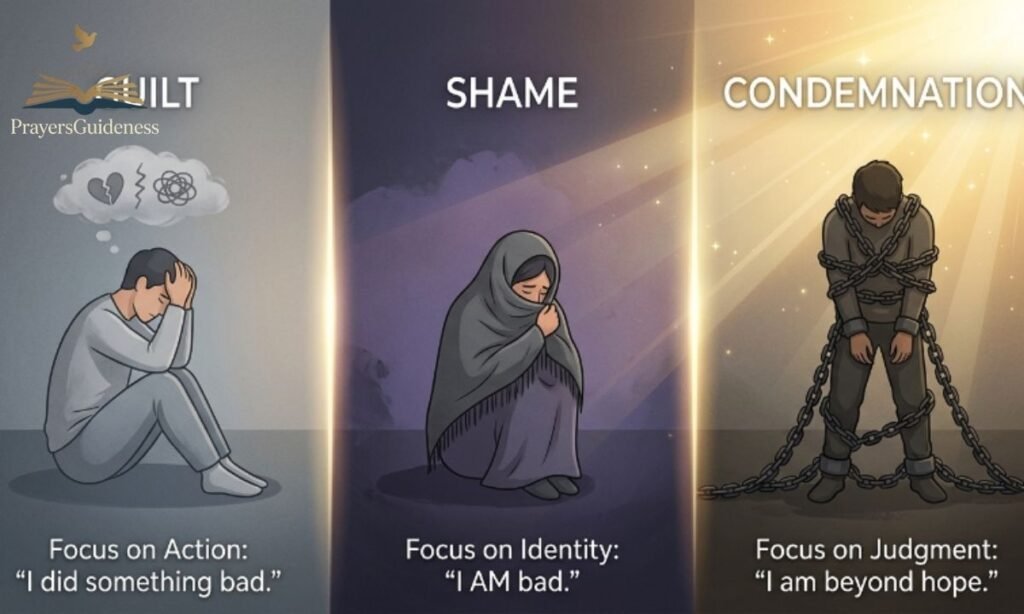
These three words are often used interchangeably, but they are meaningfully different and understanding each one helps you respond correctly.
Understanding Guilt
Guilt is the internal awareness that you have done something wrong. It is not inherently bad in fact, healthy guilt is part of how God designed our conscience. Guilt says: “I did something wrong.” It is action-focused and can lead you toward repentance and correction.
Understanding Shame
Shame goes deeper than guilt. Shame says: “I am wrong. I am broken. I am the problem.” It is identity-focused rather than behavior-focused. While guilt addresses what you did, shame attacks who you are. Shame often has roots in past trauma, rejection, or abuse and it makes it very difficult to receive grace.
Understanding Condemnation
Condemnation takes guilt and shame and adds a spiritual sentence: “You are guilty, and there is no hope for you.” It is the final verdict of worthlessness. Condemnation speaks of being in genuine danger of God’s future judgment being cast out of God’s presence. Condemnation is unacceptable for believers. As Romans 8:1 says, “There is therefore now no condemnation for those who are in Christ Jesus.”
The gospel addresses all three; it forgives guilt, heals shame, and abolishes condemnation. You don’t have to carry any of them.
How to Overcome Condemnation Spiritually?
Renewing Your Mind With Scripture
The most powerful weapon against condemnation is God’s Word. Romans 12:2 tells us to be transformed by the renewing of our minds. This is not passive; it is an active, daily choice to replace the lies you have believed with the truth of what God says about you.
When condemnation rises, speak Scripture out loud:
- “There is therefore no condemnation for those who are in Christ Jesus.” (Romans 8:1)
- “If God is for us, who can be against us?” (Romans 8:31)
- “He is faithful and just to forgive us our sins.” (1 John 1:9)
You may not feel it at first. Keep going. Truth repeated consistently begins to reshape how you feel.
Standing on God’s Promises
A key way to discern whether you are experiencing conviction or condemnation is to examine the source and the fruit it produces: conviction comes from the Holy Spirit and leads to repentance, restoration, and peace (2 Corinthians 7:10). Condemnation comes from Satan or our own negative self-talk and results in shame, fear, and separation from God (1 John 3:20).
Once you identify condemnation for what it is, refuse to receive it. God’s promises are your legal ground. Stand on them firmly not because of how you feel, but because of who God is and what He has declared over you.
Prayer and Spiritual Strength
Prayer is not just asking God for things, it is coming into His presence where condemnation cannot survive. When you feel crushed by false guilt, bring it to God honestly. Tell Him how you feel. Ask Him to show you the difference between His correction and the enemy’s accusation. Ask for the peace that surpasses understanding (Philippians 4:7).
Community also matters. Sharing your struggles with a trusted pastor, mentor, or Christian friend breaks the isolation that condemnation thrives in.
What Jesus and Paul Teach About Condemnation?

Jesus and Forgiveness
Jesus’ entire ministry was a statement against condemnation. He touched the untouchable, forgave the unforgivable, and restored the people everyone else had written off. To the woman caught in adultery, someone facing literal condemnation from the crowd He said: “Neither do I condemn you; go, and from now on sin no more.” (John 8:11)
Jesus came not to add to our weight of shame but to remove it. He said plainly in John 3:17, “God did not send His Son into the world to condemn the world, but in order that the world might be saved through Him.”
Paul’s Teaching in Romans 8
Paul understood condemnation from the inside. Before his conversion, he was a man consumed by religious rule-keeping and he knew its crushing weight. After encountering Christ, he wrote with authority: there is no condemnation in Christ. Not less condemnation. Not reduced condemnation. None.
Romans 8 is Paul’s great declaration of freedom. He begins with “no condemnation” (verse 1) and ends with “nothing can separate us from the love of God” (verse 39). The entire chapter is a celebration of what Christ has done for believers. If you struggle with condemnation, Romans 8 is the chapter you should read, memorize, and return to again and again.
The Role of the Law in Condemnation
Many believers don’t realize that one major source of ongoing condemnation is a misapplication of the Law. Paul explains in Romans 3:20 that through the Law comes the knowledge of sin the Law reveals our guilt, but it cannot remove it. Trying to earn righteousness through rule-keeping only deepens the sense of failure.
The Law was never meant to save you. It was meant to show you your need for a Savior. Once you are in Christ, you are no longer under the condemnation of the Law, you are under grace (Romans 6:14). This does not mean the Law is irrelevant; it means its power to condemn you has been broken by the cross.
When you understand that distinction, you stop performing for God’s approval and start resting in it.
What the Bible Says About Self-Condemnation?
Sometimes the most relentless accuser is not Satan, it’s yourself. The Bible addresses this directly. 1 John 3:20 says: “Even if our heart condemns us, God is greater than our heart, and He knows everything.”
Your heart can be wrong. Your feelings of unworthiness do not override God’s verdict. If you have repented and placed your faith in Christ, the verdict is settled you are forgiven, justified, and free. Even 1 John 3 reminds us, “Beloved, if our heart condemns us not, we have confidence toward God.” The goal is to bring your heart into agreement with what God has already declared.
Self-condemnation often stems from pride, an unwillingness to accept grace because it feels too good to be true, or a subtle belief that your own suffering can add to what Christ already accomplished. It cannot. His sacrifice was sufficient. You honor it by receiving it.
Frequently Asked Questions
What is the biblical meaning of condemnation?
Condemnation in the Bible means being declared guilty and sentenced to judgment before God. For those in Christ, this verdict has been completely removed through faith in Jesus (Romans 8:1).
Is condemnation the same as conviction?
No. Conviction comes from the Holy Spirit and leads you toward repentance and restoration. Condemnation comes from Satan or your own self-talk and leads to hopelessness and distance from God.
Can a Christian be condemned by God?
No. Romans 8:1 is clear there is no condemnation for those who are in Christ Jesus. God disciplines His children in love, but He does not condemn those covered by the blood of Jesus.
Why do I still feel condemned after repenting?
Feelings often lag behind spiritual truth. You may also be under spiritual attack, as Satan is called the “accuser of the brethren” (Revelation 12:10). Keep standing on Scripture until your feelings align with what God says.
What is the Greek word for condemnation in Romans 8:1?
The word is katakrima (κατάκριμα), which refers to the sentence or penalty following a guilty verdict making Romans 8:1 a declaration that the penalty has been fully removed for believers in Christ.
Conclusion
Condemnation is a heavy word and an even heavier feeling. But the Bible is unmistakably clear: if you are in Christ Jesus, condemnation is not your portion. It was nailed to the cross and buried in the tomb. The enemy wants you to live as though the verdict is still guilty, but God has already declared you righteous through the blood of His Son.
The next time that voice rises up to remind you of who you were, remind it of what Christ has done. You are not condemned. You are not beyond forgiveness. You are loved, restored, and free and that is the truth that Romans 8:1 has been declaring for two thousand years.
Looking to grow deeper in your understanding of biblical words and their spiritual meaning? Explore our related articles: