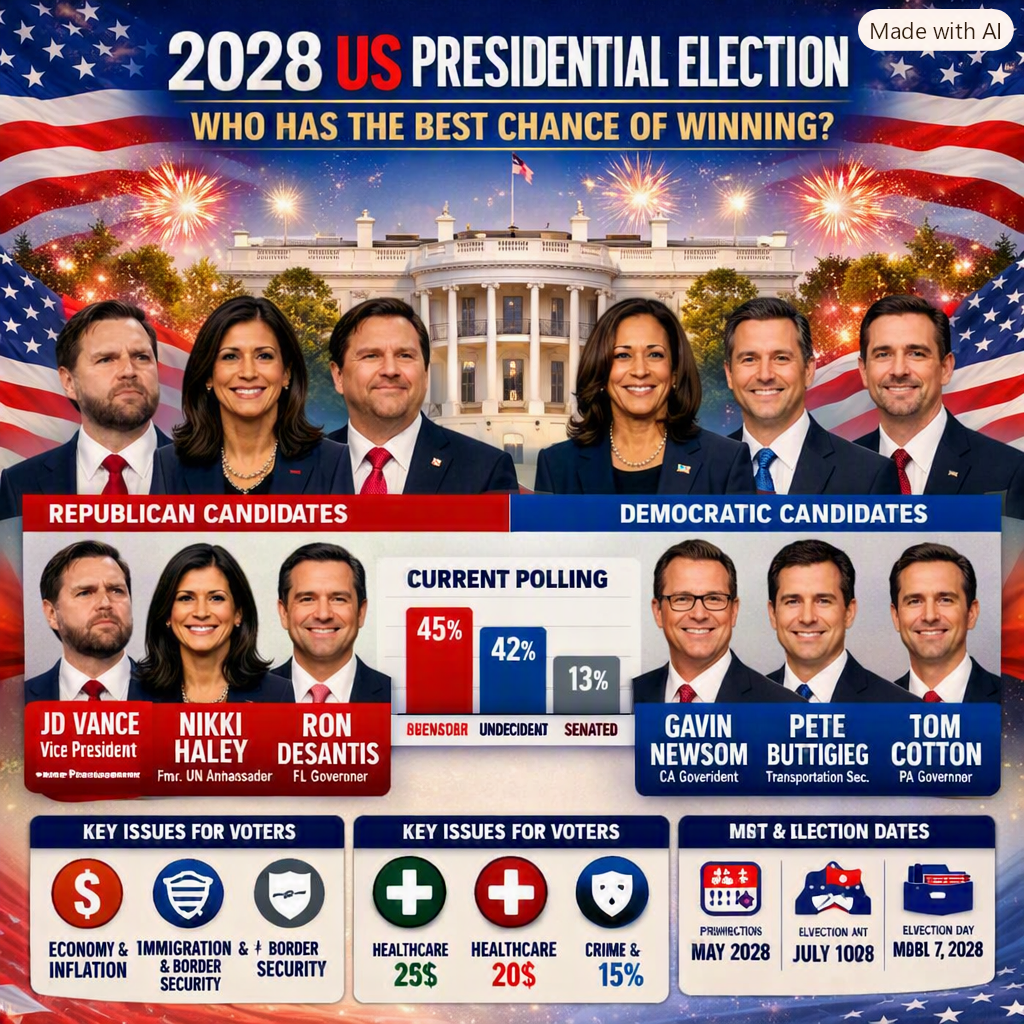
2028 US Presidential Election: Who Has the Best Chance of Winning?
2028 US Presidential Election: Who Has the Best Chance of Winning?
Introduction
The 2028 United States presidential election is already becoming one of the most closely watched political contests in America. Although Election Day is not until November 7, 2028, potential candidates from both major parties are beginning to position themselves for what could become a major generational change in American politics. The election will be especially significant because Donald Trump will not be eligible to seek a third elected term under the Twenty-Second Amendment, meaning the Republican Party will have to choose a new presidential standard-bearer for the first time since Trump became the dominant figure in the party. (Who’s Running 2028)
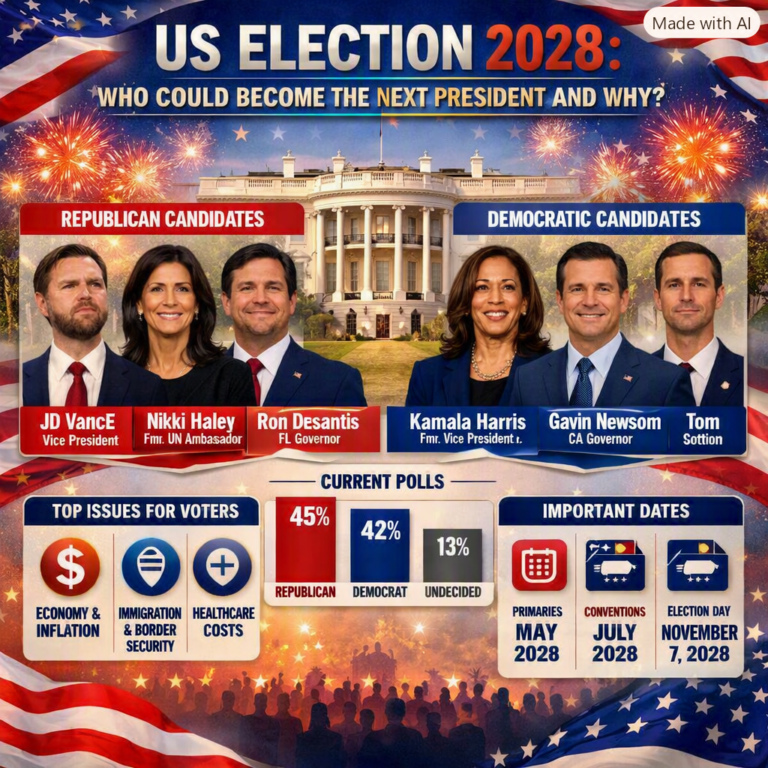
At this stage, there is no official Republican or Democratic nominee, and most of the leading names have not formally entered the race. Nevertheless, early polling, prediction markets, political reporting, and the public profiles of potential candidates provide some clues about who could have the best chance. On the Republican side, Vice President JD Vance and Secretary of State Marco Rubio currently stand out. On the Democratic side, potential contenders include Gavin Newsom, Kamala Harris, Pete Buttigieg, Alexandria Ocasio-Cortez, Josh Shapiro, Andy Beshear, and others. (Time)
The biggest question is whether the 2028 election will be a continuation of the political movement created by Trump or a turning point toward a new Republican and Democratic generation. Vance has a natural succession argument because he is already vice president, while Rubio has extensive national-security and foreign-policy experience. Democrats, meanwhile, must determine whether to return to a familiar figure such as Harris or select a new candidate capable of presenting a different vision.
Current prediction markets show how uncertain the contest remains. Recent odds have placed JD Vance and Marco Rubio among the strongest overall potential presidential candidates, with Gavin Newsom also near the top. (Oddschecker.com) However, these are early indicators rather than reliable final predictions. Much can change between now and 2028.
Why the 2028 Election Could Be Historic
The 2028 election could mark one of the biggest changes in American presidential politics in decades. Donald Trump has transformed the Republican Party, but the Constitution prevents him from being elected president more than twice. That means the Republican Party must eventually decide who can inherit his coalition and political influence.
For Democrats, the election offers another opportunity to regain the White House. The party will likely argue that voters need a new direction, while Republicans will attempt to persuade voters that the policies implemented during Trump’s second administration should continue under a new leader.
The age and generation of the candidates could also become important. JD Vance is significantly younger than the presidents who dominated American politics in recent years. Potential Democratic candidates such as Pete Buttigieg, Gavin Newsom, and Alexandria Ocasio-Cortez would also represent a younger generation of national political leadership.
This generational shift could change the issues discussed during the campaign. Housing affordability, artificial intelligence, technology, student debt, healthcare costs, wages, immigration, climate policy, and America’s relationship with China could become just as important as traditional debates over taxes and government spending.

JD Vance: One of the Strongest Republican Candidates
JD Vance currently has one of the clearest paths to the Republican nomination. As vice president, he has an enormous advantage over most potential challengers because he already occupies one of the highest political offices in the country.
Vance also has a strong relationship with Donald Trump and has become closely associated with the modern Republican movement. If Trump continues to support him, Vance could enter the Republican primary with an enormous advantage in fundraising, endorsements, media coverage, and grassroots support.
Recent political reporting has repeatedly identified Vance as one of the leading Republican possibilities. A recent report said Trump privately told donors that he wants Vance to become the Republican nominee, although Trump has also publicly created uncertainty between Vance and Rubio. (The Daily Beast)
Vance’s age could also help him. At a time when many voters have expressed concerns about the age of American political leaders, he could present himself as the beginning of a new generation of conservative leadership.
However, being the favorite for the Republican nomination does not automatically make someone the favorite to win the general election. Vance would still need to persuade independent voters and swing-state voters who may not be enthusiastic about Trump’s political style.
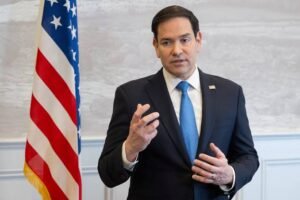
Marco Rubio: The Major Republican Alternative
Marco Rubio is probably the most important alternative to JD Vance. Rubio has already built a national political career through his service in the Senate, his previous presidential campaign, and his position as secretary of state.
His foreign-policy experience could become a major advantage if international security becomes a major issue before 2028. Problems involving China, Russia, the Middle East, trade, NATO, and other international relationships could give Rubio an opportunity to argue that he is more experienced and prepared for the presidency.
Early polling has shown Rubio becoming increasingly competitive. A May 2026 Emerson poll cited by political observers showed Rubio and Vance essentially tied among potential Republican primary voters, demonstrating that the Republican race should not be considered settled. (Who’s Running 2028)
Rubio’s biggest challenge is the Trump succession question. If Trump gives Vance his full endorsement, Rubio could find it difficult to defeat the vice president. On the other hand, if Trump remains neutral or Republican voters begin looking for a slightly different style of leadership, Rubio could become extremely competitive.
Current betting markets have also placed Rubio near the top of the overall 2028 presidential field. (Oddschecker.com)

Gavin Newsom: The Leading Democratic Possibility
Gavin Newsom is one of the most important Democratic names to watch. As governor of California, he has extensive executive experience and a highly developed national political profile.
Newsom has spent considerable time participating in national political debates and criticizing Republican policies. That means he would not have to introduce himself to American voters from scratch.
His greatest strength could be his ability to campaign as a strong Democratic defender who is comfortable fighting Republicans on national television. He could argue that Democrats need a candidate willing to directly challenge conservative politics rather than simply respond defensively.
Newsom’s biggest problem would be his association with California. Republicans would likely attack California’s record on taxes, housing, homelessness, crime, regulation, and other issues. Newsom would therefore have to demonstrate that his political approach could work outside California.
Nevertheless, current prediction markets place him among the strongest potential Democratic candidates. Recent reporting on prediction markets also showed Newsom near the top of the Democratic field. (Stokastic)
Kamala Harris: Can She Win the Presidency in 2028?
Kamala Harris remains another major Democratic possibility. Her previous service as vice president and her 2024 presidential campaign give her a level of national recognition that few other Democratic candidates can match.
Harris could argue that she has already faced a presidential campaign and therefore understands the challenges of running against Republicans at the national level. She also has an established fundraising network and relationships throughout the Democratic Party.
However, her 2024 defeat could create a significant obstacle. Democratic voters may decide they want a fresh candidate rather than another campaign from someone who has already lost a presidential election.
At the same time, Harris should not be underestimated. Early Democratic polling has frequently placed her near the top of the potential field, and some recent surveys have shown her with substantial support among Democratic primary voters. The Democratic race therefore remains much more open than a simple Harris-versus-Newsom contest. (Who’s Running 2028)
If Harris decides to run, her campaign would probably focus heavily on reproductive rights, economic issues, healthcare, and opposition to Republican policies.
Pete Buttigieg and the Next Generation of Democrats
Pete Buttigieg remains a potential Democratic contender with considerable national experience. He previously competed in the 2020 Democratic presidential primary and later served as transportation secretary.
One of Buttigieg’s greatest advantages is communication. He has demonstrated an ability to explain complicated political issues in relatively accessible language and has experience appearing before national audiences.
His age could also become an important asset. Buttigieg could present himself as part of a younger generation capable of moving beyond the political battles that dominated the Trump era.
However, he would need to prove that he can win enough working-class and independent voters in key swing states. His previous presidential campaign demonstrated that he could compete nationally, but winning the Democratic nomination and then the Electoral College would require an even broader coalition.
Alexandria Ocasio-Cortez and the Progressive Option
Alexandria Ocasio-Cortez could represent one of the most significant ideological choices for Democratic voters. She has an exceptionally strong following among progressive activists and younger voters.
AOC’s potential advantage would be enthusiasm. A presidential campaign could generate enormous grassroots energy, especially among younger Americans who believe the Democratic Party should take more aggressive positions on economic inequality, housing, healthcare, climate policy, and workers’ rights.
The challenge would be the general election. Winning the Democratic nomination requires building support beyond the progressive base. AOC would need to demonstrate that she could appeal to moderate Democrats and independents in swing states.
Her candidacy could therefore create a major debate inside the Democratic Party: should Democrats nominate the candidate most capable of energizing the progressive base, or should they choose a more moderate candidate with potentially broader appeal?
Josh Shapiro: A Candidate With Swing-State Experience
Josh Shapiro could become one of the most interesting Democratic contenders because of his experience as governor of Pennsylvania.
Pennsylvania is one of the most important swing states in presidential politics. A Democratic candidate who has already won statewide there can make a powerful electability argument.
Shapiro could tell Democratic voters that he understands the concerns of voters in a politically competitive state. That could become particularly valuable if Democrats believe they need to improve their performance among suburban and working-class voters.
His main disadvantage is national recognition. Compared with Harris and Newsom, Shapiro is less familiar to voters across the country.
A successful presidential campaign could solve that problem quickly. If he performs well during the 2026 midterms and becomes a prominent national Democratic figure, his chances could rise substantially.
Other Republicans Who Could Enter the Race
Although Vance and Rubio currently receive the most attention, they are not the only Republicans who could compete.
Ron DeSantis remains nationally known after his previous presidential campaign and his time as governor of Florida. Glenn Youngkin has also been discussed as a potential Republican presidential candidate, particularly because of his ability to compete in Virginia.
Other names that could potentially enter the conversation include Sarah Huckabee Sanders, Tim Scott, and other Republican governors and senators. The 2026 midterm elections could produce new presidential contenders if a politician delivers an unexpectedly strong performance.
The Republican Party therefore has a large potential field even though Vance and Rubio are currently the dominant names.
Other Democrats Who Could Become Serious Contenders
The Democratic Party’s potential field is even larger.
Andy Beshear is an interesting candidate because he has demonstrated that a Democrat can win statewide in a heavily Republican state. That could give him a powerful argument if Democrats become focused on winning back rural and working-class voters.
Other possible candidates include Mark Kelly, Ruben Gallego, JB Pritzker, Cory Booker, and other governors and senators.
However, the field could change significantly after the 2026 midterms. Politicians who perform exceptionally well may suddenly become presidential contenders, while candidates who suffer political setbacks could disappear from consideration.
What Current Polls Are Telling Us
Early polling should be interpreted cautiously because the 2028 election is still more than two years away. Many voters have not seriously considered their preferred presidential candidate, and name recognition can heavily influence early surveys.
Nevertheless, the available evidence provides some useful clues.
On the Republican side, Vance and Rubio are clearly among the strongest names. One recent candidate tracker described Vance as leading recent Republican primary polling while Rubio remained the strongest alternative. (Who’s Running 2028)
On the Democratic side, the situation is more fragmented. Harris, Newsom, Buttigieg, AOC, and Shapiro have all received meaningful support in different surveys and prediction markets. Recent market analysis placed Newsom among the leading Democratic possibilities, while other polling has shown Harris performing strongly. (Stokastic)
The differences between polls demonstrate why it is too early to announce a clear winner.
What Prediction Markets Are Saying
Prediction markets provide another way to examine the race. They do not represent traditional scientific polling, but they reflect the expectations of people who are financially trading on possible outcomes.
Current odds place JD Vance and Marco Rubio among the strongest overall candidates, while Gavin Newsom is also near the top. One current odds market listed Vance ahead of Rubio and Newsom, while Harris was considerably further back. (Oddschecker.com)
Another recent analysis of prediction-market data highlighted the close competition between Vance and Rubio and showed that Newsom was among the strongest Democratic possibilities. (OddsShopper)
However, markets can change quickly. A candidate’s odds can rise following an endorsement, political victory, debate performance, or major news event. They should therefore be viewed as an indicator of expectations rather than a guaranteed forecast.
Why the 2026 Midterms Matter So Much
The 2026 midterm elections could become the first major turning point in the 2028 presidential race.
If Republicans perform strongly, Vance could benefit because he could argue that voters want the Republican agenda to continue after Trump.
If Democrats perform strongly, Democratic governors and senators could gain enormous momentum. A strong Democratic performance could create a favorable environment for Newsom, Harris, Shapiro, Buttigieg, or another candidate.
The midterms will also reveal which issues are most important to voters. Immigration, inflation, housing, healthcare, abortion, taxes, foreign policy, and government spending could all influence the results.
Candidates who perform exceptionally well in competitive 2026 races could emerge as presidential frontrunners almost overnight.
The Economy Could Decide the Winner
The state of the U.S. economy in 2028 could be more important than almost any candidate’s campaign strategy.
If Americans feel financially secure, have rising wages, stable employment, and manageable housing costs, the party in power could benefit.
If inflation remains a major concern or Americans struggle with housing, healthcare, and everyday expenses, voters could become more interested in changing political leadership.
Economic performance will therefore shape the arguments made by both parties.
Republicans will likely argue that their policies created prosperity and stability if economic conditions are favorable. Democrats will argue that voters need different policies if economic dissatisfaction remains high.
Because economic conditions can change quickly, it is impossible to know in 2026 which party will have the advantage in 2028.
Immigration and Border Security
Immigration will almost certainly remain a major issue.
Republicans have made border security one of their strongest political priorities. Vance could make immigration enforcement an important part of his presidential campaign and argue that Republicans are better equipped to control the border.
Democrats would likely argue that the United States needs secure borders while also maintaining legal immigration and humanitarian protections.
The political importance of immigration will depend heavily on conditions by 2028. If illegal immigration declines significantly, the issue may become less dominant. If border pressures remain high, Republicans could benefit.
Abortion and Reproductive Rights
Abortion could become another major issue in the 2028 election.
Democrats have increasingly used reproductive rights to mobilize voters, especially women and suburban voters. A Democratic nominee could argue that Republican leadership would result in additional restrictions.
Republicans would likely emphasize the rights of states, unborn children, and conservative voters who support abortion restrictions.
The issue could be particularly important in swing states where voters have different views from their state’s traditional party alignment.
Foreign Policy Could Help Marco Rubio
If international events dominate the 2028 campaign, Marco Rubio could become particularly strong.
As secretary of state, Rubio has direct experience with international diplomacy and national security. A major crisis involving China, Russia, the Middle East, NATO, or another international issue could make that experience highly valuable.
Vance could present a different approach focused more heavily on American interests and reducing unnecessary foreign involvement.
Democratic candidates would likely emphasize alliances, diplomacy, international institutions, and America’s role as a global leader.
The importance of foreign policy will depend heavily on what happens between now and 2028.
The Electoral College Is the Real Battlefield
Winning the national popular vote is not enough to become president. Candidates need to win at least 270 electoral votes.
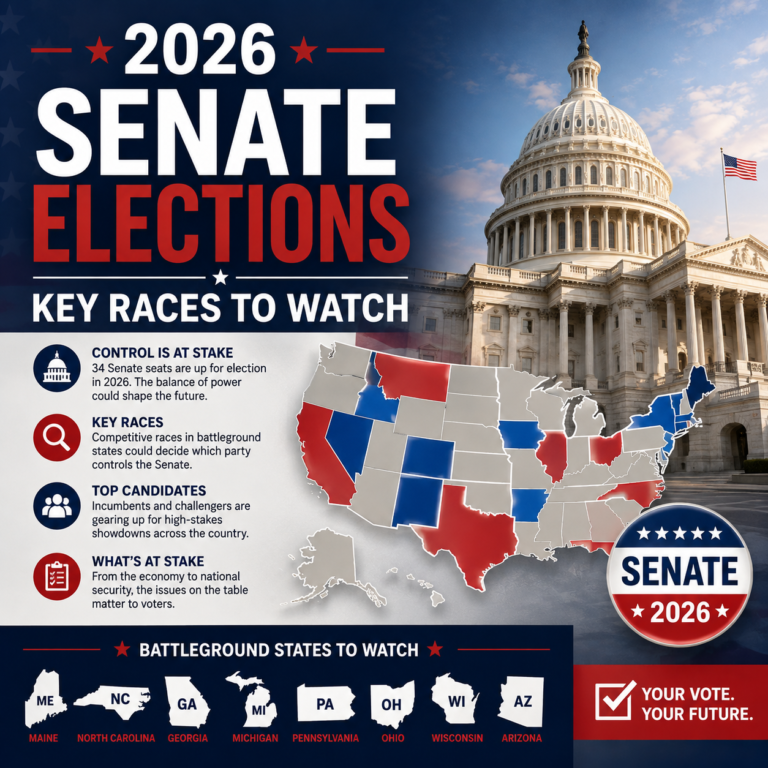
That makes states such as Pennsylvania, Michigan, Wisconsin, Arizona, Georgia, Nevada, and North Carolina especially important.
A Republican candidate could potentially win by maintaining strong support among working-class voters while improving performance among suburban and minority voters.
A Democratic candidate could win by maintaining strong support in major metropolitan areas while rebuilding support among working-class and independent voters.
This is why a candidate’s national polling numbers cannot tell the entire story.
Independent Voters Could Decide the Election
Independent voters will likely play a crucial role.
Republicans have a strong base of conservative voters, while Democrats have a strong base of liberal voters. The decisive group could be voters who do not identify strongly with either party.
JD Vance would need to convince these voters that he can provide effective leadership without being defined entirely by Trump’s most controversial political battles.
A Democratic nominee would face a similar challenge. Harris, Newsom, Buttigieg, or another candidate would need to show that Democrats can provide practical solutions rather than simply opposing Republicans.
The candidate who performs best among independents in the key swing states could have a major advantage.
Could JD Vance Actually Win the General Election?
Yes, but he would face challenges.
His greatest strength is the Republican base. If Trump endorses him and the Republican Party remains strongly aligned with the MAGA movement, Vance could have an enormous advantage during the primary.
His biggest challenge is the general election. He would need to expand his support beyond the Republican base and convince enough independents and moderate voters to support him.
Vance’s youth could help him present himself as the next generation of Republican leadership.
If the economy performs well and Trump remains popular, Vance could have a particularly strong opportunity.
Could Marco Rubio Beat Vance?
Yes.
Rubio’s strongest argument would be that he has extensive experience and could potentially appeal to voters who want Republican policies without the same political style associated with Trump.
His foreign-policy credentials could also become valuable.
However, if Trump clearly endorses Vance, Rubio would face a difficult primary.
Recent reporting shows that the Vance-Rubio rivalry is already being watched closely because both are viewed as major contenders for the future of the Republican Party. (The Washington Post)
Could Gavin Newsom Win the Presidency?
Newsom has a realistic path.
His strongest advantages include executive experience, national recognition, fundraising ability, and a strong ability to communicate with Democratic voters.
His biggest weakness is California. Republicans would likely make California a central part of their attacks against him.
To win, Newsom would need to demonstrate that his political approach can appeal to voters in the Midwest and Sun Belt.
If Democrats decide they want an energetic candidate capable of aggressively confronting Republicans, Newsom could become the nominee.
Could Kamala Harris Return and Win?
Harris could absolutely compete again.
Her national recognition is a major advantage, and she has already built a presidential campaign organization.
However, her 2024 loss would remain part of the political conversation. She would need to convince Democrats that she is better positioned to win in 2028 than she was in 2024.
If the Democratic Party wants a familiar candidate with national experience, Harris could become the nominee.
If Democrats want a completely new political direction, another candidate could overtake her.
Could a Surprise Candidate Win?
Absolutely.
The 2028 race is far too early to assume that the current frontrunners will remain dominant.
The 2026 midterms could produce unexpected political stars. A governor who wins a difficult state could suddenly become a presidential contender. A senator who delivers a strong national campaign could attract donors and media attention.
A major political crisis could also change voter priorities.
Presidential politics is full of examples where candidates who seemed unlikely early in the process eventually became serious contenders.
Therefore, the current list should be viewed as a starting point rather than a final ranking.
Who Has the Best Chance Right Now?
Based on the available information in August 2026, JD Vance currently has one of the strongest overall cases, particularly because of his position as vice president and his connection to Trump’s political movement.
Marco Rubio is probably his strongest Republican competitor. Current markets and polling show that Rubio is not far behind and could become the leading alternative if the Republican primary changes direction. (Oddschecker.com)
On the Democratic side, Gavin Newsom and Kamala Harris are among the strongest possibilities, although the Democratic field remains highly competitive.
If the question is who has the strongest combination of nomination potential and national political profile today, the leading group is approximately:
- JD Vance
- Marco Rubio
- Gavin Newsom
- Kamala Harris
- Pete Buttigieg
- Alexandria Ocasio-Cortez
- Josh Shapiro
- Andy Beshear
- Ron DeSantis
- Other emerging candidates
This is not a prediction of the final result. It is an assessment of the political landscape as it currently stands.
Possible 2028 Matchups
JD Vance vs. Gavin Newsom
This would be a major ideological contrast. Vance would represent the Republican movement that developed under Trump, while Newsom would represent a younger generation of Democratic leadership.
JD Vance vs. Kamala Harris
This matchup would feature two politicians with vice-presidential experience and could become one of the most closely watched contests in American politics.
Marco Rubio vs. Gavin Newsom
This would provide a strong contrast between a Republican foreign-policy specialist and a progressive Democratic governor.
Marco Rubio vs. Kamala Harris
Both candidates would bring substantial national political experience, making this another potentially competitive matchup.
What Could Change the Race Before 2028?
Several major events could completely reshape the race.
The first is the economy. A recession or major economic boom could significantly change voter attitudes.
The second is the 2026 midterms. The results could strengthen one party and weaken the other.
The third is Trump’s approval rating. If Trump remains highly popular among Republicans, his endorsement could become extremely valuable. If his popularity declines, Republican candidates may seek more distance from him.
The fourth is international affairs. A major war or diplomatic crisis could change the importance of foreign policy.
The fifth is the candidates themselves. Someone currently considered a secondary contender could suddenly become a frontrunner after a major political victory.
Final Prediction
The 2028 U.S. presidential election is still wide open, and it would be irresponsible to claim that any candidate is guaranteed to win.
However, the early picture provides several useful clues. JD Vance currently has a particularly strong path because he is vice president and closely connected to Trump’s political movement. Marco Rubio is his strongest potential Republican rival, and current prediction markets have at times placed Rubio at or near the top of the overall field. (Oddschecker.com)
For Democrats, Gavin Newsom and Kamala Harris are among the most important candidates to watch. Newsom has strong executive experience and national visibility, while Harris has the advantage of previous presidential and vice-presidential experience. Pete Buttigieg, AOC, Josh Shapiro, Andy Beshear, and other Democrats could also become serious contenders.
The most important point is that the 2028 winner will probably be determined by events that have not happened yet. The economy, 2026 midterm results, presidential approval ratings, immigration, abortion, foreign policy, candidate fundraising, and performance in the primary debates will all matter.
If the Republican Party remains strongly aligned with Trump’s political movement, JD Vance could have the best chance of becoming the Republican nominee. If Republicans prefer a more experienced foreign-policy figure, Marco Rubio could rise.
If Democrats want continuity and national experience, Kamala Harris could return as a powerful contender. If they want a fresh candidate with executive experience, Gavin Newsom or Josh Shapiro could become more attractive. If the party prioritizes younger progressive leadership, Alexandria Ocasio-Cortez could become a major force.
So, as of August 2026, the safest conclusion is:
JD Vance and Marco Rubio are the leading Republican possibilities, while Gavin Newsom and Kamala Harris are among the strongest Democratic possibilities. But the 2028 presidential race remains far too early to call, and the 2026 midterms could dramatically change the entire political landscape. (Who’s Running 2028)
Frequently Asked Questions
Who is the current favorite for the 2028 U.S. presidential election?
JD Vance and Marco Rubio are among the strongest current possibilities. Recent prediction-market odds have placed Vance ahead in some markets, while Rubio has also surged and remains highly competitive. (Oddschecker.com)
Can Donald Trump run for president in 2028?
No. The Twenty-Second Amendment limits a person to being elected president twice. Trump has already been elected twice, so he cannot seek another elected presidential term.
Is JD Vance likely to run in 2028?
Vance is widely considered one of the leading potential Republican candidates. His position as vice president makes him a natural successor candidate.
Can Marco Rubio become president in 2028?
Yes. Rubio has extensive national political experience and is currently one of the strongest potential Republican candidates.
Could Kamala Harris run again?
Yes. Harris remains eligible to seek the presidency in 2028 and is one of the most recognizable potential Democratic candidates.
Who are the leading Democratic candidates?
Potential leading candidates include Gavin Newsom, Kamala Harris, Pete Buttigieg, Alexandria Ocasio-Cortez, Josh Shapiro, and Andy Beshear. The Democratic field remains open.
When is the 2028 U.S. presidential election?
The 2028 presidential election is scheduled for November 7, 2028. (Who’s Running 2028)
What states could decide the election?
Pennsylvania, Michigan, Wisconsin, Arizona, Georgia, Nevada, and North Carolina are among the states most likely to receive significant attention from both parties.
Will the 2026 midterms affect the 2028 election?
Yes. The midterms could significantly change the political environment, influence candidate decisions, and provide voters with an early judgment of the party controlling the White House.
Who has the best chance of winning right now?
There is no certain favorite, but JD Vance, Marco Rubio, Gavin Newsom, and Kamala Harris are among the most important candidates to watch. Current prediction markets have Vance and Rubio particularly high in the overall field. (Oddschecker.com)
For More Information about this article, Please Click Here.
For More Information, Please Click Here.