
If you’ve ever read Matthew 11:30 and wondered, “What does Jesus actually mean when He talks about a yoke?” you’re not alone. The word shows up dozens of times throughout Scripture, yet most modern readers have never seen one used in real life. Understanding the yoke meaning in the Bible opens up a deeper picture of God’s heart toward His people: His call to rest, His invitation to obedience, and His promise of freedom from every burden that weighs us down.
In this guide, we’ll walk through the yoke meaning from its agricultural roots to its spiritual significance, look at key scriptures, and explore what Jesus meant when He said His yoke is easy. By the end, you’ll have a clear, grounded understanding of this powerful biblical image and how it applies to your walk with God today.
What Does Yoke Mean in the Bible?
At its core, the yoke meaning in the Bible centers on connection, submission, and shared labor. A yoke was a wooden bar or frame placed across the necks of two animals, usually oxen so they could plow a field or pull a cart together. The word appears around 60 times throughout Scripture, and its meaning stretches far beyond farming equipment.
In biblical usage, “yoke” carries two major meanings:
- A symbol of bondage, oppression, or slavery often describing the weight of sin, harsh rulers, or the burden of the Old Testament law.
- A symbol of partnership, discipleship, and submission describing a willing relationship of learning, service, or covenant with God.
This dual meaning is what makes the topic so rich. The same image that represents crushing slavery in one passage represents loving discipleship in another. Understanding which yoke meaning applies depends on context and that’s exactly what we’ll unpack throughout this article.
Quick Definition Table
| Term | Meaning | Example Reference |
| Yoke (literal) | Wooden frame joining two oxen for plowing or pulling loads | Numbers 19:2 |
| Yoke (bondage) | Oppression, slavery, harsh rule | Deuteronomy 28:48 |
| Yoke (discipleship) | Submission to a teacher’s authority and way of life | Matthew 11:29 |
| Yoke of Christ | Relationship of rest, obedience, and grace with Jesus | Matthew 11:30 |
| Unequally yoked | Mismatched partnership between believer and unbeliever | 2 Corinthians 6:14 |
What Is a Yoke? Understanding Its Historical and Biblical Background
To grasp the yoke meaning behind this familiar biblical image, it helps to picture the world Jesus and the prophets lived in. Agriculture was the backbone of daily life, and oxen were the primary “machinery” used to till soil, pull carts, and thresh grain.
The Physical Design of a Yoke
A traditional yoke was typically made of wood, shaped to rest across the shoulders or necks of two animals. Farmers crafted each yoke to fit the specific animals wearing it; a poorly fitted yoke would chafe, injure, and exhaust the animal, while a well-made one distributed the weight evenly so the load felt manageable.
Key features of an ancient yoke included:
- A curved wooden beam that sat across the animals’ necks or shoulders
- Bows or straps that secured the yoke in place
- A central pole or chain connecting the yoke to the plow, cart, or load
- Custom shaping based on the size and strength of the animal
Why This Matters for Understanding Scripture?
When Jesus said, “Take my yoke upon you” (Matthew 11:29), His audience immediately pictured this custom-fitted wooden tool. They understood that a yoke wasn’t a one-size-fits-all burden, it was something shaped specifically for the one who would wear it. This is a crucial piece of the yoke meaning in Scripture: God doesn’t hand His people generic, crushing weights. He fits the calling to the person.
Farmers also paired animals carefully. A young, untrained ox was often yoked beside an older, experienced one so it could learn the rhythm of the work without bearing the full weight alone. This pairing concept becomes especially important when we look at the spiritual meaning of yoke in the New Testament, where believers are described as being yoked together with Christ learning His pace, His pattern, and His way of carrying life’s load.
The Spiritual Meaning of a Yoke in Scripture
Beyond the farm, the spiritual meaning of yoke in Scripture touches on submission, relationship, training, and freedom. Biblical writers used yoke symbolism to describe how people relate to God, to sin, to the law, and to each other and grasping this yoke meaning helps modern readers connect ancient imagery to present-day faith.
Yoke as a Symbol of Submission and Training
In Jewish rabbinic tradition, the phrase “yoke of the Torah” or “yoke of the kingdom” described a disciple’s submission to a rabbi’s teaching and way of life. To “take on the yoke” of a teacher meant adopting their interpretation of God’s law and following their instruction closely.
When Jesus invited people to take His yoke, He was using familiar rabbinic language but with a radical twist. Instead of a yoke of strict legal demands, He offered a yoke marked by grace, gentleness, and rest.
Yoke as a Symbol of Bondage
On the other end of the spectrum, yoke symbolism frequently represents oppression. The Old Testament repeatedly uses “yoke” to describe:
- Slavery under foreign nations (Egypt, Babylon, Assyria)
- The crushing weight of sin and rebellion against God
- Harsh political or religious rule
Yoke as a Symbol of Partnership
A yoke joins two together. This is why Paul uses the image in 2 Corinthians 6:14 to talk about partnerships whether in marriage, business, or ministry. Two oxen yoked together must move at the same pace, in the same direction. If one pulls one way and the other resists, both suffer a vivid picture of what happens when the yoke meaning of partnership gets ignored.
Summary of Yoke Symbolism
| Symbolic Meaning | What It Represents | Where We See It |
| Submission/Discipleship | Following a teacher’s instruction and lifestyle | Matthew 11:29 |
| Bondage/Oppression | Slavery, sin, harsh rule | Deuteronomy 28:48, Galatians 5:1 |
| Partnership | Shared direction and purpose | 2 Corinthians 6:14 |
| Rest and Relief | God’s gentle, manageable way of living | Matthew 11:28-30 |
Just as believers search for meaning behind recurring numbers like the 444 meaning in the Bible or seek to understand spiritual signs such as the meaning of 111 in the Bible, the image of the yoke offers its own layer of spiritual insight pointing believers toward a life of trust, surrender, and rest in God.
Bible Verses About the Yoke and Their Meaning
Looking at specific Bible verses about yoke helps clarify how this image is used across different books and contexts, and reveals just how layered the yoke meaning becomes once we trace it from Genesis to the New Testament. Below are some of the most significant references.
Old Testament Verses
- Genesis 27:40 – Esau is told he will eventually break free from “his yoke” a reference to subjugation under his brother.
- Leviticus 26:13 – God reminds Israel that He broke “the bars of your yoke” when He freed them from Egypt.
- Deuteronomy 28:48 – A warning that disobedience will result in an “iron yoke” of enemy oppression.
- 1 Kings 12:4 – The people ask King Solomon’s son to “lighten the yoke” their father placed on them a literal request about heavy taxation and labor.
- Isaiah 9:4 – A prophecy that God will break “the yoke of his burden” pointing toward future deliverance.
- Isaiah 10:27 – Promises that “the yoke shall be broken” because of anointing, a verse often connected to spiritual breakthrough.
- Jeremiah 28:10-13 – The prophet Jeremiah wears a literal wooden yoke as a symbolic act about coming into captivity.
- Nahum 1:13 – God promises to “break his yoke from you” regarding the Assyrian oppression.
New Testament Verses
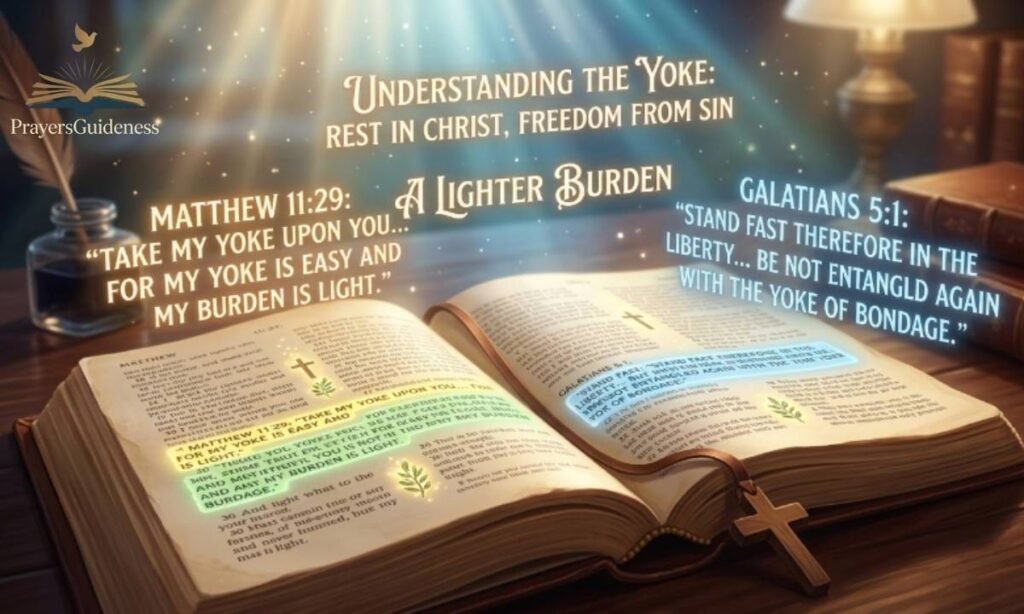
- Matthew 11:28-30 – Jesus’ invitation: “Take my yoke upon you… for my yoke is easy, and my burden is light.”
- Acts 15:10 – Peter refers to the Mosaic law as “a yoke” that even the Jewish ancestors couldn’t bear.
- Galatians 5:1 – Paul urges believers to stand firm in freedom and not be “burdened again by a yoke of slavery.”
- 2 Corinthians 6:14 – “Do not be unequally yoked with unbelievers.”
- 1 Timothy 6:1 – Refers to servants “under the yoke” in the context of household relationships.
These scriptures about yoke show a consistent thread: God’s ultimate desire is to free His people from heavy, crushing burdens and invite them into a relationship marked by trust and manageable responsibility not despair. Each reference adds another layer to the overall yoke meaning we’re exploring.
What Did Jesus Mean by “My Yoke Is Easy and My Burden Is Light”?
This is perhaps the most quoted yoke passage in the entire Bible, and understanding the Matthew 11:30 meaning transforms how we read the whole chapter and how we understand the yoke meaning behind Jesus’ invitation as a whole.
The Full Context of Matthew 11:28-30
Jesus says: “Come to me, all who labor and are heavy laden, and I will give you rest. Take my yoke upon you, and learn from me, for I am gentle and lowly in heart, and you will find rest for your souls. For my yoke is easy, and my burden is light.”
He’s speaking to people exhausted by the religious system of His day, a system loaded with extra rules, traditions, and demands that the religious leaders had piled on top of God’s law. The Pharisees’ “yoke” had become heavy, complicated, and impossible to fully satisfy.
Breaking Down “My Yoke Is Easy”
My yoke is easy, meaning doesn’t suggest a life with zero effort or no responsibility. The Greek word translated “easy” (chrestos) can also mean “well-fitting” or “useful” like a tool that’s been custom-made for the person using it. Remember the earlier point about yokes being shaped to fit each animal? Jesus is saying His way of life fits us. It’s not generic. It’s not crushing. It’s designed by someone who knows exactly what we can carry.
Three Key Takeaways from This Passage
- Rest is the invitation, not the reward. Jesus offers rest first before obedience, before performance.
- Learning from Jesus replaces striving under the law. “Learn from me” suggests an ongoing relationship, not a one-time transaction.
- The burden is “light” because Jesus carries it with us. A yoke connects two when paired with Christ, we’re never pulling alone.
This is the heart of the yoke meaning in its most encouraging form: a relationship with God that brings relief rather than exhaustion.
The Yoke of Bondage in the Bible Explained
While Matthew 11 presents the yoke meaning in its most hopeful light, other passages use the term to describe something far heavier slavery, oppression, and spiritual captivity. This darker yoke meaning is just as important to understand as the encouraging one.
What Is the “Yoke of Bondage”?
The phrase “yoke of bondage” comes primarily from Galatians 5:1, where Paul writes that Christ has set believers free, and they should not return to being “burdened again by a yoke of slavery.” In context, Paul was addressing Gentile Christians who were being pressured to follow Jewish ceremonial law (like circumcision) as a requirement for salvation.
The yoke of bondage meaning points to:
- Returning to rule-based religion after experiencing grace
- Living under a system of works rather than faith
- Any practice, addiction, relationship, or mindset that re-enslaves a person after Christ has set them free
Spiritual Bondage Today
While the original context was about the Mosaic law, the principle extends to modern life. Spiritual bondage can look like:
- Addiction to substances, habits, or behaviors
- Toxic relationships that pull a person away from God
- Legalistic religious environments that emphasize fear over grace
- Generational patterns of sin or dysfunction
- Persistent shame, guilt, or condemnation that keeps someone from approaching God
The Bible’s consistent message is that God never intends His people to remain under such yokes. Just as He delivered Israel from Egypt’s “iron yoke,” He offers deliverance from every form of bondage through Christ another reminder of how central freedom is to the yoke meaning overall.
How God Breaks Every Yoke According to the Bible?
One of the most encouraging themes in Scripture is breaking every yoke the idea that no matter how heavy or long-standing an oppression is, God has the power and the will to remove it. This side of the yoke meaning shifts the focus from burden to deliverance.
Isaiah 10:27 The Anointing That Breaks the Yoke
This verse declares that “the yoke shall be broken” because of an anointing. This is often referenced in worship and prayer contexts as a promise that God’s power can shatter oppressive circumstances whether spiritual, emotional, financial, or relational.
Isaiah 58:6 The Fast That Breaks Every Yoke
In this passage, God describes the kind of “fast” that pleases Him not just abstaining from food, but actively working “to undo the heavy burdens… and to break every yoke.” This connects the breaking of yokes to justice, mercy, and practical action freeing the oppressed, feeding the hungry, and caring for those in need.
Nahum 1:13 A Promise of National Deliverance
God promises to break the yoke of Assyrian oppression off of Judah, showing that yoke breaking scriptures aren’t only personal they can apply to nations, communities, and systems as well.
How This Applies Today
| Type of Yoke | Biblical Promise of Freedom |
| Sin and guilt | Romans 8:1-2 no condemnation in Christ |
| Addiction or habitual sin | John 8:36 “if the Son sets you free, you will be free indeed” |
| Legalism/religious burden | Galatians 5:1 stand firm in freedom |
| Oppression/injustice | Isaiah 58:6 God calls His people to break every yoke through justice |
| Fear and anxiety | 2 Timothy 1:7 God gives a spirit of power, love, and self-control |
For believers walking through difficult seasons, these promises offer real hope God is not distant from human suffering. He actively works, through His people and His power, to remove what weighs others down, reminding us that the yoke meaning always points toward freedom in the end.
What Does the Bible Say About Being Unequally Yoked?
This phrase gets quoted often, especially in conversations about dating, marriage, and friendships but its original meaning is broader than romance alone. To understand it fully, we need to connect it back to the wider yoke meaning found throughout Scripture.
The Origin: 2 Corinthians 6:14
Paul writes: “Do not be unequally yoked with unbelievers. For what partnership has righteousness with lawlessness? Or what fellowship has light with darkness?”
The unequally yoked meaning draws from an old farming practice rooted in Deuteronomy 22:10, which prohibited plowing with an ox and a donkey together. These two animals have different strengths, paces, and instincts pairing them would cause confusion, inefficiency, and strain for both.
What “Unequally Yoked” Really Means
The unequally yoked Bible verse isn’t simply a dating rule, it’s a principle about partnerships where core values, purposes, and spiritual direction are fundamentally mismatched. This can apply to:
- Marriage between a believer and someone with no shared faith commitment
- Business partnerships where ethics and goals conflict
- Close friendships that consistently pull someone away from their values
- Ministry partnerships lacking shared spiritual vision
Common Questions About This Topic
- Does this mean Christians can’t have non-Christian friends? No Jesus Himself spent time with people outside the faith. The passage addresses deep, binding partnerships, not all relationships.
- Is this only about marriage? While marriage is the most common application, the original Greek wording is broad enough to cover any close, binding partnership.
- What if someone is already in such a relationship? The Bible encourages wisdom, prayer, and seeking godly counsel rather than abrupt or harsh decisions 1 Corinthians 7:12-14 offers guidance for existing marriages where one spouse is a believer. Even here, the yoke meaning points toward grace rather than condemnation.
Examples of Yokes in the Bible: Old and New Testament
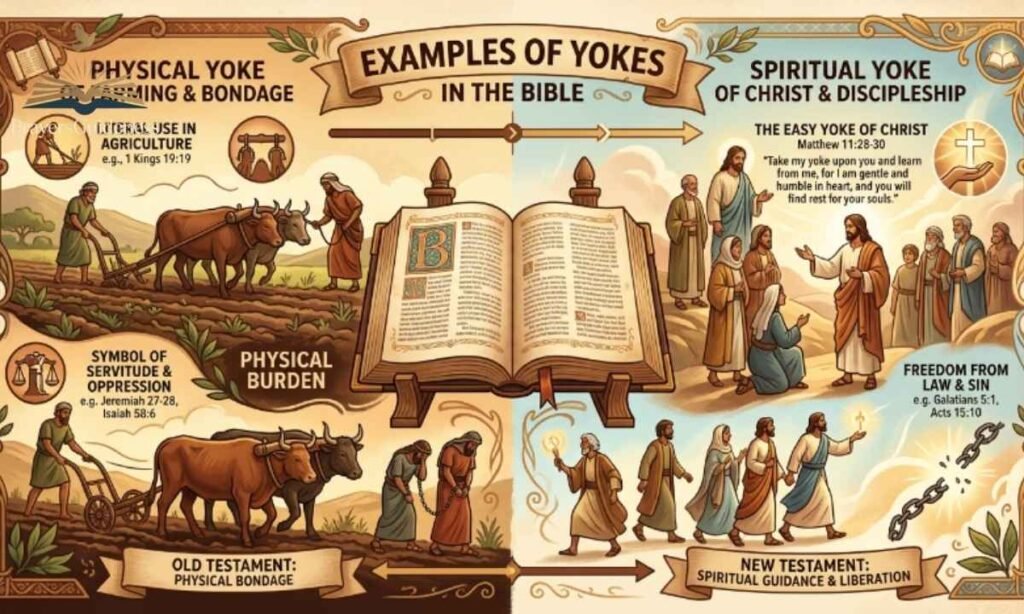
To fully appreciate the yoke meaning in the Bible, it helps to see how the image develops from the Old Testament into the New Testament moving from a symbol of judgment toward a symbol of grace. Tracing this development shows how the yoke meaning shifts depending on who is speaking and why.
Old Testament Yoke Examples
- Genesis 27:40 – Esau’s prophetic word about eventually breaking free from servitude to Jacob’s line.
- 1 Kings 12:1-19 – Israel’s plea to King Rehoboam to lighten the “yoke” of labor and taxation imposed by Solomon.
- Jeremiah 27-28 – Jeremiah wears a wooden yoke as a prophetic sign of Babylonian captivity, and another prophet, Hananiah, breaks it only for God to declare an even heavier “iron yoke” is coming due to continued disobedience.
- Hosea 11:4 – God describes lifting “the yoke from their neck” as an act of tender care toward Israel.
New Testament Yoke Examples
- Matthew 11:28-30 – Jesus’ invitation to take His easy yoke and find rest.
- Acts 15 – The early church council debates whether Gentile believers must take on “the yoke” of the Mosaic law, ultimately deciding grace through faith is sufficient.
- Galatians 5:1 – Paul’s call to stand firm in Christian freedom and resist a “yoke of slavery.”
- 1 Timothy 6:1 – A practical reference to those serving “under the yoke” in household or work relationships, encouraging honorable conduct.
Old Testament vs. New Testament Yoke Themes
| Aspect | Old Testament | New Testament |
| Primary tone | Judgment, captivity, consequence | Grace, rest, freedom |
| Common context | National oppression, disobedience | Personal discipleship, spiritual freedom |
| Key promise | God will eventually break the yoke | Christ’s yoke is light and restful |
| Central figures | Israel, prophets, foreign nations | Jesus, Paul, the early church |
This progression shows a beautiful arc across Scripture: from a yoke that represents the weight of sin and rebellion to a yoke that represents a restful, life-giving relationship with Christ. It’s a helpful summary of the yoke meaning as a whole.
Lessons Christians Can Learn from the Biblical Meaning of Yoke
Understanding the yoke meaning for Christians isn’t just an academic exercise it has practical implications for daily faith and decision-making. Once the yoke meaning clicks, it tends to reshape how believers think about rest, obedience, and freedom all at once.
1. Rest Is Part of God’s Design, Not a Reward for Performance
Many people live as though rest must be earned through enough productivity, prayer, or good behavior. Jesus flips this completely rest is the starting point of relationship with Him, not the finish line.
2. God’s Commands Fit the Person He’s Calling
Just as a yoke was custom-fitted to each animal, God’s calling on a person’s life is designed with that individual in mind. What feels impossible for one person might be exactly the right “fit” for someone else and vice versa.
3. Freedom Doesn’t Mean No Responsibility
Galatians 5:1 calls believers to freedom, but the same letter goes on to describe living by the Spirit, bearing fruit, and serving one another in love. Freedom from a “yoke of slavery” isn’t freedom from all structure, it’s freedom from fear-based, performance-driven religion.
4. Partnerships Matter
The teaching on being unequally yoked reminds Christians to be thoughtful about who they walk closely with in marriage, business, friendships, and ministry. Shared direction matters for the health of both parties.
5. God Actively Works to Remove Oppression
The promise of “breaking every yoke” isn’t passive. Isaiah 58 ties it directly to action feeding the hungry, freeing the oppressed, and caring for those in need. Christians are called to participate in this work, not just wait for it.
6. Christ’s Yoke Is a Relationship, Not Just a Rulebook
“Learn from me” (Matthew 11:29) is relational language. The Christian life isn’t about memorizing a list of dos and don’ts, it’s about walking closely with Jesus, learning His pace, His priorities, and His heart over time. This relational angle is, in many ways, the most important part of the yoke meaning for everyday believers.
Just as exploring topics like the deity meaning in the Bible or the Tristan name meaning in the Bible can deepen one’s appreciation for Scripture’s layers of meaning, studying the yoke reminds believers that even ordinary, everyday objects carried profound spiritual lessons for the people who first heard them. Names themselves often carry spiritual weight too, as seen in studies like the Alora name meaning in the Bible, and even emotional states described in Scripture, such as the dismayed meaning in the Bible, connect back to this same theme of God meeting His people in their struggles and offering relief.
Frequently Asked Questions
What is the simplest definition of “yoke” in the Bible?
The simplest yoke meaning is a wooden frame placed across the necks of two animals so they can pull a load together. In the Bible, it’s also used symbolically for submission, partnership, slavery, or relationship with God.
What does “my yoke is easy” mean in Matthew 11:30?
It means Jesus offers a way of life that is well-fitted and manageable, not crushing. He carries the load alongside His followers, making the burden lighter than living under legalism or sin.
What is the “yoke of bondage” in Galatians 5:1?
It refers to returning to a rule-based, works-driven religious system after experiencing the freedom of grace through Christ. It can also apply to any habit or system that re-enslaves a believer.
What does it mean to be “unequally yoked”?
It describes a close partnership, most often marriage between a believer and someone who doesn’t share their core faith and values, which can create lasting tension and conflict.
Does the Bible promise that God will break every yoke?
Yes. Verses like Isaiah 10:27 and Isaiah 58:6 describe God’s power and desire to break oppressive yokes, including sin, injustice, and bondage, both personally and communally a hopeful side of the yoke meaning worth remembering.
Conclusion
The yoke meaning in the Bible carries far more depth than a simple farming tool. From Israel’s literal slavery in Egypt to Jesus’ tender invitation in Matthew 11, this image captures the full range of human experience bondage and freedom, burden and rest, struggle and partnership with God.
At its heart, the message is one of hope. Whatever yoke you may be carrying right now whether it’s guilt, exhaustion, fear, or an unhealthy attachment Scripture points to a God who breaks every yoke and offers a far lighter one in its place. Taking on Christ’s yoke means walking closely with Him, learning His pace, and finding the rest your soul has been searching for all along. Holding onto this yoke meaning can change the way you read the rest of Scripture, too.

2 thoughts on “Yoke Meaning in the Bible: Understanding God’s Call to Rest, Obedience, and Freedom”