Prayer Times vs Iqamah Times 1
Prayer Times vs Iqamah Times: What Is the Difference?
Introduction
Understanding the difference between prayer times and Iqamah times is essential for every Muslim who wants to perform Salah correctly and participate in congregational prayer with confidence. These two terms are often displayed together on mosque timetables and Islamic prayer apps, which can sometimes make them appear as though they mean the same thing. However, they have different purposes. Prayer time refers to the period in which a particular obligatory prayer becomes due, while Iqamah is the call made immediately before the congregational prayer begins. Knowing this distinction helps Muslims understand when they can pray individually and when they should arrive at the mosque to join the congregation.
The five daily prayers in Islam are Fajr, Dhuhr, Asr, Maghrib, and Isha. Each prayer has a prescribed time that is connected to specific signs in the movement of the sun and the changing conditions of daylight and darkness. These times change throughout the year and can also vary according to geographical location and the calculation method being used. A prayer timetable may therefore show several different times for each prayer. Among these may be the beginning of the prayer period, the Adhan time, and the Iqamah time. Understanding what each time means prevents confusion and helps Muslims organize their daily worship.
Iqamah is particularly important when praying in congregation. A mosque may announce the Adhan when the prayer time begins and then wait for several minutes before calling the Iqamah. During this interval, worshippers can perform Wudu, travel to the mosque, pray voluntary prayers where appropriate, and prepare themselves for the congregation. The length of this interval is not necessarily the same in every mosque. One mosque might begin Dhuhr congregation ten minutes after the prayer time starts, while another might wait twenty or thirty minutes. This does not necessarily mean that their prayer times are different.
This article provides a complete explanation of prayer times and Iqamah times, including how they differ, why mosques use separate Iqamah schedules, how the system applies to Fajr, Dhuhr, Asr, Maghrib, and Isha, and what Muslims should do when praying alone or attending a mosque. By understanding these concepts, beginners and experienced worshippers alike can read prayer timetables more accurately and avoid common misunderstandings about the beginning of Salah.
What Are Prayer Times in Islam?
Prayer times are the prescribed periods during which the five obligatory daily prayers are to be performed. In Islam, Salah is not simply performed at any convenient point during the day. Each obligatory prayer has a specific time period established by Islamic teachings. These periods are traditionally identified through observable signs involving the sun, daylight, twilight, and night. Because these natural signs change throughout the year, the exact clock time of each prayer also changes from day to day and from one location to another.
Fajr begins with true dawn, when the first horizontal light of dawn appears, and its time continues until sunrise. Dhuhr begins after the sun has passed its highest point in the sky. Asr follows later in the afternoon, with its beginning determined according to the jurisprudential method being followed. Maghrib begins after sunset, while Isha begins after the disappearance of evening twilight according to the relevant calculation and interpretation. Each prayer therefore has both a beginning and an ending period. Understanding these periods is more important than simply memorizing a particular clock time because clock times change throughout the year.
Modern Muslims usually rely on prayer calendars, mosque timetables, Islamic websites, or mobile applications to determine these times. These resources calculate prayer times based on geographical coordinates, date, and selected calculation settings. Small differences between different applications are possible because organizations may use different calculation methods. Asr can also differ depending on the jurisprudential method selected. Fajr and Isha can show noticeable differences when different twilight angles or calculation conventions are used.
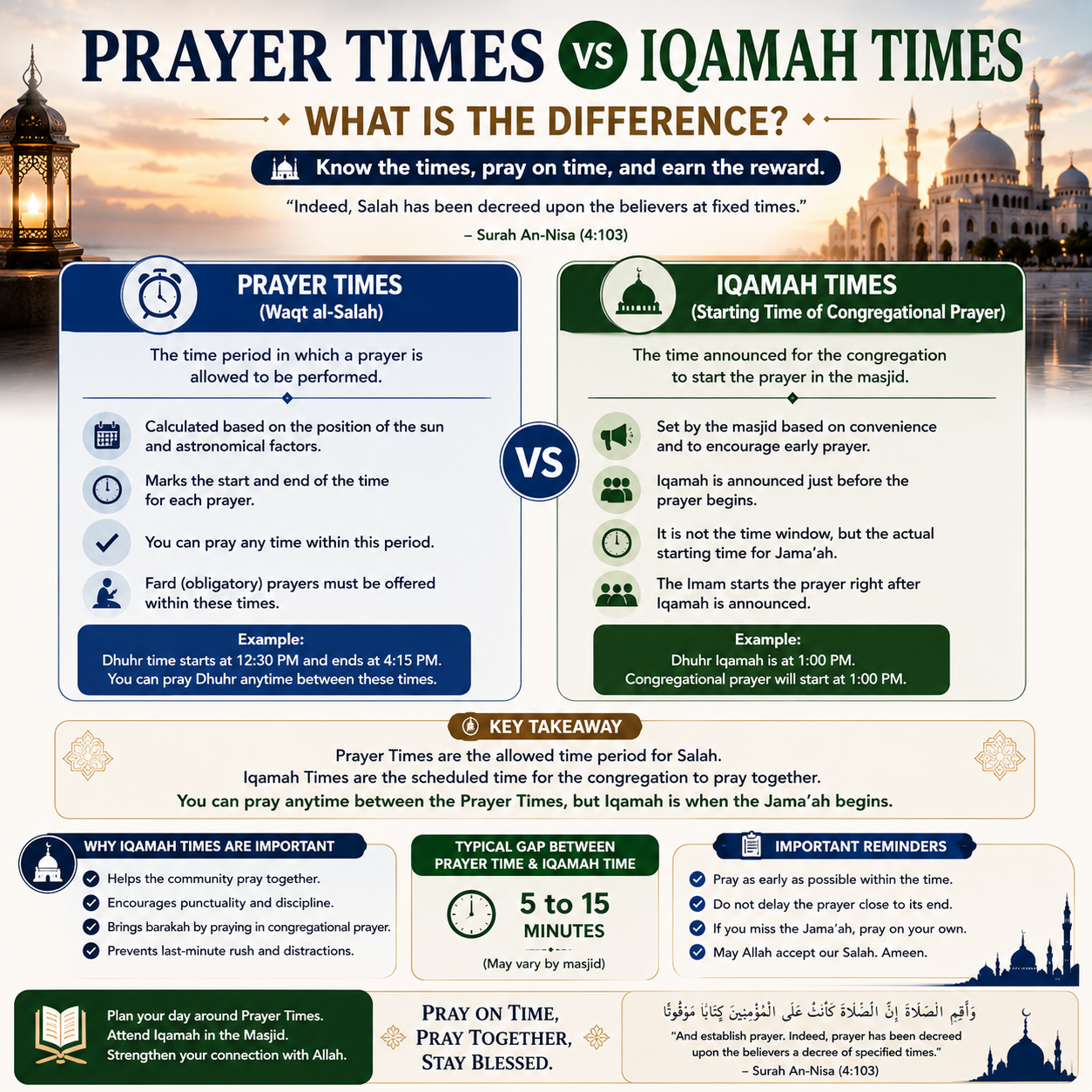
The important point is that the prayer time and Iqamah time should not be confused. If a timetable says that Dhuhr begins at 1:00 PM and the Iqamah is at 1:20 PM, it does not mean Dhuhr starts at 1:20 PM. The prayer period has already begun at 1:00 PM, while the mosque has simply chosen 1:20 PM as the time for its congregation. A Muslim praying individually generally needs to know the valid prayer period, while someone planning to pray with the mosque needs to know the congregation’s Iqamah schedule as well.
What Is Iqamah?
Iqamah is the call that is made immediately before the obligatory congregational prayer begins. It is closely related to the Adhan, but it serves a different purpose. The Adhan announces the prayer and calls Muslims toward Salah, while the Iqamah indicates that the congregation is about to stand and begin the actual prayer. When worshippers hear the Iqamah, they should prepare to stand in the rows and follow the Imam.
In a mosque, the Iqamah normally takes place after the Adhan rather than at exactly the same moment. The interval allows people to respond to the call, make Wudu, enter the mosque, complete preparations, and join the congregation. The amount of time between Adhan and Iqamah can vary depending on the prayer and the local mosque. For example, Maghrib may have a short interval because of its particular timing, while Dhuhr or Isha may have a longer interval to accommodate worshippers.
Iqamah is therefore primarily connected with congregational prayer rather than with the legal beginning of the prayer period. A mosque may set an Iqamah time based on the needs of its community. A large mosque in a busy commercial area may give workers more time to arrive for Dhuhr, while a residential mosque may have a different schedule. The fact that two mosques have different Iqamah times does not automatically mean that they disagree about when the prayer itself becomes due.
It is also useful to understand that hearing the Iqamah does not mean the prayer has already been performed. It signals that the congregation is preparing to begin. The Imam will then start the Salah, and the worshippers follow him. The Iqamah is therefore a transition between the announcement and the actual congregational prayer. Understanding this simple distinction makes it much easier to interpret mosque timetables.
Prayer Time vs Iqamah Time: The Main Difference
The main difference between prayer time and Iqamah time can be explained in one simple sentence: prayer time tells you when the period for a Salah begins, while Iqamah time tells you when the mosque’s congregation is scheduled to begin. These are two separate pieces of information, even though they appear together on many timetables. Confusing them can lead to unnecessary uncertainty about when Salah can be performed.
Suppose a local timetable says that Asr begins at 4:15 PM and the mosque’s Iqamah is at 4:30 PM. At 4:15 PM, the Asr prayer period has entered according to that timetable. At 4:30 PM, the mosque plans to begin its congregational Asr prayer. A person praying alone does not normally need to interpret 4:30 PM as the moment Asr becomes valid. The person needs to understand the valid prayer period and follow the applicable rules.
The same principle applies to the other daily prayers. If Dhuhr begins at 12:45 PM and Iqamah is at 1:00 PM, the fifteen-minute difference is simply the mosque’s waiting period. If Maghrib begins at sunset and the mosque calls Iqamah several minutes later, the prayer period has already begun. If Fajr begins at dawn but the mosque holds Iqamah later, Fajr has not suddenly started at the Iqamah time.
This distinction is particularly important for Muslims who travel, work away from a mosque, study at school or university, or pray at home. They may not always have access to the local congregation, but they still need to know the valid prayer periods. At the same time, people who want to benefit from congregational prayer should know the mosque’s Iqamah time so that they can arrive before the Imam begins.

What Is the Difference Between Adhan and Iqamah?
The Adhan and Iqamah are both important calls associated with Salah, but they are not identical. The Adhan is the call to prayer that announces that the time for a particular prayer has arrived. It reminds Muslims of the obligation of Salah and calls them toward worship. The Iqamah is recited later, immediately before the obligatory congregational prayer begins.
In many mosques, the Adhan is given when the prayer time enters. Worshippers then have an opportunity to prepare for prayer. They may make Wudu, travel to the mosque, perform voluntary worship where appropriate, and settle into the prayer area. After this waiting period, the Mu’adhdhin gives the Iqamah, signaling that the congregation is ready to begin.
The amount of time between Adhan and Iqamah can vary. There is no universal rule requiring every mosque in every place to use exactly the same number of minutes. Practical circumstances often influence the schedule. The mosque may also use different intervals for different prayers. Maghrib is often scheduled more quickly after Adhan, while Dhuhr, Asr, or Isha may have longer intervals.
Understanding Adhan and Iqamah also helps explain why someone may hear the Adhan and still have enough time before the congregational prayer begins. The Adhan is not simply a countdown that means the Imam will immediately begin. It is an announcement and call toward Salah, while the Iqamah indicates that the congregation is about to start.
Why Do Mosques Have Separate Iqamah Times?
Mosques use separate Iqamah times because the beginning of a prayer period and the beginning of a congregation are not necessarily the same moment. If a mosque began the congregation immediately when the prayer time entered, some worshippers might not have enough time to travel to the mosque or prepare themselves. A waiting period makes congregational prayer more accessible to the community.
For example, Dhuhr might begin during working hours. Employees may need several minutes to leave their workplace, make Wudu, and reach the mosque. A mosque might therefore announce Dhuhr at the beginning of its time and schedule Iqamah fifteen or twenty minutes later. This gives more people an opportunity to participate in congregation without changing the actual beginning of the prayer period.
Local circumstances can also influence Iqamah schedules. A mosque near a university may consider class schedules, while a mosque in a residential neighborhood may choose times that suit families. During Ramadan, special considerations may affect Maghrib and Isha schedules because of fasting and Tarawih. These differences are normal and do not mean that the mosque has created a new prayer time.
Because Iqamah is a congregational schedule, it is important to check the timetable of the specific mosque you plan to attend. A prayer application may accurately calculate the prayer period but may not know the current Iqamah schedule of every local mosque. The mosque’s own timetable, announcement, or official communication is generally the better source for its congregation times.
Fajr Prayer Time and Iqamah Time
Fajr has a unique importance because its prayer period begins at true dawn and ends at sunrise. The Fajr prayer is therefore connected to a relatively early and limited period of the day. A timetable may show the beginning of Fajr, the sunrise time, and the mosque’s Iqamah time as three different pieces of information. Understanding all three prevents confusion.
Suppose Fajr begins at 4:25 AM and sunrise is at 5:50 AM. A mosque may schedule Iqamah at 4:45 AM. In this example, 4:25 AM is the beginning of Fajr, 4:45 AM is the congregation time, and 5:50 AM marks sunrise. The Iqamah does not establish the beginning of Fajr, and the congregation cannot extend the Fajr prayer period beyond its prescribed ending.
Because Fajr occurs early in the morning, some people may pray at home while others attend the mosque. A person who is praying individually needs to understand the valid Fajr period rather than assuming that the mosque’s Iqamah is the start of Fajr. At the same time, someone intending to attend the mosque should know its Iqamah schedule and arrive in time.
The exact Fajr time can differ slightly between prayer calendars because of different calculation methods. This is especially relevant when comparing mobile applications, websites, and mosque timetables. If the differences are significant or create uncertainty about whether dawn has entered, Muslims should follow a reliable local timetable and consult a knowledgeable scholar if necessary.
Dhuhr Prayer Time and Iqamah Time
Dhuhr begins after the sun passes its highest point in the sky. The exact clock time changes throughout the year because the position of the sun changes. A prayer timetable may therefore show Dhuhr beginning at a different time in summer compared with winter. The mosque may then establish an Iqamah time some minutes after the beginning of Dhuhr.
Dhuhr is one of the prayers for which a waiting interval can be particularly useful. During the day, many Muslims are working, studying, or traveling. Giving people time between the Adhan and Iqamah can increase the number of people who are able to attend the congregation. The mosque may therefore choose an Iqamah time that is practical for the local community.
For someone praying alone, the relevant question is whether Dhuhr time has entered and whether the prayer is being performed within its valid period. The person does not normally need to wait for the mosque’s Iqamah simply because the congregation has not started. However, the detailed rulings concerning individual and congregational prayer can depend on circumstances and jurisprudential interpretation.
For someone attending the mosque, both times are useful. The Dhuhr prayer time helps you understand when the prayer period begins, while the Iqamah tells you when to be ready for congregation. Arriving before Iqamah also gives you time to make Wudu, find a place in the rows, and settle yourself before the Imam starts.
Asr Prayer Time and Iqamah Time
Asr is another prayer where Muslims may notice differences between prayer applications and timetables. One reason is that different Islamic jurisprudential methods can be used to determine when Asr begins. As a result, two reliable sources may sometimes display different Asr times even when they use the same location.
Once the applicable Asr prayer time begins, the mosque may schedule Iqamah later. For example, a timetable might show Asr beginning at 4:10 PM while the mosque schedules Iqamah at 4:30 PM. The twenty-minute gap does not mean that Asr begins at 4:30 PM. Instead, it indicates the time selected for the congregation.
People who pray alone should use a reliable timetable appropriate to their chosen method and local circumstances. People attending the mosque should follow the mosque’s congregation schedule. If a person is uncertain about why their application and mosque show different Asr times, asking the mosque administration or a qualified scholar can help explain which calculation or jurisprudential method is being used.
Asr is also a good example of why simply memorizing a clock time is not enough. Prayer times change throughout the year. The beginning of Asr in one month may be very different from its beginning several months later. Learning the concept of prayer periods is therefore more useful than relying on a fixed daily number.
Maghrib Prayer Time and Iqamah Time
Maghrib begins immediately after sunset. This makes it different from prayers such as Dhuhr or Asr because the beginning of Maghrib is directly associated with a visible natural event. When the sun has set, the Maghrib prayer period begins according to the relevant Islamic rules.
Because Maghrib begins at sunset, mosques commonly keep the interval between Adhan and Iqamah relatively short. Worshippers may already be nearby, and the prayer needs to be performed within its prescribed period. In Ramadan, the timing becomes especially important because Muslims break their fast at sunset and then prepare for Maghrib.
Suppose sunset occurs at 6:50 PM. The mosque may announce Maghrib around that time and call Iqamah a few minutes later. This does not mean Maghrib starts only when the Iqamah is called. The prayer period began with sunset, while the congregation begins according to the mosque’s schedule.
Muslims should therefore avoid treating Maghrib Iqamah as the beginning of Maghrib. If someone is praying at home, they should understand the local sunset and valid prayer period. If they want to pray in congregation, they should follow the mosque’s schedule and arrive promptly.
Isha Prayer Time and Iqamah Time
Isha begins after evening twilight has disappeared according to the applicable Islamic calculation. Because twilight changes throughout the year, the beginning of Isha can vary significantly between seasons. The mosque may then choose an Iqamah time that gives worshippers enough opportunity to arrive and prepare.
Isha often has a longer gap between Adhan and Iqamah than Maghrib because it occurs later in the evening and people may be coming from work, study, or home. Some mosques may also adjust their Isha congregation schedule according to seasonal conditions and community needs.
When praying individually, a Muslim should pay attention to the beginning and ending period of Isha rather than assuming that the Iqamah time determines when Isha becomes valid. The mosque’s Iqamah schedule is primarily relevant to those who intend to join the congregation.
Differences in Isha times between applications can also occur because of different methods for calculating twilight. If a Muslim notices a significant difference between a prayer app and a local mosque timetable, checking the calculation settings and asking a knowledgeable local authority can help clarify the issue.
Can You Pray Before Iqamah?
In general, the beginning of a prayer’s valid time is what determines when the obligatory prayer may be performed, not the mosque’s Iqamah time. Therefore, if the prayer time has entered, a Muslim who is praying individually does not normally need to wait for the Iqamah simply because the mosque has scheduled its congregation for later.
However, if a person is at the mosque and knows that the congregation is about to begin, there may be a strong practical reason to wait and join the congregation rather than praying the obligatory Salah alone. Congregational prayer has its own importance, and the exact rulings can differ according to circumstances and school of jurisprudence.
For example, if Dhuhr begins at 1:00 PM and Iqamah is scheduled for 1:15 PM, someone who is already in the mosque may use those fifteen minutes for Wudu, voluntary prayer where appropriate, remembrance, or other preparation. There is usually no need to rush into an individual obligatory prayer simply because the prayer time has entered.
If someone is unsure about whether to pray immediately or wait for a congregation, the best approach is to understand the relevant Islamic ruling for their situation. A trusted Imam or qualified Islamic scholar can provide guidance according to the person’s circumstances and the jurisprudential school they follow.
Can You Pray After Iqamah Has Started?
When the Iqamah has begun, it indicates that the congregation is preparing to start. Someone who intends to join the congregation should generally focus on joining the Imam rather than starting a separate obligatory prayer. The purpose of the Iqamah is to organize the worshippers for congregational Salah.
If the actual Salah has already begun, a person arriving late should join the congregation and follow the Imam. They should not stand aside unnecessarily simply because they missed the Iqamah. Missing the call itself does not automatically mean that the person has missed the opportunity to pray with the congregation.
If someone is already performing a prayer when the Iqamah begins, the situation can have different rulings depending on the type of prayer and circumstances. Questions about continuing, shortening, or ending a voluntary prayer can involve details that vary among Islamic schools. Therefore, beginners should learn these situations from a knowledgeable teacher rather than relying on assumptions.
The most important principle is to understand the difference between Iqamah and the actual Salah. Iqamah is the announcement that the congregation is about to begin. The prayer itself starts when the Imam begins the Salah, and the worshippers then follow him according to the rules of congregational prayer.
Why Do Different Mosques Have Different Iqamah Times?
It is completely possible for two mosques in the same city to have different Iqamah schedules. This happens because Iqamah times are often determined by the individual mosque according to the needs of its congregation. The legal prayer period may be the same, but the practical congregation schedule can vary.
For example, Mosque A may set Dhuhr Iqamah fifteen minutes after the prayer time begins, while Mosque B may set it twenty-five minutes later. Mosque A might serve nearby offices, while Mosque B might be located in a residential area where people need more time to arrive. Both mosques are simply organizing their congregations according to local circumstances.
Seasonal conditions can also affect schedules. During winter, some prayers occur earlier or later according to the changing daylight pattern. During summer, the length of the day can be much greater. Mosques may adjust their Iqamah schedules to make attendance practical while remaining within the valid prayer periods.
For this reason, Muslims should not assume that an Iqamah time from one mosque applies to another mosque. If you are visiting a different area, check that mosque’s current timetable. This is especially important when traveling because local prayer times and congregation schedules can differ from what you are accustomed to.
Prayer Times and Iqamah Times When Traveling
Traveling can make prayer schedules more confusing because the Muslim may be in a new location with different prayer times, a different time zone, and unfamiliar mosque schedules. The basic distinction between prayer time and Iqamah remains important. A traveler needs to know the valid prayer period in the location where they are staying or traveling.
For example, a traveler may normally pray Dhuhr at a certain clock time at home, but after traveling to another city, Dhuhr may begin earlier or later because of geographical differences. The traveler should therefore use local prayer times rather than relying on the timetable from home.
If the traveler wants to pray in congregation, they also need to know the local mosque’s Iqamah time. A mosque may begin its congregation at a time that is unfamiliar to the traveler. Checking the local schedule before leaving for the mosque can prevent missed congregations.
Travel can also involve special Islamic rulings regarding Salah, such as shortening certain prayers or combining prayers in circumstances where the relevant conditions are fulfilled. Those rulings are separate from the distinction between prayer time and Iqamah. A traveler should learn the applicable rules from a qualified scholar if unsure about their particular situation.
Prayer Times and Iqamah Times at Home
Muslims who pray at home may not need to pay attention to a mosque’s Iqamah schedule unless they intend to join the congregation. Their primary concern is knowing the valid prayer period for each Salah. This makes understanding prayer times particularly important for people who are unable to attend a mosque.
For example, if Dhuhr begins at 12:40 PM and the local mosque has Iqamah at 1:00 PM, someone praying at home does not normally need to interpret 1:00 PM as the beginning of Dhuhr. The person should follow the valid prayer period and the applicable rules for individual prayer.
A reliable prayer application can be useful for someone who prays at home. However, the user should make sure the location, time zone, calculation method, and other settings are correct. Incorrect settings can produce prayer times that do not match the local timetable.
When there is uncertainty, the best practice is to compare the application with a reliable local mosque timetable or trusted Islamic source. If a significant difference remains, especially for Fajr, Asr, or Isha, asking a qualified scholar can provide additional clarity.
How Prayer Apps Display Prayer and Iqamah Times
Modern prayer applications commonly display the five daily prayer times along with sunrise. Some applications may also offer Iqamah settings, but users should understand that calculated prayer times and mosque-specific Iqamah schedules are not necessarily generated in the same way.
Prayer times can be calculated using geographical coordinates and established astronomical formulas. Once the application knows the date and location, it can calculate approximate beginning times for Fajr, Dhuhr, Asr, Maghrib, and Isha according to the selected method. Iqamah, however, is generally a local congregational schedule and cannot always be automatically determined from astronomy.
Some apps allow users to manually enter Iqamah times or select a mosque. If those features are available, users should verify that the information is current. Mosque schedules can change due to seasonal adjustments, Ramadan, special events, or community decisions.
Therefore, a prayer app should be treated as a helpful tool rather than assuming that every displayed Iqamah time is automatically the official schedule of your local mosque. For congregation, check the mosque’s own timetable when possible. For prayer periods, use a reliable calculation method appropriate to your location and circumstances.
What Should You Do When Prayer and Iqamah Times Differ?
When prayer time and Iqamah time are different, the first step is not to assume there is a problem. A difference is expected in many cases. Prayer time identifies when the prayer period begins, while Iqamah identifies the scheduled beginning of the mosque’s congregation.
For example, if Maghrib begins at 6:30 PM and the mosque schedules Iqamah at 6:35 PM, those five minutes represent the interval between the beginning of the prayer period and the congregation. If Dhuhr begins at 12:50 PM and Iqamah is at 1:10 PM, the twenty-minute gap serves a similar purpose.
If you are praying individually, you need to know the valid prayer period. If you are attending the mosque, you need to know when the congregation is scheduled. Understanding your purpose helps determine which time is most relevant.
If the issue is not simply a difference between prayer time and Iqamah but a conflict between two different prayer timetables, investigate the calculation method, location, date, and settings. For matters that could affect the validity of Salah, consult a qualified Islamic scholar rather than relying solely on an internet discussion or an unfamiliar application.
What If the Mosque’s Iqamah Is Very Late?
Sometimes a mosque may schedule Iqamah considerably later than the beginning of the prayer period. This can happen for practical reasons, especially when the mosque serves a community whose members need additional time to arrive. The important issue is whether the congregation remains within the valid period of the prayer.
A late Iqamah does not automatically mean that the mosque has changed the prayer time. The prayer period may have started much earlier. The mosque is simply choosing a later time for congregation. However, because every prayer has an ending period, the congregation cannot simply be delayed without considering whether the prayer will remain within its valid time.
For worshippers, this means that they should understand both the beginning and ending of prayer periods. Someone who cannot wait for a very late congregation may need to consider their own circumstances and the applicable Islamic rulings.
If a mosque regularly schedules a congregation close to the end of a prayer period and you are concerned about its timing, ask the Imam or mosque administration for clarification. A knowledgeable local authority can explain how the schedule is determined and whether any jurisprudential considerations apply.
What If the Iqamah Is Very Soon After Prayer Time?
Some mosques schedule Iqamah only a few minutes after the beginning of a prayer period. This can be particularly common when the mosque is located in a place where worshippers are already nearby or when the prayer is one for which a short interval is practical.
A short interval does not mean that the prayer time itself has changed. It simply means that the mosque chooses to begin congregation soon after the prayer becomes due. Worshippers who want to join the congregation should therefore arrive promptly.
Maghrib often illustrates this principle because the prayer begins at sunset and mosques frequently avoid unnecessary delay. The exact local schedule can vary, but the short interval should not be interpreted as a different definition of Maghrib time.
If you are unable to reach the mosque in time, you should not assume that you have lost the entire prayer. The valid prayer period can continue after the congregation has started, subject to the rules applicable to that Salah. If unsure, consult a qualified scholar.
Common Mistakes About Prayer and Iqamah Times
One common mistake is believing that a prayer becomes valid only when Iqamah is called. This is incorrect as a general understanding because Iqamah is connected with the congregation, while the beginning of the prayer period is established separately. Confusing these concepts can make people unnecessarily delay their prayers.
Another mistake is assuming that every mosque must have identical Iqamah times. Mosques can establish different schedules according to their communities. Even within the same city, one mosque may use an Iqamah time that differs from another mosque by several minutes.
A third mistake is confusing Adhan and Iqamah. The Adhan announces the prayer, while the Iqamah indicates that the congregational prayer is about to begin. They are both calls connected with Salah, but they are not interchangeable terms.
Another common mistake is using a prayer application without checking its settings. Location, calculation method, Asr method, and twilight settings can influence displayed times. Muslims should learn enough about these settings to understand why different sources may sometimes show different numbers.
How Beginners Can Read a Mosque Timetable
A mosque timetable may initially look complicated because it can include several columns such as Fajr, Sunrise, Dhuhr, Asr, Maghrib, Isha, Adhan, and Iqamah. Beginners should first identify which columns represent the beginning of prayer periods and which represent congregation schedules.
If the timetable has separate columns for prayer time and Iqamah, the difference becomes easier to see. For example, Fajr may have a beginning time of 4:30 AM and Iqamah at 4:50 AM. Dhuhr may begin at 12:45 PM and have Iqamah at 1:00 PM. Each pair represents a prayer period and a congregation schedule.
It is also important to check whether the timetable is monthly or daily. Prayer times change gradually throughout the month, so a mosque may publish a complete monthly schedule. Iqamah times may also change seasonally or during special periods.
Beginners should not feel overwhelmed by the different numbers. The most important thing is to remember that prayer time and Iqamah time serve different purposes. Once this concept is understood, reading a timetable becomes much easier.
The Importance of Praying Within the Prescribed Time
Salah is one of the central acts of worship in Islam, and the five obligatory prayers are connected to prescribed periods. Muslims should therefore learn enough about prayer times to ensure that their Salah is performed within the appropriate period.
This is especially important for people who cannot regularly attend a mosque. If someone relies only on Iqamah times, they may misunderstand the beginning of a prayer. Knowing the actual prayer period allows a person to pray appropriately whether they are at home, at work, traveling, or elsewhere.
The beginning of the prayer period is not the only consideration. Muslims should also understand that each prayer has an ending point or period after which performing it on time may no longer be possible. The exact legal details surrounding the ending of each prayer can involve jurisprudential differences.
Because of these details, learning prayer times should be part of learning Salah itself. A Muslim who understands when Fajr begins and ends, when Dhuhr and Asr occur, and how Maghrib and Isha are determined will be better prepared to maintain regular prayer throughout different seasons and circumstances.
Why Understanding the Difference Matters
The difference between prayer time and Iqamah time may seem small, but understanding it can prevent several practical problems. It helps Muslims know when a prayer period has started, when to attend congregation, and why different mosque schedules may not match exactly.
For beginners, this knowledge reduces anxiety. Someone who sees Dhuhr at one time and Iqamah at another can understand that there is no contradiction. The same applies to Fajr, Asr, Maghrib, and Isha. Each prayer has its own valid period, and the mosque establishes a practical congregation time within that period.
Understanding the distinction is also useful when traveling. A traveler may visit different mosques with different Iqamah schedules but can still identify the prayer periods using a reliable local timetable. This makes it easier to organize Salah regardless of the mosque being visited.
Most importantly, this knowledge encourages Muslims to treat Salah as a structured daily obligation rather than simply following a random clock time. Prayer times are based on established Islamic principles, while Iqamah times help communities organize congregational worship around those prayer periods.
Frequently Asked Questions About Prayer Times and Iqamah
Is prayer time the same as Iqamah time?
No. Prayer time refers to the beginning or valid period of a particular Salah, while Iqamah time refers to the scheduled beginning of the mosque’s congregational prayer. A mosque can schedule Iqamah several minutes after the prayer period begins.
Can I pray as soon as the prayer time begins?
Generally, when the valid prayer time has entered, the obligatory prayer may be performed individually according to the applicable rules. You do not normally need to wait for the mosque’s Iqamah simply to make the prayer valid. However, if you are attending a mosque and the congregation is about to begin, joining the congregation may be preferable depending on the circumstances.
Why does my mosque’s Iqamah time come after the prayer time?
The mosque may intentionally leave a gap between the beginning of the prayer period and Iqamah so worshippers have time to arrive, make Wudu, and prepare for congregation. This is common and does not mean the prayer began only at Iqamah.
Does every mosque have the same Iqamah schedule?
No. Different mosques can establish different Iqamah schedules according to their local communities, practical needs, seasonal arrangements, and other considerations.
Which time should I follow when praying at home?
When praying at home, you need to know the valid prayer period for the Salah. The mosque’s Iqamah time is primarily relevant if you intend to join that mosque’s congregation.
Why are Asr times different on some apps?
Different jurisprudential methods can be used to determine the beginning of Asr. Prayer applications may also have different settings. Check the calculation method and local practice before assuming that one source is automatically wrong.
Why are Fajr and Isha times different between apps?
Fajr and Isha calculations can vary because different organizations use different methods for determining twilight angles or related astronomical conditions. Local mosque schedules may therefore differ from some applications.
Is Iqamah necessary for an individual prayer at home?
Iqamah is associated especially with congregational prayer. A person praying alone should learn the applicable rules for individual Salah rather than assuming that a mosque’s Iqamah schedule determines when the prayer becomes valid.
What should I do if I arrive after Iqamah?
If the congregational Salah is still taking place, you should generally join the Imam rather than waiting outside or praying separately without a valid reason. If you miss part of the prayer, there are rules for completing what you missed.
Does hearing the Adhan mean I must pray immediately?
The Adhan announces the prayer and calls Muslims toward Salah. It does not necessarily mean that the Imam will begin the congregational prayer immediately. The mosque may have an interval between Adhan and Iqamah.
Is the Iqamah time more important than the prayer time?
They are important for different reasons. The prayer time tells you when the prayer period begins, while Iqamah helps you know when the congregation will start. Neither should be confused with the other.
What if my prayer app and mosque timetable disagree?
First check the location, date, calculation method, and other settings. If the difference remains significant, ask the mosque or a qualified Islamic scholar which method is being followed and which timetable you should use.
Tips for Managing Prayer and Iqamah Times
A simple way to manage daily Salah is to keep a reliable local prayer timetable available on your phone or in printed form. Make sure it shows the five daily prayers and, if possible, sunrise. This gives you a clear understanding of the actual prayer periods throughout the day.
If you regularly attend a particular mosque, save its Iqamah schedule as well. Many people make the mistake of knowing only the prayer time and then arriving too late for congregation. Knowing both times allows you to plan your journey and preparation.
It is also useful to review the timetable at the beginning of each month because prayer times gradually change. Iqamah schedules may also be adjusted seasonally. Do not assume that a time that worked in one season will remain unchanged throughout the year.
Finally, learn the basic principles rather than depending entirely on a single application. Technology is useful, but understanding what Fajr, Dhuhr, Asr, Maghrib, Isha, Adhan, and Iqamah actually mean gives you greater confidence when schedules differ.
Conclusion
Prayer times and Iqamah times are related to Salah, but they are not the same thing. The prayer time identifies when a particular prayer period begins and helps establish when the obligatory Salah should be performed. The Iqamah, on the other hand, is the call indicating that the mosque’s congregational prayer is about to begin. This simple distinction is the key to understanding why a mosque timetable may show two different times for the same prayer.
The five daily prayers each have their own prescribed periods. Fajr begins at true dawn and ends at sunrise, Dhuhr begins after the sun passes its highest point, Asr follows later according to the applicable method, Maghrib begins after sunset, and Isha begins after the relevant evening twilight disappears. These prayer times can change according to location, season, and calculation method. A mosque then establishes Iqamah times within those prayer periods so its community can gather for congregation.
Muslims who pray at home or while traveling should focus on reliable prayer times rather than assuming that the mosque’s Iqamah is the beginning of the prayer. Muslims who want to pray in congregation should also learn the Iqamah schedule of the mosque they attend. When different mosques or applications display different times, the difference should first be understood before assuming that there is an error.
Ultimately, knowing the difference between prayer times and Iqamah times makes daily worship easier and more organized. It helps Muslims understand prayer timetables, arrive at the mosque on time, avoid unnecessary confusion, and maintain Salah within its prescribed periods. When a specific situation involves a detailed Islamic ruling or differences between schools of jurisprudence, consulting a trusted and qualified Islamic scholar is the best way to receive guidance appropriate to that situation.
For More Information about this article, Please Click Here.
For More Information, Please Click Here.