US Election 2028: Who Could Become the Next President and Why?
US Election 2028: Who Could Become the Next President and Why?
Introduction
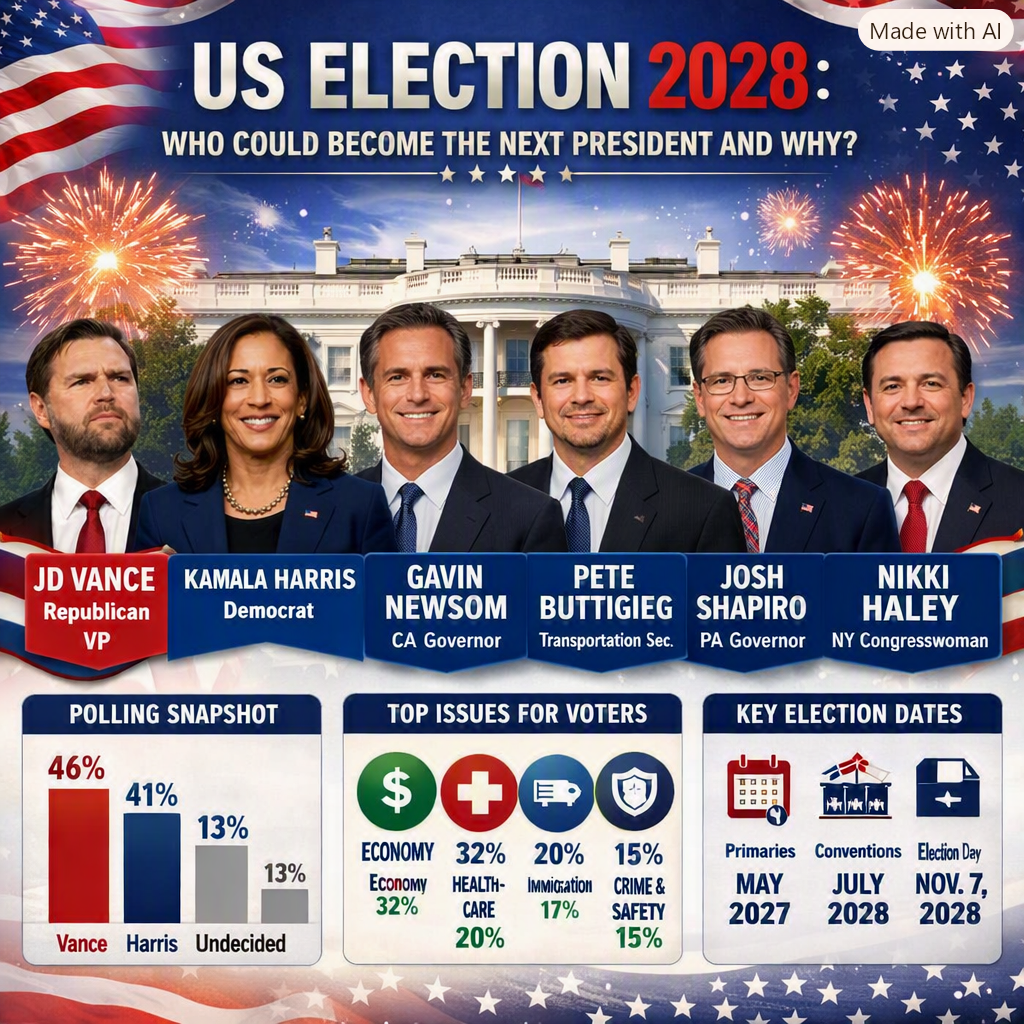
The 2028 United States presidential election is already attracting enormous attention, even though Election Day is still more than two years away. The election will be fundamentally different from a normal presidential contest because Donald Trump cannot be elected to a third term under the Twenty-Second Amendment. That means both major political parties will be preparing for a succession battle in which voters will choose a completely new president. The 2028 election is scheduled for November 7, 2028, and the eventual winner will take office in January 2029. (Ballotpedia)
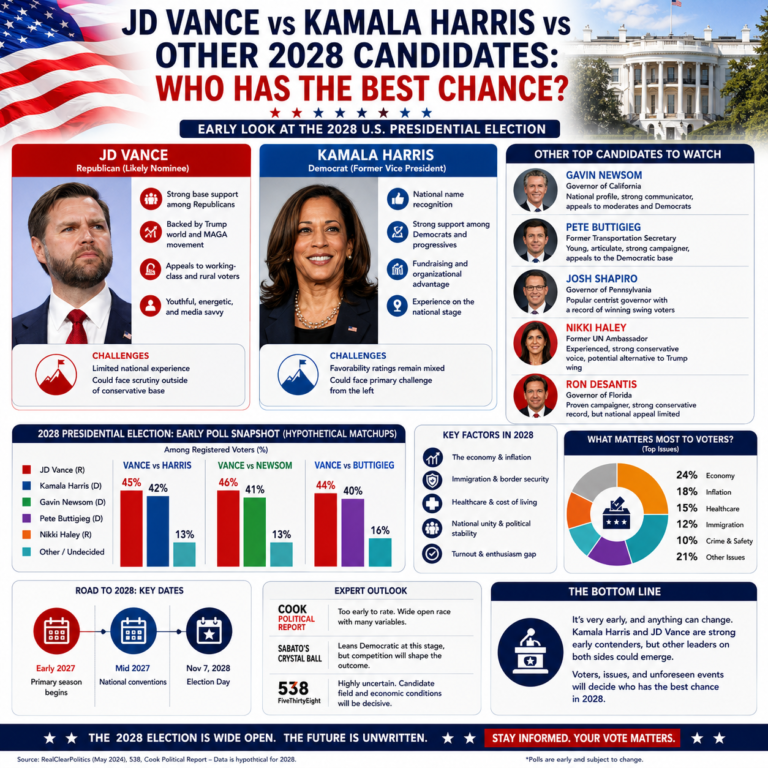
The Republican Party currently appears to have a clearer early frontrunner than the Democratic Party. Vice President JD Vance has emerged as one of the strongest Republican possibilities, while Secretary of State Marco Rubio has also attracted significant attention. On the Democratic side, the potential field is much more open. Kamala Harris, Gavin Newsom, Pete Buttigieg, Josh Shapiro, Alexandria Ocasio-Cortez, Andy Beshear, and several other Democrats have been discussed as possible contenders. Current prediction markets and early polling show that no candidate has anything close to a guaranteed path to the presidency. (Federal News Network)
The most interesting question is therefore not simply who is leading today, but which candidates have the political ingredients needed to win the nomination and then win the Electoral College. Presidential elections are not determined only by national popularity. Candidates need strong party support, fundraising, campaign organization, favorable economic conditions, strong turnout, and enough support in competitive states such as Pennsylvania, Michigan, Wisconsin, Arizona, Georgia, Nevada, and North Carolina.
At this stage, JD Vance may have the strongest overall Republican position because he is already vice president and has a close relationship with Trump’s political movement. Marco Rubio could become a serious alternative, while other Republicans such as Ron DeSantis, Glenn Youngkin, Sarah Huckabee Sanders, Tim Scott, and others could enter the contest. On the Democratic side, Kamala Harris has substantial national recognition, but the party could decide that a new candidate offers a better chance of defeating Republicans. That makes the 2028 election one of the most unpredictable presidential contests of the coming decade.
Why the 2028 Election Will Be Different
The biggest reason the 2028 election will be unusual is the absence of an eligible incumbent president seeking reelection. Donald Trump has already won two presidential elections, so he cannot be elected president for a third time under the Twenty-Second Amendment. This means Republicans must eventually decide which politician can inherit the coalition Trump built while also developing an identity of their own.
For Republicans, this creates a succession contest. The party must determine whether it wants to continue Trump’s political approach as closely as possible or gradually move toward a different style of conservatism. JD Vance is particularly well positioned because he can argue that he represents the next generation of the Trump movement. At the same time, another Republican could argue that the party needs a new leader who can appeal to voters who supported Trump but do not necessarily want the same political style indefinitely.
Democrats face a different challenge. Because there is no Democratic incumbent preparing to pass the nomination to a successor, multiple politicians can realistically imagine themselves as the party’s future. Kamala Harris has the strongest existing national profile among many potential candidates because she served as vice president and was the Democratic presidential nominee in 2024. However, other Democrats can argue that the party needs a fresh face after the 2024 defeat.
The result is an election that could produce a major generational shift. The eventual candidates could be significantly younger than the presidents who dominated American politics during the previous decade. Voters may be choosing not only between Republican and Democratic policies but also between different generations and visions of leadership. That makes the 2028 campaign potentially more transformative than a typical presidential election.

JD Vance: The Early Republican Favorite
JD Vance currently has one of the clearest paths toward the Republican nomination. As vice president, he possesses an advantage that few other potential candidates can match. He already has a national platform, White House experience, access to Republican donors, and a direct relationship with the president and the Republican base. His political identity is also closely associated with the modern conservative movement that Trump helped build.
Vance has previously served as a U.S. senator from Ohio, giving him legislative experience before becoming vice president. His relatively young age also allows Republicans to portray him as a representative of a new generation of conservative leadership. Instead of presenting himself as simply another traditional Republican politician, he can argue that he represents a political transition from Trump to a younger generation.
Early polling and prediction markets have repeatedly placed Vance near the top of the Republican field. However, the exact rankings have changed depending on the survey or market. In some current prediction markets, Marco Rubio has been slightly ahead of Vance, while other markets have placed Vance first. This demonstrates that the race is fluid rather than settled. (Kalshi)
Vance’s biggest advantage could be Trump’s influence. If Trump ultimately gives Vance a strong endorsement and actively campaigns for him, Vance could become extremely difficult to defeat in the Republican primary. However, Trump has also repeatedly mentioned Rubio as a potential successor, meaning the relationship between Vance and Rubio could become one of the defining stories of the Republican nomination battle. (Time)

Marco Rubio: The Strongest Alternative?
Marco Rubio is arguably the most important Republican alternative to JD Vance. Rubio has extensive national political experience, having served as a senator from Florida and later becoming secretary of state. He also ran for president in 2016, so he understands the demands of a national presidential campaign and already possesses a national political network.
Rubio’s foreign-policy experience could become particularly important if international security, wars, China, trade, or America’s role in the world become major issues by 2028. As secretary of state, he would be able to campaign as someone with direct experience handling international affairs. That could differentiate him from candidates whose experience is primarily domestic.
Current prediction markets demonstrate why Rubio cannot be dismissed. One current market listed Rubio and Vance among the leading potential winners of the 2028 presidency, with Gavin Newsom also close behind. (Kalshi) Another recent report noted that Trump has promoted the possibility of a Vance-Rubio ticket or even a Rubio-Vance combination, demonstrating that both men remain central to discussions about the Republican Party’s future. (Time)
Rubio’s biggest problem is that he could struggle to differentiate himself if Vance receives Trump’s full support. If Republican voters believe Vance is the natural successor, Rubio would need to explain why he offers a stronger path to victory. However, if Republicans become more interested in foreign policy, experience, or a somewhat different style of conservative leadership, Rubio could become a very serious contender.

Kamala Harris: Can She Return in 2028?
Kamala Harris remains one of the most recognizable Democratic politicians in the United States. She served as vice president and became the Democratic presidential nominee in 2024. Although she lost that election, she retains an extensive political network, national name recognition, donor relationships, and experience campaigning for president.
Harris’s potential 2028 campaign would be built around a complicated political argument. She could tell Democratic voters that she has already faced the national Republican campaign machine and understands what went wrong in 2024. She could argue that her experience makes her better prepared for another presidential campaign than almost any other Democrat.
However, the same history could also be her greatest weakness. Democratic voters may ask whether the party should nominate the candidate who lost the previous election or choose a new politician who can present a completely different political message. Opponents inside the Democratic primary could argue that the party needs a fresh start rather than a repeat of the previous campaign.
Early Democratic polling remains mixed, which shows both Harris’s strength and the uncertainty surrounding her candidacy. Some polls have placed her near the top, while other surveys show Gavin Newsom, Pete Buttigieg, or other candidates performing strongly. The fact that no Democrat has established overwhelming dominance means Harris could become the frontrunner if she enters the race, but she cannot assume that the nomination will automatically be hers. (New York Post)
Gavin Newsom: A Major Democratic Challenger
Gavin Newsom is another Democrat with a strong potential path to the presidency. As governor of California, Newsom has developed a national political identity and frequently participates in national political debates. He has become one of the most visible Democratic governors and has spent years positioning himself as an aggressive defender of Democratic policies.
Newsom’s strongest argument is executive experience. Unlike many presidential contenders who come primarily from Congress, Newsom can point to his record as governor of one of America’s largest states. He can argue that he has managed a huge government, dealt with economic issues, handled crises, and developed policies that affect millions of residents.
Newsom also has significant national recognition. Prediction markets have repeatedly placed him among the leading potential Democratic candidates, and current 2028 winner markets show him competing closely with major Republican names. (Kalshi) His national profile means he would not have to spend as much time introducing himself to Democratic voters as many lesser-known candidates.
His biggest weakness could be California itself. Republicans would almost certainly attack his record on taxes, housing, crime, homelessness, energy, and other California issues. Newsom would need to convince voters in Midwestern and Southern swing states that his California record translates effectively to national leadership. If he can overcome that challenge, he could become one of the strongest Democratic alternatives to Harris.
Pete Buttigieg and the Generational Argument
Pete Buttigieg remains another important potential Democratic candidate. He gained national attention during the 2020 Democratic presidential primary and later served as transportation secretary. His previous presidential campaign gave him valuable experience with national fundraising, media attention, debates, and grassroots organization.
One of Buttigieg’s biggest strengths is communication. He has consistently demonstrated an ability to explain political issues in a way that can appeal beyond a narrow ideological base. In a general election, that could be useful because the eventual Democratic nominee will need to communicate with independents as well as Democratic voters.
Buttigieg also represents a generational change. His potential candidacy could appeal to voters who believe American politics needs younger leadership. After years of presidential politics dominated by older candidates, a younger nominee could offer Democrats a powerful narrative about the future.
The challenge is electability. Buttigieg has never won a statewide general election, and Republicans would likely use that fact against him. He would need to prove that his national campaign experience compensates for his limited statewide electoral background. Nevertheless, he remains a serious potential candidate, and a strong political environment could allow him to become much more competitive.
Josh Shapiro: The Swing-State Governor
Josh Shapiro could become one of the most interesting Democratic candidates because of his experience in Pennsylvania. Pennsylvania is one of the most important swing states in modern presidential elections, and a candidate who has already won statewide there can make a powerful electability argument.
Shapiro’s potential advantage is straightforward: he can tell Democratic voters that he knows how to win in a competitive state. Presidential elections are ultimately decided through the Electoral College, and Pennsylvania is often considered one of the key states capable of determining the national result.
He can also campaign as a governor rather than a Washington-based politician. That allows him to emphasize executive leadership, state-level results, and practical governance. If Democratic voters become particularly concerned about winning back suburban and working-class voters, Shapiro could become more attractive.
His biggest challenge is national recognition. Compared with Harris and Newsom, Shapiro is less familiar to voters across the country. A presidential campaign would require him to build a national fundraising network and establish a recognizable national identity. If he succeeds, however, his Pennsylvania background could make him one of the most electability-focused candidates in the Democratic field.
Alexandria Ocasio-Cortez and the Progressive Future
Alexandria Ocasio-Cortez represents a very different possible direction for the Democratic Party. She has built an enormous national profile around progressive politics, economic issues, social policy, and generational change. Her communication skills and social-media presence give her an unusual ability to reach younger voters directly.
AOC’s biggest advantage would be enthusiasm. If she ran for president, she could potentially generate enormous attention among younger voters and progressive activists. She could argue that Democrats need a more ambitious economic message and a stronger connection with working-class voters.
However, a presidential campaign would require her to expand beyond the progressive base. Winning a Democratic primary is different from winning the general election. A candidate needs to appeal to moderates, independents, suburban voters, and swing-state voters who may not share the political views of the party’s most progressive activists.
Her potential candidacy could therefore produce one of the biggest ideological debates in the Democratic Party. Democrats would have to decide whether they want a more progressive nominee who could energize the base or a more moderate candidate who might have broader appeal in competitive states.
Other Republican Candidates to Watch
The Republican field could become much larger than Vance and Rubio. Ron DeSantis remains nationally known after his 2024 presidential campaign and could potentially seek the presidency again. His experience as governor of Florida gives him an executive record, although he would need to rebuild momentum after his previous presidential campaign.
Glenn Youngkin is another potential Republican contender. His record as governor of Virginia gives him experience winning in a state that is more politically competitive than many Republican strongholds. He has also received attention from political observers as a possible 2028 candidate. Sarah Huckabee Sanders, Tim Scott, and other Republicans have likewise been discussed as potential candidates. (Wikipedia)
Donald Trump Jr. could also become part of the conversation. His biggest advantage would be his connection to Trump’s political brand and voter base. However, it remains uncertain whether he would actually seek the presidency or whether Republican voters would prefer an elected official with executive or legislative experience.
The Republican field could also change after the 2026 midterm elections. A senator or governor who performs exceptionally well could suddenly become a national contender. Conversely, candidates who suffer major political setbacks could lose momentum. That means the 2026 elections are likely to be one of the most important early turning points in the 2028 race.
Other Democratic Candidates to Watch
The Democratic Party also has a large potential field. Andy Beshear, governor of Kentucky, has attracted national attention because of his ability to win statewide in a strongly Republican state. His record could allow him to argue that Democrats need a candidate capable of appealing to voters who do not normally support the party.
Other potential candidates include senators, governors, and members of Congress who may become more prominent over the next two years. The current list of potential 2028 contenders includes figures such as Cory Booker, Ruben Gallego, Mark Kelly, Andy Beshear, Pete Buttigieg, and Kamala Harris. (Track AIPAC)
The Democratic field could also change depending on what happens during the 2026 midterms. If Democrats perform strongly, governors and senators who lead successful campaigns may become presidential contenders. If Democrats perform poorly, the party may search for a candidate capable of rebuilding its coalition.
The biggest Democratic advantage is that the party has many possible paths. The biggest disadvantage is that too many candidates can divide support. Harris, Newsom, Buttigieg, Shapiro, AOC, Beshear, and others could compete for similar voters. The eventual winner will need to build a coalition that extends beyond one ideological faction.
What Current Polling Tells Us
Early polling is useful but must be treated carefully. Most voters are not yet focused intensely on a presidential election scheduled for November 2028. Candidate recognition can therefore matter more than actual political preference. A famous politician can perform well in an early poll simply because voters know the name, while an emerging candidate may initially receive little support.
Recent polling has nevertheless produced some important signals. An Emerson College survey released in May 2026 examined the political environment and potential 2028 contenders, while other polling has shown different candidates gaining or losing support. (Emerson Polling) The variation between surveys is one reason it would be misleading to declare a final frontrunner at this stage.
Prediction markets provide another perspective. Current markets have placed figures including Marco Rubio, JD Vance, and Gavin Newsom near the top of the potential 2028 presidential field. One current market showed Rubio at 18 percent, Vance at 17 percent, and Newsom at 12 percent. (Kalshi) These numbers should not be interpreted as traditional election probabilities because market prices reflect trader expectations and can change quickly.
The most important takeaway is that the race is fluid. Vance has a strong Republican position, Rubio is highly competitive, and Newsom is one of the strongest Democratic possibilities. Harris remains a major contender even when particular polls place other Democrats ahead. As more candidates announce and voters learn more about them, the rankings will almost certainly change.
The Importance of Trump’s Endorsement
Donald Trump’s influence could be one of the biggest factors in the Republican primary. Even though he cannot run for another term, he remains central to the Republican coalition. His endorsement could provide a candidate with enormous advantages in fundraising, media coverage, grassroots support, and credibility among Republican primary voters.
JD Vance would benefit enormously if Trump formally endorsed him. Vance has already established a close relationship with Trump and is positioned as one of the leading figures of the current administration. A clear Trump endorsement could discourage other Republicans from challenging him.
Marco Rubio could also benefit from Trump’s support. Trump has repeatedly discussed Vance and Rubio as possible successors, and in June 2026 he promoted the possibility of the two appearing together on a future ticket. (Time) That makes the relationship between Vance and Rubio especially important.
However, Trump’s political preferences can change. A candidate who appears favored today may not necessarily be Trump’s preferred candidate two years from now. The eventual Republican primary will therefore depend not only on Trump’s endorsement but also on the political environment created by the administration between now and 2028.
The 2026 Midterms Could Change Everything
The 2026 midterm elections could be a major turning point in the 2028 presidential race. Voters will effectively provide an early judgment on Trump’s presidency and the Republican-controlled federal government. The results could strengthen the Republican Party or create significant momentum for Democrats.
If Republicans perform well in 2026, Vance could benefit. He could argue that voters are supporting the administration’s policies and that the Republican Party should continue that direction after Trump. A strong Republican performance would also make it easier for him to campaign as the natural successor.
If Democrats make major gains, the political environment could shift dramatically. Democratic candidates could argue that voters are rejecting Republican policies and preparing to return the party to the White House. Governors and senators who win competitive races could suddenly emerge as major presidential contenders.
The midterms could also reveal which issues matter most to voters. If economic concerns dominate, candidates may focus heavily on inflation, wages, housing, taxes, and jobs. If immigration dominates, Republicans may have an advantage. If abortion or healthcare becomes central, Democrats could benefit. The 2026 results will therefore provide important clues about the issues that will shape 2028.
The Economy Could Decide the Election
The economy is likely to be one of the most important factors in the 2028 election. Voters often judge political parties based on their personal financial experiences. Inflation, wages, unemployment, housing costs, interest rates, healthcare expenses, and consumer confidence could all influence the result.
If the economy is strong by 2028, Republicans will have a major opportunity to argue that their policies produced positive results. JD Vance or another Republican could campaign on economic continuity and tell voters that changing parties would threaten progress.
If voters remain frustrated by high living costs, Democrats will have an opportunity to make affordability a central issue. Harris, Newsom, Shapiro, or another Democratic nominee could argue that the Republican administration failed to improve the financial situation of ordinary Americans.
The economic situation is impossible to predict with certainty in 2026. A recession, inflation shock, housing boom, technological transformation, or major changes in employment could completely alter the political environment. Therefore, any current 2028 forecast should be understood as conditional rather than definitive.
Immigration and Border Security
Immigration is likely to remain one of the most important issues in the 2028 election. Republicans have increasingly emphasized border security, illegal immigration, deportation, and immigration enforcement. Democrats have generally focused more on legal immigration, humanitarian concerns, citizenship pathways, and balancing border security with individual rights.
JD Vance could make immigration a major part of his campaign. His political style is well suited to arguments about national sovereignty, border enforcement, and protecting American workers. If voters believe the Trump administration successfully reduced illegal immigration, that could strengthen the Republican nominee.
Democrats could respond by arguing that immigration policy needs to be effective but also humane and economically practical. A Democratic nominee could attempt to appeal to moderate voters who want stronger border management but do not support aggressive immigration policies.
The issue’s impact will depend heavily on actual conditions by 2028. If border crossings fall and public confidence improves, immigration may become less politically dominant. If border pressures increase or immigration becomes associated with crime or economic concerns, Republicans could benefit substantially.
Abortion and Reproductive Rights
Abortion is another issue that could significantly influence the 2028 election. Democrats have used reproductive rights as a major mobilizing issue, particularly among women and suburban voters. Republicans have generally emphasized restrictions on abortion and protections for unborn children, although the party contains different views about the exact policy approach.
Kamala Harris could potentially make reproductive rights a central part of a Democratic campaign. Her role as a national Democratic leader gives her the ability to argue that Republicans would impose further restrictions while Democrats would protect access to abortion.
Republican candidates would likely attempt to emphasize state authority, parental rights, and conservative social values. The exact Republican position could vary depending on the eventual nominee. Vance, Rubio, DeSantis, and other potential candidates may approach the issue differently.
The issue could become especially important in swing states. Even voters who do not normally vote Democratic may support Democratic candidates because of concerns about abortion restrictions. This makes reproductive rights potentially significant in determining whether Democrats can win states such as Michigan, Pennsylvania, Wisconsin, and Arizona.
Foreign Policy and National Security
Foreign policy could become much more important by 2028 depending on developments around the world. Wars, relations with China, Russia, the Middle East, NATO, trade conflicts, and international security could all shape voter attitudes.
Marco Rubio would have a particularly strong argument on this issue because of his role as secretary of state. He could campaign on direct foreign-policy experience and argue that his knowledge of international affairs makes him better prepared to serve as commander in chief.
JD Vance could present a different approach focused on putting American interests first and reducing U.S. involvement in overseas conflicts. If Republican voters continue moving toward a less interventionist foreign-policy position, Vance could benefit.
Democrats would likely emphasize alliances, international cooperation, democratic institutions, and America’s global leadership. A candidate such as Newsom or Harris could argue that strong alliances protect American security and economic interests. Ultimately, foreign policy could become a decisive issue if a major international crisis occurs before 2028.
The Electoral College Matters More Than the Popular Vote
A presidential candidate can win the national popular vote and still lose the presidency because the United States uses the Electoral College. That means candidates need to focus on states that can provide the 270 electoral votes necessary to win.
The most important states could include Pennsylvania, Michigan, Wisconsin, Arizona, Georgia, Nevada, and North Carolina. Candidates who perform well nationally but lose several of these states can still lose the presidency.
JD Vance’s challenge would be expanding the Republican coalition beyond traditionally conservative states. Republicans would need strong support among working-class voters, rural voters, suburban voters, and potentially some minority communities in swing states.
Democrats face the opposite challenge. They need to maintain strong support in large urban areas while improving performance among working-class and independent voters in competitive states. A candidate like Josh Shapiro could have an advantage because of his experience winning Pennsylvania, while candidates such as Newsom would need to demonstrate that they can connect with voters outside California.
Young Voters Could Be Decisive
Young voters could become one of the most important groups in the 2028 election. Younger Americans have different political priorities from older voters, including concerns about housing affordability, student debt, climate change, wages, technology, healthcare, and social issues.
Democrats have traditionally performed strongly among younger voters, but their level of enthusiasm can vary. If young voters become disappointed with the Democratic Party, Republicans could potentially make gains. Conversely, if Democrats successfully mobilize younger voters, they could create a powerful turnout advantage.
Alexandria Ocasio-Cortez and Pete Buttigieg could potentially benefit from generational politics. Both represent a younger generation of political leadership compared with many traditional presidential candidates.
JD Vance could also appeal to younger voters by presenting himself as part of a new Republican generation. His success with young voters would depend on whether they identify with his economic, cultural, and political message. The ability of either party to mobilize younger voters could become decisive in closely contested states.
Independent Voters Will Be Crucial
Independent voters are likely to determine the outcome in many swing states. Party loyalists make up the foundation of every presidential campaign, but independents can decide close elections when neither party has a large enough advantage.
JD Vance would need to demonstrate that he can appeal to independents who may have supported Trump but are not committed to the Republican Party. His challenge would be to preserve conservative enthusiasm without appearing too closely tied to the most polarizing aspects of Trump’s politics.
Democratic candidates face a similar challenge. Harris would need to persuade independents that she represents a credible governing alternative rather than simply opposition to Trump. Newsom, Buttigieg, and Shapiro could each attempt to present themselves as candidates with broader appeal.
The eventual winner may be the candidate who best understands this middle ground. Presidential elections are rarely won by motivating only the party base. Successful candidates usually combine enthusiastic supporters with enough moderate and independent voters to create a winning Electoral College coalition.
Could a Surprise Candidate Win?
Yes. One of the biggest mistakes in early presidential forecasting is assuming that the current frontrunners will necessarily remain the frontrunners. American politics regularly produces unexpected candidates who gain momentum through a strong speech, debate performance, political victory, fundraising success, or major endorsement.
The 2026 midterms could create several surprise candidates. A governor who wins a difficult reelection campaign or a senator who performs exceptionally well could suddenly become a national figure. Similarly, a candidate who initially receives little attention could benefit from a political crisis or major change in voter priorities.
The Democratic Party is particularly vulnerable to a surprise because the field is so open. If Harris, Newsom, Buttigieg, and other major candidates divide the electorate, a lesser-known candidate could potentially build a coalition and emerge through the primary process.
The Republican Party could also experience an unexpected challenge to Vance. If Rubio decides to compete aggressively or another Republican builds a strong coalition, the current frontrunner could face a much more difficult primary than expected.
What Could Help JD Vance Win?
Vance’s strongest path would involve maintaining Trump’s support while developing an independent national identity. He needs to convince Republican voters that he can continue the administration’s successful policies while also demonstrating that he can lead the party after Trump.
A strong economy would help enormously. If voters feel financially secure and believe the administration improved their lives, Vance could argue that changing leadership would be unnecessary. Strong Republican results in the 2026 midterms would reinforce that message.
Vance would also need to expand his coalition. Winning the Republican primary may require strong conservative support, but winning the general election requires independents and moderate voters. He would need to show that he can appeal beyond the most loyal Trump voters.
Finally, Vance would need to avoid being defined entirely by Trump. His connection to Trump is currently one of his greatest strengths, but it could become a weakness if the administration becomes unpopular. The most successful strategy would likely be to present himself as the successor to Trump’s political movement while still demonstrating independent leadership.
What Could Help Kamala Harris Win?
Harris’s strongest path would involve presenting herself as an experienced candidate who has learned from the 2024 election. She would need to show Democratic voters that she has evolved politically and that her campaign would be stronger the second time.
She could also benefit from Democratic enthusiasm around reproductive rights, healthcare, economic affordability, and opposition to Republican policies. If voters become dissatisfied with the Trump administration, Harris could argue that Democrats offer a return to a different governing philosophy.
However, Harris would need to address the question of why she should be nominated again after losing in 2024. Her campaign would need a compelling explanation that goes beyond simply criticizing Republicans. She would need to persuade voters that she is the best person to win the states necessary for an Electoral College majority.
Her greatest advantage may ultimately be familiarity. Democratic voters already know her strengths and weaknesses. In a crowded primary, that recognition could help her establish an early lead while other candidates compete to introduce themselves nationally.
What Could Help Gavin Newsom Win?
Newsom’s strongest argument would be that Democrats need a new generation of leadership with executive experience. He could present himself as a governor capable of running a large government and defending Democratic policies nationally.
His national media experience would also help. Newsom has repeatedly participated in political debates and national discussions, meaning he would not be entering the presidential spotlight for the first time.
Newsom would need to convince voters that California’s political environment does not define his ability to govern the entire country. Republicans would likely focus heavily on California’s problems, so Newsom would need to explain how his policies would work in Midwestern and Southern states.
If Democrats decide that they want an aggressive national campaigner who can challenge Republicans directly, Newsom could become extremely competitive. Current prediction markets already place him among the leading potential Democratic figures. (Polymarket)
What Could Help Marco Rubio Win?
Rubio’s strongest advantage would be experience. He has served in the Senate, run for president, and served as secretary of state. That gives him a resume that few other potential candidates can match.
He could also benefit if foreign policy becomes central to the 2028 campaign. A major international crisis could make his experience much more valuable to Republican voters. His ability to discuss national security and international affairs could distinguish him from candidates with primarily domestic records.
Rubio would need to build a coalition capable of challenging Vance’s relationship with Trump’s base. If Trump endorses Vance, Rubio would have a difficult battle. But if Trump remains neutral or if Republican voters become interested in a more experienced candidate, Rubio’s chances could increase substantially.
His potential relationship with Vance also creates an unusual possibility. Instead of becoming opponents, the two could potentially form a presidential ticket. Trump himself has promoted the possibility of Vance and Rubio appearing together on a future Republican ticket. (Time)
What Could Happen in the Republican Primary?
The Republican primary could begin with Vance as the favorite, Rubio as the strongest alternative, and several other candidates competing for attention. The central question will be whether Republican voters want continuity with Trump or a different style of conservative leadership.
If Vance has strong approval and Trump’s endorsement, he could dominate early contests. Other candidates may decide that challenging him is too difficult and instead compete for the vice presidency or future political opportunities.
If Vance’s support weakens, Rubio could become the main alternative. A strong performance in early primary states such as Iowa or New Hampshire could change the entire narrative.
The Republican primary could ultimately be decided by three factors: Trump’s endorsement, the administration’s popularity, and the performance of the candidates in early primary states. Until those factors become clearer, Vance should be considered the early favorite rather than a guaranteed nominee.
What Could Happen in the Democratic Primary?
The Democratic primary could be much more unpredictable. Harris may begin with a strong national profile, but Newsom, Buttigieg, Shapiro, AOC, Beshear, and other Democrats could challenge her.
The party’s strategic debate could center on whether Democrats need a familiar candidate or a fresh face. Harris could argue that experience and national recognition are essential, while opponents could argue that Democrats need a new candidate capable of creating a new coalition.
The outcome may also depend on ideology. Progressive voters could gravitate toward AOC, pragmatic Democrats could support Shapiro or Beshear, and voters seeking a nationally experienced candidate could prefer Harris or Newsom.
Because the Democratic field is so large, early endorsements and fundraising will be extremely important. A candidate who builds a strong donor network before the primaries could quickly establish an advantage over better-known rivals.
Who Is Most Likely to Become the Next President?
If the election were being decided today, it would be extremely difficult to name one candidate with confidence. Current prediction markets show Rubio, Vance, and Newsom among the leading possibilities, but the numbers remain relatively close and can change quickly. (Kalshi)
If we focus only on the Republican nomination, JD Vance currently has one of the strongest cases. His vice presidency, relationship with Trump, national recognition, and early polling position give him a major advantage.
If we focus only on the Democratic nomination, Kamala Harris remains one of the strongest individual candidates, but she faces serious competition from Newsom, Buttigieg, Shapiro, AOC, and others.
If we focus on the general election, the answer becomes much more complicated. The eventual winner could depend on the economy, Trump’s approval, the 2026 midterms, international events, candidate quality, turnout, and the political conditions in seven or eight swing states.
Possible 2028 Presidential Matchups
A JD Vance vs. Kamala Harris election would be one of the most dramatic possibilities. Both candidates have vice-presidential experience, and the race would represent a direct competition between the Republican and Democratic visions for America’s future.
A JD Vance vs. Gavin Newsom contest would offer a different contrast. Vance would represent the Republican movement that emerged under Trump, while Newsom would represent a younger generation of Democratic leadership and a strongly progressive state.
A Marco Rubio vs. Kamala Harris election would emphasize experience and national security more strongly. Both candidates have extensive national political backgrounds and would be able to campaign as experienced leaders.
A Marco Rubio vs. Gavin Newsom election could also be highly competitive. Both have executive or major governmental experience and strong national profiles, but they represent sharply different political philosophies. Which matchup eventually occurs will depend entirely on the primary process.
Final Prediction for 2028
As of August 2026, JD Vance is one of the strongest candidates to become the next Republican presidential nominee, although Marco Rubio has emerged as a serious alternative and current prediction markets sometimes place Rubio slightly ahead. The Republican field is still open, and the results of the 2026 midterms could change the situation dramatically. (Kalshi)
On the Democratic side, Kamala Harris remains one of the strongest possibilities, but she is far from guaranteed to become the nominee. Gavin Newsom, Pete Buttigieg, Josh Shapiro, Alexandria Ocasio-Cortez, Andy Beshear, and other Democrats could build serious campaigns. The Democratic nomination may ultimately depend on whether voters prioritize familiarity, ideology, executive experience, or general-election electability.
If forced to identify the candidates with the strongest positions today, the short list would include JD Vance, Marco Rubio, Kamala Harris, and Gavin Newsom, with several other politicians capable of becoming serious contenders. Current prediction markets show how narrow the early landscape can be, with Rubio, Vance, and Newsom all appearing among the leading names. (Kalshi)
However, the most responsible prediction is that the 2028 election is still wide open. The next president could be Vance, Rubio, Harris, Newsom, or a candidate who has not yet become a national frontrunner. The 2026 midterms, economic conditions, Trump’s political standing, candidate decisions, and early primary contests will provide much clearer answers.
Frequently Asked Questions
Who is the early favorite for the 2028 U.S. presidential election?
JD Vance is one of the strongest early Republican contenders, while Marco Rubio has also become highly competitive in current prediction markets. Gavin Newsom is among the leading Democratic possibilities. Because the election is still more than two years away, no candidate can reasonably be considered a certain winner. (Kalshi)
Can Donald Trump run for president again in 2028?
No. Donald Trump has already been elected president twice, and the Twenty-Second Amendment prevents a person from being elected president more than twice. He can still influence the Republican Party, endorse candidates, campaign for them, and play a major role in the 2028 political environment.
Is JD Vance likely to run in 2028?
JD Vance is widely regarded as a leading potential Republican candidate. He has acknowledged thinking about a 2028 campaign but has also emphasized focusing on the 2026 midterms. His position as vice president makes him one of the most obvious potential successors to Trump. (Wikipedia)
Could Marco Rubio become president in 2028?
Yes. Rubio is one of the strongest potential Republican candidates. His experience as a senator, presidential candidate, and secretary of state gives him a substantial political résumé. Current prediction markets have placed him among the leading potential winners. (Kalshi)
Could Kamala Harris run again in 2028?
Yes. Harris is eligible to run for president again. Her previous presidential campaign and vice-presidential experience give her major national recognition, although she would need to compete with other Democrats for the nomination.
Who are the strongest Democratic candidates for 2028?
Potential Democratic contenders include Kamala Harris, Gavin Newsom, Pete Buttigieg, Josh Shapiro, Alexandria Ocasio-Cortez, Andy Beshear, and several others. The Democratic field remains considerably less settled than the Republican field. (Track AIPAC)
Who are the strongest Republican candidates?
JD Vance and Marco Rubio currently appear among the strongest possibilities. Other Republicans who have received attention include Ron DeSantis, Glenn Youngkin, Sarah Huckabee Sanders, Tim Scott, and others. (Wikipedia)
When is the 2028 U.S. presidential election?
The 2028 U.S. presidential election is scheduled for November 7, 2028. (Ballotpedia)
What states will decide the 2028 election?
The most important battlegrounds are likely to include Pennsylvania, Michigan, Wisconsin, Arizona, Georgia, Nevada, and North Carolina. The exact battleground map could change depending on the candidates and political conditions.
Will the 2026 midterms affect the 2028 presidential election?
Yes. The 2026 midterms could significantly affect the political environment. Strong Republican results could strengthen Vance and the broader Republican succession argument, while strong Democratic results could create momentum for Harris, Newsom, Shapiro, or another Democratic candidate.
What is the biggest factor that could change the 2028 race?
The biggest factors include the economy, presidential approval, international crises, immigration, abortion, the 2026 midterms, candidate fundraising, and the performance of the major candidates during the primary campaign.
Conclusion
The 2028 U.S. presidential election is shaping up to be one of the most important and unpredictable political contests of the decade. For the first time since 2016, neither party will have a sitting president eligible to simply seek another term. Donald Trump cannot run for a third elected term, meaning Republicans must select a successor while Democrats attempt to rebuild their path to the White House.
JD Vance currently has one of the strongest positions in the Republican field. His vice presidency, connection to Trump’s political movement, national recognition, and early support make him a logical frontrunner. However, Marco Rubio has emerged as a serious alternative, and the Republican field could change substantially after the 2026 midterms. Current prediction markets demonstrate just how competitive the early contest remains. (Kalshi)
The Democratic race is even more uncertain. Kamala Harris has the advantage of national recognition and previous presidential campaign experience, but Gavin Newsom, Pete Buttigieg, Josh Shapiro, Alexandria Ocasio-Cortez, Andy Beshear, and other Democrats could challenge her. The party must eventually decide whether it wants to continue with a familiar national figure or embrace a new generation of leadership.
The most important point is that no one can accurately guarantee the winner in August 2026. The 2028 election is still far enough away for political conditions to change dramatically. A recession, economic boom, international crisis, major scandal, successful midterm campaign, or surprise candidate could completely transform the race.
For now, JD Vance, Marco Rubio, Kamala Harris, and Gavin Newsom are among the most important names to watch, but the eventual president could emerge from a much larger field. The 2026 midterms will provide the first major clue, while the 2027 campaign season and 2028 primaries will reveal which candidates can turn early attention into genuine political momentum.
The current race is best described as wide open. JD Vance has a particularly strong Republican path, Kamala Harris remains a major Democratic possibility, and Marco Rubio and Gavin Newsom are serious alternatives. But the candidate who ultimately becomes the next president will be determined not by today’s polls or prediction markets, but by the voters who participate in the 2028 primaries and the general election.
For More Information about this article, Please Click Here.
For More Information, Please Click Here.