

If you have ever sat through a church split or watched a Christian community fall apart over arguments, you already know the pain that dissension causes. But what does the Bible actually say about it? Understanding the meaning of dissensions in Scripture is not just an academic exercise it is a deeply personal and spiritually urgent matter for every believer.
The word “dissensions” appears in some of the most serious passages in the New Testament, placed right alongside sins like idolatry and murder. For American Christians navigating a culture already divided along political and social lines, the biblical teaching on dissensions is more relevant than ever.
What Does Dissensions Mean in the Bible?
Biblical Definition of Dissensions Explained
The Greek term behind “dissensions” is dichostasiai, which literally means sharp divisions, factions, or standing apart. It highlights a deliberate fracturing of unity within the Church community.
This is not a mild word. Dichostasiai carries the weight of intentional division, someone actively pulling people away from one another. It goes beyond a simple difference of opinion. It describes a posture of heart that seeks to separate, undermine, and fracture what God has joined together.
In historical Christian usage, dissensions referred to the kinds of disagreements seen in churches, towns, families, and even state divisions, sometimes serious enough to produce full-scale conflict. The word is broad but always carries one consistent meaning: separation where there should be unity.
What the Bible Means by Dissensions
At its core, dissensions in the Bible means more than arguing. It means choosing division over reconciliation. It is a selfish, dividing force that does not seek resolution or peace. It is the direct opposite of the peaceable, gentle spirit that the Holy Spirit produces in believers.
Think of it this way: disagreement asks, “How can we work through this?” Dissension says, “I don’t care about resolution, I just want my side to win.” That distinction is critical for every Christian to understand.
Bible Verses About Dissensions and Unity
Galatians Verses About Dissensions
The most direct reference to dissensions in the Bible comes from the Apostle Paul in Galatians 5. In Galatians 5:19–21, Paul lists the works of the flesh, including adultery, fornication, uncleanness, lewdness, idolatry, sorcery, hatred, contentions, jealousies, outbursts of wrath, selfish ambitions, dissensions, heresies, envy, murders, drunkenness, and revelries warning that those who practice such things will not inherit the kingdom of God.
That is a sobering list. Notice that dissension sits alongside murder and idolatry. Paul is not treating it as a minor personality flaw. He is treating it as a serious sin of the flesh, one that reveals a heart not governed by the Spirit of God. In Galatians 5:20, Paul places this grievous sin squarely among the “works of the flesh,” contrasting it sharply with the “fruit of the Spirit” and emphasizing its spiritual danger to every believer.
Other Key Bible Verses Related to Dissensions
The theme of dissension and division runs throughout both Testaments. Here are key passages every Christian should know:
- Proverbs 6:16–19 God lists seven things He hates, and one of them is “sowing discord among brothers.” This shows how deeply God views deliberate division.
- Romans 16:17 Paul urges believers to watch out for those who cause divisions contrary to sound teaching, and to avoid them.
- 1 Corinthians 1:10 Paul urges the Corinthian believers to all speak the same thing, with no divisions among them, being perfectly joined together in the same mind and judgment.
- 1 Corinthians 3:3 Paul links envying, strife, and divisions directly to carnality, asking the Corinthians whether they are not walking as mere men of the flesh.
- Ephesians 4:3 Christians are called to make every effort to keep the unity of the Spirit through the bond of peace.
Causes of Church Dissension According to the Bible
Why Do Christians Experience Dissension?
It might seem strange that dissensions exists in the Church at all. These are people who claim to follow the Prince of Peace. But the Bible is honest about human nature and it tells us exactly why dissensions happens.
Paul’s intent in listing the works of the flesh is to describe the nature of self-serving lifestyles. Christians are meant to use their freedom and the power of God’s Spirit to serve others in love. Those who refuse to do so end up serving sins like dissension instead. In other words, dissension grows when the flesh takes the wheel instead of the Spirit. It is a fruit of self-centeredness masquerading as conviction.
Common Biblical Causes of Division
The Bible identifies several specific roots of dissensions in the Church:
- Pride and ego When Christians care more about being right than being righteous, dissension follows. Proverbs 13:10 says, “Pride only breeds quarrels.”
- Gossip and slander One of the things that stirs up dissension is gossip. Instead of praying for a struggling brother or sister, people talk to others about them rather than talking to God about them.
- Carnality and spiritual immaturity Paul directly connects dissension to carnal living in 1 Corinthians 3:3. Spiritually immature believers have not yet learned to die to self.
- False teaching divisions in churches often spring from a corrupt and carnal mind and are pushed forward with selfish motives such as the desire for popular applause or worldly advantage.
- Selfish ambition Dissension often starts when someone wants power, recognition, or control within a congregation.
How the Bible Says Christians Should Handle Dissensions

Bible Steps for Dealing With Dissensions
The good news is that the Bible does not just diagnose the problem it gives clear direction for how to respond to dissension when it arises.
Step 1 Examine yourself first. Before confronting someone else, look inward. Christians should check their own attitudes and motives to make sure they are approaching the situation with humility, not self-righteousness.
Step 2 Go directly to the person. Matthew 18:15 is clear: if your brother sins against you, go and tell him his fault between you and him alone. Dissension festers in the dark. Bring it into the light through honest, private conversation.
Step 3 Pursue peace with humility. Galatians 6:1 instructs that those who are spiritual should restore someone overtaken in a fault in a spirit of gentleness. Restoration, not retaliation, is always the goal.
Step 4 Seek wise counsel. When individual effort fails, Matthew 18 advises bringing one or two witnesses. The goal is always reconciliation, not winning an argument.
Step 5 Remove persistent troublemakers if necessary. Romans 16:17 makes clear that when someone is committed to causing division contrary to sound doctrine, the Church has an obligation to identify and avoid them.
Scriptural Guidance for Church Unity
Unity does not mean uniformity. Christians can hold different views on secondary matters while remaining unified around the essentials of the gospel. There is all the difference in the world between believing that we are right and believing that everyone else is wrong. Unshakable conviction is a Christian virtue; unyielding intolerance is a sin.
The key scriptural principles for maintaining unity include:
- Speaking truth in love (Ephesians 4:15)
- Being quick to listen and slow to speak (James 1:19)
- Forgiving one another as God has forgiven us (Colossians 3:13)
- Prioritizing the body of Christ over personal preferences
Difference Between Dissension and Disagreement in the Bible
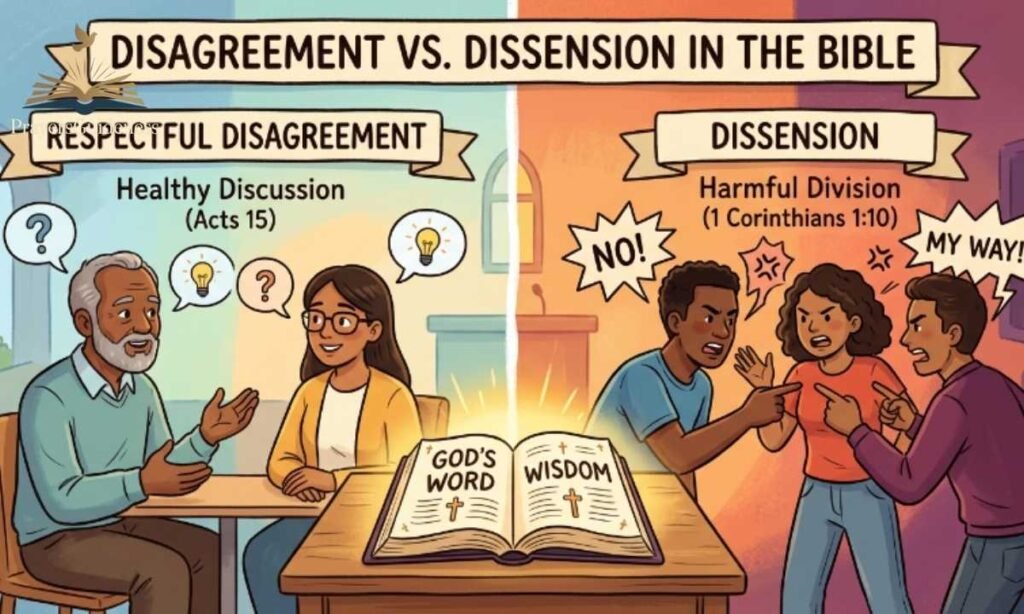
This is a distinction many Christians miss, and it matters enormously. Not every disagreement is a dissension. The Bible shows us that healthy disagreement can actually serve the Church sharpening doctrine, protecting truth, and producing growth. Dissension, on the other hand, tears down without building anything in its place.
| Feature | Disagreement | Dissension |
| Motive | Truth-seeking | Self-promotion or pride |
| Goal | Resolution and understanding | Division and taking sides |
| Tone | Respectful, humble | Contentious, hostile |
| Result | Growth and clarity | Broken relationships |
| Spirit | Holy Spirit-led | Flesh-driven |
In Acts 15, Paul and Barnabas had a firm and necessary confrontation with those teaching that circumcision was required for salvation, a theologically valid and Spirit-led stand. Later, those same two men had a sharp personal disagreement about whether to take John Mark on their next missionary journey. Both were real conflicts, but they were different in nature. The first was a defense of the gospel. The second was a relational tension between godly men. The Bible records both honestly because both happen and both require wisdom to navigate well.
Examples of Dissensions in the Bible With Meaning
New Testament Examples
- The Corinthian Church (1 Corinthians 1:10–13) Believers were splitting into factions based on which apostle they preferred: Paul, Apollos, or Cephas. Paul’s response was sharp: “Is Christ divided?” This is a timeless warning against personality-driven divisions in the Church.
- Paul and Barnabas (Acts 15:39) Their sharp disagreement over John Mark led to a painful separation. Yet God eventually used it to expand missionary work in two directions, showing that even flawed human conflict can be redeemed.
- The Grecian Widows (Acts 6:1) Early in the Church’s history, there was a murmuring of the Grecians against the Hebrews because their widows were being neglected in the daily distribution of food. This ethnic tension was an early test of the Church’s unity and the apostles addressed it wisely and directly.
Old Testament Examples
- Korah’s Rebellion (Numbers 16) Korah led a group of 250 leaders to rebel against Moses and Aaron. This is one of the most dramatic examples of dissension against God-ordained leadership in all of Scripture. God’s response was immediate and severe, showing how seriously He takes rebellion against rightful authority.
- The Division of Israel (1 Kings 12) After Solomon’s death, the kingdom of Israel split in two under Rehoboam and Jeroboam. Pride, heavy taxation, and failure to listen to wise counsel tore apart what God had built. This dissension haunted Israel for generations.
- Miriam and Aaron Against Moses (Numbers 12) Even within Moses’s own family, dissension arose when his siblings challenged his God-given authority. God rebuked them directly, a reminder that no one is immune to the temptation of dissension, not even those closest to godly leadership.
Christian Lessons From Dissensions in Scripture
Every biblical account of dissension teaches something we need to hear today. Here are the most important takeaways:
- Dissension is a sin, not just a personality conflict. Paul listed it among the works of the flesh for a reason. Treat it with the spiritual seriousness it deserves.
- The Church’s unity reflects the character of God. Jesus prayed in John 17:21 that believers would be one, just as He and the Father are one. Every act of division chips away at that witness before the watching world.
- God takes division seriously. Proverbs 6 calls sowing discord among brothers an abomination one of seven things God hates. That is not a casual dislike.
- Reconciliation is always the goal. Whether you are the one causing dissension or the one on the receiving end, the biblical call is always toward peace and restoration.
- Walking in the Spirit is the antidote. The fruit of the Spirit love, joy, peace, patience, kindness, goodness, faithfulness, gentleness, and self-control is the direct counterforce to flesh-driven dissension.
- Accountability matters in the Church. Healthy churches have structures in place to address conflict biblically before it grows into full-blown dissension that splits the body.
Frequently Asked Questions
What Does Dissensions Mean in Galatians 5?
In Galatians 5:20, dissension comes from the Greek word dichostasiai, meaning deliberate, flesh-driven division within the Church community. Paul lists it as one of the works of the flesh that stands in direct contrast to the fruit of the Spirit.
Is Dissension Always Wrong in the Bible?
Not every form of dissension is equivalent. Standing against false teaching, as Paul did in Galatians 2, is necessary and righteous. However, dissension rooted in pride, gossip, selfish ambition, or personal grievance is always sinful according to Scripture.
How Can Churches Avoid Dissension Biblically?
Churches avoid dissension by building a culture of humility, biblical conflict resolution, and Spirit-led leadership. Preaching on unity, establishing clear channels for addressing grievances, and discipling members toward spiritual maturity are all essential and practical tools.
What Is the Greek Word for Dissensions in the Bible?
The primary Greek word is dichostasiai, meaning to stand apart or to divide. It is also closely related to stasis, which carries connotations of rebellion and insurrection against established order.
What Does the Bible Say About Someone Who Causes Dissension?
Proverbs 6:16–19 says God considers it an abomination. Romans 16:17 instructs believers to identify those who cause divisions contrary to sound teaching and to avoid them. The pattern across Scripture is consistent and clear: causing dissension is a serious offense before God.
Conclusion
Dissension in the Bible is not a vague theological concept; it is a named, serious sin that the Apostle Paul placed in the same category as idolatry and murder. If that sounds extreme, it is meant to. The body of Christ is God’s primary witness to the world, and every act of division chips away at that testimony. Understanding what dissensions truly mean in Scripture is the first step toward protecting yourself and your church from their damage.
The wonderful truth is that the same Spirit who names dissension as a work of the flesh also provides the power to overcome it. As you walk in the Spirit through prayer, humility, honest conversation, and genuine love for your brothers and sisters in Christ dissension loses its grip. God’s design for the Church has always been unity, and with His help, that unity is not just possible it is promised.