
Few phrases in American history carry as much weight as this one. Found in the Preamble to the U.S. Constitution, “secure the blessings of liberty to ourselves and our posterity” is not just ceremonial language — it is the founding promise of a self-governing people.
Understanding what this phrase truly means helps every citizen appreciate why the Constitution was written, how it has shaped American law, and why protecting liberty is a duty that belongs to every generation.
Understanding the Preamble and Its Purpose
The Preamble is the opening statement of the U.S. Constitution. It does not create laws or grant specific powers — those are handled in the seven Articles that follow. Instead, the Preamble acts as a mission statement, explaining exactly why the Framers wrote the Constitution in the first place.
Its full text reads: “We the People of the United States, in Order to form a more perfect Union, establish Justice, insure domestic Tranquility, provide for the common defence, promote the general Welfare, and secure the Blessings of Liberty to ourselves and our Posterity, do ordain and establish this Constitution for the United States of America.”
Six goals are listed. Securing the blessings of liberty is the final — and arguably the most aspirational — of them all. The Framers placed it last intentionally, as the culminating purpose behind every other goal.
The Meaning of “Blessings of Liberty”
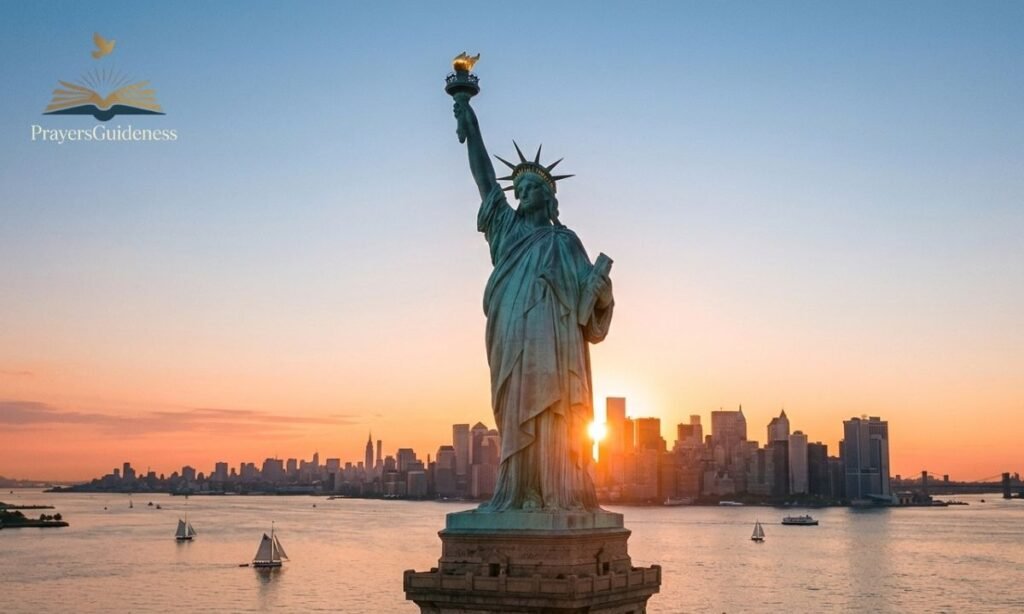
The word “blessings” is not accidental. It reflects Enlightenment thinking — the idea that freedom is not merely useful, but a gift, something to be treasured and actively preserved. The Founders viewed liberty as a divinely endowed or naturally inherited right, not a privilege granted by government.
The “blessings” that flow from liberty include:
• The right to speak, write, and think freely without government censorship
• The freedom to practice any religion — or none at all
• The right to own property and enjoy the fruits of your own labor
• The right to a fair trial and equal protection under the law
• The ability to vote, petition the government, and participate in self-governance
• Freedom from arbitrary arrest or cruel and unusual punishment
These are not abstract ideals. They are the practical realities of daily life in a free society, and they are what the Constitution was designed to protect.
Definition of “Secure the Blessings of Liberty”
In the simplest terms, “secure the blessings of liberty” means to protect and permanently preserve the freedoms that make a just and meaningful life possible. Each word carries specific constitutional weight:
• “Secure” — to create durable, enforceable protections. Not just to declare rights, but to build institutions and laws that defend them against threats like tyranny, disorder, and foreign domination.
• “Blessings” — the tangible benefits of being free: civil rights, rule of law, political representation, economic opportunity, and personal security.
• “Liberty” — the freedom to live, speak, act, and believe according to your own conscience, within the boundaries of fair, equal law.
Together, the phrase is a constitutional commitment: the government exists not to rule people, but to protect their freedom.
Secure the Blessings of Liberty to Ourselves and Our Posterity
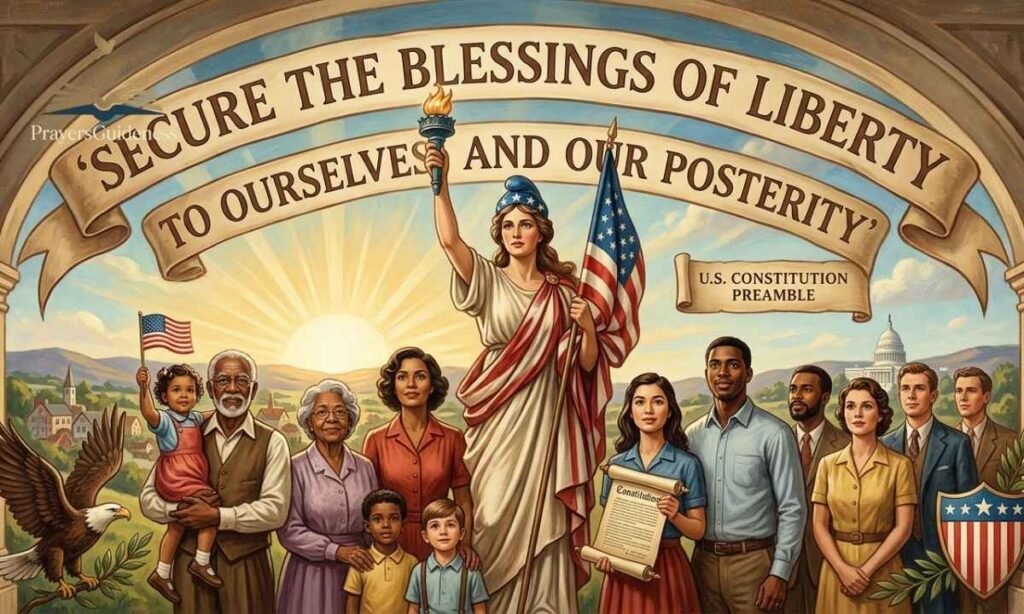
This is one of the most important phrases in the entire Preamble because it extends the promise of liberty across time. “Ourselves” refers to the generation alive in 1787 — the citizens who would live under the new Constitution immediately.
“Our posterity” reaches into the future. It means children, grandchildren, and every generation of Americans yet to come. The Framers were not making a short-term political bargain. They were creating an intergenerational contract — a promise that the freedoms secured in 1787 would still be worth inheriting centuries later.
What Does Liberty Mean in the Preamble?
In the Preamble, liberty does not mean doing anything you want without consequence. It means ordered freedom — the ability to live, speak, worship, work, and pursue happiness under the protection of fair and equal laws, free from the arbitrary power of any ruler or government.
The Founders had firsthand experience with what it felt like to lose liberty. Under British rule, colonists faced taxation without representation, searches without warrants, and the quartering of soldiers in private homes. The Constitution was a direct response to those abuses. Liberty in the Preamble is therefore both a reaction to tyranny and a positive vision for what a free society should look like.
What “Posterity” Means and Why Future Generations Are Part of the Promise?
“Posterity” means all who come after us — every person who will ever be born and live as an American citizen. Including it in the Preamble was a deliberate, forward-thinking choice.
The Framers understood that constitutions are not just for the moment. They knew that a document built only for 1787 would quickly become irrelevant. By including posterity, they acknowledged a moral obligation that goes beyond any single generation’s concerns.
This is why the Constitution includes an amendment process. Rather than locking every future generation into the exact thinking of 1787, it built in a mechanism to grow and adapt — all while remaining committed to the same core goal of securing liberty.
Who Actually Wrote “Secure the Blessings of Liberty” — and Why the Word Choice Matters
Most people attribute the Constitution broadly to the Founders, but the specific language of the Preamble was crafted by one man: Gouverneur Morris of New York. As the head of the Committee on Style and Arrangement at the Constitutional Convention, Morris took a rough draft and transformed it into the elegant, precise language we know today.
Morris could have simply written “and secure liberty.” He chose not to. By writing “the blessings of liberty,” he signaled something more ambitious — not just liberty as a legal status, but the actual, lived benefits that come from being free. The word “blessings” turns an abstract legal concept into something tangible, warm, and worth protecting.
Morris distinguished clearly between political liberty (the right to participate in government) and civil liberty (the right to be left alone, including security in one’s property and person). In his view, civil liberty was the more important of the two, because without it, political liberty itself would eventually collapse. That distinction is baked into the Preamble’s language.
The Founders’ Vision: Securing Freedom for All
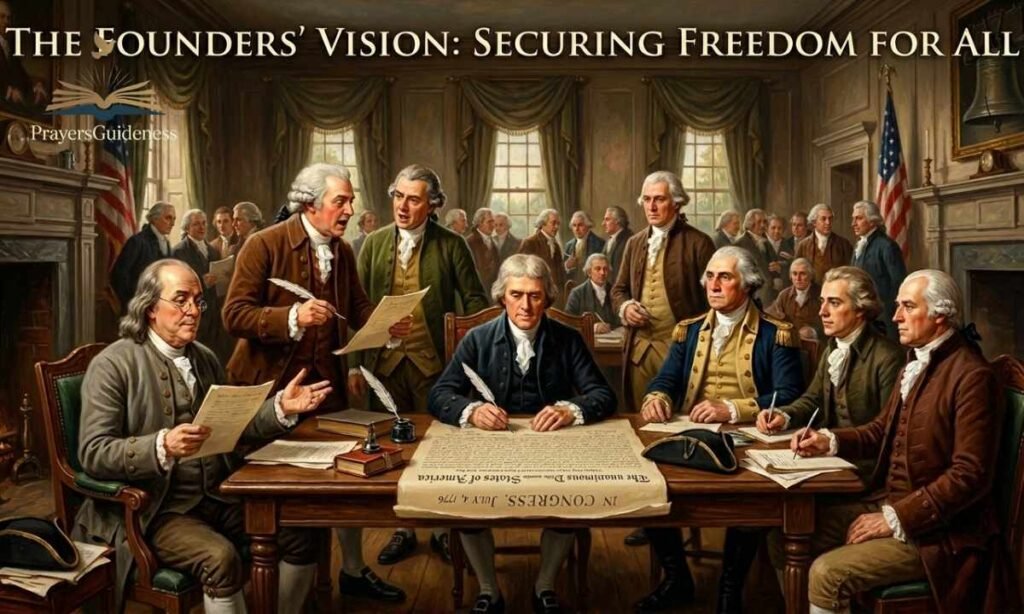
The Founders envisioned a society where the law is king — not the other way around. They wanted a marketplace of ideas where the best solutions would rise through debate rather than force, where no individual or faction could seize unlimited power.
James Madison, writing in the Federalist Papers, argued that the Constitution needed to be structured so that the ambition of those in power would counteract the ambition of others. The separation of powers — legislative, executive, and judicial — was not bureaucratic formality. It was the engine designed to keep liberty alive.
Their vision was a limited government: strong enough to protect rights and maintain order, but constrained enough that it could never become the source of the very tyranny it was designed to prevent.
“Secure the Blessings of Liberty” in the Context of Other Founding Documents
The phrase does not stand alone. It draws meaning from a broader conversation in American founding documents. The Declaration of Independence (1776) had already established the philosophical foundation: all people are created equal and endowed with unalienable rights, including life, liberty, and the pursuit of happiness.
The Constitution then created the legal architecture to protect those rights. Where the Declaration said “we believe in liberty,” the Constitution said “here is how we will keep it.” Several state constitutions — Pennsylvania (1777), Virginia (1776), North Carolina (1776), and Massachusetts (1780) — had already used the phrase “blessings of liberty” in their preambles, giving the Framers a well-established framework to build on.
Together, these documents form an interlocking promise: the Declaration established the why; the Constitution established the how.
How the Government Works to Secure the Blessings of Liberty?
Liberty is not self-sustaining. It requires active protection through institutional design. The Constitution achieves this through three interlocking systems:
• Separation of Powers: The legislative branch makes laws; the executive enforces them; the judiciary interprets them. No single branch can do all three.
• Checks and Balances: Each branch has the authority to limit the others. The president can veto legislation; Congress can override that veto; courts can strike down unconstitutional laws.
• Federalism: Power is divided between the federal government and state governments. This dual layer of government creates what James Madison called “a double security” for the rights of citizens.
This architecture of tension is not a flaw in the system — it is the feature. The friction between branches is precisely what protects liberty from any single point of failure.
How the Bill of Rights Gives Meaning to the Blessings of Liberty?
When the Constitution was first ratified in 1788, it did not include a specific list of individual rights. Many Americans, led by Anti-Federalists, worried that without such protections the new government could erode the very liberties the Preamble promised to secure.
James Madison, initially skeptical of a Bill of Rights, came to see it differently. He argued that enumerating rights could build public opinion in their favor, creating a cultural commitment to liberty that would outlast any political shift. In 1791, the first ten amendments — the Bill of Rights — were ratified.
The Bill of Rights gave the Preamble’s promise concrete legal teeth:
• The First Amendment protects speech, religion, and the press
• The Fourth Amendment guards against unreasonable searches and seizures
• The Fifth and Sixth Amendments protect due process and fair trials
• The Eighth Amendment prohibits cruel and unusual punishment
The Preamble announced the goal. The Bill of Rights defined what reaching that goal actually looks like in practice.
How Courts Have Interpreted “Secure the Blessings of Liberty” Over Time?
The Supreme Court has long grappled with what it means to secure liberty in a changing society. Because the Preamble does not grant legal powers on its own, courts have most often applied its goals through specific amendments rather than the Preamble directly.
A pivotal moment came with the 14th Amendment (1868), ratified after the Civil War. Its due process and equal protection clauses extended the promise of liberty to formerly enslaved people and eventually required all states — not just the federal government — to respect the rights in the Bill of Rights. This process, known as incorporation, unfolded through decades of Supreme Court decisions.
Key constitutional cases that expanded the meaning of secured liberty include:
• Marbury v. Madison (1803) — established judicial review, giving courts the power to strike down laws that violate constitutional liberty
• Meyer v. Nebraska (1923) and Pierce v. Society of Sisters (1925) — the Court protected personal liberty under the 14th Amendment’s due process clause
• Brown v. Board of Education (1954) — ruled that racial segregation in schools violated equal protection, the clearest judicial statement that the blessings of liberty must be available to all
• Obergefell v. Hodges (2015) — extended the constitutional right to marry, affirming that the definition of liberty evolves with the nation’s moral understanding
These rulings show that “securing” liberty is not a one-time event — it is an ongoing legal and moral conversation.
The Tension Between Liberty and Equality: Where “Secure the Blessings” Has Fallen Short
No honest account of this phrase can ignore its contradictions. In 1787, the same Constitution that promised liberty to “ourselves and our posterity” also protected the institution of slavery through the Three-Fifths Compromise and the protection of the slave trade until 1808. Women were excluded from political participation. Native Americans were not counted as part of “We the People.”
The gap between the promise and the reality did not go unnoticed. Abraham Lincoln famously pointed to the Declaration of Independence as the “apple of gold” that the Constitution — the “frame of silver” — was meant to preserve. His point was that the Constitution existed to protect the Declaration’s promise of equality, even when it visibly failed to do so.
The struggle to close that gap has driven the most defining chapters of American history:
• The Civil War and the 13th, 14th, and 15th Amendments abolished slavery and extended citizenship and equal protection
• The women’s suffrage movement and the 19th Amendment (1920) extended political liberty to women
• The Civil Rights Movement and the Civil Rights Act of 1964 addressed systemic racial inequality
• Ongoing constitutional litigation continues to refine who benefits from the blessings of liberty and on what terms
Far from discrediting the Preamble, these struggles confirm its enduring power. Each generation has used its language to demand more of the nation — and the nation has, imperfectly but meaningfully, responded.
Examples of “Secure the Blessings of Liberty” in Everyday Life
The blessings of liberty are not found only in courtrooms or congressional debates. They show up in ordinary daily life, often in ways people take for granted:
• Posting a social media opinion critical of the government — protected by the First Amendment
• Starting a small business without the government requiring ideological loyalty — economic liberty at work
• Attending any house of worship on any day of the week — or none at all
• Receiving a fair trial before any penalty is imposed, no matter the accusation
• Voting in a free election and having that vote counted equally
• Teaching your children your own values, language, and traditions
None of these feel dramatic in a healthy democracy. That invisibility is the point — secured liberty functions best when it does not need to be fought for daily.
How American Symbols Embody the Constitutional Promise of Liberty?
American culture has given the constitutional promise of liberty physical form through its most enduring symbols. Each one reflects a different dimension of what it means to secure freedom:
• The Statue of Liberty — a gift from France, its torch represents enlightenment and the light of freedom welcoming those seeking refuge from oppression.
• The Liberty Bell — its inscription from Leviticus, “Proclaim liberty throughout all the land,” directly connects American freedom to a moral and spiritual tradition.
• The Bald Eagle — chosen as the national symbol for its independence and strength, representing a nation that answers to no king.
• The National Archives — where the original Constitution, Bill of Rights, and Declaration of Independence are preserved, a physical reminder that these promises are legally binding documents, not just aspirations.
These symbols serve a civic purpose: they remind citizens of the promise they have inherited and the responsibility they carry to pass it on.
"The Liberty Bell's inscription from Leviticus reminds us that true freedom is rooted in faith. These Bible verses about peace and strength deepen that connection beautifully."
The Responsibility of Citizens in Preserving Liberty
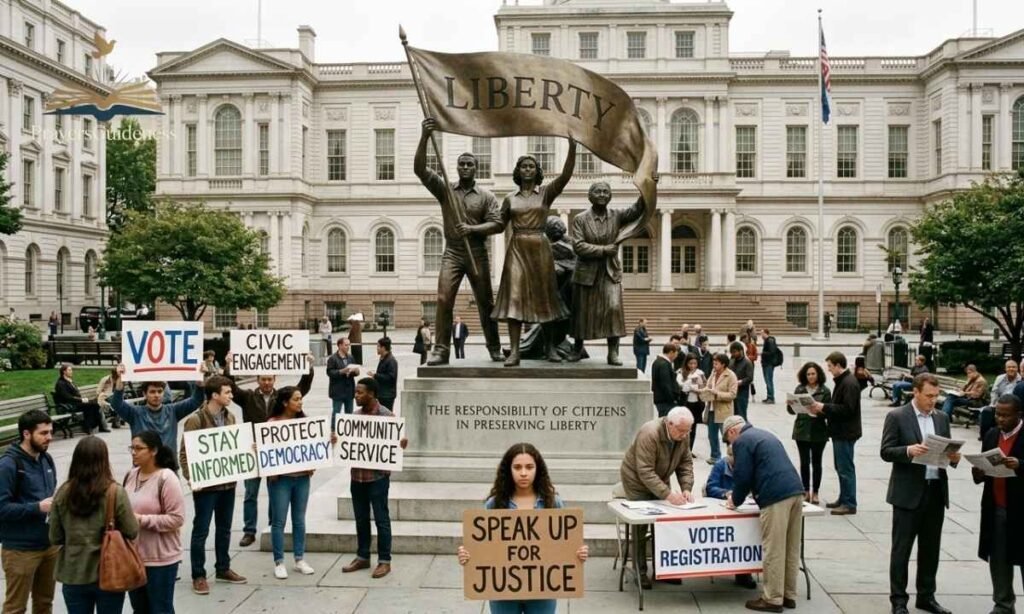
The Constitution does not govern itself. Liberty requires active, informed citizens who understand what is at stake. The Founders built this assumption into the system — they believed that democratic self-governance only works when the governed are engaged and educated.
That civic responsibility takes many forms:
• Voting in every election — local, state, and federal
• Staying informed about legislation, court decisions, and constitutional issues
• Respecting the rights of others, including those with opposing views
• Participating in peaceful protest and civic discourse
• Teaching children the value of freedom, fairness, and civic duty
• Holding elected officials accountable to constitutional standards
Liberty, as the Founders understood, is not passive. It is a garden — it grows when tended, and withers when neglected.
"Preserving liberty begins with intention each day. These morning prayers to start each day with God can help ground your civic duty in faith and purpose."
The Connection Between Liberty and Justice
Liberty and justice are inseparable partners in the constitutional framework. The Preamble lists both — “establish justice” and “secure the blessings of liberty” — as distinct but deeply connected goals.
Liberty without justice becomes a license for the powerful to exploit the weak. Justice without liberty becomes authoritarian control dressed up as fairness. The two must be held in balance — and the entire structure of American constitutional law is the ongoing effort to maintain that balance.
When someone’s rights are violated, justice steps in to restore equilibrium. When justice itself becomes corrupted, liberty is the standard against which it is measured and corrected. This is why every major civil rights movement in American history has appealed to both: the freedom to be treated equally, and the fairness of equal treatment under law.
Why “Secure the Blessings of Liberty” Still Matters Today?
More than 235 years after it was written, this phrase has lost none of its urgency. Modern debates over free speech online, privacy in the digital age, equal protection for all Americans, and the limits of government surveillance are all, at their core, debates about what it means to secure liberty in a new era.
Every generation must interpret the promise anew. The Framers could not have anticipated the internet, artificial intelligence, or global interconnection — but they understood something timeless: that power, left unchecked, will always tend toward controlling the freedom of others.
The phrase endures because the challenge it describes never disappears. Securing the blessings of liberty is not an achievement — it is a practice, a commitment renewed by each generation that chooses to take it seriously.
Frequently Asked Questions
What does “secure the blessings of liberty” mean in simple terms?
It means the government has a duty to protect the freedoms — such as speech, religion, and equal rights — that make life free and fair, both for people today and for all future generations.
Is the Preamble legally binding?
No. The Preamble is an introduction and does not grant legal powers or individual rights on its own, but it serves as a guiding statement of purpose for interpreting the rest of the Constitution.
Who wrote “secure the blessings of liberty”?
The specific wording was crafted by Gouverneur Morris, who served as head of the Committee on Style and Arrangement at the 1787 Constitutional Convention and authored the Preamble’s final language.
What does “posterity” mean in the Preamble?
“Posterity” means all future generations — every American yet to be born. Including it reflects the Founders’ intent to create a lasting constitutional system, not just a temporary agreement.
How does the Bill of Rights relate to securing liberty?
The Bill of Rights (1791) translated the Preamble’s promise into specific, enforceable protections — from free speech to fair trials — giving the goal of secured liberty concrete legal meaning.
Has the government always successfully secured the blessings of liberty?
No. Slavery, the exclusion of women from voting, and racial segregation were major failures. Amendments like the 13th, 14th, 15th, and 19th, along with landmark civil rights legislation, have been the nation’s attempts to correct those failures.
Why does this phrase still matter in everyday life?
Every time you vote, speak freely, worship, or rely on a fair trial, you are experiencing the blessings of liberty in action. The phrase still matters because those freedoms only last as long as citizens understand and protect them.
"As you reflect on what it means to secure the blessings of liberty, celebrate this freedom with these happy 4th of July blessings that honor the spirit of American independence."
Conclusion
“Secure the blessings of liberty to ourselves and our posterity” is one of the most carefully chosen phrases in American civic life. It is a promise made across time — from the founding generation to every one that follows — that freedom is worth building institutions around, worth fighting for, and worth passing on.
Understanding this phrase is not just a history lesson. It is a reminder that liberty requires constant care, honest reckoning with past failures, and active participation from every citizen. The blessings are real. The work of securing them is never finished.

1 thought on “What Does “Secure the Blessings of Liberty” Mean?”