Why Prayer Times Change Every Day?
Why Do Prayer Times Change Every Day? A Simple Explanation
How the Sun Determines Prayer Times
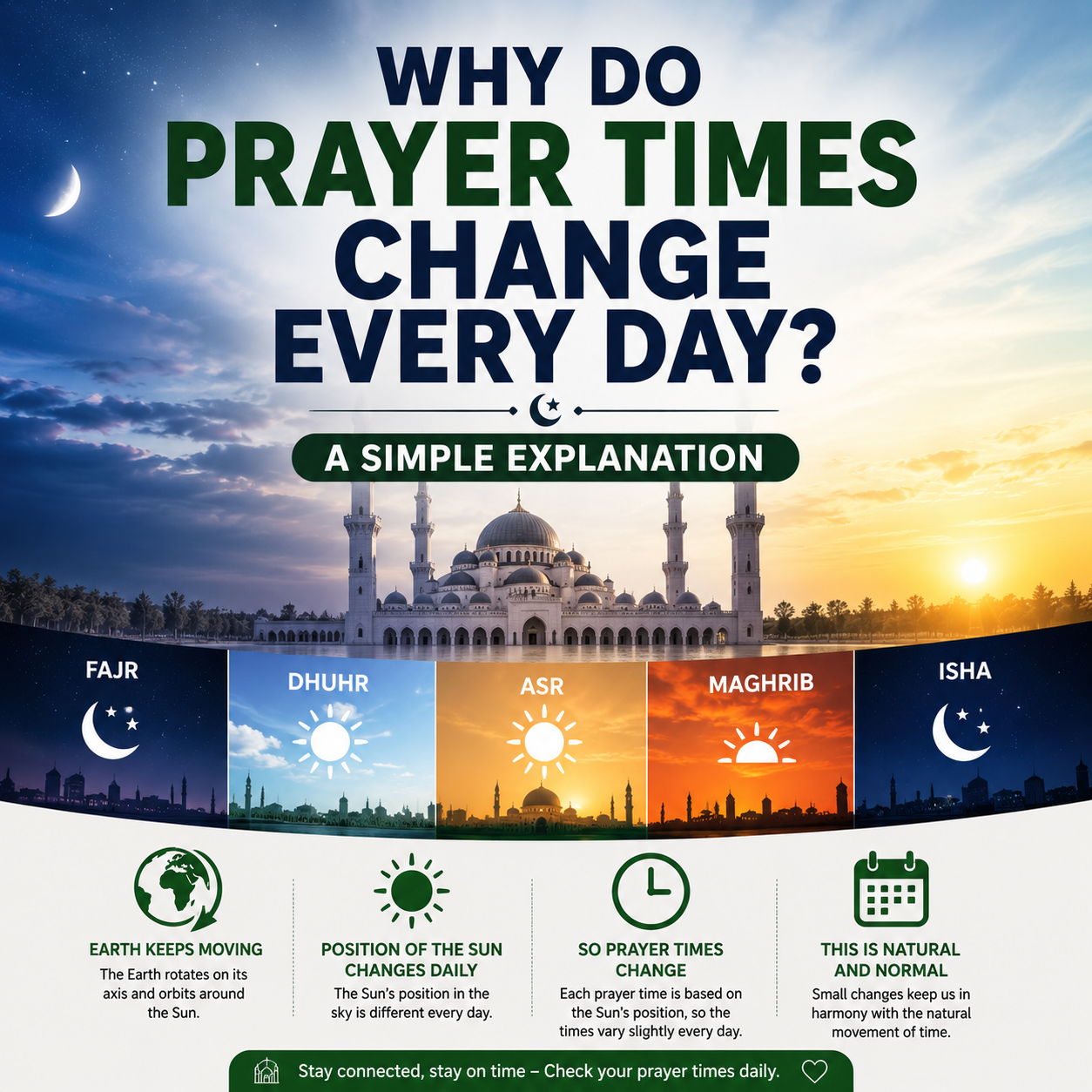
The sun plays a central role in determining the five daily prayer times in Islam. Salah times are connected to specific positions of the sun in the sky, making them naturally change throughout the day and year. Instead of following fixed clock times, Muslims observe signs such as dawn, midday, afternoon shadows, sunset, and the disappearance of twilight to determine when each prayer begins.
Fajr begins at true dawn, when the first horizontal light appears across the horizon, and continues until sunrise. Dhuhr begins after the sun has passed its highest point in the sky. Asr is determined by the length of an object’s shadow, with different calculation methods producing slightly different times. Maghrib begins immediately after the sun sets, while Isha begins after the evening twilight has sufficiently disappeared.
Because the sun’s position changes according to the date and geographical location, prayer times are not the same every day. During summer, sunrise and sunset may occur earlier and later, while winter generally brings shorter daylight hours. Latitude also has an important effect, particularly in northern regions where daylight can become extremely long or short during different seasons.
Modern prayer-time apps and websites use astronomical calculations to determine the sun’s position and provide daily Salah schedules. These calculations use information such as location, date, sunrise, sunset, and solar angles. Understanding the relationship between the sun and prayer times helps Muslims understand why Salah schedules change daily and why using an accurate, location-specific timetable is important.

Why Sunrise and Sunset Change
Sunrise and sunset do not occur at exactly the same time every day because the Earth moves around the Sun while its axis is tilted. This combination changes the angle at which sunlight reaches different parts of the Earth throughout the year. As a result, the length of daylight gradually increases or decreases depending on the season, which also affects Islamic prayer times.
During summer, many locations experience earlier sunrises and later sunsets, creating longer days. In winter, the opposite generally happens, with later sunrises and earlier sunsets resulting in shorter daylight hours. The exact amount of change depends on geographical location, with areas farther from the equator often experiencing larger seasonal differences in daylight.
Sunrise and sunset also vary according to a person’s location. Two cities in the same country can have different sunrise and sunset times because they are at different latitudes and longitudes. This is why prayer schedules should be based on the user’s specific city or coordinates rather than using one fixed timetable for an entire country.
These natural changes are important for Islamic prayer because several Salah times are directly connected to the sun. Fajr ends at sunrise, Dhuhr begins after midday, Maghrib starts at sunset, and Isha is related to the disappearance of evening twilight. As sunrise and sunset change throughout the year, Muslims should use updated local prayer schedules to know the correct times for their daily prayers.

Earth’s Rotation and Prayer Times
Earth’s rotation is one of the main reasons the sun appears to move across the sky each day. The Earth rotates on its axis approximately once every 24 hours, causing different parts of the planet to move into and out of sunlight. This daily cycle creates sunrise, midday, afternoon, sunset, and nighttime, which are closely connected to the timing of the five daily prayers in Islam.
As the Earth rotates, the sun’s apparent position changes from east to west throughout the day. Fajr occurs before sunrise, Dhuhr is connected to the sun passing its highest point, Asr occurs later in the afternoon, Maghrib begins at sunset, and Isha follows after evening twilight disappears. Because these natural events happen at different clock times depending on location, Muslims around the world have different prayer schedules.
The rotation of the Earth also explains why prayer times differ between places. When it is daytime in one part of the world, another region may be experiencing evening or nighttime. Even locations within the same country can have different prayer times because longitude affects when the sun reaches particular positions in the sky. Therefore, prayer schedules are calculated according to the local geographical location.
Understanding Earth’s rotation helps explain why Islamic prayer times cannot be fixed to the same clock times every day or everywhere. As the sun’s apparent position changes, the beginning and ending times of different prayers change as well. This is why Muslims should check an updated local prayer timetable to determine the appropriate times for Salah each day.

How Seasons Affect Daily Salah Times
Seasons have a major effect on daily Salah times because the position of the sun changes throughout the year. As the Earth travels around the Sun while maintaining its tilted axis, different regions receive different amounts of daylight during different seasons. Since Islamic prayer times are connected to natural events such as dawn, midday, sunset, and twilight, the times for Fajr, Dhuhr, Asr, Maghrib, and Isha gradually change throughout the year.
During summer, days are generally longer, so sunrise may occur earlier and sunset later. This can make Fajr begin earlier in the morning and Maghrib occur later in the evening. Dhuhr and Asr also shift according to the changing position of the sun. In winter, daylight hours are usually shorter, resulting in later sunrise and earlier sunset in many locations, which causes corresponding changes in the daily prayer schedule.
The effect of seasons is not the same everywhere. Locations closer to the equator usually experience smaller seasonal changes, while areas at higher latitudes can experience significant differences in daylight hours. In some northern regions, summer days can be extremely long and winter days very short, creating additional challenges when determining Fajr and Isha. Local Islamic centers may therefore provide specific guidance for these conditions.
Because prayer times change with the seasons, Muslims should avoid relying on an old timetable or fixed clock times throughout the year. Reliable prayer apps, websites, Islamic calendars, and local mosque schedules can provide updated times based on the current date and location. Checking these schedules regularly helps Muslims perform each Salah within its appropriate time regardless of the season.

Why Fajr and Isha Change
Fajr and Isha times change because both prayers are connected to twilight and the sun’s position below the horizon. Fajr begins at true dawn, when the first light appears across the horizon, while Isha begins after the evening twilight has sufficiently disappeared. Since the timing of dawn and twilight changes throughout the year, the clock times for Fajr and Isha also change from day to day.
Seasonal changes have a particularly noticeable effect on these two prayers. In summer, Fajr may occur much earlier and Isha much later because daylight lasts longer and twilight can remain visible for an extended period. During winter, Fajr may occur later and Isha earlier in many locations because the nights are longer. The exact changes depend on the geographical location and latitude of the area.
Calculation methods can also cause differences in Fajr and Isha schedules. Prayer-time services may use different solar angles to determine when dawn begins and when twilight ends. This can result in several minutes of difference between apps, websites, and mosque timetables. In high-latitude regions, ordinary calculations may become difficult during certain seasons, so special adjustment methods may be used.
Muslims should therefore check updated and location-specific prayer schedules instead of relying on fixed Fajr and Isha times. A reliable prayer app, Islamic calendar, or local mosque timetable can provide useful daily guidance. Keeping the correct location and calculation method selected helps ensure that Fajr and Isha are observed within their appropriate times throughout the year.
Why Dhuhr Changes Throughout the Year
Dhuhr prayer time changes throughout the year because it is connected to the sun’s position in the sky. Dhuhr begins after the sun passes its highest point, known as solar noon. Solar noon does not occur at exactly the same clock time every day because of the Earth’s orbit, its axial tilt, and the difference between solar time and standard clock time.
The length of daylight also changes with the seasons, which affects when the sun reaches its highest point. During different parts of the year, solar noon may occur slightly earlier or later according to the location and date. This means that Dhuhr cannot be assigned one permanent clock time throughout the year, even when a person remains in the same city.
Geographical location also plays an important role in determining Dhuhr. Longitude affects the relationship between the sun’s position and local clock time, so two cities in the same country may have different Dhuhr times. Modern prayer-time calculators use the user’s location and astronomical data to determine when the sun has passed its highest point and when Dhuhr begins.
For this reason, Muslims should use an updated local prayer timetable rather than relying on a fixed Dhuhr time. Reliable prayer apps, websites, and local mosque schedules can provide daily times based on the current date and location. Checking these schedules regularly makes it easier to perform Dhuhr within its proper time throughout the year.
Why Asr Time Changes
Asr time changes throughout the year because it is determined by the position of the sun and the length of an object’s shadow. Unlike Dhuhr, which begins after solar noon, Asr depends on a specific shadow-length condition. As the sun’s height changes from season to season, the time at which an object reaches the required shadow length also changes.
During summer, the sun generally stays higher in the sky for longer periods, so shadows may remain shorter during the afternoon. As a result, the Asr prayer time can occur later according to the chosen calculation method. In winter, the sun follows a lower path across the sky, causing shadows to become longer more quickly and often making Asr begin earlier.
Another reason Asr times can differ between prayer apps is the calculation method. The standard method and Hanafi method use different shadow-length ratios to determine the beginning of Asr. Because of this difference, two reliable prayer schedules can show different Asr times for the same location. Muslims should select the method that corresponds with the practice they follow or the guidance of their local mosque.
Location also affects Asr because the sun’s path varies according to latitude and longitude. For accurate daily prayer times, Muslims should use a schedule based on their current location and keep the appropriate Asr calculation method selected. Regularly updated prayer apps, websites, and local mosque timetables can help ensure that Asr is performed within its proper time throughout the year.
Why Maghrib Changes Every Day
Maghrib prayer time changes every day because it begins immediately after sunset, and sunset does not occur at the same clock time throughout the year. The Earth’s rotation, its tilted axis, and its movement around the Sun cause the length of daylight to change. As a result, the sun sets at different times on different dates, which directly affects the beginning of Maghrib.
During summer, many locations have longer days, so sunset generally occurs later and Maghrib begins later in the evening. During winter, days are usually shorter, causing the sun to set earlier and Maghrib to begin earlier. The amount of change depends on the location, with some regions experiencing much larger seasonal differences than others.
Geographical location also affects Maghrib time. Cities at different longitudes and latitudes can have different sunset times even when they are in the same country. This is why a Maghrib timetable for one city should not automatically be used for another. Prayer-time apps and websites calculate sunset according to the user’s specific location to provide a more appropriate daily schedule.
Because sunset changes throughout the year, Muslims should check an updated local prayer timetable rather than relying on a fixed Maghrib time. Reliable prayer apps, Islamic calendars, and local mosque schedules can provide daily sunset and Maghrib times. Keeping these schedules updated helps Muslims begin Maghrib at the correct time each day.
How Your Location Affects Prayer Times
Your location has a major effect on Islamic prayer times because Salah is based on the position of the sun. The times for Fajr, Dhuhr, Asr, Maghrib, and Isha depend on natural events such as dawn, solar noon, afternoon shadows, sunset, and twilight. Since these events occur at different times in different parts of the world, Muslims in different cities can have different prayer schedules on the same day.
Latitude and longitude are two important factors used to calculate local prayer times. Longitude affects when the sun reaches its highest point and when sunrise and sunset occur, while latitude influences the sun’s path and the length of daylight. This is why cities that are far apart can have significantly different Salah times, even if they are located within the same country.
Location becomes especially important in areas with extreme seasonal daylight changes. Countries and regions at higher latitudes may experience very long summer days and short winter days, which can create unusual Fajr and Isha times. In such locations, special calculation methods or adjustments may be recommended by local Islamic organizations to determine appropriate prayer times.
When using a prayer app or website, Muslims should enter their exact city or enable accurate location services whenever possible. They should also check the time zone, daylight-saving settings, and calculation method. Using a location-specific and regularly updated prayer schedule helps ensure that each Salah is performed at the appropriate time, regardless of where a person lives or travels.
The Effect of Daylight Saving Time
Daylight Saving Time (DST) can affect the clock times shown for Islamic prayers in countries and regions that observe it. DST usually moves clocks forward by one hour during part of the year and back by one hour later. The position of the sun itself does not suddenly change because of this clock adjustment, but the time displayed on clocks changes, so prayer schedules must reflect the local time standard.
When clocks move forward in spring, prayer times shown on the clock may appear about one hour later compared with standard time. When clocks move back in autumn, the displayed prayer times shift back accordingly. This can affect all five daily prayers, including Fajr, Dhuhr, Asr, Maghrib, and Isha. The actual astronomical events remain connected to the sun, while the clock time used to record them changes.
Prayer apps and websites usually adjust automatically for Daylight Saving Time when the correct location and time zone are selected. However, incorrect phone settings or manually entered locations can cause prayer schedules to appear inaccurate. This is especially important for people who travel between regions with different DST rules or use an app that requires manual time-zone settings.
To avoid confusion, Muslims should make sure their device has the correct date, time zone, and automatic time settings enabled. Prayer apps should also have the correct location and calculation method selected. Checking the updated schedule from a trusted local mosque can provide additional confirmation, helping Muslims follow accurate prayer times when clocks change during the year.
Why Prayer Apps Update Times Daily
Prayer apps update times daily because Islamic prayer times are based on the changing position of the sun. Sunrise, sunset, dawn, solar noon, and twilight do not occur at exactly the same clock time every day. Since Fajr, Dhuhr, Asr, Maghrib, and Isha are connected to these solar events, their calculated times naturally change as the date changes.
The amount of change depends on the season and the user’s geographical location. During some parts of the year, daylight hours become longer, while in other seasons they become shorter. A prayer app uses the selected location, date, and astronomical information to calculate the appropriate times for that specific day. This allows users to receive a schedule that reflects current local conditions rather than relying on fixed prayer times.
Prayer apps may also update times because of changes in time-zone rules and Daylight Saving Time. When clocks move forward or backward in regions that observe DST, the displayed clock times for prayers need to be adjusted. Some apps automatically detect these changes, while others may require users to check their settings. Correct location and time-zone information is therefore important for accurate results.
Daily updates make prayer apps convenient for Muslims who want to keep track of Salah without manually calculating each prayer time. Users should still make sure their location, calculation method, Asr method, and time-zone settings are correct. Comparing the app with a trusted local mosque timetable can also help ensure that the displayed prayer times are appropriate for the local community.
How to Check Accurate Daily Prayer Times
To check accurate daily prayer times, start by choosing a reliable Islamic prayer app, website, or local mosque timetable. Prayer times depend on the date and geographical location, so select your exact city or allow the service to use your device’s location. A trustworthy schedule should provide the five daily prayers—Fajr, Dhuhr, Asr, Maghrib, and Isha—along with sunrise information.
Next, review the calculation settings used by the prayer service. Different organizations may use different methods for calculating Fajr and Isha, while Asr can vary according to the selected jurisprudential method. If you regularly follow a particular local mosque or Islamic community, it is useful to check which calculation method they use and select the corresponding setting in your prayer app.
Your device’s time and location settings should also be correct. Make sure the correct time zone, date, and daylight-saving settings are selected, especially when traveling or using a new device. Incorrect settings can cause prayer times to appear earlier or later than expected. In areas with unusual daylight patterns, particularly high-latitude regions, users should also follow guidance from trusted local Islamic authorities.
Finally, compare your digital prayer schedule with a reliable local mosque timetable if you notice significant differences. Avoid relying on outdated screenshots, old calendars, or prayer times from another city. Checking an updated schedule each day and keeping your settings properly configured will help you follow accurate Salah times and maintain a consistent daily prayer routine.
Common Mistakes When Checking Prayer Times
One common mistake when checking prayer times is using a timetable for the wrong location. Prayer times depend on geographical coordinates, so schedules can differ between cities and even nearby areas. Muslims should always select their current city or location when using a prayer app or website rather than assuming that a timetable from another city will be accurate for them.
Another mistake is ignoring the calculation method and Asr setting. Different Islamic organizations may use different methods for calculating Fajr and Isha, while Asr times can vary depending on the selected shadow-length method. This can cause two reliable apps to show slightly different times. Users should check which method their local mosque follows and configure their prayer app accordingly.
Incorrect time-zone and daylight-saving settings can also create inaccurate prayer schedules. This is especially common when traveling, changing phones, or manually adjusting device settings. Relying on an old timetable is another problem because prayer times change throughout the year as the position of the sun changes. Users should regularly update their schedules and verify that their device has the correct date, time, and location.
Finally, Muslims should avoid depending entirely on an unfamiliar or unreliable prayer website or app. If there is a significant difference between digital prayer times and a trusted local mosque timetable, it is helpful to investigate the calculation settings rather than simply choosing one at random. Using reliable sources, correct settings, and regularly updated schedules can reduce mistakes and make it easier to perform Salah at the appropriate time.
Benefits of Following Updated Prayer Times
Following updated prayer times helps Muslims perform Salah within its prescribed time throughout the year. Since Fajr, Dhuhr, Asr, Maghrib, and Isha are connected to the position of the sun, their times naturally change from day to day. Using an updated schedule ensures that Muslims are aware of these changes and can avoid relying on outdated prayer times.
Another important benefit is better daily planning. Accurate prayer schedules allow Muslims to organize work, school, travel, family activities, and other responsibilities around their Salah. Prayer apps and online timetables can provide reminders before each prayer, making it easier to prepare for Wudu and prayer without constantly checking the clock.
Updated prayer times are also especially useful when seasons change or when traveling to another location. Sunrise, sunset, daylight hours, and time zones can vary significantly between places. By updating the location and checking the current schedule, Muslims can avoid confusion and follow prayer times appropriate for their new surroundings.
Finally, following a reliable and updated prayer timetable can provide greater confidence and consistency in worship. When the location, calculation method, and time settings are correct, Muslims can focus on performing Salah without unnecessary uncertainty about its timing. Regularly checking a trusted prayer app, website, or local mosque schedule is a simple way to maintain an accurate daily prayer routine.
Frequently Asked Questions About Daily Prayer Times
Why do prayer times change every day?
Prayer times change because they are based on the sun’s position, including dawn, solar noon, afternoon shadows, sunset, and twilight. As the Earth moves through its yearly cycle and daylight changes, these solar events occur at different clock times. This is why Fajr, Dhuhr, Asr, Maghrib, and Isha times gradually change throughout the year.
Do prayer times change between different cities?
Yes, prayer times can be different from one city to another because geographical location affects sunrise, sunset, solar noon, and the length of daylight. Even cities within the same country may have different Salah schedules. Muslims should therefore use prayer times calculated specifically for their current location.
Why do prayer apps sometimes show different times?
Different apps may use different calculation methods, particularly for Fajr and Isha. Asr can also vary depending on the selected calculation method. Differences in location coordinates, time-zone settings, and rounding can contribute to variations. Checking the calculation settings and comparing the schedule with a trusted local mosque can help explain these differences.
How can I make sure my daily prayer times are accurate?
Use a reliable prayer app, Islamic website, or local mosque timetable and make sure your location, date, time zone, and calculation settings are correct. Update your schedule regularly because prayer times change throughout the year. If you notice a significant difference between sources, consult the timetable of a trusted local mosque or Islamic authority for guidance.
Conclusion
Prayer times change every day because they are closely connected to the sun’s position and the natural cycle of daylight. Factors such as Earth’s rotation, seasonal changes, geographical location, sunrise, sunset, and twilight all influence when Fajr, Dhuhr, Asr, Maghrib, and Isha begin. Understanding these factors makes it easier to see why there is no single fixed prayer schedule for every day or location.
Using accurate and updated prayer times helps Muslims perform Salah within its prescribed periods. Modern prayer apps, websites, Islamic calendars, and local mosque timetables make it easier to check the correct times based on a person’s location. However, users should ensure that their location, time zone, calculation method, and other settings are properly configured.
It is also important to avoid common mistakes such as relying on outdated schedules, using prayer times for another city, or ignoring differences in calculation methods. When digital prayer times differ significantly, checking the schedule of a trusted local mosque can provide useful guidance. Regularly updating prayer times is especially important when traveling or when seasons and daylight-saving rules change.
By understanding why prayer times change and developing the habit of checking a reliable daily schedule, Muslims can organize their routines around Salah with greater confidence. Staying informed about accurate prayer times supports consistency in worship and helps ensure that each of the five daily prayers is performed at the appropriate time throughout the year.
For More Information about this article, Please Click Here.
For More Information, Please Click Here.