

The Gospel of Luke is one of the most deeply human accounts of Jesus Christ ever written. More than any other Gospel, it captures His compassion for the broken, His love for the overlooked, and His message of salvation for everyone regardless of background or past. If you have ever needed a word from Scripture that meets you right where you are, Luke almost certainly has it.
This collection of 100+ powerful Luke Bible verses about faith, love, and strength is organized by theme so you can find exactly what your heart needs. Whether you are studying a specific passage, searching for daily encouragement, or exploring what the Book of Luke teaches about prayer, forgiveness, or hope, this guide has everything you need in one place.
What Are the Most Popular Bible Verses in Luke?
The Gospel of Luke contains some of the most beloved and most-searched scriptures in the entire Bible. From the Christmas story to the parable of the Prodigal Son, from Jesus’ declaration in Luke 1:37 to His powerful prayer on the cross, this Gospel has given believers throughout history some of their most treasured verses.
Why Christians Love the Book of Luke?
Christians are drawn to this Gospel for reasons that go beyond theology. It reads with unusual warmth, tenderness, and humanity. Luke, a physician by training and a careful historian by practice, wrote with both precision and heart. He paid close attention to people that other accounts passed over women, children, tax collectors, Gentiles, and those considered outsiders by the religious establishment of the day.
In this Gospel, Jesus weeps. He eats with sinners. He heals on the Sabbath. He welcomes the thief on the cross into paradise. For anyone who has ever felt too far gone, too different, or too insignificant for God to notice, this message becomes deeply personal and full of hope.
Key Themes Found in Luke Scriptures
• Compassion and mercy for the poor, the sick, and the marginalized
• Universal salvation the gospel message is for all people, not just one group
• The power and centrality of prayer in Jesus’ own life and teaching
• The role of the Holy Spirit from the very opening chapters
• Forgiveness as both a divine gift and a human calling
• Joy Luke uses the word more than any other Gospel writer
• The dignity and significance of women in the ministry of Jesus
Most Quoted Verses From Luke
• 1:37 For nothing will be impossible with God.
• 6:31 Do to others as you would have them do to you.
• 6:37 Forgive, and you will be forgiven.
• 10:27 Love the Lord your God… and your neighbor as yourself.
• 11:9 Ask and it will be given to you.
• 12:22 Do not worry about your life.
• 19:10 The Son of Man came to seek and to save the lost.
Why Is the Book of Luke Important in the Bible?
Among the four Gospels, Luke stands apart for its literary quality, historical detail, and theological breadth. It is the longest book in the New Testament and, together with the Acts of the Apostles, forms a two-volume work that traces the story of Jesus and the early church from Bethlehem to Rome.
Who Wrote the Gospel of Luke?
The Gospel is traditionally attributed to a physician, a Greek-speaking Gentile and close companion of the Apostle Paul. He is mentioned by name in Colossians 4:14, Philemon 1:24, and 2 Timothy 4:11. Unlike the twelve apostles, he was not an eyewitness to Jesus’ ministry, but he was a meticulous researcher. In the opening verses (1:1–4), he explains that he carefully investigated everything from the beginning and interviewed those who were there.
This Gospel was likely written between 60–80 CE, possibly during Paul’s imprisonment in Caesarea or Rome, where the author had direct access to apostles, eyewitnesses, and early Christian communities. This makes it one of the most historically grounded accounts of Jesus’ life in all of Scripture.
The Purpose of Luke’s Gospel
Luke addressed his Gospel to a man named Theophilus, whose name means “lover of God.” This may have been a specific patron or a symbolic address to all believers. Either way, his stated goal was to provide a reliable, orderly, and thorough account of Jesus’ life so readers could know with certainty the truth of what they had been taught about Him.
Beyond historical accuracy, Luke’s Gospel was also written to demonstrate that God’s salvation was not limited to Israel. It was for the whole world for Gentiles, for women, for sinners, for the poor, for everyone. This universal scope is one of Luke’s defining contributions to the New Testament.
Major Teachings in the Book of Luke
• The Sermon on the Plain (6:17–49) Jesus’ foundational ethical teachings on love, mercy, and integrity.
• The Great Commandment (10:27) Love God completely and your neighbor as yourself.
• The Lord’s Prayer (11:1–13) How and why to pray with persistence and trust.
• The Parables of the Lost Sheep, Lost Coin, and Prodigal Son (15) God’s relentless pursuit of the lost.
• The Rich Young Ruler (18:18–30) The cost and reward of true discipleship.
• Zacchaeus (19:1–10) Salvation comes to those who respond to Jesus with genuine repentance.
Powerful Luke Bible Verses About Faith

Faith is not a secondary theme in this Gospel; it is central to nearly every miracle, healing, and encounter Jesus has with the people He meets. Luke consistently presents Jesus calling people to deeper, bolder, and more persistent faith. These verses about faith are among the most powerful in all of Scripture.
Luke 1:37 Nothing Is Impossible With God
Luke 1:37 “For nothing will be impossible with God.”
These words were spoken by the angel Gabriel to Mary after announcing that she would conceive and bear the Son of God. Mary had asked a logical question: how could this happen? Gabriel’s answer did not address the mechanics. It pointed to the character of God Himself. Nothing absolutely nothing falls outside the reach of His power. This verse has anchored the faith of believers in every generation who have faced situations that looked humanly impossible. It is not a general motivational statement. It is a theological declaration: the God you are trusting does not have limitations.
Luke 17:6 Faith Like a Mustard Seed
Luke 17:6 “If you have faith as small as a mustard seed, you can say to this mulberry tree, ‘Be uprooted and planted in the sea,’ and it will obey you.”
When the disciples asked Jesus to increase their faith, He redirected their focus entirely. The issue was not the size of their faith, even the smallest genuine faith is sufficient when it is placed in God. The mustard seed illustration is not about working yourself into a more confident spiritual state. It is about trusting the right person with even the smallest, most fragile trust you can muster. That is enough.
Luke 18:27 What Is Impossible With Men Is Possible With God
Luke 18:27 “Jesus replied, ‘What is impossible with man is possible with God.’”
After the rich young ruler walked away from Jesus unable to part with his wealth, the disciples were stunned and asked who then could be saved. Jesus answered with one of the most hope-generating statements in the Gospels. No human being, no matter how spiritually accomplished, can save themselves. But God is not limited by what limits us. Salvation, healing, transformation, deliverance all the things we cannot accomplish on our own are entirely possible with God.
Luke Bible Verses About Love and Compassion
No Gospel portrays the love and compassion of Jesus more vividly than Luke’s. From His tender care for the widow of Nain, to His welcome of children, to His treatment of the woman who wept at His feet, this account presents a Savior who loves in ways that defy social convention, religious tradition, and human expectation.
Luke 6:35 Love Your Enemies
Luke 6:35 “But love your enemies, do good to them, and lend to them without expecting to get anything back. Then your reward will be great, and you will be children of the Most High, because he is kind to the ungrateful and wicked.”
This is perhaps the most demanding and the most distinctive of all of Jesus’ teachings. Every culture, religion, and ethical system has some version of ‘love those who love you.’ But Jesus calls His followers to something qualitatively different: love without expectation of return, directed toward people who have actively wronged you. This is not passive tolerance. It is active goodwill toward enemies, the very quality that reflects the character of God toward humanity.
Luke 10:27 Love Your Neighbor as Yourself
Luke 10:27 “He answered: ‘Love the Lord your God with all your heart and with all your soul and with all your strength and with all your mind’; and, ‘Love your neighbor as yourself.’”
When a religious expert asked Jesus what was necessary for eternal life, the answer was not a list of theological propositions. It was love directed first toward God with total commitment, and then outward toward others with the same care you instinctively give yourself. The parable of the Good Samaritan that immediately follows this exchange defines who your neighbor is: whoever is in front of you and in need.
Jesus’ Compassion in the Gospel of Luke
Luke portrays Jesus as a person of extraordinary and visible compassion. He is moved by the grief of the widow of Nain and raises her dead son (7:13). He welcomes and heals ten lepers (17:11–19). He stops on His way to Jairus’ house to speak tenderly to the woman who had been bleeding for twelve years (8:43–48). This portrayal of Jesus does not rush past people’s pain. He turns toward it, names it, and meets it.
Encouraging Bible Verses From Luke for Difficult Times
The Gospel of Luke contains some of the most direct and comforting words in all of Scripture for seasons of hardship. Jesus speaks tenderly and specifically to fear, anxiety, grief, and uncertainty, and these moments are recorded with particular care. These verses are an anchor for anyone walking through a difficult chapter.
Luke 12:6–7 God Cares for You
Luke 12:6–7 “Are not five sparrows sold for two pennies? Yet not one of them is forgotten by God. Indeed, the very hairs of your head are all numbered. Don’t be afraid; you are worth more than many sparrows.”
Jesus used the smallest, most commercially insignificant creatures He could think of sparrows, sold five for two pennies to make an enormous theological point. If God tracks every one of those birds, you can be certain He has not lost track of you. The detail about numbered hairs is striking: this is not general divine awareness, but specific, individual attention. Whatever you are facing, you are not invisible to God.
Luke 21:19 Stand Firm in Faith
Luke 21:19 “Stand firm, and you will win life.”
Spoken in the context of Jesus’ teaching about persecution and end-time hardship, this verse is deceptively simple and enormously powerful. It does not promise that standing firm will be easy or that everything will work out the way you hoped. It promises something better: life. Endurance in faith, even through the hardest seasons, is not just survival it is the path to something eternal.
Finding Strength Through God’s Word
Luke’s Gospel is full of moments where God’s Word arrives exactly when someone needs it most. The angel’s message to Mary in her fear. The words of Jesus to the disciples in the storm. The promise to the thief on the cross in his final moments. God’s Word is presented as timely, personal, and powerful. One of the most practical ways to find strength in difficult times is to immerse yourself in how Jesus responded to real people in real need.
Luke Bible Verses About Prayer and Trusting God
No Gospel emphasizes prayer as consistently as Luke’s. Jesus prays before His baptism, before choosing the twelve, before the transfiguration, in Gethsemane, and from the cross. This Gospel includes more recorded prayers of Jesus than any other and preserves two unique parables focused entirely on persistent and trusting prayer.
Luke 11:9 Ask and It Shall Be Given
Luke 11:9 “So I say to you: Ask and it will be given to you; seek and you will find; knock and the door will be opened to you.”
Jesus spoke these words in direct connection with a parable about a friend who kept knocking at a neighbor’s door in the middle of the night until he received what he needed. The lesson is not that God is reluctant and needs to be worn down. It is that persistent, specific prayer is the posture of genuine trust. Ask. Keep asking. Seek. Keep seeking. Knock. Keep knocking. The promise is not instant results, it is a guaranteed response from a Father who loves to give good gifts to His children.
Luke 18:1 The Parable of Persistent Prayer
Luke 18:1 “Then Jesus told his disciples a parable to show them that they should always pray and not give up.”
Luke is unusually direct here: he tells you the point of the parable before Jesus tells it. It is a parable about perseverance in prayer. A widow kept coming to an unjust judge until he finally gave her justice not because he cared about her, but because she would not stop. Jesus’ argument is a ‘how much more’ comparison: if even an unjust judge eventually responds to persistence, how much more will your perfectly just and deeply loving Father respond to His children who cry out to Him day and night?
Trusting God Through Every Season
One of the most consistent patterns in Luke’s Gospel is the connection between prayer and trust. Every time Jesus faces a critical moment, whether at His baptism, when choosing the twelve, or in Gethsemane, He prays first. This Gospel models an important truth for believers: prayer is not the last resort when everything else has failed. It is the first response that shapes everything else. Trusting God through every season means staying in conversation with Him in every season.
Inspirational Teachings of Jesus in Luke

The Gospel of Luke is a treasury of Jesus’ teaching. It contains the Sermon on the Plain, the parable of the Good Samaritan, the parable of the Prodigal Son, the Lord’s Prayer, and dozens of other teachings found nowhere else in Scripture. These are not abstract theological lectures, they are living words addressed to real human situations.
The Sermons and Teachings of Christ
Jesus’ Sermon on the Plain in Luke 6:17–49 is one of the most comprehensive ethical teachings in the New Testament. It covers love for enemies, generosity without expectation of return, non-judgment, authentic versus performative discipleship, and the foundation of a life built on genuine obedience to God’s Word. What makes it remarkable is not just its content, but its audience: Jesus delivered it to a mixed crowd of disciples, seekers, and skeptics standing in an open field. These words were not reserved for the religiously advanced. They were offered to everyone.
Lessons From Jesus’ Parables
The parables of Luke are uniquely powerful because they work on multiple levels simultaneously. On the surface, they are vivid stories drawn from everyday life. Underneath, they reveal the character of God, the nature of the kingdom, and the response God invites from every person. The father in the Prodigal Son is a portrait of God’s extravagant, undignified love. The Samaritan who stops to help a stranger is a picture of what it actually means to love your neighbor. The Pharisee and the Tax Collector in Luke 18 redefines what genuine prayer looks like before God.
Following Jesus Through Faith
Luke’s account of discipleship is realistic and demanding. Jesus does not promise comfort or social approval to those who follow Him. He promises purpose, identity, and life. When He calls the first disciples in chapter 5, they leave everything immediately. When He calls Levi (5:27–28), the response is the same: he got up and followed. The simplicity of that response, getting up and walking away from a life that no longer defines you, captures the essence of what it means to follow Jesus through faith.
Luke Bible Verses About Forgiveness
Forgiveness is woven through every chapter of Luke’s Gospel. Jesus forgives sins at the beginning of His ministry and extends forgiveness from the cross at the very end. No other Gospel records as many personal encounters with forgiveness, and few present it as more central to the kingdom Jesus came to establish.
Luke 6:37 Forgive and You Will Be Forgiven
Luke 6:37 “Forgive, and you will be forgiven.”
Short, direct, and without qualification. In the context of the Sermon on the Plain, Jesus links the forgiveness we receive to the forgiveness we extend. This is not a transactional equation, it is a portrait of a transformed heart. A person who has genuinely received God’s forgiveness cannot hold unforgiveness toward others. The flow of mercy from God to us is meant to flow through us to the people around us. Blocking that flow does not just harm the relationship it affects our own experience of the grace we have been given.
Luke 23:34 Father, Forgive Them
Luke 23:34 “Jesus said, ‘Father, forgive them, for they do not know what they are doing.’”
These words, spoken from the cross while soldiers were dividing His clothes and the crowd was mocking Him, are among the most staggering in all of Scripture. In His most excruciating moment, Jesus did not pray for justice or revenge. He prayed for the forgiveness of the people killing Him. Only Luke records these words. They are the ultimate demonstration that His teaching about loving enemies was not theoretical, it was a practice He maintained even at the cost of His own life.
The Importance of Mercy in Luke
Luke 6:36 carries a command that summarizes the entire ethical vision of this Gospel: “Be merciful, just as your Father is merciful.” Mercy here is not sentiment. It is the choice to respond to another person’s suffering, failure, and need with compassion rather than condemnation. It appears in the way Jesus treats the sinful woman who washes His feet (7:36–50), in the way the father runs to meet the returning son (15:20), and in the way Zacchaeus is welcomed rather than shamed (19:1–10). Mercy is how the kingdom of God operates.
Luke Bible Verses About Salvation and Eternal Life
The theme of salvation is the heartbeat of Luke’s Gospel. From the angels’ announcement at Jesus’ birth to His final words before ascending into heaven, this Gospel tells the story of a God who came to seek, save, and restore what had been lost. Every chapter moves steadily toward that purpose.
Luke 19:10 Jesus Came to Save the Lost
Luke 19:10 “For the Son of Man came to seek and to save the lost.”
Jesus spoke these words after the dramatic encounter with Zacchaeus the despised chief tax collector who climbed a tree just to see Jesus and was called down by name. When the crowd grumbled at Jesus’ decision to eat at Zacchaeus’ house, Jesus answered with a statement that defines His entire mission in a single sentence. He did not come for the already-found. He came for the lost and He actively seeks them. This is perhaps the clearest summary of the gospel in the entire Book of Luke.
Luke 23:43 Promise of Paradise
Luke 23:43 “Jesus answered him, ‘Truly I tell you, today you will be with me in paradise.’”
Only Luke records this exchange between Jesus and the repentant thief crucified beside Him. The thief had nothing to offer, no good works, no years of faithful service, and no opportunity to make restitution for his past. All he had was a moment of faith and a request: “Jesus, remember me when you come into your kingdom.” In response, Jesus gave him one of the clearest promises of salvation in Scripture. Salvation is not earned. It is received through faith, even in the final breath.
Salvation Through Jesus Christ
Luke’s portrayal of salvation is strikingly inclusive. Throughout the Gospel, people from every background experience redemption: a Jewish tax collector, a Samaritan leper, a Gentile centurion, a sinful woman, and a dying criminal. The common thread is not their background, religious standing, or moral record. It is their encounter with Jesus and their response to Him. This message is unmistakable: salvation through Jesus Christ is available to everyone without exception.
Bible Verses in Luke About Peace and Hope
Luke’s Gospel opens with songs of peace and closes with a promise of power. From the angels’ announcement over Bethlehem to Jesus’ blessing of His disciples at the ascension, peace and hope are the bookends of this Gospel’s entire narrative. These scriptures about peace and hope are some of the most beloved in the Christian tradition.
Luke 2:14 Peace on Earth
Luke 2:14 “Glory to God in the highest heaven, and on earth peace to those on whom his favor rests.”
The angels’ announcement to the shepherds at Jesus’ birth is not merely a festive greeting. It is a theological declaration: the arrival of Jesus into the world is the arrival of peace. This peace is not the absence of war or conflict; it is the Hebrew concept of shalom, a deep, comprehensive wholeness and rightness of relationship between God and humanity. His birth initiates a peace that the world could not produce for itself.
Luke 12:22 Do Not Worry About Your Life
Luke 12:22 “Then Jesus said to his disciples: ‘Therefore I tell you, do not worry about your life, what you will eat; or about your body, what you will wear.’”
The context of this verse matters enormously. Jesus had just told a parable about a rich man who spent his entire life accumulating goods and died the same night his barns were finally full. The lesson is not that material needs do not matter Jesus goes on to say that God knows you need food and clothing. The lesson is that worry about these things is a form of practical unbelief. God, who clothes the fields and feeds the birds, is deeply aware of your needs and entirely capable of meeting them.
Finding Hope Through God’s Promises
One of the most distinctive features of Luke’s Gospel is how consistently Jesus meets despair with hope. The widow of Nain who had lost everything receives her son back (7:11–17). The woman bent double for eighteen years stands upright and praises God (13:10–17). The blind beggar Bartimaeus receives his sight and follows Jesus (18:35–43). In this Gospel, hope is not wishful thinking—it is the documented outcome of encountering Jesus with faith.
Luke Bible Verses About God’s Mercy and Grace
If Luke’s Gospel has a single defining theme, it is mercy. The Greek word for mercy appears more frequently in this Gospel than in any other, and the stories that illustrate it are among the most memorable in all of Scripture. In this Gospel, Jesus is not a distant deity dispensing judgment—He is a compassionate Savior who actively reaches toward those who least expect to be reached.
Luke 15:11–32 The Prodigal Son
The parable of the Prodigal Son is one of the most powerful stories ever told. A son demands his inheritance early, squanders it in reckless living, and eventually returns home in disgrace expecting at best to be treated as a servant. What he finds instead is a father who was watching for him from a distance, who ran to meet him before he could finish his rehearsed apology, who called for celebration before his son could demonstrate any change of behavior.
This is not a parable about a son becoming worthy. It is a parable about a father whose love was never conditional on worthiness. The running father is the portrait of God undignified in His pursuit, extravagant in His welcome, overflowing in His joy at what was lost being found.
Luke 6:36 Be Merciful
Luke 6:36 “Be merciful, just as your Father is merciful.”
Six words that summarize Luke’s entire ethical vision. God’s mercy is not reserved for exceptional circumstances; it is His constant, defining posture toward humanity. And because it is His posture toward us, it is to be our posture toward one another. Mercy in Luke is not passive; it costs something. It requires turning toward someone’s need rather than away from it, extending grace where judgment would be easier, and reflecting the character of the God who loved us before we deserved it.
Understanding God’s Grace Through Luke
Grace in Luke’s Gospel consistently shows up in the most unexpected places. A Pharisee’s dinner party becomes the setting for a demonstration of extravagant gratitude (7:36–50). A despised Samaritan becomes the hero of a story about what love actually looks like in practice (10:25–37). A short, dishonest tax collector becomes the host of Jesus for dinner and the recipient of salvation (19:1–10). In this Gospel, grace does not arrive where people expect it. It arrives where people need it.
Famous Parables and Scriptures in the Book of Luke
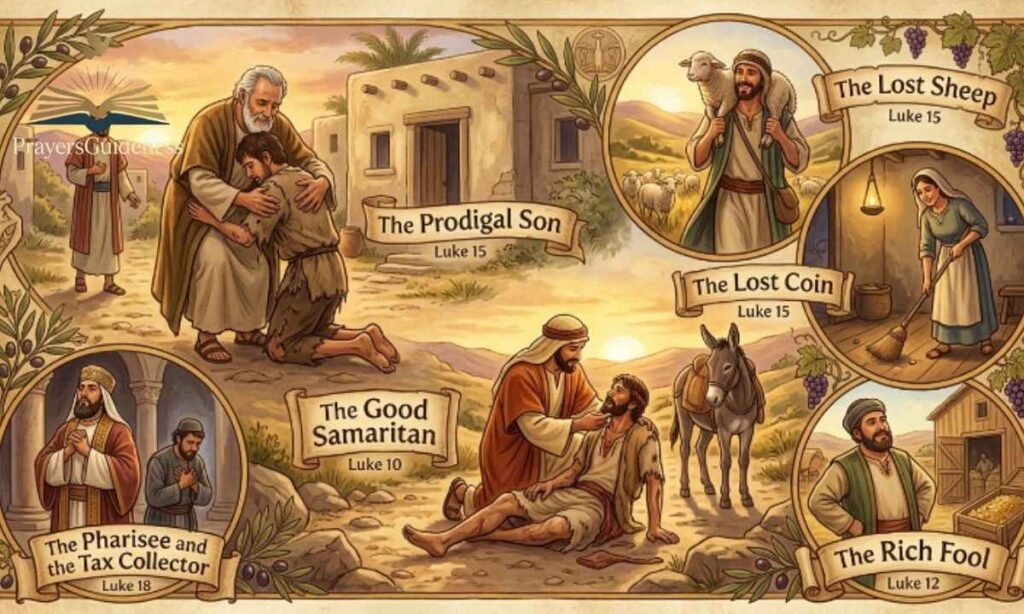
Luke contains more of Jesus’ unique parables than any other Gospel. These stories are not illustrations added to make a point more memorable, they are the point itself, told in a form that bypasses intellectual defense and reaches the heart directly. Three of them stand above the rest in cultural impact and theological depth.
The Good Samaritan
Found only in Luke 10:25–37, the parable of the Good Samaritan was told in response to a lawyer’s self-justifying question: ‘And who is my neighbor?’ A man is beaten and left for dead. A priest passes by. A Levite passes by. A Samaritan, someone the Jewish audience would have viewed with contempt, stops, tends his wounds, puts him on his own animal, takes him to an inn, and pays for his care out of his own pocket. Jesus then asks: which of these three was a neighbor? The answer redefines the question entirely. Your neighbor is not defined by your relationship to them. It is defined by your response to them.
The Prodigal Son
Found only in Luke 15:11–32, the parable of the Prodigal Son is perhaps the greatest short story ever told. Its power lies not in the prodigal’s repentance, remarkable as that is, but in the father’s response. He saw his son ‘while he was still a long way off.’ He runs. He embraces him before a word is spoken. He throws a party before any restitution has been made. The older son’s resentment in the closing verses adds a final, uncomfortable layer: religious self-righteousness can make you just as far from the father’s heart as reckless rebellion.
The Pharisee and the Tax Collector
Found only in Luke 18:9–14, this brief parable upends every religious assumption about who is right with God. The Pharisee prays a confident prayer cataloguing his own virtues. The tax collector will not even look up, but beats his chest and says simply: “God, have mercy on me, a sinner.” Jesus’ verdict is shocking: “I tell you that this man, rather than the other, went home justified before God.” Genuine prayer in this Gospel begins with honesty about who you are before God—not a performance of who you wish you were.
Short Luke Bible Verses for Daily Encouragement
Some of the most powerful scriptures in Luke are also among its shortest. These brief, memorable verses are ideal for daily meditation, memorization, or sharing with someone who needs a word of encouragement. Each one carries enormous truth in just a few lines.
Luke 6:31 Treat Others as You Want to Be Treated
Luke 6:31 “Do to others as you would have them do to you.”
Known as the Golden Rule, this verse from the Sermon on the Plain is one of the most universally recognized ethical principles in human history. But in its Lukan context, it is not just a social guideline—it is a summary of the love-ethic Jesus has been teaching throughout this Gospel. The standard is not how you have been treated. It is how you genuinely wish you were treated. That is the measure you are to apply to every person you encounter.
Luke 1:45 Blessed Is She Who Believed
Luke 1:45 “Blessed is she who has believed that the Lord would fulfill his promises to her!”
Elizabeth spoke these words to Mary during their meeting in the hill country. Mary had received an impossible promise and chosen to believe it rather than explain it away. Elizabeth’s declaration connects Mary’s blessing directly to her faith, not to her social status, not to her religious qualifications, but to her willingness to trust God’s word over her own understanding. This verse is a powerful encouragement to any person who is holding onto a promise from God that has not yet visibly arrived.
Luke 16:10 Faithful in Little Things
Luke 16:10 “Whoever can be trusted with very little can also be trusted with much, and whoever is dishonest with very little will also be dishonest with much.”
This verse from Jesus’ teaching on stewardship is one of the most practically applicable principles in the entire Gospel. It applies to money, to relationships, to responsibilities at work and at home, and to spiritual disciplines. Faithfulness is not reserved for grand, visible moments. It is built one small, unobserved act of integrity at a time. The person who is trusted with much is almost always the person who was faithful in the things that did not seem to matter.
Luke Bible Verses for Strength and Comfort
Fear is one of the most common human experiences addressed in Luke’s Gospel. Jesus says “do not fear” or “do not be afraid” more times in this Gospel than in any other. In this Gospel, the specific, personal way He speaks to fear in individual encounters gives these verses an intimacy that makes them powerful to return to in seasons of anxiety, grief, or uncertainty.
Luke 8:50 Do Not Fear, Only Believe
Luke 8:50 “Hearing this, Jesus said to Jairus, ‘Don’t be afraid; just believe, and she will be healed.’”
Jairus had fallen at Jesus’ feet begging Him to come and heal his dying daughter. By the time Jesus arrived, she had already died. The mourners were laughing at Jesus’ confidence that she was only sleeping. Into this scene of completed grief and social ridicule, Jesus spoke these five words to her father: Don’t be afraid; just believe. Then he took her hand and called her back to life. The verse is a word for every believer who has received news that looks like the end of hope. Fear is the natural response. Faith is the invitation.
Luke 12:32 Fear Not, Little Flock
Luke 12:32 “Do not be afraid, little flock, for your Father has been pleased to give you the kingdom.”
This tender verse follows Jesus’ extended teaching about worry and the futility of anxiety. He addresses His disciples not as an army or an institution, but as a ‘little flock’ small, vulnerable, in need of a shepherd. The command ‘do not be afraid’ is grounded in the most astonishing reality: your Father has not just offered you the kingdom as a future possibility. He has been pleased and delighted to give it to you. The antidote to fear in Luke 12:32 is not courage. It is knowing what you already have.
Comfort Through Faith in Christ
Throughout Luke, Jesus provides comfort not through explanation but through presence. He does not explain to Jairus why his daughter became ill. He does not explain to the widow of Nain why she lost her son. In this Gospel, He shows up, He sees the pain, and He acts. For believers today, Luke’s pattern of comfort is a reminder that God’s presence in suffering does not require an explanation of the suffering. It requires only the willingness to receive it.
Luke Bible Verses About Serving Others
Luke’s Gospel presents serving others not as an optional expression of generosity but as the defining character of greatness in the kingdom of God. Jesus modeled this from the beginning of His ministry to the end and He consistently turned the world’s definition of greatness upside down in the process.
Luke 22:26 The Greatest Must Serve
Luke 22:26 “But you are not to be like that. Instead, the greatest among you should be like the youngest, and the one who rules like the one who serves.”
Jesus spoke these words at the Last Supper, after a dispute had broken out among the disciples about who was the greatest. Rather than settling the argument by establishing a hierarchy, He inverted the entire definition of greatness. In the kingdom of God, greatness is not measured by authority, position, or recognition. It is measured by the willingness to serve. He then pointed to Himself: ‘I am among you as one who serves’ (Luke 22:27). The King of the universe defined His own life as service.
Helping Others With Compassion
Luke’s Gospel is full of stories where compassionate action changes everything. The Good Samaritan crosses social boundaries to bandage a stranger’s wounds. Jesus heals a woman who had been bent double for eighteen years in a synagogue, calling her “a daughter of Abraham” and treating her with the dignity she had been denied (13:10–17). Zacchaeus responds to the grace shown to him by immediately committing to give half his possessions to the poor (19:8). In this Gospel, receiving God’s love consistently produces generosity toward others.
Living Like Jesus Through Service
Luke’s account of Jesus’ final days includes a moment that captures His entire orientation toward service: at the table where He would be betrayed, He took bread, gave thanks, broke it, and gave it to the people who would abandon Him within hours. Living like Jesus through service in this Gospel means offering yourself consistently, generously, and without conditions—not because the people you serve deserve it, but because that is the character of the God you follow.
Lessons Christians Can Learn From the Book of Luke

The Gospel of Luke is not only a historical record of Jesus’ life—it is a practical manual for Christian living. Its lessons are as relevant today as they were when Luke first set them down.
Living With Faith and Obedience
Luke’s Gospel consistently shows that faith without obedience is incomplete. The disciples who followed Jesus left their nets, their tax tables, and their livelihoods. Zacchaeus responded to salvation with immediate, voluntary restitution. The sinful woman responded to forgiveness with extravagant gratitude. In this Gospel, genuine faith always produces action. It does not produce perfect behavior but it produces movement toward God and away from the life that defined you before the encounter.
Showing Love and Mercy
The parable of the Good Samaritan does not end with Jesus defining the neighbor, it ends with a command: “Go and do likewise” (10:37). The lesson of mercy in this Gospel is never purely intellectual. It is always practical. Seeing a need and having the ability to help creates a moral responsibility that cannot be discharged by sympathy alone. Luke’s Gospel calls believers to a lived theology of mercy that shows up in specific, concrete actions toward specific, concrete people.
Staying Humble Before God
The parable of the Pharisee and the Tax Collector in Luke 18 contains one of the most challenging lessons in the entire Gospel: the person who thought he was closest to God was the furthest from Him; the person who knew he had nothing to offer was the one who went home justified. Luke consistently warns against spiritual self-confidence and calls believers to the kind of humble, honest dependence on God’s mercy that the tax collector modeled in his simple prayer.
How to Apply Luke Bible Verses in Everyday Life?
Knowing scripture and living scripture are two different things. Luke’s Gospel is particularly rich in practical, applicable teaching because Jesus addressed real people in real situations with concrete instructions. Here is how to take what Luke teaches and bring it into your daily life.
Strengthening Your Prayer Life
Luke’s Jesus is a praying Jesus. If you want to develop a deeper prayer life, start by reading the prayer texts in sequence: 3:21, 5:16, 6:12, 9:18, 9:28–29, 11:1–13, 18:1–14, 22:39–46. Notice what He prays before major decisions, in moments of crisis, and in seasons of connection with the Father. Then adopt His posture: pray before decisions, pray persistently about what matters, and pray honestly rather than performing. 11:9 is a practical starting point: ask, seek, knock and keep doing all three.
Trusting God During Challenges
The next time a difficult season arrives, return to Luke 12:22–34 in full. Read it slowly. Let Jesus work through His argument about birds and flowers and worry. Then sit with 12:32 specifically: your Father has been pleased to give you the kingdom. Whatever the challenge, you are not facing it as someone abandoned or forgotten. You are facing it as someone for whom God has already settled the largest question of all. That settled reality is the ground from which trust grows.
Sharing God’s Love With Others
The Gospel of Luke ends with Jesus commissioning His disciples to be witnesses “in Jerusalem, and in all Judea and Samaria, and to the ends of the earth” (Acts 1:8). In this theological vision, encountering Jesus is always meant to produce an outward movement.
The shepherds leave the manger and tell everyone what they heard (2:17). The healed demoniac is sent back to his own town to tell what God has done for him (8:38–39). The practical application is straightforward: the love you have received from God through Jesus is not meant to stop with you. Find someone this week and share it.
Frequently Asked Questions
What is the Book of Luke mainly about?
The Gospel of Luke is primarily about Jesus Christ His life, teachings, miracles, death, and resurrection. Luke emphasizes that God’s salvation is for all people regardless of background, with a particular focus on compassion for the poor, the sick, women, and those considered outsiders.
Who wrote the Gospel of Luke and when?
The Gospel of Luke is traditionally attributed to Luke, a Greek physician and companion of the Apostle Paul. Most scholars date it to between 60 and 80 CE, written for both Jewish and Gentile audiences with careful historical research and refined literary style.
What are the most important Bible verses in Luke?
Among the most important and widely quoted are Luke 1:37 (nothing is impossible with God), 6:31 (the Golden Rule), 10:27 (the Great Commandment), 11:9 (ask and it will be given), 19:10 (Jesus came to seek and save the lost), and 23:34 (Father, forgive them).
What parables are unique to the Gospel of Luke?
Several of Jesus’ most famous parables appear only in Luke, including the Good Samaritan (10:25–37), the Prodigal Son (15:11–32), the Pharisee and the Tax Collector (18:9–14), the Rich Man and Lazarus (16:19–31), and the Persistent Widow (18:1–8).
How can I use Luke Bible verses in my daily life?
Start by reading one passage from Luke each morning and identifying one practical application. Use 11:9 to guide your prayer, 6:31 to shape your interactions with others, and 12:22 to replace worry with trust. In this Gospel, consistency over time transforms these verses from words you have read into convictions you live by.
Conclusion
The Gospel of Luke is one of the most extraordinary documents ever written. In its pages, you encounter a Jesus who is more human, more tender, more radically compassionate, and more powerfully redemptive than any other portrait in the New Testament. These 100+ Luke Bible verses about faith, love, and strength are not simply inspirational quotes; they are living words from a God who knows your name, counts your hairs, and came personally to seek and save you.
Wherever you are today, Luke’s Gospel has a word for you. Return to these verses often. Pray for them. Share them. Let them move from the page into your daily choices, your conversations, and your response to the people around you. The Book of Luke was written so that you would know the truth about Jesus with certainty and so that knowing it would change everything.